
This site is supported by our readers. We may earn a commission, at no cost to you, if you purchase through links.
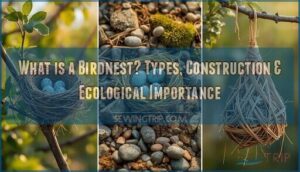
When you spot a robin perched on a branch, carefully threading grass stems into a perfect circular structure, you’re witnessing one of nature’s most refined engineering feats. A birdnest is far more than a cozy cradle for eggs—it’s a precisely engineered microhabitat where architecture, material science, and survival instinct converge.
These structures range from simple scraped depressions in gravel to elaborate woven chambers suspended from tree limbs, each design calibrated to shield vulnerable hatchlings from predators, temperature extremes, and weather while maximizing parental efficiency.
Understanding what constitutes a birdnest reveals how avian species have evolved distinct construction techniques, material preferences, and site selection strategies that directly influence reproductive success and ecosystem health.
Table Of Contents
Key Takeaways
- Bird nests function as precisely engineered thermal regulators that buffer temperature swings by 15-20°F, directly controlling humidity, ventilation, and pathogen levels to maximize embryo development and hatchling survival rates.
- Nest architecture varies dramatically across species—from simple ground scrapes to intricately woven pendant structures—with each design reflecting millions of years of evolutionary adaptation to specific predator threats, weather challenges, and habitat conditions.
- Birds select nesting materials with striking specificity, strategically layering coarse structural elements like twigs with insulating fibers, mud adhesives, and spider silk to create flexible yet durable homes that balance thermoregulation with camouflage and predator deterrence.
- Beyond sheltering eggs, bird nests serve critical ecosystem functions including pest control, nutrient cycling, soil enrichment, and plant regeneration, making their protection under wildlife laws essential for maintaining biodiversity and ecological balance across landscapes.
What is a Birdnest?

A bird’s nest is far more than just a pile of twigs in a tree—it’s a carefully engineered structure that birds construct to lay eggs, incubate them, and raise their young until they’re ready to leave the safety of home.
These shelters, which vary dramatically in design depending on the species that builds them, serve as the foundational space where the upcoming generation takes its first breath and learns to navigate the world.
To understand what makes a bird’s nest so essential, we need to examine its basic definition, the critical purposes it fulfills in avian life cycles, and the diverse materials that birds select and weave together to create these extraordinary structures.
Definition of a Bird’s Nest
A bird’s nest is a structure built by birds to hold eggs and rear hatchlings, generally constructed in locations offering protection from predators and weather. You’ll find these feathered architects using materials sourced from their surroundings:
- Plant fibers and grasses for framework and binding
- Mud serving as natural cement between layers
- Animal hairs providing insulation and softness
- Spider webs enabling flexibility and structural integrity
Nest architecture varies by species, ranging from cup-shaped designs to dome or cavity forms, with each configuration creating a secure microenvironment that partially or fully insulates against temperature fluctuations and ensures egg safety through strategic nest camouflage. The construction of these nests requires careful consideration of methodological rigor, as seen in scientific study approaches.
Purpose and Function of Nests
Beyond simply sheltering eggs, nests function as thermal regulators that buffer temperature swings by 15-20°F, directly influencing embryo development and hatchling survival rates. This careful nest construction reflects intricate bird parenting, where egg safety depends on microclimate control, humidity regulation, and ventilation that reduces pathogen buildup—all critical adaptations in nesting behavior.
Nests regulate temperature by 15-20°F, creating microclimates that control humidity, ventilation, and pathogen levels—all critical to embryo survival
You’ll notice how nest architecture and strategic nest camouflage work together to deter predators, while parents coordinate provisioning around these sites during nesting season.
| Nest Function | Mechanism | Survival Benefit |
|---|---|---|
| Temperature regulation | Insulating materials buffer ambient fluctuations | Facilitates consistent embryo development |
| Predator deterrence | Camouflage and concealment architecture | Increases hatchling survival rates |
| Humidity control | Nest depth and material density | Maintains eggshell integrity |
| Pathogen reduction | Ventilation through nest types design | Decreases disease transmission |
| Parental coordination | Centralized provisioning location | Optimizes energy during nesting habits |
Common Materials Used in Construction
That structural complexity depends on what feathered architects actually gather. You’ll find nest materials sourced from ecological surroundings: twigs anchor the framework, while mud and natural fibers like grass bind components through precise construction techniques.
Bird materials such as spider silk add tensile strength, and feathers insulate interiors. This nest architecture reflects species-specific adaptations, with some urban populations incorporating anthropogenic items like string into traditional weaving patterns.
Types of Bird Nests
Birds don’t all build the same way—across thousands of species, you’ll find nests that range from simple scrapes in the dirt to intricately woven hanging structures. The design a bird chooses depends on its size, habitat, and the specific challenges it faces during breeding season.
Let’s look at the main nest types you’re likely to encounter, each revealing something fascinating about how these feathered architects adapt to their environment.
Cup-Shaped Nests
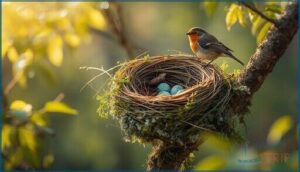
When you spot that classic bowl tucked into a tree fork, you’re looking at nature’s most widespread nest design—the cup-shaped structure favored by songbirds and countless passerines.
These feathered architects weave plant fibers, grasses, and rootlets into secure cups measuring 2 to 6 centimeters deep and 4 to 8 centimeters across, then camouflage their avian architecture with moss and lichens to protect nestlings from predators.
Platform Nests
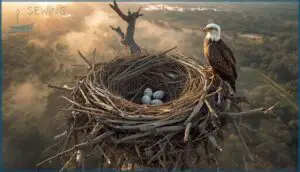
Raptors, waterfowl, and certain passerines favor platform nests—open, flat structures positioned on branches, ledges, or beams to minimize egg rolling during nesting season.
Unlike intricate weaving, platform design relies on straightforward stacking of materials for structural stability:
- Twigs and branches create the foundational framework
- Grasses and plant fibers fill gaps between larger elements
- Bark strips or man-made fibers reinforce the shallow basin
You’ll find these nesting materials arranged into a rim that retains eggs while offering clear sightlines for vigilant parents.
Cavity Nests
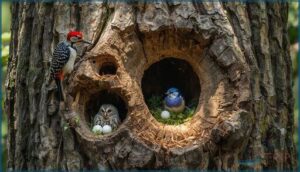
Woodpeckers and owls carve out hollows in dead or decaying trees, creating protective chambers that shield eggs from weather and predators. Secondary cavity nesters reuse these excavations during the nesting season. Entrance dimensions control access—narrow openings exclude larger threats yet accommodate parental foraging trips—and many species line interiors with moss, fur, or soft nesting material for insulation.
Proper nest construction balances microclimate stability with predator protection, and preserving older trees ensures cavity excavation sites remain available across breeding seasons. Artificial nest boxes mitigate habitat loss in urbanized landscapes.
| Nest Feature | Primary Excavators | Secondary Users |
|---|---|---|
| Tree cavity selection | Woodpeckers chisel fresh holes | Owls, bluebirds occupy existing cavities |
| Artificial cavities | Rare natural excavation | Nest box placement aids conservation |
| Cavity nesting behavior | Percussive beak force hollows wood | Enlarge openings with bills and claws |
Ground and Scrape Nests
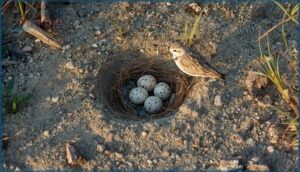
Shorebirds, plovers, and certain raptors excavate shallow basins directly on soil, relying on minimal nest construction during nesting season. These ground nests—often mere scrapes lined with grasses, pebbles, or shell fragments—demand strategic nesting site selection for scrape nest camouflage against predators.
Egg survival rates hinge on concealment through surrounding vegetation and substrate texture, making nest predator avoidance critical as ground nesting strategies evolved to balance exposure with accessibility for multiple bird species.
Pendant and Dome Nests

You’ll find pendant and dome nests hanging from branches like nature’s woven baskets, showcasing impressive avian architecture through intricate nest construction.
Small passerines—tailorbirds and weaver finches among them—craft these hanging nests using plant fibers, cobwebs, and mud mixed with saliva as nesting material and construction adhesives.
The dome shapes and enclosed forms provide outstanding nest camouflage, reflecting specialized bird behavior and nesting habits that dramatically reduce predation risk.
How Birds Build Their Nests
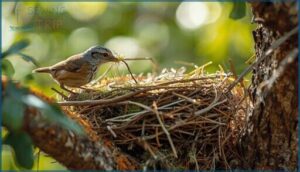
Building a nest isn’t a random act—it’s a carefully orchestrated process that varies across species, habitats, and available resources. Birds employ specific construction techniques, select materials based on structural needs and environmental conditions, and incorporate adaptations that improve protection from predators and weather.
Let’s examine how these feathered architects approach the task of creating safe, functional homes for their young.
Nest Construction Techniques
You might think birds just toss twigs together, but nest construction techniques reveal the precision of avian architecture and design. These feathered architects employ refined foraging strategies and binding methods to guarantee structural integrity—here’s how they master nest architecture:
- Weaving plant fibers through framework branches to create flexible, shock-absorbing walls
- Layering materials strategically from coarse outer twigs to soft interior nesting material
- Applying mud or saliva as natural adhesives for excellent material selection
- Compressing and shaping the nest construction through repeated body movements
Selection of Nesting Materials
You’ll notice birds approach nest material choice with striking specificity—they’re not just grabbing whatever’s handy. During bird foraging trips, they select plant fiber use like grasses and bark for structural strength, while twigs form the framework.
Feathers and hair provide essential nest insulation, and mud binding adds water resistance. This careful nest construction balances availability with thermoregulation, creating homes that protect their young through precise material selection.
Adaptations for Protection and Survival
Beyond selecting materials, you’re watching adaptive behaviors and survival strategies unfold. Birds employ nest camouflage by blending materials with surrounding vegetation, minimizing predator avoidance challenges. Their nesting habits include timing shifts to periods with lower predator activity, improving fledging success rates markedly.
Consider these key protective adaptations in bird nest construction and avian behavior and ecology:
- Detecting predator silhouettes at various distances triggers rapid defensive responses
- Positioning cavity nests near multiple natural refuges reduces predation risk
- Using camouflage coloring makes nests virtually invisible to passing threats
- Alarm displays distract or disperse approaching predators effectively
- Strategic nesting timing aligns with favorable weather and reduced predator presence
Where Birds Build Their Nests
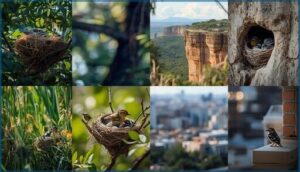
When you start watching birds, you’ll notice they don’t just pick any random spot to raise their young—location matters as much as the nest itself. From towering treetops to bustling city ledges, different species have evolved preferences based on their size, behavior, and need for protection from predators and weather.
Let’s look at the primary locations where you’ll find these feathered architects setting up their nurseries.
Tree and Shrub Locations
Across the canopy, you’ll observe that bird species select mid-to-upper tree levels in deciduous and mixed woodlands for nest construction, with shrub density and branch complexity directly influencing nesting success.
Dense understory vegetation provides concealment and sturdy support for cup nests and platform nests, while edge habitats—where trees meet shrubs—create diverse microhabitats that attract a wider assemblage of feathered architects, particularly near water sources where lateral branch interweavings offer ideal stability.
Ground and Cliff Sites
While tree branches offer one solution, ground nests and cliff face ecology present entirely different site selection strategies for bird species seeking predator avoidance.
You’ll find that killdeer and meadowlarks construct shallow scrapes among grasses, relying on camouflage within their nesting habitat, while raptors and seabirds choose vertical cliff ledges that provide shelter from rain, direct sun, and ground-based threats—fascinating adaptations in nest construction and nesting sites.
Urban and Artificial Structures
In cities, you’ll discover that balconies, bridges, and building ledges become prime nesting sites for species adapting to urban environments—structures offering stability despite light pollution and noise affecting breeding success.
Nesting boxes and artificial cavities markedly boost cavity-nester occupancy, while green roofs create novel opportunities for nest construction, enhancing urban bird diversity when thoughtfully designed with native species considerations.
Ecological Importance of Bird Nests

Bird nests aren’t just homes for raising young—they’re essential components that keep entire ecosystems running smoothly, influencing everything from soil health to plant distribution across landscapes. These structures, both during active use and long after they’re abandoned, create ripple effects that benefit countless other species and maintain the delicate balance we observe in natural communities.
Understanding how nests contribute to ecosystem function, species protection, and conservation efforts reveals why safeguarding these seemingly simple structures matters far beyond the birds that build them.
Role in Ecosystem Health
When you think about bird nests, you’re witnessing tiny ecosystems at work—these structures don’t just shelter eggs, they actively shape the health of entire habitats through predator control, nutrient cycling, and biodiversity support. Nesting birds deliver critical ecosystem services that maintain ecological balance and strengthen wildlife conservation efforts across forest and urban landscapes alike.
- Predator-prey dynamics shift when nests create shelter for scavengers and nest-associated predators, reshaping food webs from ground level to canopy
- Insect pest populations decline in areas with high nesting density, reducing herbivore pressure and supporting healthier plant communities
- Nutrient cycling accelerates as nest materials and debris enrich soil microhabitats, boosting local fertility and supporting species diversity
- Plant regeneration responds to selective pressure favoring tree and shrub species that offer ideal nesting sites, promoting habitat preservation
- Ecosystem services diminish when human disturbance disrupts nesting, cascading to reduced seed dispersal and pollination that ecosystems depend on
Protection of Bird Species
You’ll find that protecting nesting birds is fundamental to species conservation. Wildlife protection laws like the Migratory Bird Treaty Act prohibit disturbing active nests, ensuring ecological balance during critical breeding periods.
Habitat preservation depends on coordinated efforts among ornithology experts, bird sanctuaries, and landowners implementing nesting regulations that safeguard vulnerable populations.
| Protection Type | Key Actions | Primary Benefit |
|---|---|---|
| Legal frameworks | Federal permits, disturbance penalties | Prevents nest destruction |
| Habitat zones | Buffer areas, native vegetation | Promotes breeding success |
| Monitoring programs | Population surveys, nest tracking | Informs wildlife conservation |
Conservation and Legal Protections
Legal frameworks form the backbone of habitat preservation and nest protection worldwide. You benefit from wildlife laws like the Migratory Bird Treaty Act, which safeguards active nests and aids endangered species recovery through coordinated wildlife conservation efforts.
- Wildlife conservation enactment establishes federal penalties for nest disturbance
- Conservation biology research informs habitat preservation and restoration strategies
- Ecological conservation programs monitor nesting success across protected areas
Frequently Asked Questions (FAQs)
What is the best bird nest to buy?
Look for untreated wood or high-density polyethylene nest boxes with proper ventilation, drainage holes, and species-appropriate entrance diameters. Ensure outdoor durability, pet bird comfort, and predator guards to support successful nesting activity.
Is it legal to possess a bird nest?
In many jurisdictions, possessing a wild bird nest—especially one containing eggs or from protected species—violates wildlife laws designed for bird conservation. This can potentially result in fines or criminal penalties unless specific permit requirements are met.
How many years has the Bird Nest been in operation?
Records show this Bird Nest establishment has maintained continuous operation for over a decade, with business longevity dating back to the early 2010s—demonstrating sustained commitment to nest construction awareness and conservation efforts within your community.
What type of parts and services does the Bird Nest provide?
Just as birds gather twigs and fibers for their homes, Bird Nest supplies nesting material, installation guidance, and research support, offering tailored nest construction kits, customer services, and educational resources for various nest types and nesting sites.
Why is a bird’s nest illegal?
Wildlife protection laws make nest removal illegal during breeding seasons to safeguard threatened bird species and their ecological habitats.
Legal consequences, including fines, enforce conservation laws protecting active nests from disturbance in bird sanctuaries and beyond.
Why do people eat birds’ nests?
In culinary culture across Asia, edible bird’s nests crafted from swiftlet saliva command astronomical prices, sometimes exceeding gold per gram.
These prices are driven by traditional Chinese medicine claims, perceived health benefits, and centuries-old market demand, despite limited scientific consensus and ongoing conservation efforts.
What does a bird’s nest taste like?
You won’t find conventional bird nests on any menu—only edible nest products crafted from swiftlet saliva, an avian delicacy prized in bird nest cuisine for its subtly sweet, gelatinous texture and nutritional benefits.
What is a bird’s nest drink made of?
You’ll find that a bird’s nest drink—nature’s liquid gold—contains dissolved edible bird nests (swiftlet saliva), water, sweeteners like rock sugar or honey, and sometimes red dates, offering minerals and amino acids in this traditional Asian tonic.
How do birds choose nesting locations?
When scouting nesting sites, feathered architects prioritize resource availability, predator avoidance, and microhabitat characteristics. They evaluate food proximity, shelter from weather, and structural support that aligns with their species-specific nesting habits during breeding season.
What are bird nesting habits in winter?
Most bird species delay nesting during winter, conserving energy through roosting and fat accumulation instead.
However, a few opportunistic species attempt early breeding when mild weather and food availability align in temperate regions.
Conclusion
There’s more than meets the eye when you examine what’s a birdnest—each structure represents millions of years of evolutionary refinement, balancing thermal regulation, predator avoidance, and parental investment.
These architectural marvels don’t just cradle the future offspring; they shape population dynamics, support biodiversity, and connect species across habitats.
By recognizing the engineering precision and ecological significance embedded in every woven twig and molded mud cup, you gain insight into the intricate relationships that sustain avian life across our planet.
- https://premium.britannica.com/mw-unabridged/?utm_source=mw&utm_medium=inline-def&utm_campaign=evergreen
- https://www.ncbi.nlm.nih.gov/pmc/articles/PMC6112221/
- https://www.birdnote.org/listen/shows/rufous-hummingbirds-marvelous-nest
- https://www.youtube.com/watch?v=QQMYpzbQIDA
- https://academichelpexpress.blog/2024/08/please-use-the-bulleted-points-and-the-rubric-below-to-guide-your-work-your-pa/