This site is supported by our readers. We may earn a commission, at no cost to you, if you purchase through links.
A dress that fits perfectly in the store can suddenly feel too tight after you wash it, not because the fabric shrank, but because you measured yourself on a full stomach or with your shoulders hunched forward. Body measurements shift throughout the day based on posture, hydration, and even the tension you apply to the measuring tape.
For sewers, these small inconsistencies translate into garments that gap at the waist, pull across the bust, or hang awkwardly at the hips. Mastering basic body measurements rules means learning to control these variables so your patterns match your actual proportions.
When you measure with the right tools, consistent technique, and attention to placement, you create a reliable foundation for every sewing project that follows.
Table Of Contents
Key Takeaways
- Your body measurements shift throughout the day by 1–3 cm due to posture, hydration, and digestion, so measure at the same time under consistent conditions to avoid fit problems in your finished garments.
- Use a flexible cloth or fiberglass tape measure with clear markings, keep it parallel to the floor without compressing your skin, and take two readings per measurement to average out any variance.
- Focus on bust, waist, hip, inseam, sleeve length, and back waist length as your core measurements, locating each at specific anatomical landmarks rather than estimating placement.
- Remeasure every six to twelve weeks or whenever your weight changes by 5% or more, and always compare your actual measurements to pattern sizing charts rather than relying on ready-to-wear clothing sizes.
Essential Tools for Body Measurement
Before you can take accurate body measurements for sewing, you need the right setup. The tools you use, where you work, and even what you’re wearing all affect your results.
A well-chosen tape measure and a few essential sewing accessories for beginners will help you capture measurements that actually fit your body.
Let’s walk through the three essentials that will make your measurements reliable and consistent every time.
Once you’ve nailed these three steps, you’ll be ready to match your body measurements to the right pattern size with confidence.
Choosing The Right Measuring Tape
Before you begin any body measurements, you need the right tape measure in your hands. Choose a flexible measuring tape made from cloth or fiberglass—these materials won’t warp over time like metal ones do.
A cloth tape also makes it easier to measure curved areas like hips and bust, which is especially useful when you’re learning to sew fitted garments.
For measurement accuracy and proper tape calibration, follow these tools for measuring body guidelines:
- Look for markings in millimeters or 1/8-inch increments
- Verify the zero point aligns correctly each time
- Check that your tape isn’t stretched or crinkled
- Select flexible tapes designed specifically for body measurements
This foundation ensures your measuring techniques deliver consistent, reliable results.
For more guidance on refining your technique, explore these pattern alteration resources that cover everything from basic adjustments to advanced fitting methods.
Preparing Your Workspace
Your measuring tape is ready—now set up a workspace that won’t sabotage your sewing basics. Clear a flat, stable surface in your sewing room to prevent tape slippage and boost measurement accuracy. Good workspace lighting eliminates shadows on your tools, while keeping all sewing tools within arm’s reach creates an ergonomic setup. This measurement station approach transforms sewing and measurement from frustrating to precise.
| Workspace Element | Purpose |
|---|---|
| Flat surface | Prevents tape from sliding during measurement tasks |
| Bright lighting | Reduces shadows that distort tool readings |
| Level floor | Eliminates errors from uneven positioning |
| Clean countertop | Maintains consistent tape tension |
| Organized tools | Minimizes delays between measurement steps |
Clothing and Posture Considerations
With your workspace ready, what you wear—and how you stand—matters just as much as your tools. Posture alignment dramatically affects body measurements; slouching can shift your shoulder slope and torso length by several centimeters, throwing off bust and back readings. For consistent clothing fit and accurate waist circumference:
- Stand with shoulders relaxed and weight evenly distributed
- Measure over minimal underwear to reduce garment interaction
- Document your stance each time to track measurement variance
Key Body Measurements for Sewing

Getting the right measurements is the foundation of any sewing project that actually fits. You’ll need to focus on a handful of key areas where your body’s unique proportions matter most.
For a detailed walkthrough of taking each measurement correctly, check out this sewing measurement guide that walks you through the entire process step by step.
Let’s walk through the essential measurements that will make or break your garment’s fit.
Bust/Chest Measurement Rules
Your bust circumference sits at the fullest point of your chest, where proper tape placement makes all the difference in fitting techniques. Stand relaxed with arms at your sides, ensuring the tape wraps horizontally without twisting or compressing your skin.
When measuring body measurements for garment construction, take two readings and average them if they differ by more than a centimeter—this simple step dramatically improves measurement accuracy for chest proportions.
Waist and Hip Measurement Guidelines
Finding your natural waist—the narrowest part of your torso, about an inch above your navel—sets the foundation for waist circumference that translates into proper sewing fit. Your hip measurement captures body proportions at the fullest part of your buttocks, and together these dimensions determine your waist-to-hip ratio for pattern selection.
For measurement accuracy, follow these steps:
- Stand relaxed with feet together, breathing normally
- Keep the tape level and parallel to the floor
- Apply light tension without compressing your skin
- Take two readings and average them if they differ
Additional Measurements (Inseam, Sleeve, Back Length)
Beyond waist and hips, three vertical measurements complete your fit profile: inseam runs from crotch to ankle along the inner leg seam, sleeve length traces shoulder point to wrist with your arm slightly bent, and back waist length travels from neck base down your spine to the natural waistline.
These body proportions inform pattern adjustments, affecting sleeve cap height, outseam balance, and dart placement—ensuring garments sit exactly where they should on your unique frame.
| Measurement | Key Reference Point | Common Range |
|---|---|---|
| Inseam | Crotch curve to ankle | 28–34 inches |
| Sleeve Length | Shoulder to wrist bone | Varies by arm length |
| Back Waist Length | Nape to natural waist | Determines torso fit |
Step-by-Step Measurement Techniques
Taking your measurements correctly makes all the difference between a garment that fits beautifully and one that doesn’t quite work. Whether you’re measuring yourself or enlisting help, you’ll need to follow specific techniques to guarantee your tape stays in the right position and your numbers stay consistent.
Let’s walk through the practical steps that’ll give you reliable measurements every single time.
Measuring Alone Vs. With Assistance

You can take body measurements solo, but having someone assist you cuts errors by 2–5 mm for bust and waist circumferences—a noticeable difference when clothing fitting matters. Solo techniques often require a mirror or smartphone to check your flexible measuring tape alignment, which 62 percent of sewers use.
Assistance benefits include steadier tape placement and better measurement accuracy, reducing variance by 15–30 percent across standard measurements.
Ensuring Tape Placement Accuracy
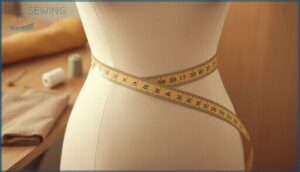
Your flexible measuring tape should lie flat against your body with no slack or tension—think of it like a gentle hug, not a cinch. Position it horizontally around the widest part of each area, keeping it parallel to the floor.
Stand upright and barefoot in a neutral posture to maintain body alignment and circumference accuracy. Double-check each measurement for consistency.
Recording and Averaging Measurements

One measurement rarely tells the whole story—that’s why you’ll capture each dimension at least twice, pausing 1–2 minutes between readings to reset your posture.
Write down both values immediately, then calculate the average by adding them together and dividing by two. Round to the nearest eighth of an inch for precision, and note the date to track progress over time.
Common Measurement Mistakes to Avoid
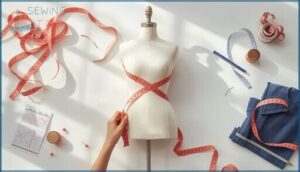
Even small mistakes when measuring can throw off your entire sewing project, leading to garments that don’t fit quite right. These errors are surprisingly common, but once you know what to watch for, you can avoid them entirely.
Let’s look at the most frequent missteps that trip up both beginners and experienced sewers alike.
Tape Tension and Placement Errors
Even small mistakes in tape tension or placement can throw off your body measurements by one to three centimeters, turning a perfect fit into a garment that pinches or sags. Pulling your tape measure too tight compresses soft tissue and underestimates true circumference accuracy, while slack tape adds extra inches you don’t actually have.
Tape tension errors—too tight or too loose—can distort your body measurements by one to three centimeters, ruining garment fit
Equally critical is body alignment: tilting the tape diagonally instead of keeping it parallel to the floor follows a longer path and inflates waist or hip girths by up to two centimeters. Always locate anatomical landmarks—like the narrowest part of your natural waist or the fullest point of your bust—before wrapping the tape, because measuring even an inch higher or lower changes the number you record.
These measurement errors compound quickly in anthropometry and body measurement techniques, so double-check that your tape sits snug but gentle, remains horizontal all the way around, and lands exactly where the pattern instructions specify for reliable results.
Measuring Over Bulky Clothing
After you’ve checked your tape tension, don’t overlook clothing thickness. Measuring over bulky layers—think hoodies or sweaters—builds in air gap effects and layering errors that can add several centimeters to your body measurements. This throws off garment measurements and leads to oversized results.
For accurate clothing fitting and design, stick to fitted undergarments, or clearly note any measurement adjustments if layers can’t be avoided. To achieve precise fits, consider using measuring techniques for consistent results.
Inconsistent Measurement Timing
Timing matters more than you’d think. Your body shifts throughout the day—circadian rhythms and fluid intake can swing waist and chest readings by 1–3 cm, while posture effects add another 1–4 cm depending on whether you’re standing or seated.
For tracking progress and avoiding common measurement mistakes, stick to timing protocols: same hour, same stance, same conditions every session.
Applying Measurements to Sewing Projects
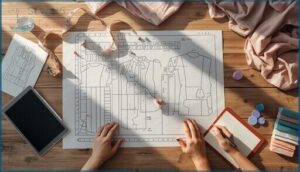
Once you’ve got your measurements written down, it’s time to put them to work in your actual sewing projects. This is where those numbers transform into well-fitting garments that flatter your unique shape.
You’ll learn how to read sizing charts, choose the right pattern size, and make adjustments so your finished pieces fit like they were made just for you.
Interpreting Sizing Charts
Sizing charts act like maps guiding you to the right starting point, but pattern grading and size variability between brands mean a size 18 won’t always match your body the same way.
Your ease calculation—subtracting your measurements from the chart’s finished garment numbers—reveals fit preferences and helps with chart comparison.
Understanding sizing charts transforms measuring for garment fit into confident pattern making and design decisions for successful garment fitting. To achieve the best fit, consider checking the finished measurements for your garment.
Selecting and Adjusting Sewing Patterns
Once you’ve compared your body measurements to the chart, pattern grading steps in—helping you select a base size and blend between lines for true garment fitting. For instance, Fit Adjustments like shifting side seams or modifying bust darts are common. Pay attention to Sewing Ease and design details, using these guidelines:
- Choose size by bust or hip, not ready-to-wear labels
- Blend between nested sizes for accuracy
- Measure flat patterns before cutting
Custom Fitting and Garment Alterations
After Pattern Modification, you’ll perfect through Fit Evaluation using a muslin test garment—this reveals how Fabric Selection affects drape and ease.
Alteration Techniques like bust darts and waist suppression rely on accurate Body Measurements: Bust Measurement, Waist Measurement, and Hip Measurement guide each adjustment.
Document changes with updated notations so future Garment Construction and Garment Reconstruction projects maintain consistent fit and comfort.
Frequently Asked Questions (FAQs)
How often should I retake my measurements?
Regularly updating your measurements—roughly every six to twelve weeks—keeps your sewing projects precise.
When weight fluctuation exceeds 5%, remeasure within two to four weeks to maintain accurate body change tracking and proper fit.
Do measurements change throughout the day significantly?
Yes, your body measurements can shift by 1–3 cm throughout the day due to diurnal variations, fluid balance, and digestion. Taking standard measurements at a consistent time ensures accurate somatic measurement for sewing.
Should I measure before or after eating?
You’d think a sandwich wouldn’t matter, but digestion causes body swelling that skews your measurements. Wait two to four hours after eating to capture accurate dimensions, ensuring postprandial changes don’t distort your body measurements for sewing projects.
How do I measure childrens bodies accurately?
Children need a flexible tape positioned flat on skin, measured at natural points like chest at nipple level.
Stand older kids upright, seat infants comfortably, then average two readings for precision in clothing design.
Whats the difference between body and garment measurements?
Body measurements capture your actual anatomy, while garment measurements include the built-in ease and design allowances that determine how clothing drapes and moves.
Understanding both ensures proper fit analysis and pattern selection for successful sewing.
Conclusion
Precision protects your projects from preventable pattern problems. When you apply these basic body measurements rules with steady tape tension, proper placement, and consistent timing, you build patterns that mirror your proportions instead of fighting them.
Each measurement you record becomes a tool for creating garments that move with your body, not against it. The difference between clothes that fit and clothes that flatter starts with the accuracy you bring to this foundational step.