This site is supported by our readers. We may earn a commission, at no cost to you, if you purchase through links.
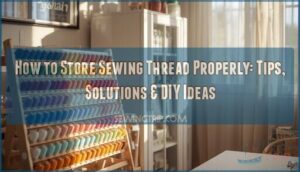
Your thread collection tells a story—but poor storage can turn that story into a tragedy. Sunlight exposure alone can weaken thread fibers by up to 90%, while improper humidity levels cause synthetic and natural threads to deteriorate at different rates.
You’ve invested in quality materials, yet a single season of fluctuating temperatures or dusty conditions can render your spools unusable.
The difference between thread that lasts decades and thread that fails mid-project comes down to how you store it. Temperature control, UV protection, and smart organization aren’t just nice-to-have extras—they’re essential practices that preserve your investment and prevent frustrating mid-seam breaks.
Table Of Contents
Key Takeaways
- Sunlight exposure weakens thread fibers by up to 90%, so you need UV-blocking containers and storage away from windows to prevent color fading and structural damage.
- Keep your thread between 60-75°F with 40-60% humidity—natural fibers like cotton and silk need stricter controls than synthetics to avoid mold and fiber breakdown.
- Store different fiber types separately because silk, cotton, and polyester have unique preservation needs, and mixing them causes static, color bleeding, and premature wear.
- Organize by color and fiber type using labeled containers or vertical racks so you’ll grab the right thread instantly while protecting your investment from dust and tangling.
Key Factors for Storing Sewing Thread Properly
Your thread collection deserves better than a dusty shelf or a hot attic. The way you store your spools directly affects how long they’ll last and how well they’ll perform when you need them.
A smart thread organization system for your sewing room keeps everything protected from light and dust while making each color easy to grab.
Let’s look at the key factors that keep your thread in top condition for years to come.
Storing spools in a climate-controlled space and reducing thread breakage through proper handling will extend their usable life significantly.
Ideal Temperature and Humidity Conditions
Temperature control and humidity levels directly impact fiber degradation in your thread storage. Keep your storage environments between 60°F and 75°F with humidity levels at 40-60% for ideal moisture management. This range prevents mold while maintaining fiber durability.
Proper thread organization systems help maintain these environmental standards by keeping spools sealed and protected from fluctuating conditions.
Natural fibers need stricter humidity control than synthetics, so install a hygrometer to monitor storage conditions and adjust as seasonal changes occur.
For best results with delicate materials like silk and linen, review proven fabric organization methods that maintain stable conditions year-round.
Protecting Thread From Sunlight and Dust
Beyond climate control, your UV protection and dust prevention strategies determine thread longevity. Light exposure weakens fibers by 90% when you store near windows, while dust particles embed moisture that degrades color and strength. Here’s how effective thread shielding preserves your collection:
- Use opaque or UV-blocking storage containers for fiber preservation
- Position thread storage solutions away from direct sunlight
- Choose sealed boxes over open racks for dust prevention
- Rotate spools regularly to distribute light exposure evenly
- Clean storage areas with microfiber cloths to maintain storage conditions
Avoiding Moisture and Extreme Temperature Changes
While shielding from light and dust helps, moisture damage and thermal shocks pose bigger threats to thread longevity. Temperature control matters because fluctuations beyond 10°F trigger moisture migration into spools, compromising textile preservation. Above 65% humidity, you’ll see mold on natural threads—fabric care basics that prevent thread expire issues.
Keep your storage climate between 60–70°F with 40–60% humidity levels for ideal fiber protection.
Separating Thread by Fiber Type for Best Preservation
You’ve nailed the climate—now fiber type matters just as much. Silk thread needs its own space, away from cotton or polyester, to prevent pilling and residue transfer. Cotton plays nicer with plant fibers, reducing tangling issues. Keep polyester separate from natural threads to dodge static and color bleeding.
Specialty threads like metallics? Store them solo to avoid tarnish. Smart thread separation protects your investment.
Organizing Thread for Easy Access and Longevity

You’ve got the storage conditions down, but now you need a system that actually works. A smart organization approach keeps your thread in great shape while making it easy to grab what you need.
Let’s look at practical ways to sort, store, and manage your spools, cones, and bobbins so everything stays tangle-free and accessible.
Sorting by Color, Fiber Type, and Usage
You’ll find your threads faster and keep them in better shape when you sort them smartly. Here’s how to organize for quick access and long-term preservation:
A well-planned industrial sewing machine workspace setup gives every spool and bobbin a dedicated spot, so you’re not hunting through drawers mid-project.
- Color Coding – Group similar hues together so you can spot the shade you need in seconds
- Fiber Sorting – Separate cotton, polyester, silk, and rayon since each has different storage needs
- Thread Usage – Keep everyday spools within arm’s reach and specialty threads further back
- Storage Systems – Label each category clearly to avoid unnecessary handling
This approach cuts your search time and protects vulnerable fibers. Proper textile storage, such as using acid free materials, is essential for maintaining the quality of your threads.
Storing Spools, Cones, and Bobbins Efficiently
Each thread format needs its own storage strategy. Stand spools upright on vertical pegs to prevent unwinding and tangling—essential for thread preservation. Place cones in dedicated holders with single-layer arrangements to avoid crushing.
For bobbin organization and storage optimization, use divided drawer trays that separate bobbins by color family. Keep thread spools in individual compartments so different fibers don’t touch, and your entire thread storage system stays tangle-free.
Using Labeling and Inventory Systems
Label each spool with color codes and fiber type so you’ll grab the right thread instantly. Digital tracking through spreadsheets or apps prevents duplicate purchases and monitors your inventory management efficiently. This thread labeling system transforms thread organization from guesswork into precision—essential for thread storage optimization.
Color coding by family creates visual order, while proper thread management protects your investment and speeds up every sewing project. Effective thread management also involves using a thread management system to simplify organization and retrieval.
Tips for Minimizing Tangling and Unwinding
Secure each thread end with a spool cap or thread net to prevent unwinding—loose ends create instant chaos. Pay attention to spool orientation when storing; position spools so thread tension stays minimal during unwinding.
Group threads by fiber handling needs, since slippery polyester requires different tangling prevention than cotton.
Stable temperature and humidity around 65–75°F keep fibers from expanding and unwinding unexpectedly, preserving your thread quality investment.
Top 5 Thread Storage Solutions for Sewists
You’ve got your threads organized by color and fiber type—now you need the right storage to keep them that way. The best solution depends on your space, your collection size, and how often you actually reach for specific spools.
Here are five storage options that balance protection, accessibility, and real-world sewing room needs.
1. Sulky Thread Storage Box
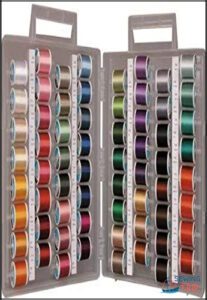
If you’re drowning in spool chaos, the Sulky Slimline storage box brings instant relief. This translucent plastic organizer holds up to 64 spools in labeled compartments, giving you clear visibility and easy access.
At 15 inches square when closed, it’s lightweight yet durable—perfect for both home studios and travel. The lifting tabs prevent snagging during spool removal, while the carry handle adds portability.
Store it away from direct sunlight and humidity to optimize thread preservation. Many sewists find the investment worthwhile for the time saved hunting through tangled thread piles.
| Best For | Sewists and embroiderers with large thread collections who need quick color identification and want to eliminate tangling while keeping spools organized at home or on the go. |
|---|---|
| Material | Plastic |
| Color | Clear |
| Storage Type | Thread Rack |
| Portability | Wall-mount/Free-standing |
| Assembly Required | No |
| Capacity | 64 spools |
| Additional Features |
|
- Holds up to 64 spools with clear visibility through translucent plastic, so you can spot the exact color you need without digging through bins.
- Works as a free-standing unit or mounts on the wall, plus the carry handle makes it easy to move between workspaces or take to classes.
- Lifting tabs let you remove spools smoothly without snagging threads, and the compartments keep everything separated to prevent tangling.
- The price point feels steep to some users, though most agree the time savings and organization make it worth the cost.
- Spindles can break if handled roughly, so you need to be careful when inserting or removing spools.
- Very large or chunky spools may not fit properly, and some specialty spool types might need modifications to work with the compartments.
2. Wooden Thread Rack Organizer
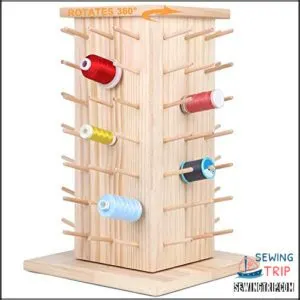
When floor space is at a premium, a wooden thread rack organizer turns vertical real estate into visual inventory. This 360° rotating model holds 120 mini spools—84 on the outer pegs, 36 inside double-sided doors—crafted from premium beech wood you can customize with paint or stain.
At 15.2 inches tall, it maximizes thread spool capacity while keeping your workspace tidy. The natural wood finish options protect against dust, and the rotating design lets you access every thread without rummaging.
Just check peg tightness monthly and keep it away from humid zones for long-term rack maintenance.
| Best For | Sewers, quilters, and embroidery enthusiasts with large mini-spool collections who need quick visual access in tight spaces. |
|---|---|
| Material | Wood |
| Color | Unfinished |
| Storage Type | Thread Rack |
| Portability | Free-standing |
| Assembly Required | Yes |
| Capacity | 120 spools |
| Additional Features |
|
- Rotates 360° so you can spin to the exact color without digging through drawers or bins.
- Holds 120 mini spools in a 15.2-inch footprint, freeing up desk and shelf space.
- Unfinished beech lets you paint or stain it to match your craft room décor.
- Only fits mini spools—standard or large cones won’t work on the pegs.
- Assembly requires hammering wooden pegs, which can splinter if you’re not careful.
- Some customers report receiving units with cracked wood or missing pieces on arrival.
3. Winsome Wood Storage Cabinet
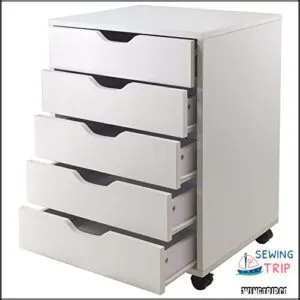
If you need drawers instead of pegs—especially for heavier cones or bulk spools—the Winsome Wood Storage Cabinet swaps visibility for capacity with its five-drawer lateral design. Each drawer holds 20 pounds and measures 15.9 inches wide, giving you serious storage capacity for thread organization across your sewing room organization needs.
The white finish complements any space, and optional casters let you roll it where you need it.
Assembly tips: use a power drill for faster setup, and don’t overtighten the pressboard screws. This wood cabinet features smart space optimization without sacrificing accessibility.
| Best For | Sewers who need serious drawer storage for heavy thread cones, bulk spools, or mixed supplies and want the flexibility to move their storage around the room. |
|---|---|
| Material | Engineered Wood |
| Color | White |
| Storage Type | Drawer Cabinet |
| Portability | Casters |
| Assembly Required | Yes |
| Capacity | 5 drawers |
| Additional Features |
|
- Five spacious drawers with 20-pound capacity each give you plenty of room for thread, notions, and heavier sewing supplies
- Optional casters make it easy to roll wherever you need it in your sewing space
- Clean white finish fits into any room style without looking bulky or out of place
- Assembly takes time and effort—you’ll want a power drill handy to avoid frustration
- Drawers don’t pull out completely, so you’ll need to reach in for items at the back
- Pressboard construction means you need to be careful not to overtighten screws during setup
4. Ikea Helmer White Drawer Unit
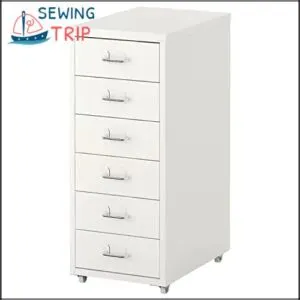
For a rolling storage solution that fits tight corners, the Ikea Helmer White Drawer Unit brings storage mobility and customization ideas to your sewing room organization. This powder-coated metal frame spans 11 inches wide by 27 inches tall, fitting six drawers on locking casters you can roll to your machine or tuck under a desk.
Thread organization improves with drawer assembly that’s straightforward—fold-over tabs replace screws. Unit durability comes from corrosion-resistant steel, though don’t overload drawers meant for lighter thread storage and DIY storage setups.
| Best For | Sewers and crafters who need compact, mobile storage for threads, bobbins, and small notions in tight spaces. |
|---|---|
| Material | Metal |
| Color | White |
| Storage Type | Drawer Cabinet |
| Portability | Casters |
| Assembly Required | Yes |
| Capacity | Multiple drawers |
| Additional Features |
|
- Casters with locks let you roll the unit to your workspace and secure it in place while you work
- Six drawers with label slots make it easy to sort threads by color, type, or project
- Tool-free assembly with fold-over tabs means you can set it up quickly without hunting for screwdrivers
- Thin metal construction isn’t built for heavy items or rough handling
- Drawers can slide off track or refuse to close properly, especially after moving the unit around
- Assembly tabs and top attachment may not line up correctly due to manufacturing inconsistencies
5. iDesign Plastic Jewelry Organizer Tray
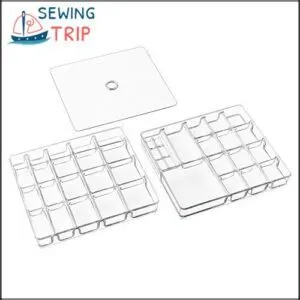
For budget-conscious sewists exploring storage solutions, the iDesign Plastic Jewelry Organizer Tray adapts surprisingly well to thread organization. This clear plastic tray spans 8.75 by 7.75 inches with 40 compartments across three stackable units, letting you sort bobbins by color or separate embroidery threads from all-purpose spools.
Jewelry storage meets sewing thread needs when you slide these trays into drawers or stack them on your work table. DIY adaptations work best for smaller spools since larger cones won’t fit the wells. Storage hacks like these prove effective DIY storage without specialized equipment.
| Best For | Budget-conscious sewists who need affordable storage for bobbins and smaller thread spools without investing in specialized sewing organizers. |
|---|---|
| Material | Plastic |
| Color | Clear |
| Storage Type | Compartment Trays |
| Portability | Stackable |
| Assembly Required | No |
| Capacity | 40 compartments |
| Additional Features |
|
- Clear plastic lets you spot the thread color you need without opening compartments
- Three stackable trays with 40 total compartments give you plenty of sorting options for bobbins and embroidery threads
- Works in drawers or on your work table, so you can adapt it to your space
- Compartments are too small for larger thread cones or bulky spools
- Some users report the plastic feels less durable than expected and may crack over time
- Not designed for sewing supplies, so you might need to get creative with how things fit
DIY and Custom Thread Storage Ideas
You don’t need fancy storage systems to keep your thread organized and protected. With a few basic materials and some creativity, you can build custom solutions that fit your space perfectly.
Here are four DIY approaches that work beautifully for sewists on any budget.
Creating Pegboard or Dowel Rod Racks

Want thread storage that’s truly yours? Building a pegboard design or dowel rod rack puts you in control.
You’ll need hardwood dowel rod materials—1/4 to 3/8 inch works best—and standard pegboard with 1-inch spacing. Custom rack building gives you perfect thread accessibility while maximizing storage efficiency.
Mount your DIY storage at eye level for easy sewing thread organization in your sewing room setup.
Repurposing Household Containers for Thread

Your kitchen and bathroom hold hidden storage solutions—no expensive purchases needed. Household hacks transform everyday items into smart thread protection with creative organization.
- Wide-mouth jars display spools upright so you can spot colors instantly without tangling
- Clear acrylic boxes stack beautifully while keeping dust off delicate threads and notions
- Recycled spice jars with airtight lids guard moisture-sensitive silk and rayon from humidity damage
- Small tackle boxes organize multiple spools by diameter for quick project access
Making Bobbin Organizers From Craft Supplies

Craft scraps solve bobbin chaos beautifully. Cardboard tubes from paper towels become stacked sewing organization—just slice notches to hold wound bobbins in place. Empty tissue boxes transform into compartment-style DIY organizers with labeled dividers for thread management by color. Old spice racks repurposed as bobbin storage ideas prevent tangling while keeping your sewing kit essentials visible.
These sewing hacks cost nothing but save frustration during every DIY storage project.
Space-saving Storage for Small Sewing Rooms

Tight quarters demand vertical thinking. Mount adjustable wall racks or corner thread cubbies to free your sewing stations from clutter—spools stay visible without hogging desk real estate.
Stackable storage bins with clear labels preserve compact shelves, while shallow rolling carts slip under tables when not in use.
Foldable racks and pegboard systems transform cramped crafting storage into spacesaving sewing organization that actually works.
Frequently Asked Questions (FAQs)
How long does sewing thread typically last?
Your thread won’t outlive you—but it might try. Polyester stays strong for 5 to 10 years, while cotton fades faster at 3 to Storage conditions make all the difference.
What are signs that thread has gone bad?
You’ll spot fiber degradation when thread snaps easily under light tension, feels brittle or fuzzy, shows color fading, or breaks during sewing—clear signs of compromised tensile strength and reduced shelf life.
Can old thread damage my sewing machine?
Yes, it can. Fiber deterioration causes lint accumulation in tension discs, while thread breakage risks needle wear.
Brittle fibers may snap under tension, and degraded material sheds particles that compromise sewing machine maintenance and overall thread quality.
Should I throw away inherited or vintage thread?
Like discovering grandmother’s recipe box, inherited thread carries history worth preserving. Test vintage spools before discarding—if they pass a gentle tug and sew smoothly on scrap fabric, these family heirlooms deserve proper thread storage solutions for continued use.
How do I test if thread is still usable?
Before you start sewing, check your thread’s quality with a quick tug test. Pull gently—usable thread stretches slightly without snapping.
Also inspect for broken fibers, chalky texture, or fading, which signal compromised fiber integrity and durability.
Conclusion
What’s the real cost of ignoring thread storage—a ruined project or years of accumulated waste? You now know how to store sewing thread properly using temperature control, UV protection, and smart organization systems.
Your threads will stay strong, your colors won’t fade, and you’ll spend less time untangling messes. Start with one storage solution today. Your future self, mid-project with perfectly preserved thread, will thank you for taking action now.