This site is supported by our readers. We may earn a commission, at no cost to you, if you purchase through links.
Your favorite shirt starts shedding threads after three washes, the seams on that dress unravel at the hem, and suddenly you’re questioning whether handmade means fragile. The culprit isn’t your fabric choice or construction—it’s what happens at the raw edges.
Seam finishing transforms vulnerable cut edges into durable barriers that withstand laundering, movement, and time. Lightweight silks demand different treatment than heavyweight denim, knits need flexibility that wovens don’t, and choosing the wrong method turns hours of careful sewing into a garment with a short lifespan.
Mastering the best seam finishing methods means matching technique to fabric weight, fiber content, and how you’ll wear and wash the piece.
Table Of Contents
Key Takeaways
- Seam finishing prevents fraying and extends garment life by protecting raw fabric edges from unraveling during washing and wear, with the right technique depending on fabric weight, fiber content, and care requirements.
- Lightweight fabrics under 150 gsm need narrow zigzag or French seams, medium-weight fabrics (170-340 gsm) work with serged or bound finishes, while heavyweight materials above 340 gsm require flat felled seams to manage bulk.
- French seams and Hong Kong finishes deliver couture-level results by completely enclosing raw edges, though they’re unsuitable for stretchy knits which need serged overlock or narrow zigzag stitching to preserve elasticity.
- Strategic seam placement matters—bodice princess seams need flat finishes to avoid bulk, high-stress crotch seams demand flat felled reinforcement, and you can combine different finishing methods within one garment for optimal results.
Why Seam Finishing Matters
Seam finishing isn’t just about making your garments look polished—it’s the foundation of construction that lasts. Without proper edge treatment, your carefully stitched seams can unravel in the wash, fray with wear, and ultimately shorten your project’s lifespan.
Mastering a few essential seam finishing techniques will transform your sewing from homemade to handcrafted quality.
Here’s why finishing your seams should never be an afterthought.
Preventing Fraying and Wear
Raw fabric edges unravel faster than you’d think—every wash cycle pulls fibers loose, creating ragged seams that weaken your garment. Edge protection through seam finishes stops fabric fraying before it starts. Here’s why fray prevention matters:
- Zigzag stitching creates a flexible barrier that keeps woven edges intact during laundering.
- Pinking shears reduce raw edge length, slowing wear naturally.
- Seam reinforcement distributes tension away from cuts, preventing fiber shedding.
You can learn more about sealing fabric edges to prevent fraying and prolong garment life.
Enhancing Garment Durability
Seam finishes do more than stop fraying—they extend garment life by reinforcing stress points where fabric pulls hardest. Fabric selection plays a role, but your seam allowance treatment determines how well edges hold up under strain.
Double stitching at armholes, bar tacks at pocket corners, and bound seams on sheer materials create wear resistance that outlasts basic construction, keeping your work intact through countless washes.
Understanding the importance of can further improve the durability and performance of your finished garments.
Achieving a Professional Look
Beyond strength and longevity, clean interiors signal skill. Professional edge treatment separates home-sewn pieces from store-bought quality, and polished results start with strategic seam finish techniques.
French seams and bound edges create garment construction that looks refined from every angle:
- Visible stitching remains uniform and intentional
- Interior seams lie flat without bulk or puckering
- Raw edges stay concealed for a couture finish
- Color-matched thread blends invisibly into fabric
- Consistent seam allowances maintain structural balance
Key Factors in Choosing Seam Finishes
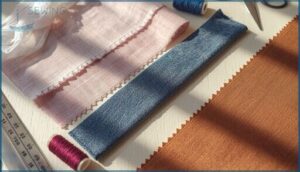
You can’t just pick any seam finish and hope for the best. The right technique depends on what you’re working with, where the seam sits, and how you’ll care for the finished piece.
Factors like fabric weight, fray tendency, and whether the seam will show all play into choosing the best seam finishing method for your project.
Let’s break down the three biggest factors that’ll guide your choice every time.
Fabric Type and Weight Considerations
Your fabric’s weight and density guide every seam finish decision. Lightweight fabrics under 150 gsm fray easily, demanding narrow zigzag or French seams for stability. Medium-weight fabrics (170-340 gsm) handle serged or bound finishes beautifully, while heavyweight materials above 340 gsm need flat felled seams to control bulk.
Understanding fiber content and fabric type ensures your garment stability lasts through countless wears.
Project Type and Seam Placement
Your garment structure dictates which seam finishes work best in each zone. Strategic seam placement balances pattern making principles with construction efficiency:
- Bodice princess seams need flat finishes to preserve shape without bulk
- Side seams benefit from serged edges aligned with fabric grain
- Curved armholes require narrow seam allowances with bound techniques
- High-stress crotch seams demand flat felled reinforcement
- Delicate necklines call for French seam finishing techniques
Washing and Care Requirements
Consider fabric shrinkage and color preservation when selecting seam finishes for long-term clothing care and maintenance. Serged edges withstand repeated machine cycles without fraying, while bound seams need delicate handling on gentle settings.
French seams resist washing damage through complete fabric edge finishing.
Always check laundry symbols before committing to a technique, and test stain removal methods on scraps to protect your finished seams.
Popular Seam Finishing Methods Compared
You’ve got plenty of seam finishing techniques to choose from, and each one brings something different to your sewing table. Some methods work fast with minimal fuss, while others deliver that couture-level finish that makes garments look professionally made.
Let’s break down the most popular options so you can pick the right technique for your fabric and project.
Pinking Shears and Zigzag Stitch
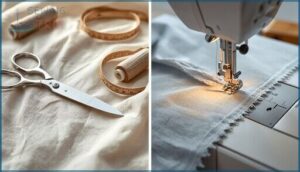
Two finishing methods work like your sewing safety net: pinking shears and zigzag stitching. Pinking techniques cut a zigzag edge that slows fray on woven fabrics, while zigzag settings on your machine wrap thread around raw edges for seam reinforcement.
For edge finishing, adjust stitch width to 3-4mm on medium fabrics. These seam finishes deliver quick fray prevention without extra materials.
Turn-and-Stitch and Overlock (Serger)
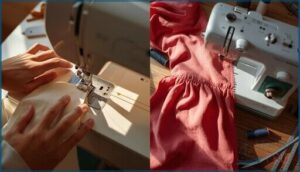
Turn and straight stitch works by folding your seam allowance once, then topstitching close to the fold. Overlock machines trim and wrap edges simultaneously with thread tension and serger settings you’ll customize for each project.
For fabric preparation, remember these serging essentials:
- Adjust stitch length between 2-3mm for standard wovens
- Set differential feed to prevent stretching or puckering
- Trim seam allowance to ¼ inch while stitching
- Test thread tension on scraps before committing
Both seam finishes prevent fraying efficiently.
French Seams and Flat Felled Seams
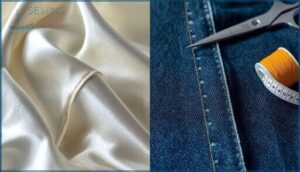
French seams and flat felled seams deliver high-quality edge finishing by completely enclosing raw edges within fabric layers.
French seams work best on lightweight to medium fabric types, requiring you to sew twice with adjusted seam allowances for precise stitch precision.
Flat felled seams provide outstanding seam reinforcement for denim and workwear, folding fabric flat to create visible exterior lines and seam enclosure that withstands heavy use.
Bound and Hong Kong Finishes
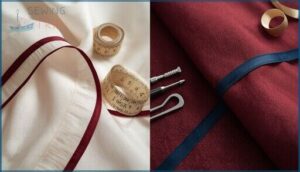
You wrap raw edges like a gift with bound and Hong Kong finishes, using bias binding to create couture techniques that refine interior seams.
Hong Kong seams deliver crisp bias bound edges with minimal bulk, while bias bound seams encase edges completely for polished fabric wrapping. Both methods offer premium seam enclosure:
- Adaptable edge finishing for lightweight to medium fabrics
- Reduced fraying on delicate materials
- Professional seam finishes for custom-fitted projects
Seam Finishing for Different Fabrics
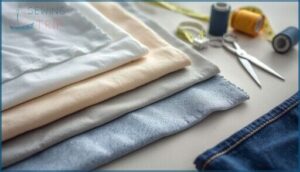
Not all fabrics play by the same rules regarding seam finishing. What works beautifully on cotton might create puckering on silk or fail completely on stretchy knits.
Here’s how to match the right finish to your fabric’s personality and performance needs.
Lightweight and Sheer Fabrics
When you’re working with sheer fabric like chiffon or voile, delicate edges demand lightweight finishes that won’t add bulk. French seams enclose raw edges beautifully, though they can overwhelm very fine weaves. Narrow hems and bias bound edges keep things clean, while zigzag stitching offers quick protection. Hong Kong seams deliver nearly invisible results that transform your most delicate projects into couture-level pieces.
Heavyweight and Denim Fabrics
Heavyweight denim demands sturdy seam finishes that match its durability. Flat-felled seams deliver unbeatable strength for jeans and workwear, enclosing raw edges while reinforcing stress points.
Bound finishes and Hong Kong seams tame thick fabric handling without adding excessive bulk. Skip delicate French seams here—they’ll buckle under denim’s weight.
Instead, opt for zigzag stitching or serged edges that withstand heavy-duty stitching demands and repeated washing.
Knits and Stretch Materials
Knit fabric choices demand seam finishes that move with your material, not against it. Stretch recovery stays intact when you use techniques that preserve elasticity—rigid stitching leads to fabric distortion and puckered seams.
Your elastic seam arsenal:
- Narrow zigzag stitching keeps edges secure without sacrificing stretch
- Serger overlock delivers professional knit edge finishing in one pass
- Avoid French seams—they restrict movement and create stiff fabric edge finishing
Test your technique on scraps first.
Special Fabrics (Non-Fraying, Delicate, Etc.)
Fabrics that resist fraying—silk charmeuse, satin, bonded synthetics—still benefit from seam finishing to stabilize drape and prevent edge wear.
For delicate materials like chiffon or organza, skip pinking and choose narrow bias binding or fusible interfacing to reinforce edges without bulk.
Edge stabilization through lightweight seam tape or narrow zigzag stitching preserves sheer fabric finishes while maintaining movement and preventing distortion during laundering.
Essential Tools and Tips for Seam Finishing
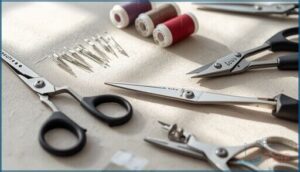
You can’t finish seams like a pro without the right arsenal in your sewing kit. Sharp tools, quality thread, and a few strategic choices make the difference between finishes that hold up and ones that unravel after the first wash.
Here’s what you need to stock up on, plus how to keep those finished seams looking sharp wear after wear.
Choosing The Right Tools and Threads
Your thread selection and needle choices can make or break your seam finishing results. Match thread weight to your fabric type—40 weight for most woven fabrics, 30 weight for denim. Use universal needles on your sewing machine for general sewing techniques, ballpoint for knits.
Sharp tools and proper tool maintenance prevent fabric damage while ensuring fabric compatibility across different seam finishing methods.
Maintenance and Care for Finished Seams
After every wash, inspect seams for loose threads and trim them close to prevent unraveling. Store garments folded or hung properly to minimize stress on seam finishes. Gentle pressing with low heat maintains flatness without scorching thread.
Check stress points like pockets for gaps, reinforcing with backstitching if needed. Proper garment handling extends the life of your fabric edge finishing work.
Frequently Asked Questions (FAQs)
Can you combine different seam finishes in one garment?
Yes, you can mix finishes strategically. French seams work beautifully on bodices, while zigzag stitching reinforces side seams—these finish combinations balance edge stability across garment layering without compromising seam allowance or creating bulk.
How do you fix poorly finished seams after construction?
You can repair rough edges without starting over. Mark the damaged area, unpick that section, then restitch with matching thread.
Finish raw edges using zigzag stitching or overcasting for pucker removal and edge reinforcement.
What seam finish works best for curved seams?
For curved seams, serger techniques and narrow zigzag stitches deliver flexible seam options that follow the curve smoothly. Bias binding methods and French seams also work beautifully, while curved edge finishing requires careful clipping to reduce bulk.
Which finish is fastest for beginner sewers?
Pinking shears will transform your sewing game overnight—literally the fastest beginner finishes you’ll master.
Quick edges with zigzag stitching or simple turn-and-stitch deliver speedy stitches without complicated seam finishes or intricate sewing techniques.
Conclusion
Seventy percent of homemade garments fail at the seams before the fabric wears out—a preventable loss. You’ve compared the best seam finishing methods across fabric types, weights, and care demands.
Now you can match pinking to stable cottons, French seams to sheers, and flat-felling to denim with precision. Your raw edges won’t betray your construction anymore.
Choose the finish that suits your fabric’s behavior, not just its appearance, and watch your garments outlast their store-bought counterparts.