This site is supported by our readers. We may earn a commission, at no cost to you, if you purchase through links.
Your thread choice can make or break a quilt before you even stitch the first seam. Cotton threads offer that classic matte finish quilters love, but polyester won’t fade after fifty washes. Weight matters too—50-weight glides through piecing while 40-weight adds definition to appliqué edges.
The real challenge isn’t finding thread, it’s finding complete sets that balance color variety with performance. You need spools that won’t lint up your machine or snap mid-seam, especially when you’re joining dozens of fabric pieces into one cohesive design.
The right sewing thread sets for patchwork and appliqué eliminate guesswork, giving you coordinated colors and consistent quality across every project.
Table Of Contents
Key Takeaways
- Cotton thread gives you that classic matte finish and handles high heat beautifully, but polyester delivers 30 percent more strength and won’t fade after fifty washes—so match your thread fiber to your fabric type and project longevity needs.
- Fifty-weight thread creates nearly invisible piecing seams that keep your patchwork blocks accurate, while 40-weight adds visible dimension to appliqué edges, making weight selection your most critical technical decision after choosing fabric.
- Quality thread sets eliminate color-matching guesswork by giving you curated palettes in consistent weights, saving you from buying dozens of individual spools and letting you focus on stitching instead of shopping.
- Pair your thread weight with the right needle size—50-weight needs an 80/12, 40-weight requires a 90/14—because mismatched combinations cause puckering, thread breaks, and sloppy seams that ruin otherwise perfect patchwork.
Best Sewing Thread Sets for Patchwork and Appliqué
You need the right thread to make your patchwork blocks hold together beautifully and your appliqué edges look crisp. The best sets give you a color range that matches most fabrics without buying dozens of individual spools.
A beginner-friendly thread set takes the guesswork out of color matching so you can focus on stitching instead of shopping.
Here are nine thread sets that quilters actually reach for when they’re piecing blocks or stitching down appliqué shapes.
1. Simthread Cotton Quilting Thread
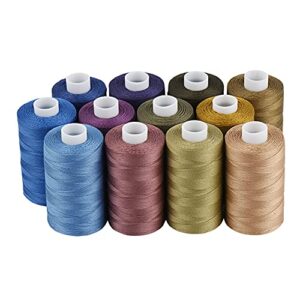
Simthread Cotton Quilting Thread gives you 100% long staple mercerized cotton in a 50s 3-ply construction that balances strength with a sleek finish. The mercerization cuts lint and adds a subtle sheen that looks clean on modern or traditional quilts.
You get 550-yard spools in curated sets—neutrals, jeans tones, or spring colors—so you can match most patchwork fabrics without hunting for singles.
Use it for piecing, free motion quilting, and appliqué; the long staple fibers resist shredding at higher machine speeds and hold up beautifully through frequent washing.
| Best For | Quilters and sewists who want a strong, low-lint cotton thread for piecing, appliqué, and free motion work across a range of neutral and denim-inspired fabric colors. |
|---|---|
| Material | 100% Cotton |
| Thread Count | 12 spools |
| Length Per Spool | 550 yards |
| Thread Weight | 30wt |
| Sewing Type | Machine & Hand |
| Suitable For | Quilting, Appliqué, Embroidery |
| Additional Features |
|
- Long staple mercerized cotton resists shredding at higher speeds and adds a subtle sheen that looks polished on finished quilts.
- 550-yard spools in curated color sets save you from buying singles and make it easy to match most patchwork palettes.
- Holds up through frequent washing without breaking down, making it reliable for everyday quilts and baby projects.
- Breaks easily if you don’t pair it with the right needle size (80/12 recommended), which can frustrate beginners.
- Some users report quality control issues like receiving polyester instead of cotton or getting smaller spool sizes than advertised.
- Lacks the stretch of polyester or nylon, so you may need to slow your stitching speed on thick seams to avoid thread jams.
2. Simthread Cotton Embroidery Thread
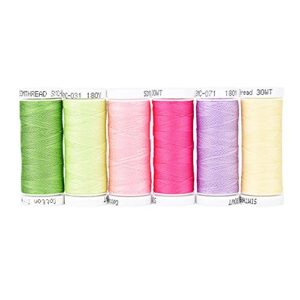
If you need a slightly heavier cotton for decorative work, Simthread Cotton Embroidery Thread delivers 30WT thickness that outlines appliqué shapes with visible dimension. The 100% long staple mercerized cotton in a 50s 3 construction resists fraying during dense satin stitches, and the matte finish keeps your topstitching from looking too glossy.
You’ll find 12-color sets in themes like spring brights or jeans neutrals, each spool holding 550 yards—enough for multiple projects without constant rethreading. Pair it with an 80/12 needle for clean, raised stitches that won’t sink into the fabric.
| Best For | Sewers who want a thicker cotton thread for decorative topstitching, appliqué outlines, and quilting projects where visible texture matters. |
|---|---|
| Material | 100% Cotton |
| Thread Count | 6 spools |
| Length Per Spool | 180 yards |
| Thread Weight | 30wt |
| Sewing Type | Machine & Hand |
| Suitable For | Quilting, Appliqué, Embroidery |
| Additional Features |
|
- Long staple mercerized cotton resists fraying during dense stitches and provides a smooth, lustrous finish with less lint
- Available in convenient 12-color themed sets with 550 yards per spool, giving you plenty of thread for multiple projects
- Versatile 30WT thickness works well for hand or machine embroidery, quilting, piecing, and appliqué on various fabrics
- Cotton doesn’t stretch, so you’ll need to slow down your stitching speed to prevent thread breakage
- Some users report thread snapping issues depending on their machine, requiring tension adjustments or larger needle eyes
- May not work smoothly on all sewing machines without some trial-and-error setup tweaks
3. Ilauke Sewing Thread Kit
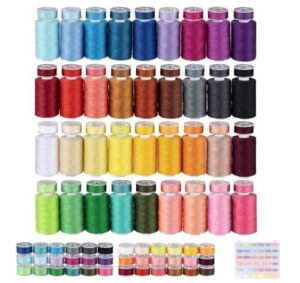
The Ilauke Sewing Thread Kit offers 60 or 80 polyester colors in a compact set, ensuring you always find the right shade for piecing or appliqué without searching through multiple boxes.
Each spool contains 228–250 yards of soft yet strong polyester that feeds smoothly through your machine and resists fraying at appliqué edges.
The 80-color kit includes 144 matching bobbins, allowing you to load coordinated top and bottom threads for tidy satin stitches—ideal for building a color library on a budget.
| Best For | Beginner quilters and sewists who need an affordable starter kit with plenty of color options for basic piecing, appliqué, and small repair projects. |
|---|---|
| Material | 100% Polyester |
| Thread Count | 36 spools |
| Length Per Spool | 550 yards |
| Thread Weight | Standard |
| Sewing Type | Machine & Hand |
| Suitable For | Repairs, Embroidery, Décor |
| Additional Features |
|
- Arrives with 36 coordinating colors and matching prewound bobbins, so you can start sewing right away without winding your own
- Each 550-yard spool provides enough thread for multiple small to medium projects before running out
- Budget-friendly way to build a color library without investing in individual high-end spools
- Thread may loosen or jam the machine near the end of the bobbin, requiring manual attention during longer sessions
- Some users report quality control problems like missing spools or inconsistent tension
- Polyester can occasionally break mid-stitch, though most reviewers say it happens rarely
4. Ciaraq Sewing Thread Kit
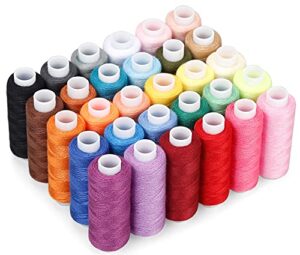
The Ciaraq Sewing Thread Kit puts 30 vibrant polyester colors in your hands—enough variety to match most patchwork fabrics without buying specialty spools. Polyester’s natural stretch means you won’t snap threads mid-stitch, even through multiple quilt layers.
Each 250-yard spool feeds smoothly through your machine, so appliqué edges stay crisp while pieced seams hold firmly.
Choose from thread for quilting explained to find the right weight and finish for hand or machine work.
The boxed set keeps colors visible at a glance, helping you grab the perfect shade quickly and get back to stitching beautiful blocks.
| Best For | Quilters and crafters who need a budget-friendly rainbow of thread colors for appliqué, piecing, and decorative stitching without buying individual spools. |
|---|---|
| Material | 100% Polyester |
| Thread Count | 30 spools |
| Length Per Spool | 250 yards |
| Thread Weight | Standard |
| Sewing Type | Hand & Machine |
| Suitable For | Sewing, Embroidery, DIY |
| Additional Features |
|
- 30 vibrant polyester colors give you plenty of matching options for patchwork and embroidery projects
- Polyester’s stretch and durability prevent thread breakage when sewing through multiple quilt layers
- Organized box keeps all your colors visible and easy to grab when you’re mid-project
- Spools are smaller than some sewers expect, so you might run out faster on larger quilts
- Thread thickness can make it tricky to get through finer needles for hand-sewing details
- A few users reported breakage or quality issues, so it may not hold up for heavy-duty work
5. Leonis Sewing Thread Set
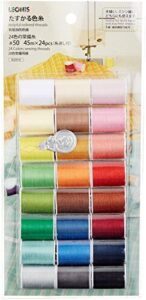
The Leonis Sewing Thread Set offers 30 polyester colors in a clear case, making shade selection simple while you work. Each spool holds 45 to 50 yards, perfect for small appliqué motifs and patchwork blocks without overbuying.
The smooth polyester resists shrinking and glides through standard machines, so your seams stay flat and your appliqué edges hold their shape after washing.
The compact case fits your sewing basket easily, and some sets include a needle threader to speed up your prep work.
| Best For | Crafters and sewers who need a variety of thread colors for small projects like appliqué, patchwork, or quick repairs without committing to full-sized spools. |
|---|---|
| Material | 100% Polyester |
| Thread Count | 24 spools |
| Length Per Spool | 50 yards |
| Thread Weight | Standard |
| Sewing Type | Machine & Hand |
| Suitable For | Sewing, Crafts, Travel |
| Additional Features |
|
- 24 to 30 assorted colors in one compact case make it easy to find the right shade for any fabric
- Polyester thread is strong, durable, and resists shrinking so your seams stay neat after washing
- Portable size fits easily in a sewing basket or travel kit, and some sets include a needle threader
- Spools are small (45-50 yards each) and may run out quickly on larger projects
- Some users report the thread can split or fray when threading needles or during sewing
- Not ideal if you need full-sized spools for heavy-duty or professional sewing work
6. Multicolor Polyester Sewing Threads Set
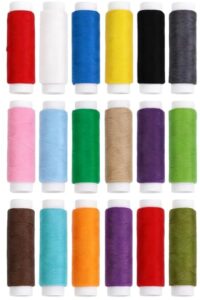
A 20-pack multicolor polyester set gives you vibrant shades for mixing and matching fabrics across multiple projects. You’ll find high-quality polyester that works smoothly with hand stitching and domestic machines, perfect for appliqué and patchwork blocks.
The bright assorted colors let you experiment with contrast or pull exact matches, and the strong synthetic fibers resist breaking during dense stitching. These sets usually include one-inch spools that fit standard thread holders, making them a practical choice for quilters who want variety without buying full cones of every shade.
| Best For | DIY enthusiasts and quilters who need a variety of bright thread colors for mixing fabrics, patchwork, and embroidery projects without investing in full-size spools. |
|---|---|
| Material | 100% Cotton |
| Thread Count | 6 spools |
| Length Per Spool | 180 yards |
| Thread Weight | 30wt |
| Sewing Type | Machine & Hand |
| Suitable For | Quilting, Appliqué, Embroidery |
| Additional Features |
|
- 20 vibrant colors give you plenty of options for matching or contrasting fabrics across different projects
- High-quality polyester resists breaking during dense stitching and works smoothly with both hand and machine sewing
- Compact one-inch spools fit standard thread holders and take up minimal storage space
- Conflicting material information (listed as both cotton and polyester) raises questions about actual composition
- No clear details on thread length or yardage per spool, so you might run out quickly on larger projects
- Likely too lightweight for heavy-duty or industrial sewing work
7. Sewing Thread Kit Polyester
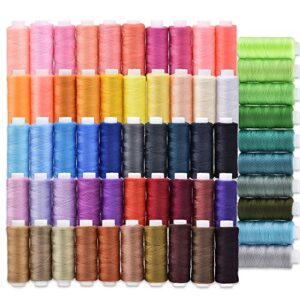
You’ll get sixty colors in this polyester kit, with 250 yards per spool to power through daily sewing and decorative appliqué. The premium polyester fibers deliver strength and durability, so seams hold up through heavy use and repeated washing.
These spools work beautifully for hand stitching, machine piecing, and embroidery projects, giving you flexibility across techniques. The packaging makes it easy to grab a color and keep everything organized.
While some users report occasional breakage, most find the thread perfectly adequate for patchwork blocks and appliqué shapes at an excellent value.
| Best For | Sewists who need a wide variety of thread colors for everyday projects, DIY crafts, and decorative work without breaking the bank. |
|---|---|
| Material | Polyester |
| Thread Count | 20 spools |
| Length Per Spool | Not specified |
| Thread Weight | Standard |
| Sewing Type | Machine & Hand |
| Suitable For | Tailoring, Quilting, Embroidery |
| Additional Features |
|
- Sixty colors give you plenty of options to match fabrics and get creative with embroidery
- Works across different techniques—hand sewing, machine stitching, and decorative projects
- Strong polyester construction holds up well through washing and regular wear
- Some users experience thread breakage, though experiences vary
- Individual spools may run short for larger projects
- Quality isn’t top-tier, but it gets the job done for most tasks
8. Gutermann Natural Cotton Thread Set
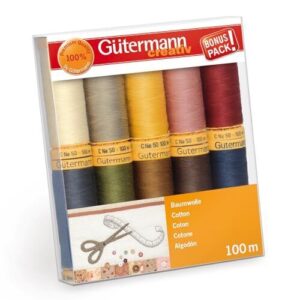
When you want smooth, natural fibers for patchwork and quilting, Gutermann’s mercerized cotton thread set delivers elegant results. You’ll find ten spools of 100-meter Cotton C Ne 50 in coordinated color themes—bright, basic, or multicolour palettes that match your project vision.
The mercerization adds subtle gloss and enhanced strength without slippery handling. Use it with a universal needle size 70 to 90 for balanced stitching on piecing seams, decorative appliqué, and quilting lines.
The fine yet strong construction helps seams press flat beautifully.
| Best For | Quilters and sewers who want premium Egyptian cotton thread with a natural sheen for patchwork, appliqué, and decorative stitching projects. |
|---|---|
| Material | Polyester |
| Thread Count | 60 spools |
| Length Per Spool | 250 yards |
| Thread Weight | Standard |
| Sewing Type | Machine & Hand |
| Suitable For | Sewing, Embroidery, DIY |
| Additional Features |
|
- Mercerized Egyptian cotton gives you strength and a subtle shine without feeling slippery
- Works great for both hand and machine sewing across different projects—from quilting to repairs
- Ten coordinated spools in themed color palettes make it easy to match your fabric choices
- Thread can tangle more than you’d expect, especially when filling bobbins
- The 100-meter spools run out faster than they look like they should
- Costs more than similar cotton threads from other brands
9. New Brothread Cotton Thread
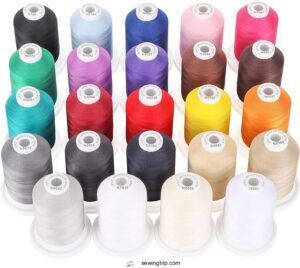
New Brothread cotton thread combines extra long staple cotton fibers with a 3-ply twisted construction, giving you a smooth 30-weight thread that minimizes lint while you stitch. Each 660-yard spool passes cleanly through an 80/12 needle or larger, making it ideal for bold quilting lines and decorative appliqué edges.
The mercerized finish adds a subtle sheen without slippery handling. You’ll appreciate the 24-color basic set or the variegated options that shift tone gradually, bringing dimension to free-motion quilting and satin-stitched appliqué outlines.
| Best For | Quilters and sewers working with natural fabrics who want a sturdy, lint-resistant thread with enough body for decorative stitching and bold topstitching. |
|---|---|
| Material | Cotton |
| Thread Count | 10 spools |
| Length Per Spool | 100 meters |
| Thread Weight | 50wt |
| Sewing Type | Machine & Hand |
| Suitable For | Patchwork, Quilting, Appliqué |
| Additional Features |
|
- Three-ply mercerized cotton construction reduces lint and creates smooth feeding through machines
- 660-yard spools with locking bases prevent thread tangling and offer good value for larger projects
- Available in 24 basic colors plus variegated options for matching or adding visual interest to quilts and appliqué
- Thicker 30-weight profile requires needles sized 80/12 or larger, which may punch visible holes in delicate fabrics
- Zero stretch means it’s not suitable for knits or anything requiring elasticity
- Some machines need an upright thread stand to accommodate the spool size and prevent tension issues
Choosing The Right Thread Type
You can’t build a quilt that lasts if you’re stitching with the wrong thread. Cotton and polyester behave differently under your needle, and weight changes everything from seam bulk to stitch visibility.
Choose thread that matches your fabric’s fiber and weight, because the wrong one will ruin your quilt’s seams and longevity
Let’s break down what actually matters so you can match thread to fabric like you know what you’re doing.
Cotton Vs. Polyester Threads
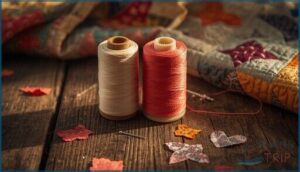
Cotton thread gives your patchwork that classic matte finish and breathes beautifully with cotton fabrics, but polyester thread delivers serious thread durability—about 30 percent stronger with enhanced color retention through countless washes.
Fiber comparison shows cotton tolerates high pressing heat for quilting threads, while polyester resists fading and fraying in applique methods.
Your thread selection shapes both sewing performance and fabric interaction, so choose wisely for your project’s life. When choosing thread, it’s helpful to understand the impact of on quilting results.
Thread Weight for Patchwork
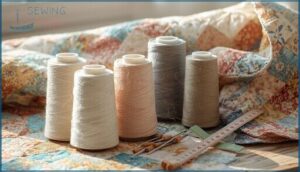
Fifty weight cotton thread hits that sweet spot for patchwork piecing—fine enough to keep your seam allowance accurate without adding bulk at intersections. Higher weight numbers mean finer quilting threads, so 50 creates nearly invisible stitches while 40 shows more stitch visibility.
Your fabric choice and quilt durability goals drive thread selection, and matching thread weight to needle size keeps everything running smoothly. For more details, you can explore thread weight considerations for quilters.
Thread Weight for Appliqué
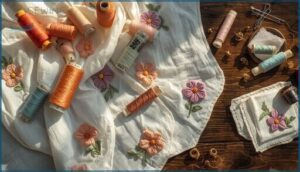
Machine appliqué works beautifully with 40 to 50 weight thread—40 gives you visible, dimensional stitches for bold blanket or satin edges, while 50 weight offers smoother lines that blend softly. For nearly invisible appliqué techniques, try monofilament thread or fine 60 weight cotton that sinks right into your fabric folds.
- Thread visibility: Choose 40 weight for showy stitches, 60 to 80 for subtle seams
- Stitch tension: Pair fine bobbin thread with heavier top thread for flatter appliqué blocks
- Fabric compatibility: Match variegated thread to bold designs, Sulky 50wt Cotton Thread to everyday quilting cottons
Matching Thread to Fabric
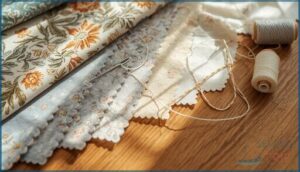
Match your fiber choice to your fabric—cotton quilting thread on cotton fabric keeps shrinkage and wear consistent, while polyester applique threads pair better with synthetics.
For thread color, lay a strand directly on your fabric to test; dove gray or cream sewing thread often blends across scrappy prints.
Weave considerations matter: tightly woven cottons work best with smooth Aurifil thread sets that glide through stable fabric without distorting seams.
Essential Features in Patchwork Threads

Not all thread is built the same, and patchwork demands specific qualities that cheaper spools just can’t deliver. You need thread that holds up under tension, keeps its color after washing, and runs smoothly through your machine without gumming up the works.
Let’s break down the non-negotiable features that separate reliable patchwork thread from the stuff that’ll make you want to throw your bobbin across the room.
Thread Strength and Durability
You want quilting thread that won’t snap mid-project or fray after a few washes. Tensile strength matters—polyester sewing thread packs roughly 30 percent more pull-resistance than cotton thread, making it ideal for high-stress seams.
Fiber durability and abrasion resistance keep stitches intact through friction and frequent handling.
Thread longevity also depends on material science: polyester can last 200 years under proper storage, while cotton thread usually holds strong for 50 to 100 years.
Colorfastness and Variety
Colorfast dyes protect your patchwork from ruined seams when you throw that quilt in the wash. Thread variety gives you the freedom to match fabrics or create bold contrast—most appliqué threads come in curated palettes of 12 to 24 shades.
Here’s what to check:
- Polyester resists color bleeding even with strong laundry chemicals
- Mercerized cotton improves dye fixation for consistent hues
- Aurifil and similar thread sets offer dozens of shades for fabric matching
Lint Levels and Finish
Low lint finishes transform your machine experience and keep stitch lines crisp. Double gassed cotton burns off surface fuzz—some quilting thread drops lint by 80 percent—while mercerized cotton swells fibers smooth for fewer clogs.
| Thread Finishing | Lint Reduction |
|---|---|
| Double Gassed Cotton | Up to 80% less fuzz |
| Mercerized Cotton | Smooth, low lint |
| Glazed Thread | Slick but leaves residue |
| Fine Polyester | Minimal machine buildup |
| Standard Cotton | Higher lint, more cleaning |
Aurifil and similar thread sets use fiber smoothness to let you piece longer between brush-outs.
Spool Size and Value
Most thread sets bundle 200 to 300 yard spools—perfect for lap quilts—while larger 1,000 meter spools slash your cost per yard.
Aurifil and Gutermann quilting thread sets with 20 to 26 spools give you around 2,200 to 2,860 yards at better value than singles.
Check spool capacity against total yardage to see which applique threads deliver real cost efficiency.
Tips for Seamless Patchwork and Appliqué
Getting your thread and fabric to work together takes more than choosing the right spool. You need to match weight to needle size, understand how thread affects your seam finish, and decide when your stitches should pop or disappear.
These four techniques will help you avoid puckered seams, broken threads, and appliqué that looks stiff instead of smooth.
Pairing Thread Weight With Needle Size
Needle selection drives stitch quality in patchwork and appliqué just as much as fabric choice does.
Pair 50wt quilting thread with an 80/12 needle for balanced thread tension, while 40wt thread sets need a 90/14 to prevent fraying.
Fine 100wt threads in Aurifil collections run smoothly through 60/8 or 70/10 Microtex needles, letting your sewing technique shine through delicate needlework.
Achieving Flat Seams in Patchwork
Press seams to one side, nesting them at block intersections to dodge bulky layers. A consistent 1/4 inch seam allowance keeps patchwork quilting flat, while balanced thread tension stops puckering.
Spin four-patch joins so seam allowances circle outward—bulk management at its finest.
Let your block cool completely before moving it; fabric relaxation locks those quilting techniques and stitching techniques in place.
Creating Dimensional Appliqué Stitches
Want your appliqué to pop off the quilt? Padded satin stitching builds up texture, while trapunto style creates serious dimension with hidden batting. Try stumpwork padding for sculpted petals—layer those embroidery floss strings, then cover with appliqué threads.
Thread weight matters: 40 wt shows bold lines, 50 wt keeps it subtle. Adjust machine settings for smooth coverage over padding, and your stitching techniques will transform flat fabric into touchable art.
Blending Vs. Contrasting Thread Colors
Color harmony in your patchwork comes down to one choice: blend or contrast. Matching thread colors to fabric value makes seams recede, letting your prints shine. Contrasting thread turns quilting lines into bold design elements—but it’ll show every wobble.
Consider these visual impact factors:
- Light neutral thread sets forgive uneven stitches and keep busy prints center stage
- Dark applique threads on pale fabric create crisp, graphic edges that pop
- Medium gray or taupe sewing threads balance across multiple fabric contrasts without harsh lines
- Variegated quilting threads shift between blender and statement depending on the fabric underneath
- Matching thread visibility to your skill level prevents frustration and builds confidence
Audition strands across your quilt top before committing. Design balance depends on whether you want texture or color to lead.
Must-Have Tools and Accessories

Great thread alone won’t carry your patchwork or appliqué projects across the finish line. You need the right needles, tools, and workspace essentials to stitch cleanly and work efficiently.
Here’s what belongs in your sewing toolkit to support those beautiful thread choices you just made.
Needles for Patchwork and Appliqué
Your sewing machine needs the right needle materials to deliver excellent stitch quality through patchwork seams and appliqué edges. Schmetz Topstitch Needles handle heavier threads beautifully, while embroidery needles protect specialty floss and maintain proper thread tension.
For hand work, Clover Gold Eye and Sasiko needles glide smoothly through fabric preparation layers, giving you clean, professional results every time.
Pins and Marking Tools
{{OUTPUT }}
Fine patchwork tons with 0.4 mm threads hold your beams together without losing threads. Glass head tons won’t melt under your iron, so you can press as you go. For marking, glass marking chalk buses off easily, while water soluble markers run away after marking. Heat erasable options like the F bus ion C marker Pen delete with warmth, though ghost lines may show on some floors.
{{/ OUTPUT }}
Cutting Mats and Rulers
Your rotary cutter deserves a self-healing cutting mat that closes shallow grooves and keeps the surface smooth. Look for five-layer PVC construction in cutting mat materials—these mats protect your blade and won’t warp under heat.
Pair them with clear acrylic Creative Grids rulers featuring high-contrast grid markings for ruler accuracy on light and dark fabrics.
Clean mats with mild soap to maintain performance, and rotate your cutting position so the surface heals evenly between projects.
Storage and Organization for Thread Sets
Stack your thread sets on wooden racks that hold up to 120 spools, keeping patchwork and appliqué colors visible and ready. Storage boxes with latching lids prevent tangling, while dust protection through enclosed cabinets guards tension disks. Bobbin organizers pair wound bobbins with matching spools.
Portable cases with elastic loops carry curated sewing supplies to retreats, protecting your crafting supplies and sewing accessories from loose pins and lint.
Frequently Asked Questions (FAQs)
What is the best thread to use for appliqué?
Choosing appliqué threads depends on the stitch visibility you’re after. Cotton blends beautifully with fabric, while polyester resists fraying.
Fifty-weight thread balances strength and subtlety; finer weights vanish into embroidery details seamlessly.
What kind of thread should I use to sew on patches?
Polyester all-purpose thread works best for patches because it’s strong, stretchy, and colorfast.
Match your thread weight to fabric thickness—use 40–50 weight for everyday clothes, heavier threads for denim or canvas.
How often should I replace my sewing threads?
Test your sewing thread by pulling a strand firmly—if it snaps easily, replace it.
Cotton quilting thread usually lasts five to ten years with proper storage conditions, while polyester embroidery thread stays strong much longer.
Can thread sets work on serger machines?
Picture spools spinning at breakneck speed—most sewing thread sets handle sergers beautifully if they’re 40 to 50 weight polyester.
Cotton quilting thread can snap under pressure, so choose polyester thread performance for structural seams.
What causes thread to break during stitching?
Thread breaks when tension is off, the needle is dull or bent, or poor thread quality can’t handle the stress.
Machine issues like burrs, fabric interference from fusible adhesives, and misthreading also cause snaps.
Do vintage threads still work for modern quilts?
Many quilters find that vintage threads from the 1970s and 1980s still handle patchwork and appliqué beautifully—if they pass a simple pull test and show no fraying or excessive lint during quilting.
Should I prewash fabric before using new thread?
Yes, prewash your fabric. Quilting cotton can shrink around 3 percent and release dye bleeding onto light applique.
Prewashing removes fabric finishes, stabilizes thread seams, and prevents puckering when cotton thread meets unwashed material later.
Conclusion
The irony? You can own a closet full of fabric yet stall on a single project because your thread selection feels off. Investing in quality sewing thread sets for patchwork and appliqué removes that friction entirely.
You’ll stop second-guessing color choices and start finishing quilts that actually reflect your vision. Match your thread weight to your needle size, test tension on scraps, and watch your seams transform from adequate to outstanding. Your fabric deserves thread that performs as beautifully as it looks.
- https://ylithreads.com/blogs/thread-education/thread-weight-quilting-guide
- https://www.superiorthreads.com/applique-threads
- https://dcclearautobra.com/500-Yard-Spool-In-Evening-Blue-Color-k-650170
- https://www.shabbyfabrics.com/p217279/pieceful-patchwork-november-1pc-applique-thread-set
- https://www.simthreads.com/collections/cotton-thread