This site is supported by our readers. We may earn a commission, at no cost to you, if you purchase through links.
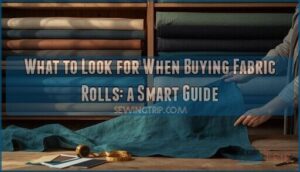
The wrong fabric can unravel an entire project—sometimes literally. A bolt that looks perfect on screen arrives stiff, off-color, or narrower than listed, and suddenly your yardage calculations mean nothing.
Knowing what to look for when buying fabric rolls separates a confident purchase from an expensive lesson. Fabric choice touches everything: how a garment drapes, how upholstery holds up after years of use, how a finished piece looks under real light.
Get the fundamentals right before you cut a single inch, and you’ll waste less, spend smarter, and produce work that actually holds together.
Table Of Contents
Key Takeaways
- Match your fabric to its end use first — weight, stretch, and durability requirements vary dramatically between upholstery, activewear, and formal garments, and getting this wrong wastes money before you cut a single inch.
- Always inspect rolls for color consistency, weave tightness, and defects by unrolling several yards in good light, since hidden flaws like shade bands or loose weaves can quietly destroy your yield.
- Calculate yardage by starting with pattern requirements, then adding seam allowances, hem space, shrinkage buffer, and at least half a yard for cutting errors — especially when working with large pattern repeats.
- Vet suppliers before committing to bulk orders by checking reviews, certifications, and response times, since roll width, minimum order quantities, and shipping reliability all directly affect your project costs.
Key Factors When Buying Fabric Rolls
Buying fabric rolls isn’t just about picking what looks good choice — the wrong choice can derail an entire project before you cut a single inch.
A good starting point is matching your fabric weight to the pattern’s demands — these sewing patterns for men show exactly what each style calls for.
A few key factors will guide you toward the right material every time.
Here’s what to check before you buy.
Matching Fabric to Project Purpose
Every project tells you what it needs — you just have to listen. A sofa fabric must survive daily friction, while a summer blouse needs to breathe. Matching your material choices to your end use is the foundation of smart fabric selection.
Every project tells you what it needs — you just have to listen
Consider these project purpose essentials:
- Upholstery needs durability and stain resistance
- Outdoor projects require UV and mildew protection
- Activewear demands moisture-wicking, high-stretch fabric types
- Formal garments call for drape and sheen
- Kids’ and pet spaces need tight weaves with easy cleanability
Assessing Fabric Weight and Width
Once you’ve matched fabric to purpose, weight and width become your next decision points.
Fabric weight — measured in GSM — tells you how dense and structured a roll will feel.
Lightweight rolls around 120–160 GSM suit summer pieces, while upholstery sits closer to 400 GSM.
Roll dimensions and usable width directly affect fabric yield, so always check both before ordering.
Considering Color, Pattern, and Texture
Weight and width sorted — now color theory matters here: check fabric dyeing quality in both natural and indoor light, since metamerism can make two rolls look like twins in the store but strangers at home.
For Print Design and Pattern Mixing, account for repeat size and directional layouts. Texture Analysis rounds it out — rough weaves hide wear; smooth ones show everything.
Evaluating Seasonal and Durability Needs
Texture tells you how something feels — durability tells you how long it lasts. Seasonal fabric choices shape both. For summer, breathable cotton and linen keep things cool. For winter, wool and fleece lock in warmth. Climate considerations matter just as much as looks.
If you’re working with lined skirts specifically, this guide to choosing the best fabrics for lined skirts breaks down which materials hold up best across seasons.
Your fabric durability checklist:
- Check weather resistance ratings for outdoor projects
- Match fabric weight to season and wear frequency
- Confirm durability tests like Martindale rub counts before committing
How to Identify High-Quality Fabric Rolls
Spotting a quality fabric roll isn’t guesswork — it just takes knowing what to look for. A few key checks will tell you a lot about whether a roll is worth your money before you commit.
Here’s what to examine closely.
Checking for Defects and Inconsistencies
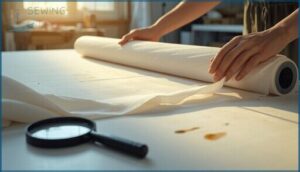
Think of fabric inspection as your first line of defense. Before committing to a roll, unroll several yards and check in good light — defects like surface flaws, color variation, slubs, or stains can quietly wreck your yield.
Solid fabric quality starts with knowing your defect classification basics: oil stains, skew, shade bands, and needle lines are all rejectable faults worth catching early.
Assessing Weave Tightness and Finish
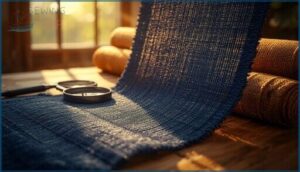
Weave tightness tells you more than it gets credit for. Hold a section of the fabric roll up to a window — if you see distinct gaps between yarns, the weave density is low and the fabric will lose shape faster.
Thread count, surface finish, and light transmission all point to fabric quality. Tightly woven, well-finished fabric types resist pilling and hold structure through repeated use.
Inspecting Color Consistency and Print Quality
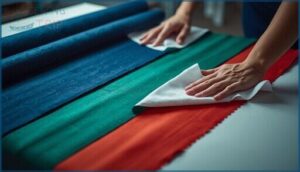
Color shade inconsistency can quietly ruin a project before the first cut. When inspecting fabric rolls, unroll sections from the start, middle, and end — shade bands across the width signal uneven dyeing. Always verify the dye lot number matches across all rolls.
Watch for these common fabric defects:
- Blurred print registration or doubled motifs
- Color bleeding beyond design edges
- Pale, unprinted patches from low dye feed
Quick colorfastness tests — rubbing a white cloth against the surface — reveal whether color and pattern will hold through real use.
Understanding Fiber Content and Blends
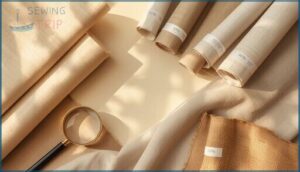
The label on a fabric roll tells you more than you’d expect. Fiber content — that percentage breakdown of cotton, polyester, linen, or other materials — directly shapes how your finished piece holds up.
Fiber blending balances natural fibers against synthetic materials for durability without sacrificing comfort. A 60/40 cotton-polyester blend, for instance, resists wrinkles while staying breathable. Understanding blend ratios helps you match fabric types to real project demands.
Calculating Fabric Needs for Your Project
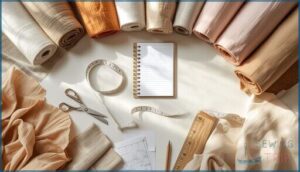
Getting your fabric math right before you buy can save you from a frustrating mid-project scramble.
There are a few key things to work through so you end up with exactly what you need — no more, no less. Here’s what to keep in mind when calculating your fabric needs.
Measuring Yardage and Allowances
Getting your yardage calculation right before you cut is everything. Here’s a simple fabric measurement framework to follow:
- Start with pattern yardage, then add 0.5 inch seam allowance per joined edge.
- Add 1–2 inches for hems.
- Factor in 5–10% for shrinkage on natural fabric types.
- Round any fraction up to the next full yard.
- Add 0.5–1 extra yard for cutting errors.
Factoring in Fabric Roll Width
Roll width shapes everything. A 60-inch fabric roll gives you far more usable width per yard than a standard 44-inch roll — and that yield impact is real money saved.
For wholesale fabric buyers, matching roll width to project suitability means less waste reduction headaches and smarter fabric sourcing strategies. Always check usable width, not just the bolt label.
Planning for Pattern Placement and Matching
Pattern repeats can quietly eat your yardage if you’re not prepared. A large-scale print with a 27-inch vertical repeat means each cut needs that full repeat added just to keep motifs aligned across seams.
Here’s what to track:
- Measure your repeat and add it to every cut length.
- Account for directional prints and fabric nap — both demand one-way layouts.
- Plan motif alignment at seams before cutting, not after.
Choosing Reliable Fabric Suppliers
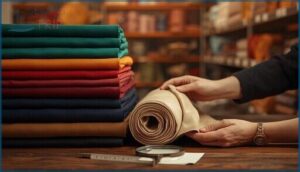
Finding the right supplier can make or break your entire project. Not every seller out there offers the same quality, pricing, or reliability — and those differences matter more than most people realize.
Here’s what to look for before you commit.
Researching Supplier Reputation
A supplier’s reputation tells you everything before you spend a dollar. Start with supplier reviews on Trustpilot or Google — patterns of complaints about wrong yardage or poor communication are red flags.
Ask for trade references from real buyers. Check certification standards like ISO or GOTS. Strong industry presence and transparent communication skills separate trustworthy wholesale fabric suppliers from risky ones in textile sourcing.
Comparing Wholesale Vs. Retail Options
Once you’ve vetted your fabric suppliers, the next call is deciding where to actually buy. Wholesale fabric usually runs 30 to 60 percent less per yard than retail, because wholesale prices are built on volume.
But if your project needs just a few yards, retail fabric sourcing can actually save money — bulk fabric rolls aren’t always the smarter move. Bulk ordering unlocks tiered wholesale discounts that drop costs even further.
Understanding Minimum Order Quantities
Most wholesale fabric suppliers set a minimum order quantity — often one full roll, which can run around 100 meters. That’s a real commitment.
For fabric sourcing and order planning, understanding MOQs upfront shapes your entire inventory management strategy. If you can consolidate designs onto one base fabric, you’ll hit those minimums without over-buying.
Smart supplier negotiation can sometimes lower MOQs, improving your cost optimization on bulk fabric orders.
Evaluating Customer Service and Delivery Times
Before you commit to a bulk order, test how fast a reliable customer support reacts to a basic question — reliable customer support usually replies within one business day.
Check their shipping policies, return policies, and delivery tracking tools. Stock fabric usually ships within two to three weeks.
Consistent order fulfillment and a solid supplier reputation and reliability record are the clearest signs you’ve found a trustworthy wholesale fabric partner.
Tips for Storing and Caring for Fabric Rolls
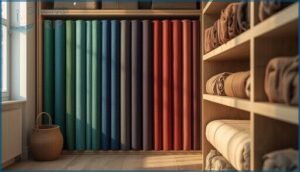
Once you’ve got your fabric rolls home, how you store and care for them matters just as much as how you chose them.
Poor storage can undo all that careful selection work — creases, fading, and moisture damage are real risks.
Here’s what you need to know to keep your rolls in top shape.
Proper Storage Methods to Prevent Damage
How you store a fabric roll is just as important as how you choose it. Poor storage can quietly ruin good yardage before you even cut a single inch. For smart fabric durability and care, follow these essentials:
- Keep climate control steady — 65–75°F with 40–55% humidity management prevents mold and fiber stress.
- Use storage racks to support rolls horizontally and protect cores.
- Practice smart shelf organization by leaving gaps between rolls for airflow.
- Consider fabric wrapping in breathable covers to block dust and UV light.
Spotting and Handling Creases or Pressure Marks
Even a high-quality fabric roll can lose usable yield to creases and pressure marks — two silent budget killers in any Wholesale Fabric Purchasing Guide.
Visual Crease Signs include straight bands across the width or shiny streaks on smooth weaves. For Inspection Techniques, unroll several meters in good light and run your hand across the surface.
Steam gently removes mild creases; deep, set lines signal permanent fiber damage — reject those rolls.
Following Care Instructions by Fabric Type
Every fabric type plays by its own rules — ignore them and you’re fast-tracking Fabric Shrinkage and Color Fading.
Cotton and linen handle machine washing well, while silk and wool need cold water and gentle handling.
Your Ironing Tips vary too: cotton tolerates high heat, synthetics don’t.
When labels say dry clean only, skip the DIY Dry Cleaning Alternatives.
Fabric Care is non-negotiable.
Frequently Asked Questions (FAQs)
How to tell if fabric is high quality?
Want to know if a fabric is truly worth your money? Check weave quality, fiber strength, and color fastness.
Quality and suitability of fabric show in tight weaves, vibrant color, and smooth texture.
What are the four things to consider when choosing fabric?
Focus on four essentials: fiber content, fabric drape, care needs, and aesthetic appeal.
Together, they form a reliable fabric selection guide, helping you match material properties and fabric durability and care to your specific project.
Can I wash fabric rolls before cutting them?
Yes, you can — and often should. Prewashing lets shrinkage happen before you cut, removes factory chemicals, and sets the stage for cleaner results.
It’s a simple step that protects your work.
How do I test fabric for colorfastness at home?
Think of fabric dye like wet paint — it can run if it isn’t set.
A simple Water Spot Test, Color Bleed check, or Vinegar Solution soak tells you everything before Home Washing ruins your project.
What tools help with cutting fabric rolls accurately?
Rotary cutters, cutting mats, and fabric rulers give you clean, accurate cuts every time. For bulk fabric roll work, slitting machines and cutting tables handle larger volumes with precision.
Are fabric rolls priced differently by fiber content?
Fiber content drives price more than most buyers expect.
Polyester rolls can cost as little as $2 per yard, while silk or cashmere fabric rolls can easily exceed $100 — fiber content is everything.
How long do unused fabric rolls typically last?
Unused fabric rolls can last anywhere from 5 to several decades, depending on fiber lifespan, storage conditions, and handling practices.
Natural fibers stored clean and dry often remain usable for 10 to 30 years.
Conclusion
Some buyers worry that knowing what to look for when buying fabric rolls means spending hours second-guessing every purchase. It doesn’t. Once you understand weight, weave, fiber content, and supplier reliability, decisions get faster—not slower. You’re not hunting for the very best; you’re building judgment.
Each roll you evaluate sharpens that instinct. The details covered here aren’t extra steps—they’re shortcuts disguised as standards. Apply them consistently, and your projects stop depending on luck.
- https://fabric-fabric.com/blog/7-steps-to-fabric-selection-checklist
- https://hookandeyeuk.com/en-us/blogs/guides/how-to-pick-your-fabric-the-complete-guide-to-fabric-selection
- https://sanvt.com/blogs/journal/fabric-weight-a-guide-to-gsm
- https://www.frawstedcreations.com/blogs/all-things-minky/the-beginners-guide-to-understanding-fabric-quality-and-bolt-sizes
- https://www.testcoo.com/en/blog/common-fabric-defects-garment-inspection