This site is supported by our readers. We may earn a commission, at no cost to you, if you purchase through links.
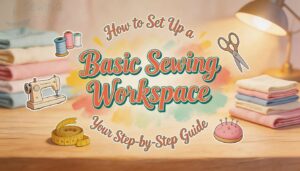
A tangled power cord, an iron balanced on a chair, fabric pooling on the floor—this is how most people start sewing. Not because they lack skill, but because nobody told them the setup matters as much as the stitching. A poorly arranged workspace slows your work, strains your body, and turns a relaxing hobby into a frustrating chore.
The good news: you don’t need a dedicated studio or expensive furniture to fix it. A few deliberate choices about layout, lighting, and storage can transform almost any room into a workspace that actually helps how you sew.
Table Of Contents
Key Takeaways
- Your workspace layout matters as much as your technique — positioning your cutting, sewing, and pressing stations within a few steps of each other keeps your workflow moving forward without backtracking.
- Good lighting isn’t optional: place your table within 3 feet of a window and add a 450–700 lumen LED daylight bulb near your needle to protect your eyes and your fabric colors.
- Smart storage — vertical fabric bins, pegboards, and rolling carts — cuts search time and keeps your table clear, so you spend more time sewing and less time digging.
- You don’t need a dedicated room or a big budget to sew well; even a 6×6-foot corner with the right table height, ergonomic chair, and organized tools can handle serious projects.
Choose Your Sewing Space
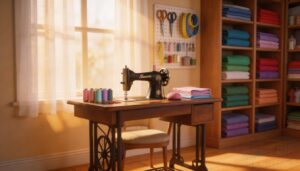
The right space sets the tone for every project you’ll make.
A tidy, well-organized workspace makes all the difference, and these sewing machine storage tips help you build one that actually works for how you sew.
Before you move a single piece of furniture, there are a few key things worth checking. Here’s what to look at first.
Measure The Room and Map Traffic Flow
Before moving a single piece of furniture, measure your room’s length, width, and height — then sketch it out to scale.
Here’s what to map first:
- Room dimensions and doorway clearance (at least 36 inches)
- Pathway width between zones for smooth traffic flow
- Obstacle identification — cords, doors, vents
- Work triangle layout connecting cutting, sewing, and pressing areas
Smart spatial planning saves real frustration later.
Pick a Dedicated or Shared Sewing Area
Once you know room’s dimensions, decide whether you’re claiming it fully or sharing it. A dedicated sewing room keeps your setup ready between sessions — no teardown, no lost momentum.
Shared zones work, but expect Shared Zone Drawbacks like interrupted flow and setup fatigue. If it’s offices or spare bedrooms pulling double duty, use Privacy Partitions or Access Scheduling to protect your creative time.
Check Outlets, Extension Needs, and Ventilation
Your space is set — now make sure the power and air can keep up. Plan for an outlet every 6 to 8 feet, with at least one dedicated circuit for your sewing area. Smart Outlet Placement prevents overloads before they happen.
- Match your Extension Cord Rating to total wattage — iron, machine, and lamps combined
- Use a surge protector with wall-mounted power strips for Surge Protection at every station
- Install an Exhaust Fan Setup near adhesives or steam tools for ventilation and Humidity Control
Place The Workspace Near Natural Light
Window Proximity matters more than most sewists realize. Position your table within 3 feet of a window to capture the best natural light.
Morning light runs cool and blue — great for color-matching. Afternoon shifts warmer.
Glare Management is simple: hang a sheer curtain. Use Reflective Mirror Placement on the opposite wall to bounce daylight onto your work during Seasonal Light Adjustments.
Add Task Lighting for The Needle and Cutting Area
Natural light alone won’t cut it — especially when you’re threading a needle at dusk. Task lighting fills that gap.
- Aim for 450–700 lumens with LED daylight bulbs at 4000–5000K for true color rendering
- Use an adjustable arm lamp for precise shadow reduction techniques near the needle
- Position your cutting station light slightly in front of and above the work surface
- LED’s heat dissipation design keeps fabric safe during long sessions
Set Up Your Workstations
Once you’ve chosen your space, it’s time to turn it into a place where you can actually work. Each station — cutting, sewing, pressing — plays a specific role, and setting them up correctly makes everything easier.
For a deeper look at how each station works together, setting up a dedicated sewing station walks you through the layout decisions that keep your workflow smooth.
Here’s how to build each one.
Position The Sewing Table for Smooth Fabric Handling
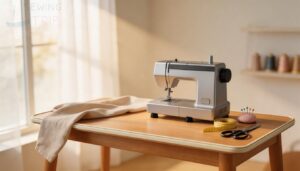
Your sewing table is the anchor of your entire work triangle. Set adjustable table height between 28 and 30 inches so your elbows rest at 90°.
Frame stability matters — wobble throws off grain alignment and ruins straight seams.
Choose a surface with edge binding and a smooth, low-friction finish for clean material handling in sewing.
Good vibration dampening keeps your machine steady through every long seam.
Create a Separate Cutting Surface if Possible
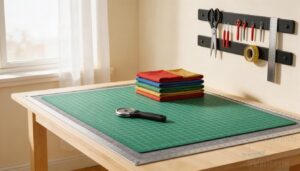
dedicated cutting zone does more than protect your sewing table — it sharpens your accuracy. Aim for at least 24 by 36 inches of surface.
Mat material selection matters: a self-healing mat paired with non-slip underlayment keeps everything stable under your rotary cutter.
Integrated ruler strips speed up alignment.
Add magnetic tool holders nearby, and a height-adjustable portable cutting table makes long sessions much easier on your back.
Add a Safe, Convenient Pressing Station
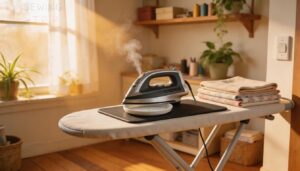
Your iron is basically a power tool — treat it like one. Set up your pressing area with heat-resistant matting rated above 250°C, a steam vent tray to catch condensate, and a dedicated power switch for quick shutoff.
Position your ironing board at elbow height for ergonomic pressing comfort.
Keep ventilation open nearby, and always use a steam iron with auto shutoff safety built in.
Arrange a Cutting, Sewing, and Pressing Workflow
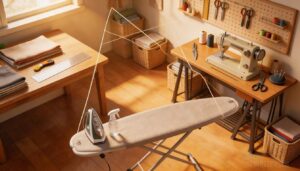
Think of your room layout planning as a triangle connecting three points: cutting table, sewing zone, and pressing station. Work flows one direction — cut, stitch, press — without backtracking.
Plan your sewing room as a triangle: cut, stitch, press — always forward, never back
Station zones should sit within a few steps of each other. Keep tool accessibility tight: everything you grab repeatedly stays within arm’s reach. That ergonomic order protects your focus and keeps safety protocols second nature.
Set Table and Chair Height for Comfort
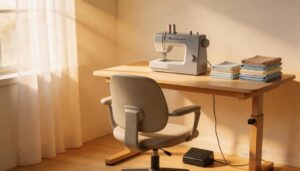
Your chair and table work together — get one wrong and your whole body pays for it. A height-adjustable table paired with an ergonomic chair with lumbar support makes every session easier.
Set your seat height between 16 and 21 inches so your forearms stay parallel to the floor. That 90-degree forearm angle keeps shoulders relaxed.
Confirm foot pedal reach is comfortable without ankle strain.
Organize Tools and Storage
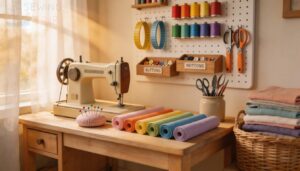
Once your workstations are set up, the next challenge is keeping everything within reach without the chaos creeping in.
Good storage isn’t about buying more bins — it’s about putting the right things in the right places. Here’s how to organize your tools, fabric, and notions so your workspace actually stays functional.
Store Fabric Vertically in Bins or Cubes
Storing fabric vertically in bins or cubes transforms cluttered piles into a clean, functional fabric organization system. Heavy-duty plastic bins — a smart Bin Material Choice — resist moisture and protect delicate fabrics from snags.
- Storage Density: Uniform bins increase shelf space by up to 20%
- Labeling Strategy: Color-coded labels separate knits from wovens instantly
- Ergonomic Height: Place bins at shoulder level to protect your back
Seasonal Rotation keeps fabrics fresh.
Use Pegboards and Jars for Everyday Tools
Once your fabrics are sorted, the wall above your sewing table is prime real estate. A pegboard turns dead space into a working tool caddy — and a proper one holds up to 40 pounds per square foot when anchored into studs.
Lipless pegboard access makes grabbing seam rippers and chalk pencils easy. Pair it with clear containers and magnetic jar lids for pins and snips.
| Tool | Storage Method | Placement |
|---|---|---|
| Scissors | Pegboard hook | 12 in. from the machine |
| Thread spools | Vertical jar stacking | Shelf front |
| Pins | Narrow-neck clear jar | Cutting area |
| Seam rippers | Lipless pegboard access | Eye level |
| Chalk pencils | Color coding bin | Near cutting mat |
DIY storage solutions like mason jars cost almost nothing. Color coding your wall storage cuts search time fast — consistent labels reduce misplacement by roughly 60%. Load capacity planning keeps everything secure and off your table.
Sort Bobbins, Needles, and Notions by Type
Your pegboard holds the big tools — now let’s tackle the small stuff. Bobbins, needles, and notions deserve the same clear system.
- Use a modular bin system with clear bin visibility to spot thread weights instantly
- Apply color-coded labeling by category: needles, snaps, hooks
- Try the FIFO inventory method — oldest supplies stay at the front
- Mount a magnetic needle holder for specialty sizes
Keep Patterns in Binders, Boxes, or Sleeves
Small notions sorted — now your pattern collection needs the same love.
Three-ring binders with plastic sheet protectors keep pieces flat and visible; add binder labeling by category and size for fast retrieval.
Box sorting works great too — transparent storage bins with labeled lids let you scan without digging.
For delicate tissue, sleeve sealing in vinyl zip pouches prevents moisture damage. Try acid-free preservation between layers to stop yellowing.
Digital indexing with a quick spreadsheet ties everything together.
Use Rolling Carts for Flexible Storage
A rolling cart might just be the smartest modular storage move you make. With Adjustable Shelf Layouts, you can dedicate one tier to thread spools and another to your Portable Cutting Station essentials — shears, rulers, rotary blades.
Locking Caster Safety keeps everything steady while you sew. Rolling Storage Cart models with Adjustable Height Cart options and Modular Tool Integration turn these DIY storage solutions for sewing spaces into a flexible, room-wide system.
The cart’s compact dimensions enable tight spaces makes it ideal for small sewing rooms.
Manage Cords, Lint, and Daily Cleanup
Keeping your workspace clean isn’t glamorous, but it protects your machine and your sanity.
Tape cords along desk edges using a Cord Labeling System — label each one by appliance for quick Power Strip Organization.
Install a simple Lint Trap Installation near your air intake, then do a Daily Surface Wipe with a damp microfiber cloth after each session. Good cord management and thread lint control add up fast.
Top 5 Sewing Workspace Items
The right furniture can make or break your sewing setup. These five items consistently earn high marks from sewists for functionality, space efficiency, and value. Here’s what’s worth your attention.
1. Giantex Folding Desk with Shelves and Lockable Wheels
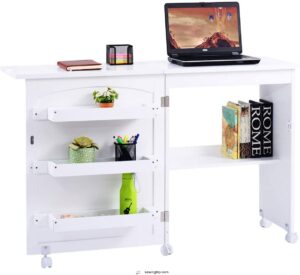
The Giantex Folding Desk is a smart pick when floor space is tight. It unfolds to 46 inches wide — enough room for your machine and notions — then folds flat against the wall when you’re done.
Three hidden bins plus a door shelf keep threads and tools within reach. The lockable casters let you wheel it where you need it, then lock it steady.
Fair warning: swap out the included screws for longer ones to stop any wobbling.
| Best For | People with small apartments, dorms, or tight home offices who need a functional workspace that disappears when the workday’s done. |
|---|---|
| Storage Included | 3 bins + door shelf |
| Primary Material | Engineered wood |
| Color Option | White |
| Mobility Feature | 5 swivel casters |
| Intended Use | Sewing/craft/office |
| Assembly Required | Yes, diagram only |
| Additional Features |
|
- Folds flat when not in use, so it’s great for spaces where every square foot counts
- Built-in bins and a door shelf keep your supplies organized and close at hand
- Lockable casters make it easy to move room to room, then stay put while you work
- The included screws are too short — expect some wobble unless you swap them out
- Leg clearance is limited, so sitting at it for long stretches can get uncomfortable
- Engineered wood means it’s not built for heavy loads; a full-size sewing machine might push its limits
2. Sew Ready Adjustable Hobby Table
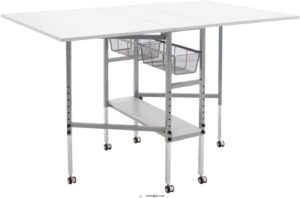
Need a table that grows with your projects? The Sew Ready Adjustable Hobby Table adjusts from 29.75 to 38.75 inches tall, so you can sit for detailed stitching and stand for cutting — no back strain.
It opens to nearly 59 inches wide, giving you real room to work. Two slide-out mesh drawers keep notions close. The casters roll easily, then lock solid.
At $286.99, it’s a practical investment for a space that actually works for you.
| Best For | Sewers, quilters, and crafters who need a flexible workspace that can fold away when not in use. |
|---|---|
| Storage Included | 2 mesh drawers + shelf |
| Primary Material | Alloy steel + engineered wood |
| Color Option | Silver/White |
| Mobility Feature | 6 floor casters |
| Intended Use | Sewing/quilting/crafting |
| Assembly Required | Yes, screwdriver + Allen wrench |
| Additional Features |
|
- Opens to nearly 59 inches wide — plenty of room for big fabric cuts or a sewing machine plus supplies
- Height adjusts from 29.75" to 38.75", so you can sit or stand depending on the task
- Rolls where you need it, locks in place when you don’t — and folds down small for tight spaces
- Height adjustment means removing and reinstalling screws, not a quick flip of a lever
- Casters have a reputation for cracking or wobbling over time and may need replacing
- At 58 lbs, it’s a two-person job to move or assemble — not exactly grab-and-go
3. Studio Designs Sew Ready Craft Table
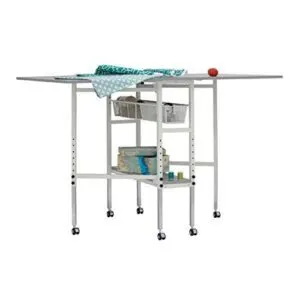
The Studio Designs Sew Ready Craft Table is built for sewists who mean business.
It stretches to 60 inches wide by 36 inches deep — plenty of room for quilting yardage or a sprawling dress pattern. At roughly 55–65 pounds, it’s solid.
Height adjusts from 30.25 to 39.25 inches, so you can switch between sitting and standing without fighting your back.
Two sliding mesh drawers keep notions within reach. Lockable casters let you reposition it, then hold it steady.
Expect a workout during assembly — bring a helper.
| Best For | Serious sewists and quilters who need a spacious, height-adjustable work surface and want the flexibility to fold it away when not in use. |
|---|---|
| Storage Included | 2 wire drawers + shelf |
| Primary Material | Powder-coated steel + MDF |
| Color Option | White/Grey |
| Mobility Feature | 4 lockable casters |
| Intended Use | Sewing/cutting/quilting |
| Assembly Required | Yes, complex instructions |
| Additional Features |
|
- Huge 60" × 36" work surface gives you real room to spread out fabric, patterns, or quilting yardage
- Height adjusts nearly 9 inches, so you can dial in the right position and save your back during long sessions
- Folds flat for storage and rolls on casters, so it doesn’t have to live in the middle of your space forever
- Assembly is a pain — instructions can be confusing and hardware doesn’t always match up, so budget extra time and grab a friend
- The caster locks only stop the wheels from spinning, not swiveling, meaning the table can still drift on smooth floors
- It’s heavy, which makes it sturdy but also a real chore to move around once it’s fully set up
4. Mr Ironstone Yellow L Shaped Desk
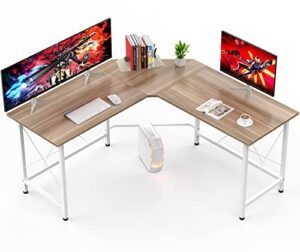
The Mr. Ironstone Yellow L-Shaped Desk gives you two generous 58.66-inch arms — that’s serious real estate for a sewing setup. Park your machine on one side and use the other for cutting or pressing prep.
It sits at 30 inches high, which suits most sewists well.
The particle-board top supports everyday loads without complaint, though avoid heavy impacts.
Assembly takes patience — follow the sequence in the manual carefully. One misstep with the screws, and the frame can warp.
| Best For | Home sewists and crafters who need generous workspace for a sewing machine, cutting, and pressing all in one spot. |
|---|---|
| Storage Included | 6 square-tube braces |
| Primary Material | Particle board + wood frame |
| Color Option | Yellow |
| Mobility Feature | None |
| Intended Use | Office/gaming/craft |
| Assembly Required | Yes, sequential steps |
| Additional Features |
|
- Two 58.66-inch arms give you serious room to spread out — machine on one side, cutting or prep on the other
- 30-inch height works well for most adults without needing any adapters
- Affordable for the amount of surface space you’re getting
- Assembly is unforgiving — skip steps or rush the screws and the frame can warp
- The edge lip can get in the way if you want to clamp on any accessories or arms
- Particle board won’t hold up to heavy impacts, so treat the surface with care
5. Amazon Basics Collapsible Fabric Storage Cubes
Big desk sorted — now let’s tackle what goes on the shelves.
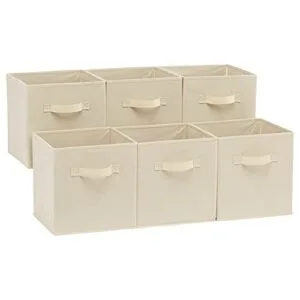
The Amazon Basics Collapsible Fabric Storage Cubes come six to a pack at just $17.84, making them one of the smartest budget buys for a sewing room. Each cube measures 10.5 × 10.5 × 11 inches, fitting standard cube organizers like IKEA Kallax perfectly.
Use them for fabric scraps, notions, or WIP projects. They hold up to 5 lb each, fold flat when empty, and the grips make pulling them off shelves genuinely easy.
| Best For | Sewers and crafters who want a simple, affordable way to organize fabric scraps, notions, and small project supplies on cube shelves without spending a lot. |
|---|---|
| Storage Included | 6 fabric cubes |
| Primary Material | Polyester-blend fabric |
| Color Option | Beige |
| Mobility Feature | Sewn-in handles |
| Intended Use | Organizing/storage |
| Assembly Required | No tools needed |
| Additional Features |
|
- Six cubes for under $18 is hard to beat — great value if you need to fill multiple shelves at once.
- Fold flat when empty, so storing extras in a drawer until you need them is no hassle.
- Sewn-in handles make pulling a cube off a high shelf quick and easy.
- The 5 lb weight limit means anything heavier than light fabric or small notions is off the table.
- No rigid frame, so the cube only holds its shape when something’s inside it.
- May not fit every cubby unit perfectly — worth measuring your shelves before ordering.
Frequently Asked Questions (FAQs)
How to set up a sewing room?
Think of your sewing room as a workshop, not just a corner. Start by measuring the space, checking outlets, and mapping your light sources.
Even an 8 by 8 foot area works beautifully.
How do I create a small sewing space?
Even a 6×6-foot corner can become a functional sewing space. Keep at least 2 feet of clearance on two sides of your table, and position your machine within arm’s reach.
Does your sewing space influence what you make?
Oddly enough, yes — your space shapes your ambition. A cramped, dim corner quietly limits your projects. But a well-lit, organized setup invites bigger ideas and keeps you sewing longer, better.
How do you sew clothes in a small space?
You don’t need a big room. A 4 by 6 foot zone works well. Use a folding desk, store fabric vertically, and keep tools on a pegboard to free up every inch.
How to organize a sewing space?
Label everything, store fabrics vertically, and keep everyday tools on a pegboard. Group bobbins, needles, and notions by type. Rolling carts handle the overflow.
tidy space means more time sewing, less time searching.
What are the 7 common sewing machine troubles?
Seven sewing machine troubles to know: thread tension issues, needle and thread problems, bobbin troubles.
Feed dog failures, skipped stitches, lint buildup, and electrical or motor issues causing slow or unexpected stops.
What are some budget friendly sewing room makeover ideas?
You don’t need a big budget to transform your sewing space.
Swap in pegboard walls, repurpose glass jars for notions, add daylight LED strips, and use painter’s tape to zone cutting, sewing, and pressing areas instantly.
How do I choose my first sewing machine?
Start with a machine priced between $100 and $400. Look for a drop-in bobbin, built-in needle threader, adjustable stitch length, and at least straight and zigzag stitch options.
That covers most beginner projects easily.
What flooring works best in a sewing room?
Luxury vinyl plank is your best bet. It resists spills, cleans fast, and won’t trap lint like carpet does. Add an anti-fatigue mat where you stand, and you’re set.
How do I soundproof a shared sewing space?
To soundproof your shared sewing space, seal gaps with acoustical caulk, hang thick curtains or quilts on walls, and add dense rugs.
Place anti-vibration pads under machines and use mass loaded vinyl to cut airborne noise by 20 dB.
Conclusion
Like a master chef with a well-stocked kitchen, you’re now equipped to whip up a sewing workspace that sparks creativity and productivity. By following these simple steps on how to set up a basic sewing workspace, you’ll transform your sewing experience.
A well-designed space is your canvas, your comfort, and your confidence. Invest in your setup, and you’ll reap the rewards in every stitch, every seam, and every finished project that brings you joy.