This site is supported by our readers. We may earn a commission, at no cost to you, if you purchase through links.
A quilting bundle can look perfect on the shelf and fall apart the minute you start placing pieces side by side. One floral shouts, another muddies the palette, and suddenly that “pretty stack” feels like a fabric argument.
That’s why learning how to coordinate colors in quilting fabric bundles matters more than chasing the newest collection.
When color, value, and print scale work together, even mixed fabrics look intentional.
You’ll know how to spot a hero print, balance busy patterns, use neutrals for breathing room, and test your choices before the rotary cutter makes things official on your cutting table.
Table Of Contents
- Key Takeaways
- Start With a Hero Fabric to Build Your Palette
- Apply Color Wheel Principles to Fabric Pairing
- Balance Pattern Scale With The 40-40-20 Rule
- Sort Fabrics by Value for Depth and Contrast
- Use Neutrals and Texture as Visual Breathing Room
- Avoid Common Fabric Coordination Mistakes
- Frequently Asked Questions (FAQs)
- Conclusion
Key Takeaways
- Start with one hero fabric, then pull supporting colors from it so the whole bundle feels intentional instead of random.
- Balance color with value and print scale by mixing lights, mediums, and darks, and by limiting your bundle to a few distinct pattern sizes.
- Use simple color schemes like complementary, analogous, monochromatic, or split-complementary pairings to create contrast or harmony on purpose.
- Give busy prints room to breathe with 20–30% neutrals, test fabrics in natural daylight, and black-and-white photos, and sew a mini block before cutting into the full quilt.
Start With a Hero Fabric to Build Your Palette
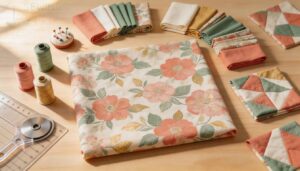
Every great quilt bundle starts with one fabric that does the heavy lifting—your hero fabric. It sets the tone, drives the palette, and gives every other fabric something to respond to.
Need help choosing one? This guide to fabric bundles for seasonal sewing makes pairing a hero print with coordinating fabrics feel easy.
Here’s how to find yours and build around it.
How to Choose a Standout Print or Saturated Solid
Your hero fabric sets the tone for everything else. Pick a standout print or saturated solid where one dominant color covers at least 40% of the surface—that’s your Dominant Color Ratio working for you.
Here’s what separates a strong hero from a weak one:
- Print Scale Readability: Choose medium-to-large motifs that read as a clear color silhouette at arm’s length.
- Colorfast Dye Quality: Look for fabrics showing no more than 2 tone shifts after repeated washing.
- Value Contrast Check: Avoid prints with close tonal gaps—they blur into mush inside a quilt block.
Thread Count Impact matters too: cotton with 40+ threads per inch holds saturated color best.
Extracting Every Hue From Your Hero Fabric
Once you’ve locked in your hero fabric, it’s time to pull every color out of it. Photograph it in natural daylight, then import that image into a digital hue picker—it maps each tone as an exact hue code.
Group those codes into warm cool groupings and note saturation levels.
That’s your hue code catalog and fabric hue mapping system done in minutes.
Echoing Hero Colors Across Supporting Fabrics
Now that you have your hue map, put it to work. Hero Hue Repetition means your hero fabric’s colors should show up in at least three supporting fabrics—think of it as a Supporting Fabric Echo across your bundle.
Use one solid as a neutral anchor, one medium-scale print, and one textured dobby for Texture Color Echo. Subtle Value Shifts keep things interesting without breaking Consistent Color Temperature.
Aligning Your Palette With Warm or Cool Tones
Once your echoes are placed, check the overall temperature of your bundle. Is it reading warm or cool? Pick a side intentionally.
Warm colors — reds, oranges, yellows — advance and energize. Cool colors — blues, greens, purples — calm and recede.
Your Temperature Balance Ratio target is roughly 60/40. Use Undertone Matching in your neutral anchor to reinforce that choice. Mood Lighting Influence is real — always test swatches in daylight.
Apply Color Wheel Principles to Fabric Pairing
The color wheel isn’t just for art class—it’s one of the most practical tools in a quilter’s kit. Knowing how colors relate to each other helps you pair fabrics with confidence instead of guessing.
Here are four approaches worth keeping in your back pocket.
Complementary Colors for High-Impact Contrast
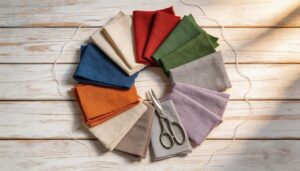
Complementary colors sit directly across from each other on the color wheel—think blue and orange, or red and green.
That tension is exactly what makes them powerful.
In your fabric bundles, this color contrast creates instant energy.
If you want balanced pairings, this guide to choosing suitable fabric for patchwork makes swatch testing much easier.
Nail the saturation balance by keeping one color muted, and use accent placement strategically: small doses of the complement, not equal halves.
Texture interaction and lighting effects shift the intensity, so always test swatches in natural light.
Analogous Colors for Smooth, Harmonious Blends
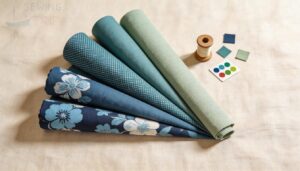
Analogous colors are your best friend when you want fabric bundles that feel simple. These are neighboring hues on the color wheel—think blue, blue-green, and teal—and they naturally share undertones, which makes Hue Shift Techniques almost foolproof.
Value Gradient Planning and Saturation Modulation to add depth without chaos.
Smart Scale Selection Sequencing, Mood Board Alignment, and visual balance keep your color palette cohesive.
Monochromatic Schemes Using Shades and Tints
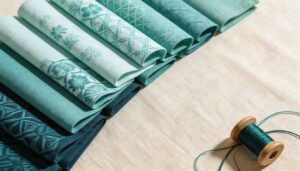
Monochromatic schemes are secretly one of the most powerful tools in your quilting arsenal. Pick one hue, then build your color palette using shade depth, midtones, and tint harmony across your fabric bundles.
- Start your value ladder: pale tints at the top, rich shades at the base
- Use saturation modulation to keep prints from competing
- Check light reflection by testing swatches under natural daylight
Triadic and Split-Complementary Options for Variety

Want more variety without the chaos? Try triadic harmony — three hues evenly spaced on the color wheel. Think red, yellow, and blue working together across your fabric bundles.
For something softer, a split complementary palette swaps one color for its neighbor, reducing tension while keeping things lively. Use triadic accent distribution to spotlight focal blocks, and adjust split complementary value for depth.
Balance Pattern Scale With The 40-40-20 Rule
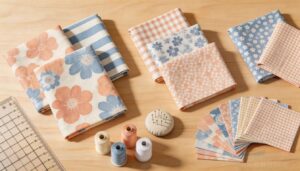
Color coordination is only half the battle—pattern scale is where things really come together. Getting the mix of large, medium, and small prints right is what separates a polished bundle from a chaotic one.
Here’s how to use the 40-40-20 rule to make every print earn its place.
Assigning Large, Medium, and Small Prints Correctly
Think of your quilt as real estate—every print needs the right neighborhood.
Large prints claim the focal areas but shouldn’t exceed 25% of your total fabric plan. Medium prints handle the transitions, guiding the eye naturally. Small prints fill the background gaps.
This Print Size Ratio and Placement Hierarchy keep your Proportion Balance intact and your visual balance working across every block.
Pairing Florals With Geometrics to Soften Sharp Lines
Florals and geometrics are a classic odd couple—they work beautifully together. The trick is Curved Motif Integration: let rounded floral shapes visually dissolve those rigid geometric edges.
Try these Scale Harmony Techniques for Floral Geometry Contrast:
- Pair a large floral with a small geometric
- Share one or two hues across both prints
- Match saturation levels for natural visual balance
- Use a muted geometric to ground a bold floral
Using Solids as Anchors Between Busy Prints
Once your florals and geometrics are talking to each other, solids step in as the peacemakers. A medium-value solid—neither too light nor too dark—creates Value Anchoring that calms competing prints. Think of it as breathing room.
Smart Placement Strategies mean repeating that same solid in sashing or borders for instant color harmony.
Temperature Balance matters too: a cool-toned solid quietly neutralizes warm, busy patterns.
Limiting Pattern Scales to Avoid Visual Overload
Too many loud prints fighting for attention create pattern overload fast. Stick to three-to-five distinct pattern scales max—your eyes will thank you.
- Large prints anchor; don’t repeat more than one
- Use blender fabrics for Scale Shift Zones between bold and quiet
- Print Density Management keeps Spacing and Rhythm consistent
- Small prints handle Scale Ratio Balance without crowding
Choosing a strong focus fabric selection helps anchor the color scheme.
Sort Fabrics by Value for Depth and Contrast
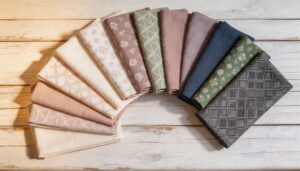
Color gets most of the attention, but value—how light or dark a fabric is—does the heavy lifting in any quilt. Without a good spread of lights, mediums, and darks, even the prettiest palette can fall completely flat.
Here’s how to sort and test your fabrics so every bundle you build has real depth and contrast.
Grouping Fabrics Into Light, Medium, and Dark Categories
Sorting your fabrics by value is the foundation of color value coordination—and it’s simpler than it sounds.
Create three piles: light, medium, and dark. Light Background Usage anchors your negative space, Medium Tone Bridge connects color zones smoothly, and Dark Edge Definition sharpens motifs.
This Value Gradient Planning gives your quilt visual balance and real depth. Try the Lighting Calibration Technique: always sort under natural daylight.
Using The Black-and-White Photo Test for Tonal Gaps
Once your piles are set, take a black and white photo to check tone contrast fast.
Keep Camera distance fixed, use Lighting diffusion for Glare reduction, and shoot under even light.
That makes Tonal gap identification and Contrast mapping much clearer so you can spot muddy mids early, strengthen color value coordination, and protect visual balance, color harmony, and overall quilt depth.
Applying The 60/30/10 Rule Across Value Groups
Once your values are sorted, the 60/30/10 Color Rule gives them purpose.
Assign 60% of your fabric bundle to your dominant value—your lightest or darkest anchor. Let 30% handle Middle Value Bridging, easing shifts across your quilt. Reserve 10% for Accent Value Highlighting—those eye-catching pops.
This value gradation creates natural Value Group Shift, keeping color harmony and Value Ratio Consistency intact throughout every block.
Avoiding Flat Designs Caused by Similar Value Stacking
Stacking too many midtones kills depth fast. When fabrics land at the same luminance level, your quilt looks printed on cardboard — flat and lifeless.
Midtone Stacking Avoidance is your fix.
- Force Value Gap Creation between every three consecutive prints
- Use Contrast Boosting Techniques: swap one midtone for a true light or dark
- Apply Varying Value Sequencing — alternate light, dark, medium deliberately
- Practice Tonal Shift Emphasis to sharpen visual hierarchy
Use Neutrals and Texture as Visual Breathing Room
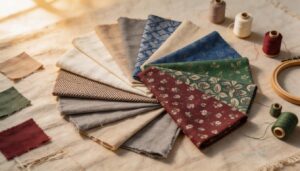
most beautiful fabric bundle needs a place to breathe. Neutrals and texture do exactly that—they calm the chaos and give your eyes somewhere to rest.
use them well.
How Much Neutral Fabric to Include (20-30% Rule)
Think of neutrals as the quiet backbone of your quilt. Aim for 20–30% of your bundle — that’s roughly 10–13 pieces in a 42-piece palette. This range reinforces your Neutral Anchor Strategy without dulling bold prints.
| Neutral Ratio Guidelines | Even Neutral Placement | Neutral Testing Methods |
|---|---|---|
| 20–30% of total bundle | One piece per quarter | Test under natural daylight |
Choosing The Right Neutrals: Cream, Gray, Blush, or Linen
Choosing neutral fabrics is where quilts either breathe or feel boxed in.
Use Undertone Identification for cream, gray, blush, or linen, then check Warm-Cool Pairing and Mood Alignment.
Cream brightens; gray softens; blush warms; linen grounds.
Fabric Finish Impact and Value Range Integration shape color harmony, visual balance, neutral color anchoring, and using neutrals to balance bold quilt fabrics beautifully.
Adding Texture With Tone-on-Tone and Dobby Fabrics
Texture is your secret weapon for visual balance without adding more color. Tone-on-Tone Light Play creates gentle depth as light shifts across weave surfaces.
Three smart Texture Layering Strategies:
- Use Dobby Motif Integration to add dimension without disrupting color harmony
- Apply Weave Contrast Techniques by pairing satin-smooth with matte finishes
- Balance Hand Feel by mixing flat solids with brushed tone-on-tone fabrics
Layering Fabrics From Darkest to Lightest for Depth
Darkness anchors a quilt — so start there. Place your deepest fabrics first, then build outward with mid‑tones, letting Backed Light Diffusion and Matte Glossy Depth guide each shift.
Edge Softening Layers prevent harsh jumps between values. Use Stitching Order Depth and Layered Color Temperature to reinforce your visual hierarchy in quilting, balancing light, medium, and dark fabrics for visual harmony through careful color value and value contrast.
Avoid Common Fabric Coordination Mistakes
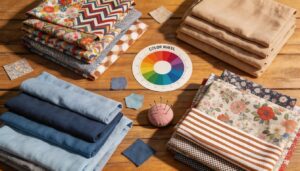
Even the most thoughtful fabric selections can fall apart when a few key habits get overlooked. These mistakes are surprisingly common—and honestly, easy to fix once you know what to watch for.
Here are the four coordination pitfalls worth keeping on your radar.
Overloading Your Bundle With Busy Prints
Too many busy patterns in one bundle are a classic trap.
Visual Clutter Risk is real—dense, high-contrast prints compete instead of cooperating, wrecking your visual hierarchy fast.
Pattern Scale Conflicts sneak up on you, and Color Coordination Strain follows.
Your fabric bundling strategy needs breathing room.
Limit bold prints to two or three, then let calmer companions do the heavy lifting.
Ignoring Color Temperature Consistency
Busy prints aren’t the only culprit—color temperature consistency trips up even experienced quilters. That same warm terra cotta reads like a dusty rose under fluorescent lights.
Hue Shift Perception is real, and Bulb Temperature Bias quietly wrecks your color harmony before you cut a single inch.
Watch for these Lighting Mismatch Effects:
- Reds and oranges look dominant under incandescent bulbs
- Cool fluorescents mute warm neutrals into ash or taupe
- Display Light Variability shifts your hero fabric’s undertones unexpectedly
- Dye Temperature Sensitivity causes some dye families to read brighter or duller
- Your planned color palette can clash once you bring fabrics home
Skipping The Natural Daylight Test Before Cutting
After temperature tricks, natural light testing is your reality check.
Testing fabric colors in natural daylight versus artificial light exposes Misjudged Value, Hue Drift, Unexpected Saturation Shift, and Contrast Errors before cutting.
Digital swatches help, but color matching improves when digital tools for fabric color matching and palette generation support daylight review—otherwise Fabric Waste Increase follows fast at home first.
Forgetting to Test a Mini Block Before Committing
Daylight catches color lies; test blocks catch the rest. A sewn fabric swatch shows real color coordination before you commit.
- Seam Visibility
- Texture Conflict
- Hue Saturation Shift
- Fabric Transparency
- Color Shift from fabric testing, testing fabric colors under varied lighting conditions
Tiny pieces tell the truth; flat prints hide, saving you from sewing yards into a bundle that feels wrong.
Tiny test blocks reveal what flat fabric can’t, saving you from a quilt bundle that feels wrong
Frequently Asked Questions (FAQs)
What is the rule for color coordination?
Use color theory and color harmony for fabric coordination:
Hue Temperature Balance, Contrast Ratio Guideline, Proportioned Color Blocks, 404020 rule, 603010 Color Rule, Visual Rhythm Rule, and Palette Consistency Check, keeps balanced, clear, and intentional.
How to match colors for quilting?
Did you know most pros start with a hero fabric that anchors 40% of their color palette?
For matching fabrics, rely on mood board creation, digital hue extraction, and seasonal palette inspiration—always factor in room lighting influence and fabric weight pairing.
How do pre-cuts affect bundle coordination choices?
Precut bundles simplify fabric coordination by offering designer-curated ratios—think Pre-cut Ratio Impact and Print Variety Control.
You gain Bundle Size Flexibility, ready-made color palette cohesion, and built-in Texture Integration Strategy for easy Value Distribution Planning and bundle editing.
Can fabric finish change color coordination visually?
Imagine sunlight dancing across glossy versus matte fabrics—sheen influence can make colors pop or recede, shifting visual harmony.
Finish hue shift, UV stabilizer impact, and white balance contrast, all subtly alter color coordination and texture mixing in fabric blending techniques.
How many fabrics belong in one bundle?
Most fabric bundles contain 5 to 8 fabrics, though 6 is common for Standard Yardage. Retail Bundle Formats include fat quarters, charm packs, and layer cakes.
Fabric Count Variations come from Vendor Count Strategies and Purchasing Value Tips.
Should background fabric differ from bundle neutrals?
Yes, choose a background that differs from your neutral bundle.
That adds Hue contrast, Value separation, Temperature shift, Tonal distinction, and Background anchoring, which protects color harmony while using neutrals to balance bold quilt fabrics.
How do seasonal themes influence fabric palettes?
Don’t worry—seasons aren’t restrictive; they sharpen color palette choices through color theory and color psychology:
Spring Bright Pastels, Summer Ocean Hues, Autumn Earth Tones, Winter Jewel Contrasts, Seasonal Value Shifts, and seasonal-fabric-coordination-tips-for-spring-summer-fall-and-winter build color harmony.
Conclusion
Let’s investigate the truth behind the perfect quilting bundle. When color, value, and print scale align, even eclectic fabrics shine.
To master how to coordinate colors in quilting fabric bundles, start with a hero print, apply color wheel principles, and balance pattern scales. Don’t forget to sort fabrics by value and add neutrals for breathing room.
With practice, you’ll create stunning quilts that showcase your fabric choices with confidence and creativity every time.