This site is supported by our readers. We may earn a commission, at no cost to you, if you purchase through links.
Your machine hums, the motor spins, but the needle sits dead still—it’s one of the most disorienting things a sewing machine can do. Everything sounds like it’s working, so the problem feels invisible.
That gap between "running" and "doing" is exactly where most people waste an hour guessing.
A motor running but needle stuck is almost never a sign of serious mechanical failure—it usually traces back to something small: a lever left in the wrong position, a clutch that didn’t re-engage, or a thread wrapped tight around the wrong part.
A few focused checks will tell you more than any amount of button-pressing.
Table Of Contents
Key Takeaways
- When your motor runs but the needle won’t move, the fix is almost always something small — a bobbin winder left in winding mode, a disengaged handwheel clutch, or a thread jam — not a major mechanical failure.
- Before you dig deeper, run five quick checks: bobbin winder position, handwheel clutch, thread path, needle seating, and presser foot — most jams clear in under five minutes.
- If the basics don’t fix it, inspect the drive belt, gears, and needle bar linkage, since a worn belt or cracked gear can kill needle movement even when the motor sounds perfectly healthy.
- When a repair quote hits 50 percent of what a new machine costs — or the problem involves control board failure, seized gears, or safety interlock faults — replacing the machine is the smarter call.
Motor Runs, Needle Stays Stuck
That sound means your motor is fine — the problem is somewhere between the motor and the needle. A few common culprits are easy to spot and fix without opening the machine up.
Check the thread path for snags or blockages — this embroidery machine troubleshooting guide walks you through each likely spot between motor and needle.
Start by checking these five things.
Bobbin Winder Left in Winding Mode
One of the most overlooked causes of motor runs, but nothing moves, is the bobbin winder left in winding mode. When the winder engagement lever sits in the wind position, it triggers a winder lockout indicator on some machines and cuts needle drive completely.
Check your winder lever position first, slide it back to reset, and confirm the mode indicator light clears before running again.
Handwheel Clutch Disengaged
Right after sorting the bobbin winder, check your handwheel clutch.
During bobbin winding, many machines disengage the clutch — and if it stays that way, the motor runs but needle doesn’t move.
Clutch housing debris, clutch spring wear, or clutch pin alignment issues can all prevent re-engagement.
Tighten the handwheel thumb screw, following lubrication guidelines for clutch contact points, and watch for any clutch sensor fault before restarting.
Thread Jam in The Bobbin Area
Even with the clutch sorted, a thread jam in the bobbin area can still lock your needle cold. Lint accumulation, thread loop formation, or bobbin case misalignment are usually the culprits.
A tangled thread and bobbin case problem creates a tight choke point — fabric fiber build-up worsens it fast.
Check for shuttle hook obstruction and reset thread tension before anything else.
Bent, Dull, or Misinstalled Needle
Sometimes the real culprit isn’t the bobbin — it’s the needle itself causing a Needle Geometry Flaw that triggers a full needle jam.
Watch for these signs of Proper Needle Seating failure:
- Visible wobble during handwheel rotation signals needle bar stress
- Thread Friction Rise from a dull tip causes Stitch Quality Loss
- A tilted needle creates Fabric Damage Risk and stops needle movement mechanisms cold
Replace it. Problem solved.
Presser Foot or Buttonhole Lever Lock
Here’s one that trips people up more than you’d think — the presser foot and buttonhole lever safety features. Many modern machines won’t allow needle movement unless the presser foot is fully lowered, engaging proper Lock Spring Tension and Detent Feedback through the Quick Release Mechanism.
If your buttonhole lever sits halfway down, Buttonhole Lever Engagement cuts the drive signal entirely. Check the Foot Height Lock position and confirm both are fully set before assuming the worst.
First Checks to Restore Needle Movement

Before you flip the machine over or start Googling repair shops, run through a few quick checks first. Most of the time, the fix is something simple you can handle in under five minutes.
Start here.
Unplug The Machine Before Inspecting
Before you touch anything inside that machine, pull the plug — full stop. Power isolation isn’t just a precaution; it’s your baseline. Many machines hold residual charge in capacitors, so wait 60 seconds after unplugging before reaching in.
- Ground your work area to avoid static discharge near sensitive components
- Use non-magnetic tools to protect electronic controls
- Apply safety labeling so no one accidentally replugs during inspection
- Keep your workspace dry — moisture plus exposed electrical connections are a bad combination
Move Bobbin Winder to Sewing Mode
Sliding the bobbin winder back to sewing mode is often the fastest fix when your motor runs but the needle doesn’t move. That little lever does more than you think — it controls spindle disengagement and drive belt activation at the same time.
Look for the detent click confirmation; that snap tells you mode lever alignment is complete and needle bar synchronization can begin.
| Check | Sewing Mode | Winding Mode |
|---|---|---|
| Spindle Disengagement Check | Spindle clear of drive | Spindle engaged |
| Drive Belt Activation | Belt drives needle | Belt bypassed |
| Bobbin Winder Position | Lever fully left | Lever pushed right |
Re-engage The Handwheel Clutch
After bobbin winding, many machines leave the handwheel clutch disengaged — and that alone kills needle movement.
Find the center knob on your handwheel and tighten it clockwise. You’re aiming for that satisfying engagement click test snap that confirms cam groove alignment is solid.
Poor clutch spring tension or skipped lubrication procedure steps can cause slipping.
Check your reference mark position to confirm handwheel clutch engagement is complete before running the motor.
Turn The Handwheel by Hand
With the handwheel clutch engagement confirmed, give the handwheel a slow, deliberate turn by hand — this is your diagnostic first move.
Proper Handwheel Tension tells you everything:
- Smooth rotation means Thread Path and Needle Alignment are clear.
- Resistance or grinding points to a Bobbin Hook Sync problem.
- Grinding noises signal timing or lubrication issues needing immediate attention.
If it turns freely, you’re in good shape.
Re-thread Upper Thread and Bobbin
Threading sounds simple, but a wrong Upper Thread Path causes more needle stalls than most people expect.
With the presser foot up, walk the thread through every Thread Guide Alignment point, through the tension discs, and down through the Take-up Spring Check loop.
Seat the bobbin case correctly for proper Bobbin Tension Balance, and use the Needle Threader if your machine has one.
Confirm The Needle is Fully Seated
With re-threading done, take one more second to check your needle. Push the shank all the way up into the needle bar shaft — no gaps, flat side toward the back.
That’s your Seating Depth Measurement sorted.
Tighten the clamp screw snugly for proper Needle Clamp Alignment. Good Needle Type Compatibility and Needle Plate Clearance keep the needle mechanism moving freely through the Presser Foot Interaction zone.
Inspect Belt, Gears, and Linkages
If the basic checks didn’t get your needle moving, it’s time to look deeper into the machine’s drive system. A worn belt, cracked gear, or loose linkage can stop the needle dead even when the motor sounds perfectly fine.
Here’s what to inspect, one component at a time.
Check for a Loose or Broken Drive Belt
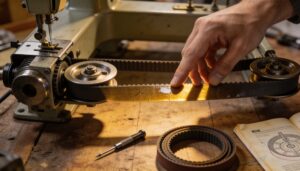
Flip the machine over and trace the drive belt along its full belt routing path — from motor pulley to needle bar pulley.
A motor belt slip usually means the belt sits loose, glazed, or cracked.
Run a belt tension check by pressing gently; it should have slight give, not flop. A proper belt alignment inspection also confirms no twisting.
Failed pulley wear assessment or missed belt replacement schedule appointments cause most "motor runs but nothing moves" complaints.
Look for Cracked or Stripped Gears

Once the belt checks out fine, shift your attention inward — the gears are next.
On machines that are 20–30 years old, plastic gears become brittle and lose teeth without warning. That’s gear tooth fatigue doing its quiet damage.
Consider evaluating root bending fatigue strength to prevent unexpected tooth failures. Watch for these red flags:
- Dull, darkened roots showing internal gear wear
- Gear alignment problems causing grinding or skipped stitches
- Rim crack detection points near keyways or fillets
- Worn flanks where poor lubrication impacts accelerated gear stripping
Inspect Needle Bar Linkage Connection
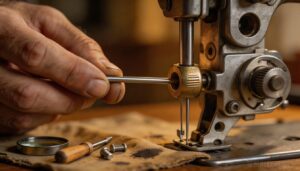
After the gears, check the needle bar linkage — the mechanical arm that actually drives the needle up and down. Grab the needle bar and gently wiggle it side to side.
Too much linkage play means worn bushings or loose fasteners. Look for wear marks around the bushing bore, and confirm cam alignment is clean and unobstructed.
Tighten any loose screws you find.
Test for Stiff or Seized Moving Parts

Once you’ve checked the linkage, run a shaft rotation test — slowly turn the handwheel by hand and note any resistance. A smooth machine should feel almost easy.
Stiff spots often point to dry bearings, so do a bearing feel test and pivot oil inspection while you’re in there.
Perform a spring tension verification and gear play check, then lubricate moving parts sparingly.
Watch for Timing-related Movement Problems

Timing is where things get tricky. If the motor runs but needle doesn’t move smoothly — or moves in a jerky, off-beat pattern — you’re likely dealing with a timing misalignment between the needle and hook assembly.
Think of it like a basal ganglia timing glitch: the signal fires, but the rhythm’s off.
A timing adjustment, done by a technician, usually fixes internal mechanism jams and restores needle movement problems for good.
Top 4 Helpful Troubleshooting Tools
Before you chase down every possible fix, having the right tools in your corner makes a real difference. A few simple items can save you time and help you work through the problem without making things worse.
Here are four worth keeping close.
1. Worx ZipSnip Cordless Electric Scissors
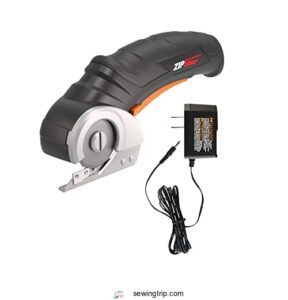
The WORX ZipSnip (model WX082L) isn’t a sewing tool, but it earns a spot in your troubleshooting kit.
When you’re cutting away tangled thread bundles, trimming frayed fabric edges, or slicing open dense materials near your machine’s workspace, this lightweight cordless scissor manages it cleanly.
It weighs under a pound, runs on a rechargeable 4V lithium battery, and activates only when you press the trigger and safety lock together — so accidental cuts aren’t a concern while you’re working close to your machine.
| Best For | DIYers, crafters, and hobbyists who want a quick, low-effort way to cut through cardboard, fabric, packaging, and other light materials without reaching for a knife or manual scissors. |
|---|---|
| Material | Plastic housing |
| Package Count | 1 unit |
| Weight | ~1 lb |
| Color | Black & Orange |
| Accessories Included | Charger, blade, pouch |
| Primary Use | Cutting materials |
| Additional Features |
|
- Dual-safety trigger means you won’t accidentally nick yourself or your project while working
- At about a pound, it’s light enough to use for long stretches without your hand wearing out
- Cordless and portable, so you can take it anywhere — garage, kitchen, outdoors, no outlet needed
- Default charger takes around 5 hours for a full charge, which can be annoying if you forget to plug it in
- Struggles with thick or dense materials, especially as the battery starts to drain
- Built for right-handed users, so lefties may find it awkward to hold and balance
2. Adjustable Metal Sewing Thimble
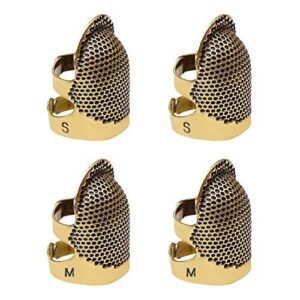
Hand sewing while troubleshooting a stubborn needle jam means a lot of close, repetitive pushing — and your fingertip pays the price. That’s where an adjustable metal thimble earns its keep.
This open-sided brass-alloy design fits fingers between 14 and 18 mm wide, so it works for most hand sizes without feeling like a vice.
The open top keeps airflow moving, which matters during a long session. It’s a small thing, but your fingers will thank you.
| Best For | Hand sewers, quilters, and embroiderers who sew for long stretches and need a comfortable, breathable thimble that fits a range of finger sizes. |
|---|---|
| Material | Metal alloy |
| Package Count | 4 pieces |
| Weight | 1.76 oz (total) |
| Color | Copper/brass finish |
| Accessories Included | None |
| Primary Use | Finger protection |
| Additional Features |
|
- Comes in two sizes (small and medium) so it works for most fingers, and the open-sided design lets you adjust the fit on the fly
- The open top keeps air moving around your finger, which makes long sewing sessions way more comfortable
- Durable brass-alloy metal holds up against needle pressure better than plastic ever could
- The open band can catch thread now and then, so you may need to pause and reposition it
- Can feel a little stiff and uncomfortable at first if you’re not used to wearing a metal thimble
- If your fingers are on the thinner side, even the small size might feel loose and slip during more active work
3. GDMINLO Soft Double Scale Tape Measure
When you’re pulling apart a seam or checking a measurement mid-repair, the last thing you need is a tape that lies to you.
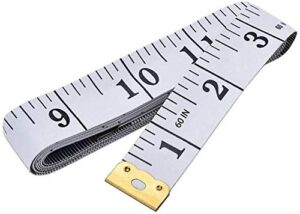
The GDMINLO Soft Double Scale Tape Measure keeps things honest — 60 inches on one side, 150 centimeters on the other, both clearly marked on a flexible fiberglass core that won’t stretch out of shape.
It wraps around curved surfaces cleanly, fits in your sewing kit without fuss, and at $3.59, it’s basically a no-brainer addition to your troubleshooting kit.
| Best For | Sewers, tailors, and crafters who need a reliable, no-fuss tape measure for body measurements, garment fitting, or fabric work. |
|---|---|
| Material | Vinyl/fiberglass |
| Package Count | 1 piece |
| Weight | Not specified |
| Color | White |
| Accessories Included | Storage sleeve |
| Primary Use | Measuring |
| Additional Features |
|
- Dual inches/centimeters scale means you never have to switch tools or do mental math mid-project.
- Flexible fiberglass core wraps cleanly around curves without stretching, so your measurements stay accurate.
- At $3.59, it’s practically free — easy to toss in a sewing kit, travel bag, or utility drawer.
- No retractable mechanism, so you’re manually folding it back up every time.
- 60 inches maxes out fast — not ideal if you’re measuring anything beyond standard body or fabric dimensions.
- Vinyl can feel a bit stiff compared to soft cloth tapes, which some people find awkward to work with.
4. Bobbin Hook Cover Plate for Brother and Babylock
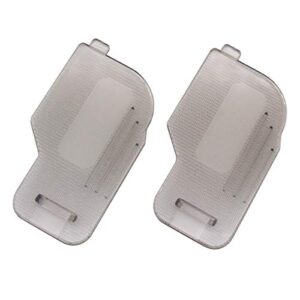
A busted or missing bobbin hook cover plate is one of those small problems that turns into a big headache fast. This pack of two from Brother and Babylock fits a wide range of models — CE, CS, NV, XR series, and more — and snaps in without tools.
At $6.99 for two pieces, you’ve got a spare ready when one goes missing. It shields the hook area, keeps thread on track, and stops fabric from snagging mid-seam.
| Best For | Home sewers and small repair shops who need a quick, affordable fix for a lost or broken bobbin cover plate on a Brother or Babylock machine. |
|---|---|
| Material | Rigid polymer |
| Package Count | 2 pieces |
| Weight | 0.352 oz each |
| Color | Clear brown |
| Accessories Included | 1 spare plate |
| Primary Use | Machine repair |
| Additional Features |
|
- Two-pack means you’ve always got a spare on hand — no scrambling when one goes missing
- Snaps in without tools, so you’re back to sewing in seconds
- Broad compatibility across Brother and Babylock models makes it easy to stock up without hunting for model-specific parts
- Some machines may need minor filing to get a snug fit, which isn’t ideal for everyone
- The clear brown color doesn’t always match the original, so it can look a little off on certain machines
- No warranty included, so you’re buying on good faith that it works as described
Repair or Replace Your Machine

At some point, every sewing machine hits a wall where a quick fix just won’t cut it. Knowing when to call in a pro — and when to walk away entirely — can save you time, money, and a lot of frustration.
Here’s how to read the signs.
When to Call a Sewing Machine Repair Technician
Some problems are beyond a DIY fix. Here’s when you stop troubleshooting and call a professional repair technician:
- Persistent needle jams return after cleaning and rethreading.
- Unusual grinding noises accompany zero needle movement.
- Intermittent stitch skipping persists despite correct needle and thread setup.
- Control panel errors won’t clear after resets.
- Safety mechanism failures prevent operation entirely.
Get a repair cost estimation before authorizing any repair shop work.
Signs of Electrical or Motor-control Failure
Sometimes the problem runs deeper than gears and belts. If your motor is humming steadily but the needle won’t budge, suspect electrical or motor-control failure.
Overcurrent trips, PWM failure, or sensor feedback loss can all kill needle movement while the motor runs.
controller error inside the drive circuit, faulty motor coupling, or fried motor belt and gear failures also point to electrical diagnostics territory — not a quick DIY fix.
Problems That Usually Need Professional Service
Beyond electrical faults, gearbox failure, precision cam wear, and microprocessor corruption are all reasons your motor runs but needle doesn’t move — and none of those are weekend fixes.
Control board burnout leaves scorch marks and fault codes that a technician needs to read.
Safety interlock fault can freeze operation entirely.
When professional repair is the only path forward, don’t delay — pushing through causes deeper damage.
When to Just Replace Your Sewing Machine
Repair cost threshold matters more than sentiment. If the quote clears 50 percent of a comparable new machine, walk away.
If the repair quote exceeds half the cost of a new machine, walk away
Parts scarcity on discontinued models drives labor costs even higher. Machines over 15 years old can carry real safety hazards — worn cords, failing insulation.
Add obsolete features, no warranty coverage, and deciding between repair and replacement of a sewing machine becomes simple math.
Preventing Further Damage After a Needle Jam
Once you’ve cleared a needle jam, don’t let the machine set you back twice.
Stick to regular lint cleaning around the bobbin area and follow your manufacturer’s lubrication schedule for proper oil application.
Timely needle replacement — every 8 to 10 hours of sewing — prevents future jams.
Add thread path inspection, thread tension adjustment, and avoid overloading fabric, and preventive maintenance becomes second nature.
Frequently Asked Questions (FAQs)
Why won’t my needle move up and down?
Think of needle as a car’s drivetrain — the motor is the engine, but if the clutch slips or a gear breaks, nothing moves.
Handwheel clutch disengagement, needle jamming, or broken internal gears are usually why.
Can a faulty foot pedal stop needle movement?
Yes, a faulty foot pedal can absolutely stop needle movement.
Worn pedal springs, faulty pedal wiring, or a dead man switch fault can interrupt the pedal signal, leaving your motor running, but needle motionless.
Does sewing speed affect needle jamming frequency?
Speed is like pressure on a weak joint — the faster you push, the more likely something gives.
higher sewing speeds increase needle jamming frequency, especially when tension, fabric type, or needle size matching is off.
How often should drive belts be replaced?
Plan on replacing your sewing machine belt every few years, or sooner if you notice cracking, glazing, or slipping. Regular drive belt inspection and replacement keeps your machine stitching smoothly.
Can fabric thickness cause the needle to freeze?
Thick fabric creates serious fabric drag and demands more needle thrust to push through.
extra load can tighten thread tension, overwhelm the feed dog height settings, and briefly freeze needle movement mid-stitch.
Is machine age a factor in needle failure?
Like an old car that burns oil and shudders uphill, an aging sewing machine carries its mileage inside.
Worn Gear Teeth, Lubrication Deterioration, and Motor Torque Loss quietly stack up — yes, age absolutely drives needle failure.
Conclusion
In dealing with fixing a motor running but needle stuck, patience and persistence are key. As the saying goes, "a stitch in time saves nine."
By methodically checking common culprits and making a few adjustments, you’ll get your machine humming along smoothly.
Remember, a motor running but needle stuck usually points to a simple issue. Stay calm, follow these steps, and you’ll be sewing in no time, with confidence and control back in your hands always.