
This site is supported by our readers. We may earn a commission, at no cost to you, if you purchase through links.
Most outdoor fabrics crumble under pressure—literally. Leave your patio furniture outside for a single summer, and you’ll watch the upholstery fade, stain, and eventually tear apart at the seams.
Olefin fabric breaks that pattern. Born from a 1954 laboratory discovery that turned propylene gas into durable polymer chains, this synthetic material resists water, shrugs off stains, and refuses to fade even after years of direct sunlight. You’ll find it covering everything from poolside loungers to car interiors, quietly outlasting materials that cost twice as much.
Understanding what makes olefin different—from its hydrophobic molecular structure to its surprisingly low environmental footprint—helps you decide whether it’s the right choice for your next furniture upgrade or DIY project.
Table Of Contents
Key Takeaways
- Olefin fabric is a synthetic textile made from polypropylene or polyethylene gas that’s been transformed through chemical polymerization, giving it a hydrophobic structure that absorbs less than 0.01% water—making it naturally resistant to moisture, stains, and mildew without any chemical coatings.
- The material’s solution-dyed manufacturing process locks color deep inside the fiber during production rather than applying it to the surface, which is why it maintains its appearance through 2,000+ hours of direct sunlight and can even tolerate bleach cleaning without fading.
- While olefin costs significantly less than alternatives like Sunbrella ($4-10 per yard versus premium pricing), it delivers comparable weather resistance and superior abrasion durability, though it melts at lower temperatures (130-170°C) so you’ll need to keep it away from heat sources like irons or fire pits.
- The fabric’s environmental footprint sits in a gray area—it uses minimal water during production and can be recycled up to five times, but it’s derived from petroleum, releases 1.6-3.6 kg of CO2 per kilogram produced, and won’t biodegrade for 20-500 years if it ends up in a landfill.
What is Olefin Fabric?
Olefin fabric might sound like something out of a chemistry lab—and in a way, it’s. This synthetic material has been quietly revolutionizing outdoor furniture, car interiors, and home textiles since the 1950s, but most people don’t know what it’s actually made of or why it works so well.
Let’s break down what olefin really is, where it came from, and what else you might hear it called.
Definition of Olefin Fabric
Olefin fabric is a manufactured textile built from polyolefin polymers—primarily polypropylene or polyethylene—derived from propylene and ethylene gas. You’ll find this synthetic material defined by five core traits:
- At least 85% polyolefin by weight per U.S. Federal Trade Commission standards
- Fully synthetic chemical structure with no natural fibers
- Crystalline polymer backbone offering mechanical strength
- Lowest density among major textile fibers (0.90–0.94 g/cm³)
- Nonpolar, hydrophobic surface chemistry resisting moisture and stains
Olefin fabric is often used for its water resistance properties, making it a popular choice for various applications.
History and Origin
You’ve seen polypropylene labeled in stores, but its roots trace back to a 1954 lab discovery. Italian chemists Karl Ziegler and Giulio Natta unlocked the Ziegler–Natta catalyst, turning propylene gas into stable crystalline polymers.
By 1957, Italy launched industrial-scale synthetic production of olefin fibers, and the U.S. followed in 1960 when Hercules Incorporated began weaving this durable, moisture-resistant fabric into carpets and upholstery. The discovery of olefin fibers led to the development of synthetic fabric solutions that are still widely used today.
Common Names (Polypropylene, Polyolefin)
The industry shuffles several labels for the same fiber. You’ll see “olefin” stamped on upholstery tags—that’s the U.S. Federal Trade Commission’s generic term for any fiber made from at least 85% propylene or ethylene. Polypropylene is the precise chemical name, while polyolefin refers to the entire polymer family.
Retailers use olefin for simplicity, but all three describe solution-dyed, quick-drying synthetic material built from propylene gas.
What is Olefin Fabric Made Of?

Olefin fabric doesn’t grow on plants or come from animals—it’s built from scratch in a lab using petroleum-based materials. The process starts with specific gases that get transformed into durable fibers through controlled chemical reactions.
Let’s break down what actually goes into making this synthetic material and how it differs from the natural fibers you might be more familiar with.
Raw Materials (Propylene, Ethylene)
Think of olefin fabric as petrochemicals reimagined into something useful. You’re looking at propylene—a colorless gas that smells faintly like petroleum—as the star ingredient, with ethylene playing a supporting role. Here’s what you need to know about these raw materials:
- Propylene comes from steam cracking naphtha or refining vacuum gas oils
- Both gases are by-products of crude oil and natural gas processing
- Ethylene production runs through the same petrochemical infrastructure
- These feedstocks cluster near major refining hubs worldwide
- Until the 1950s, propylene was simply burned off as industrial waste
The polypropylene market hit $123 billion in 2022, proving these once-discarded gases now power a massive textile industry.
Synthetic Production Process
Polypropylene polymerization kicks off when propylene meets Ziegler-Natta catalyst systems inside loop reactors running at 60–80°C. You’re watching polymer chains form under pressures up to 6 MPa—conditions that keep everything in a supercritical sweet spot.
The molten polymer then flows through melt spinning at 180–240°C, where it’s extruded into filaments and woven into olefin fabric, transforming gas into textile through precise reactor design and fiber extrusion.
Differences From Natural Fibers
Unlike cotton’s 24% moisture absorption or wool’s 30%, olefin’s hydrophobic surface grabs less than 0.01% water by weight—a textile innovation that completely changes outdoor furniture performance.
Olefin absorbs almost no water—less than 0.01%—revolutionizing outdoor furniture where cotton and wool would fail
This synthetic material floats with a density of 0.90 g/cm³ versus cotton’s 1.54 g/cm³, delivering warmth without weight while resisting mildew and chemical degradation that weaken natural fibers exposed to weather.
Key Characteristics of Olefin Fabric
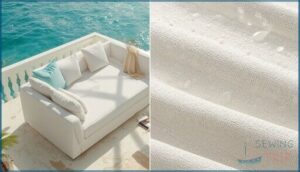
Now that you know what olefin is made from, let’s talk about what makes this fabric stand out. Olefin brings some surprisingly useful properties to the table—things that explain why it’s become such a go-to for outdoor furniture, car interiors, and carpets.
Here’s what you need to know about how this synthetic material actually performs.
Durability and Strength
You’ll find olefin fabric delivers impressive tensile strength—ranging from 150 to 640 megapascals depending on processing—which translates to real-world toughness in high-traffic upholstery and automotive interiors.
Its abrasion resistance keeps surfaces from pilling or shredding under friction, while UV durability (when stabilized) prevents that dreaded outdoor fade and brittleness.
This synthetic fabric’s fiber reinforcement properties mean it won’t quit when you need material fatigue to stay minimal.
Water and Stain Resistance
Water resistance is where olefin really breaks free from other synthetics. Its hydrophobic properties mean liquid beads up and rolls off rather than soaking in—moisture regain sits at just 0.1%, so your cushions dry fast after a downpour. Stain resistance follows naturally:
- Water-based spills won’t penetrate the fiber’s non-polar surface
- Bleach-tolerant chemistry allows aggressive stain removal without damage
- Mold and mildew struggle to colonize because there’s no moisture to sustain them
You’re fundamentally getting waterproofing without chemical coatings.
Colorfastness and Fade Resistance
Solution-dyed olefin fabric locks color deep inside the fiber during production—not on the surface—so UV resistance becomes outstanding. You’re looking at lightfastness ratings of Grade 7–8 on standardized fade testing scales, meaning color stability holds through roughly 2,000 hours of sun exposure before noticeable change.
Dye migration won’t happen because pigments are physically trapped in the polymer matrix, giving you durability and UV protection without chemical coatings or water repellent additives compromising colourfastness.
Texture and Appearance
Olefin fabric delivers a soft-to-medium-firm hand that feels comfortable without sacrificing strength—think sturdy yet cozy. Weave construction and yarn thickness shape the final look, from flat minimalist plains to textured jacquards that hide dirt and add visual interest.
- Surface texture: Looped or crimped yarns create raised patterns for grip and dimension
- Color consistency: Solution-dyed fibers show uniform, matte tones with minimal sheen
- Visual appeal: Heavier outdoor grades appear structured and canvas-like, maintaining taut profiles
How Olefin Fabric is Manufactured

Understanding how olefin fabric goes from gas to finished textile helps you appreciate its unique properties.
The manufacturing process transforms propylene into durable fibers through a series of chemical and mechanical steps.
Here’s how it all comes together, from molecular chains to woven fabric.
Propylene Polymerization
Turning raw propylene gas into solid polypropylene happens through polymerization—a chemical process where tiny molecules link into long chains. Catalyst systems like Ziegler–Natta, responsible for over 90% of production, orchestrate this transformation at temperatures between 60°C and 90°C. Reaction kinetics determine the speed of chain growth, while hydrogen controls molecular weight, influencing whether the final product is strong like rope fibers or softer in texture.
Inside industrial reactors, several key stages govern the process:
| Process Stage | Key Parameters | What It Controls |
|---|---|---|
| Catalyst activation | Al:Ti ratio 50:1 to 200:1 | Polymerization rate & efficiency |
| Reactor conditions | 10–40 bar pressure, 60–90°C | Chain growth speed & uniformity |
| Hydrogen addition | Variable partial pressure | Molecular weight & fiber strength |
| Temperature control | Maintained below 160°C | Prevents particle melting |
| Chain termination | β-hydride elimination pathway | Final polymer structure & properties |
The polymer structure—whether isotactic (highly ordered) or atactic (random)—dictates the characteristics of the final olefin fabric. Industrial processes now precisely tune polypropylene to meet specific performance targets, resulting in olefin fabrics ranging from stiff carpet backing to supple outdoor cushions. This level of precision in synthetic fabric types was only made possible through advancements in catalyst systems, evolving from basic chemistry to sophisticated molecular engineering.
Fiber Spinning and Weaving
Once polymer chains solidify, melt spinning transforms them into usable fibers. Most commercial olefin fabric starts here—polypropylene pellets heated to 230–260°C flow through spinnerets at high speeds, sometimes exceeding 6,000 meters per minute. This rapid extrusion builds fiber orientation and crystallinity, boosting strength.
Key factors in textile manufacturing include:
- Drawing ratios that control tenacity and elongation
- Spinning speed adjustments for fiber orientation
- Cooling conditions that lock in molecular structure
- Yarn formation methods matching end-use requirements
Weaving techniques then interlace these olefin yarns—multifilament types ranging from 300 to 1,200 denier—into durable upholstery and outdoor fabrics. Because polypropylene fiber has low specific gravity (around 0.90 g/cm³), you get excellent coverage without extra weight.
This synthetic fiber technology facilitates precise control over fabric properties, whether you’re manufacturing heavy-duty car seats or lightweight patio cushions. The beauty of modern textile technology lies in tailoring each step to your exact performance needs.
Environmental Impact of Production
Behind that optimized spinning process lies a hefty environmental cost. Polypropylene production releases around 1.6 kg of CO2-equivalent per kilogram of pellets—fossil fuel dependency runs deep here. Greenhouse emissions, toxic chemicals from refining, and resource depletion add up fast.
While olefin skips water-intensive agriculture, its carbon footprint and reliance on petrochemicals challenge any claim to truly sustainable fabric production.
Is Olefin Fabric Safe?
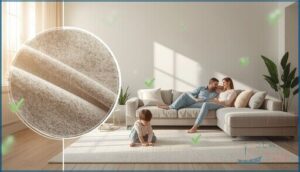
You’re probably wondering whether olefin is safe to have around your home, especially if you’re choosing it for furniture or carpeting. The good news is that olefin fabric is generally safe for household use, but there are a few things worth knowing about its chemical makeup and potential concerns.
Let’s break down what you should keep in mind regarding off-gassing, everyday safety, and any allergens or toxins.
Chemical Composition and Off-Gassing
You might wonder what your olefin furniture releases into your home. Polypropylene fibers themselves emit minimal VOCs—usually under 1,000 µg/m²·h in chamber tests—because synthetic fibers don’t need plasticizers that some polymers require.
However, polymer degradation under UV and heat generates aldehydes and ketones through chemical reactions.
Offgassing rates peak in the first few days, then drop sharply, so proper ventilation helps clear any initial emissions from fabric characteristics or additives.
Safety in Household Use
Real-world household hazards emerge when you place olefin fabric near heat sources. Fire resistance remains limited unless flame retardants are added, and melting—not charring—creates burn risks from dripping material.
Indoor pollution concerns center on initial off-gassing, though certified products keep toxic emissions low:
- Carpets passing ASTM D2859 meet minimum flammability standards
- VOCs peak during unpacking, then fade with ventilation
- Stain resistant and waterresistant surfaces simplify safe cleaning
- Durability and chemical resistance support long-term use
Potential Allergens and Toxins
Your sensitivity to fabrics matters when choosing olefin. While the base polymer resists allergic reactions, toxic chemicals added during finishing—plasticizers, flame retardants, polyfluorinated compounds—can trigger skin irritation in vulnerable individuals. Microplastic release during washing carries endocrine disruptors into your environment, though chemical resistance and stain-resistant treatments like FibreGuard reduce exposure. Eco-friendly textile manufacturing minimizes additives, but you’ll want proper ventilation initially to avoid off-gassing.
| Additive Type | Health Concern | Regulatory Limit |
|---|---|---|
| Phthalates | Endocrine disruption |
- https://textileengineering.net/what-is-olefin-fiber-properties-uses/
- https://proupholsterycleaning.com.au/olefin-upholstery/
- https://blog.aramsco.com/carpet-fibers-olefin
- https://www.dorsali.com/blogs/dorsali-ethical-fashion-guide-blog/energy-use-in-cotton-vs-polyester
- https://grokipedia.com/page/Olefin_fiber