This site is supported by our readers. We may earn a commission, at no cost to you, if you purchase through links.

You pull on a sweater that feels like touching a cloud—impossibly soft, weightless, yet somehow warmer than anything in your closet. That’s the quiet magic of angora fabric, a textile spun from the fine wool of Angora rabbits. Each fiber measures just 12–14 micrometers across, thinner than a human hair, with a hollow core that traps air and creates insulation without bulk.
This unique structure explains why angora has been prized for centuries, from Ottoman palaces to modern runways. Understanding what makes this fabric special—from its thermal properties to the careful breeding behind it—reveals why it commands premium prices and demands thoughtful consideration about how it’s produced.
Table Of Contents
- Key Takeaways
- What is Angora Fabric?
- History and Origins of Angora Fabric
- How Angora Fabric is Produced
- Key Physical Properties of Angora Fabric
- Common Uses of Angora Fabric
- Advantages of Angora Fabric
- Challenges and Care Requirements
- Ethical and Sustainability Considerations
- Angora Fabric in Modern Fashion
- Frequently Asked Questions (FAQs)
- Conclusion
Key Takeaways
- Angora fabric comes from Angora rabbit wool with fibers measuring just 12–14 micrometers in diameter and a hollow core structure that traps air, delivering exceptional warmth at roughly 20% lighter weight than sheep wool while maintaining breathability.
- The production process involves careful rabbit breeding, fiber harvesting through shearing or plucking (with plucking raising significant animal welfare concerns), and specialized cleaning and spinning techniques that preserve the delicate hollow fiber structure.
- Over 90% of angora comes from Chinese farms where investigations have revealed brutal treatment of rabbits, prompting more than 400 major fashion brands including Gucci and Armani to ban the material entirely.
- Angora requires gentle hand-washing in cold water, flat drying, and careful storage to prevent felting and maintain its structure, with blends containing 30–50% angora offering better durability than pure angora which sheds and pills easily.
What is Angora Fabric?
Angora fabric stands out in the textile world for its exceptional softness and warmth, but understanding what sets it apart starts with knowing where it comes from and how it’s made.
The fibers themselves have a unique structure that gives Angora properties you won’t find in standard wool.
Let’s break down what makes this fabric distinctive, starting with its basic composition and the animals that produce it.
Definition and Composition
Angora fabric is a natural fiber textile made from the soft, fine wool of Angora rabbits. Its keratin composition creates fibers measuring just 12–14 micrometers in diameter, placing it among the finest wool properties available. You’ll notice its hollow structure immediately—this unique fabric density of roughly 1.15 g/cm³ makes Angora wool about 20% lighter than traditional sheep wool while delivering outstanding warmth through textile science.
The remarkable softness and warmth of Angora make it ideal for natural fiber clothing.
Origin From Angora Rabbits
You might be surprised to learn this luxurious fiber comes from just a few specialized rabbit breeds. Rabbit breeding and Angora genetics trace back to Turkey’s Ankara region, where Angora rabbits originated centuries ago. Today’s fiber production centers on four main breeds:
- English Angora—compact, prized for quality Angora wool
- French Angora—larger, easier for sustainable farming
- German Angora—finest fiber, demanding ethical treatment protocols
- Giant Angora—highest yields in natural fiber textiles
Animal welfare and rabbit welfare standards shape modern production. The Angora fiber industry relies on luxury wool production to create high-quality textiles.
Comparison to Other Wool Fabrics
When you compare luxurious wool fibers, Angora fabric stands out for its ultrafine diameter—often 12–16 microns—making it softer than cashmere or merino.
Fiber analysis shows Angora’s hollow structure boosts thermal insulation, so it feels warmer yet lighter.
Breathability tests also reveal impressive comfort, setting Angora apart in natural fiber textiles for softness, warmth, and practical elegance.
History and Origins of Angora Fabric
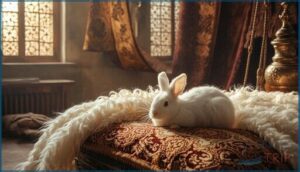
Angora fabric didn’t just appear out of nowhere—it carries centuries of history that shaped how we think about luxury textiles today.
The story begins in Turkey, where Angora rabbits were first bred and their soft wool became a symbol of prestige. From there, this exceptional fabric made its way across continents and into the wardrobes of fashion-conscious people everywhere.
Early Use in Turkey and The Ottoman Empire
Long before angora fabric became a staple in your luxury wardrobe, it was born in the highlands of Central Anatolia—a treasure locked within the Ottoman Empire for centuries. Turkish trade in angora wool from angora rabbits started near Ankara, where this luxury textile transformed into highly prized Ottoman textiles that elite society coveted for its exceptional softness and warmth.
- Nearly 10,000 workers operated over 1,500 handlooms producing mohair and angora-based fabrics in 17th-century Ankara
- Ottoman authorities strictly banned exporting live angora rabbits to protect their monopoly on this luxury fabric
- Elite Ottomans wore angora and mohair in kaftans and fine garments, marking status and wealth
- Anatolian origins of angora gave the region exclusive control over historic production for generations
- Trade liberalization in 1838 eventually opened markets, ending Turkey’s centuries-long dominance
Influence on Fashion History
Glamour transformed angora fabric from a specialty fiber into a fashion icon by the 1930s, when Hollywood starlets wore fluffy angora sweaters that became visual shorthand for sensuality.
You’ll find its cultural significance woven through decades of luxury textile production—from Victorian shawls to 1980s bold knitwear—shaping fashion trends across Europe and America.
Today, vintage styles command premium prices, cementing angora’s historical impact on luxury brands and textile history.
How Angora Fabric is Produced
Angora fabric production starts with the careful breeding and maintenance of Angora rabbits, followed by specific harvesting techniques to collect their fine wool.
The raw fibers then undergo cleaning, spinning, and dyeing processes that transform them into the luxurious textile you see in finished garments.
Understanding these production stages reveals both the craftsmanship involved and the factors that influence the fabric’s final quality and cost.
Breeding and Care of Angora Rabbits
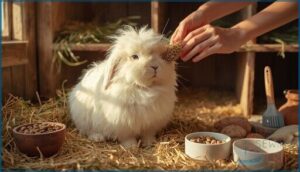
Healthy Angora rabbits need thoughtful breeding strategies and daily attention to thrive. You’ll want to provide high-fiber hay and controlled pellet portions—around 0.5–1 cup daily—to support wool growth while preventing digestive wool block. Ethical treatment means individual housing, routine grooming twice weekly, and careful health monitoring:
- Feed 16–18% protein pellets with unlimited timothy hay
- Groom at least twice weekly to prevent matting
- House individually in clean, spacious cages
- Inspect coats regularly for mites and skin issues
Harvesting Methods (Shearing, Plucking)
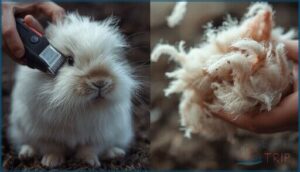
Fiber extraction from Angora rabbits happens through two main methods—shearing techniques and plucking ethics remain hotly debated. Shearing uses clippers every 3–4 months and takes about 20 minutes per rabbit, while live plucking can stretch to 1–2 hours.
Here’s how these harvesting practices affect rabbit welfare:
| Method | Duration | Welfare Impact |
|---|---|---|
| Shearing | ~20 minutes | Restraint stress, potential cuts |
| Live Plucking | 1–2 hours | Acute pain, screaming, skin loss |
Ethical treatment means choosing sustainable fashion practices that prioritize animal welfare over fiber yield.
Cleaning, Spinning, and Dyeing Processes
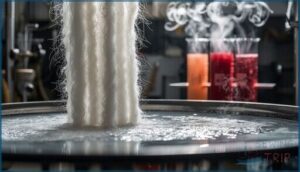
Once harvested, Angora wool undergoes specialized textile production steps that protect its delicate structure. You’ll find these processes differ markedly from standard wool handling:
- Fiber pretreatment uses mild alkali solutions (0.5–3% sodium carbonate) for 5–12 minutes, removing impurities while preserving the hollow core that gives Angora fabric its legendary warmth
- Yarn formation requires adjusted drafting speeds due to Angora’s smooth, low-scale surface—most commercial yarns blend it with wool or synthetics to improve cohesion during spinning
- Dyeing conditions operate at surprisingly gentle parameters: pH 3 and 90°C with leveling acid dyes maintain color yield without damaging fibers, though surface modification through ozone treatment (40 minutes at pH 7) can improve dye uptake for both acid and reactive dyes
These finishing techniques balance fabric composition goals—softness, durability, and that signature sheen—with practical yarn production realities.
Key Physical Properties of Angora Fabric
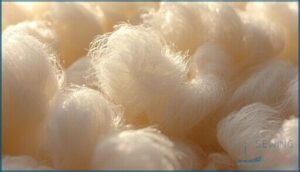
Angora fabric earns its reputation through a unique combination of physical characteristics that set it apart from other wool types.
The fibers themselves possess specific structural features that directly influence how the fabric performs in real-world use.
Understanding these properties helps explain why Angora commands such a premium in textile markets.
Fiber Fineness and Softness
When you touch Angora fabric, you’re experiencing one of nature’s finest achievements. Angora wool measures just 10–16 microns in diameter—finer than most cashmere—delivering superb softness levels that won’t irritate your skin. This fineness measure places Angora among luxury textiles prized for their gentle texture and comfort.
Angora’s smooth surface and minimal scale structure mean less friction against your skin—that’s why it feels silky rather than scratchy.
| Natural Fibers | Micron Ratings |
|---|---|
| Angora Fabric | 10–16 micrometres |
| Cashmere | 14–19 micrometres |
| Fine Alpaca | Below 23 micrometres |
| Kid Mohair | Below 27 micrometres |
| Medium Wool | 25–30 micrometres |
Hollow Structure and Insulation
What makes Angora fabric so warm without the bulk? The secret lies in its hollow core—a medullated structure that traps still air pockets, turning each fiber into a tiny insulation chamber. This unique fiber morphology delivers outstanding thermal performance while keeping your garments surprisingly lightweight.
Here’s how air trapping optimizes your warmth:
- Reduced density (1.15–1.18 g/cm³) creates more space for insulating air layers between fibers
- Hollow zones maintain stable thermal insulation even as moisture moves through the fabric
- Blends with 25% angora show measurably improved thermal comfort compared to lower ratios
This structural advantage explains why your angora sweater feels notably warmer than comparable wool pieces—it’s engineering softness and warmth into every strand while supporting natural breathability.
Lightweight and Breathability
Despite its outstanding thermal insulation, angora’s fiber structure facilitates surprisingly good breathability and moisture management.
Air permeability tests on angora blends show that while denser fabric structure restricts airflow compared to pure synthetics, the natural softness and moisture regulation properties let you wear angora comfortably across temperature shifts—from crisp mornings to warmer afternoons—without overheating or clamminess against your skin.
Common Uses of Angora Fabric
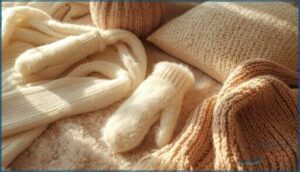
Angora fabric’s unique combination of softness, warmth, and natural sheen has secured its place in some of the most coveted items you’ll find in fashion and home design.
From high-end garments that sit directly against your skin to accessories that shield you from winter’s bite, this fiber elevates everyday pieces into something special.
Let’s look at where you’re most likely to encounter angora and why it works so well in these applications.
Luxury Clothing (Sweaters, Scarves, Coats)
You’ll find Angora fabric woven into luxury knitwear that defines winter fashion trends—soft sweaters, premium scarves, and high-end coats that feel weightless yet exceptionally warm.
This luxury fiber often appears blended with merino or silk in designer collections, where its natural sheen and halo effect create that signature floating quality.
The fine fibers trap air efficiently, delivering thermal insulation without bulk in cold-weather apparel.
Fashion Accessories (Hats, Gloves, Mittens)
Winter accessories like hats, gloves, and mittens showcase angora’s lightweight warmth at its best. The hollow fiber structure delivers outstanding insulation in cold weather gear, keeping your hands and head comfortable without bulk.
You’ll notice commercial yarns typically blend 30–50% angora wool with other fibers—pure angora felts too easily under friction. That signature softness makes angora fabric ideal for close-to-skin knitwear design in luxury textiles.
Home Textiles (Throws, Cushion Covers)
Beyond apparel, angora fabric brings luxury into your living space through plush throws and decorative cushion covers.
These home textiles leverage the same hollow-core insulation you found in cold-weather accessories, creating blankets that stay warm without the weight.
You’ll usually see 30–50% angora blended with wool or synthetics in cushion materials—this combination balances that signature halo effect with practical durability for everyday home decor use.
Advantages of Angora Fabric

Angora fabric has earned its place in luxury textiles for good reason—it delivers warmth, beauty, and comfort in ways few other materials can match. The hollow structure of its fibers and natural properties create a combination that’s hard to beat when you’re looking for cold-weather performance with a touch of elegance.
Here’s what makes angora worth the investment.
Exceptional Warmth and Thermal Insulation
You’ll find Angora fabric delivers superior warmth retention thanks to its hollow fiber structure, which traps air to create superior thermal insulation properties. This cold weather performance stands out in three key ways:
- Laboratory tests show Angora blends with at least 25% content markedly increase thermal efficiency compared to standard fabrics
- The hollow core creates air pockets that provide insulation roughly seven times greater per weight than conventional wool
- Lightweight construction means you stay warm without bulk, making Angora ideal for layering in extreme temperatures
Natural Sheen and Aesthetic Appeal
Angora fabric’s visual allure comes from its microscopic structure—fiber luster emerges as ultra-fine fibers (roughly 16.6 micrometers) with low-profile cuticle scales reflect light uniformly, creating textile shine that rivals cashmere.
This aesthetic texture produces the signature “halo effect,” where the hollow medulla amplifies softness and visual depth.
You’ll notice striking color brilliance too, as Angora wool’s inherent whiteness allows dyes to achieve more vivid, luminous hues than standard natural fibers.
Lightweight Comfort and Breathability
That hollow core traps air for warmth yet allows moisture to escape—a rare textile balance. You’ll feel thermal regulation working: angora’s breathable insulation keeps you cozy without overheating, wicking perspiration while maintaining lightweight comfort against your skin.
The medullated structure delivers softness and warmth simultaneously, managing moisture through natural air exchange that prevents the clammy sensation heavier fabrics cause.
Challenges and Care Requirements
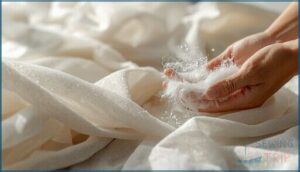
Angora fabric delivers exceptional softness and warmth, but it comes with a few quirks you’ll need to work around. The same fine fibers that make it luxurious also make it prone to shedding and pilling, and standard washing methods can ruin the fabric’s delicate structure.
Here’s what you need to know to keep your Angora pieces looking their best.
Shedding and Pilling Issues
You’ll notice your angora wool garment leaves a fuzzy trail—that’s fiber shedding at work. The ultra-fine fibers (11–16 micrometers) and hollow structure make pilling dynamics inevitable, especially in the first few wears.
Here’s what drives it:
- Yarn construction with low twist creates a visible halo
- Fabric composition under 30% angora reduces microfiber release
- Abrasion zones like underarms accelerate pilling
- Fabric durability improves in blended weaves
Gentle Washing and Storage Tips
Think of your angora piece as a delicate ally—it craves specific textile care and maintenance to stay soft and luxurious. Hand washing in cold water around 20°C (68°F) protects those hollow fibers from felting. Use pH-balanced detergent formulated for protein fibers, soak for no more than 10 minutes, then gently press—never wring.
For cold storage, lay flat in breathable fabric bags with lavender sachets to prevent moth damage while maintaining breathability and moisture regulation.
| Washing Parameter | Recommended Practice |
|---|---|
| Water temperature | 20–30°C (68–86°F) |
| Detergent type | pH-neutral, wool-safe |
| Soak duration | Maximum 10 minutes |
| Drying method | Flat on towel, air dry |
Durability and Maintenance Practices
Pure angora fibers measure around 14 cN/tex in tensile strength—moderate at best—so fabric longevity depends on smart care techniques and fiber reinforcement through blending.
You’ll extend durability by:
- Hand-washing to minimize mechanical stress and abrasion
- Choosing blends with wool or nylon for improved garment construction
- Storing flat to prevent compression that crushes the fiber halo
- Removing pills gently to delay surface degradation
- Limiting wear frequency to reduce friction-driven shedding
Proper textile care and maintenance can push wear counts past 200 cycles.
Ethical and Sustainability Considerations
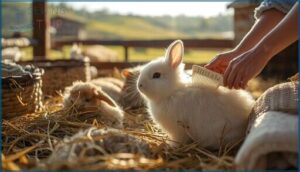
The soft luxury of Angora comes with a responsibility that goes beyond the fabric itself. How these rabbits are treated during fiber harvesting has sparked important conversations about ethics in the textile industry.
Understanding where your Angora comes from and how it’s produced helps you make choices that align with both quality and conscience.
Animal Welfare in Angora Production
Rabbit cruelty remains a harsh reality in angora production—around 90% of supply comes from Chinese farms where animal welfare in fashion often takes a backseat. Investigations reveal brutal plucking methods, cramped farm conditions, and distressing handling that violate basic animal rights.
Ninety percent of angora comes from Chinese farms where investigations reveal brutal plucking, cramped conditions, and systematic cruelty to rabbits
Many angora rabbits endure repeated trauma throughout their shortened lives, making animal welfare concerns in textile production impossible to ignore when you’re choosing ethical fashion choices.
Sustainable and Cruelty-Free Sourcing
You can break free from angora’s dark supply chain by choosing cruelty-free alternatives and sustainable textiles. Eco-friendly materials and responsible sourcing help you make ethical fashion choices that align with animal welfare concerns. Consider these swaps:
- Recycled polyester blends—8.1% market share by 2020
- Bamboo textiles from low-pesticide crops
- Tencel (lyocell) in closed-loop production
- Alpaca fiber from annual, cruelty-free shearing
- Organic cotton grown without harsh chemicals
These sustainable practices honor animal welfare in fashion while delivering warmth and comfort.
Certifications and Responsible Suppliers
When you’re ready to invest in angora, look for the Responsible Mohair Standard—a rigorous certification launched in 2020 that audits animal welfare, land management, and social practices across the supply chain.
Over 425 brands now ban uncertified angora, so responsible sourcing and eco certifications signal ethical sourcing in today’s textile industry.
Sustainable fashion starts with verified, traceable sustainable production from farm to garment.
Angora Fabric in Modern Fashion
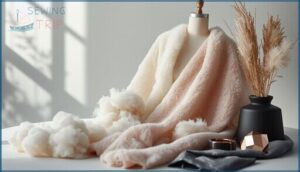
Angora fabric continues to hold a distinctive place in the fashion industry, though its role has shifted in response to both consumer values and market dynamics. Today’s designers and shoppers approach Angora with a mix of appreciation for its technical properties and caution about its origins.
Understanding where Angora fits in contemporary fashion helps you make informed choices about this unique material.
Role in Luxury and Designer Apparel
Angora fabric once held a coveted place in luxury knitwear and high-end fashion, prized by the luxury textile industry for its softness and halo effect. Designer trends featured it in premium textiles—sweaters, scarves, and high-end garments from major luxury fashion houses.
However, fashion ethics campaigns shifted the landscape. Today, over 400 brands, including Gucci and Armani, have banned angora, reshaping its role in luxury fabrics.
Current Trends and Consumer Preferences
Today, you’ll find a striking market shift: 81% of consumers in a recent 12-country survey expressed concern about animal-derived materials in fashion. This consumer awareness drives ethical choices, pushing luxury fashion toward sustainable practices and eco-friendly alternatives.
Major retailers now classify angora as restricted, reflecting fashion trends prioritizing animal welfare. You’re witnessing sustainable fashion reshape what luxury means—softness without suffering.
Future Outlook for Angora Textiles
Market trends signal constraint ahead: global angora production hovers near 500 tonnes annually, while over 300 fashion retailers have banned the fiber outright.
You’ll likely see eco-friendly alternatives—Tencel, bamboo, certified merino—capture luxury fabric market share as fiber innovation and sustainable practices accelerate.
Unless verified welfare systems emerge, angora textiles face marginal growth in the natural fiber industry through 2030.
Frequently Asked Questions (FAQs)
What is the material abbreviation for angora wool?
When you flip a luxury fabric tag, WA stands for Angora wool—the international textile abbreviation that distinguishes rabbit fiber from mohair’s WM or cashmere’s WS across global standards.
Is angora wool biodegradable?
Yes, you’ll find angora wool is biodegradable. As a natural fiber composed of keratin protein, it breaks down through microbial action in soil or compost, unlike synthetic textiles that persist indefinitely.
What is the average lifespan of an angora rabbit in the wild?
Wild Angora rabbits face brutal odds—predators, harsh weather, and disease compress their lifespan to just one or two years, a stark contrast to the seven-to-twelve-year potential they enjoy under protected, domestic care.
How does the production of angora wool impact the environment?
Angora wool production affects the environment through land use, water pollution from waste and chemicals, greenhouse emissions, and energy consumption.
Sustainable fashion practices—like eco-friendly waste management and prioritizing animal welfare—help reduce these impacts and support responsible, ethical weaving.
What are the ethical concerns surrounding the production of angora wool?
Animal Cruelty in angora wool production centers on Rabbit Welfare, especially during Fiber Harvesting. Live-plucking causes pain and distress, while poor housing and lack of enrichment raise Animal Welfare Concerns.
Sustainable Production and Ethical Sourcing remain urgent challenges in textile manufacturing.
Can angora fabric cause allergic reactions in wearers?
Have you noticed itching after wearing certain sweaters? Angora fabric can trigger allergic reactions in sensitive wearers, though true fiber allergy tests confirm genuine angora-induced respiratory issue prevention needs remain rare compared to simple skin irritation causes from mechanical friction.
How much does angora fabric typically cost?
You’ll find angora fabric priced between 40 and 100 USD per yard, reflecting its luxury status. Raw fiber costs around 10–16 USD per ounce, making finished garments generally range from 130 to 270 USD.
What are the best alternatives to angora fabric?
You’ll find excellent alternatives in cashmere, mohair, and merino wool for animal fibers, while Tencel, organic cotton, and recycled polyester offer vegan fabrics and eco-friendly textiles that rival angora’s warmth and softness.
Does angora wool shrink when washed incorrectly?
Yes, hot water and vigorous agitation cause angora wool to shrink dramatically through felting. The fiber scales interlock permanently, compacting the fabric.
Cold hand washing with gentle handling prevents this irreversible damage.
Can angora fabric be blended with synthetic fibers?
You’ll often find angora fabric blended with synthetic fibers like acrylic or nylon—usually at 20–30% angora—to boost strength, reduce shedding, and improve washability while preserving that signature softness and warmth.
Conclusion
You might hesitate because angora fabric demands more attention than synthetics—but that care ritual becomes part of its value. Each time you hand-wash a sweater or store it properly, you’re protecting an investment in genuine warmth and softness that artificial fibers can’t replicate.
The choice isn’t about convenience; it’s about whether you want clothing that feels exceptional against your skin. Angora rewards mindful ownership with decades of peerless comfort.
- https://pubs.sciepub.com/materials/2/2/1/
- https://bhutticoshawls.com/blogs/culture/the-soft-truth-about-angora-wool-nature-s-luxury-fiber
- https://italianartisan.com/what-is-angora-wool-fabric-origin-composition-and-properties/
- https://www.fabriclink.com/University/Angora.cfm
- https://dergipark.org.tr/tr/download/article-file/218317