This site is supported by our readers. We may earn a commission, at no cost to you, if you purchase through links.
You’ve threaded your machine, selected the perfect fabric, and you’re ready to finish your garment—then you hit the buttonhole stage. Without the right foot, those neat little openings can turn into puckered disasters that unravel with the first wash.
A buttonhole presser foot transforms this intimidating task into a repeatable, professional process by guiding your fabric and automating stitch placement with mechanical precision. The foot holds your button, measures the opening, and keeps everything aligned while your machine does the work.
Once you understand how the slider, stabilizer plate, and guide markings work together, you’ll produce clean, consistent buttonholes whether you’re hemming a shirt or tackling heavy denim.
Table Of Contents
Key Takeaways
- A buttonhole presser foot automates sizing and stitch placement by holding your button in a slider mechanism that measures the opening while guide markings keep fabric aligned during the four-phase stitching sequence.
- Success depends on matching your machine’s shank type and buttonhole setting (1-step automatic versus 4-step manual) to the correct foot design, then testing on scrap fabric that mirrors your project’s weight and layer count.
- Proper setup requires marking placement on-grain, adding stabilizer underneath lightweight or stretchy materials, and adjusting thread tension plus presser foot pressure to prevent puckering or distortion.
- Regular maintenance—wiping lint from grooves, storing in compartmentalized boxes with desiccant packs, and handling snap-on mechanisms gently—keeps your buttonhole foot producing clean, professional results across multiple projects.
What is a Buttonhole Presser Foot?
A buttonhole presser foot is a specialized attachment for your sewing machine that makes creating professional buttonholes surprisingly straightforward. This small but mighty tool clips onto your machine and guides you through the process, measuring and stitching perfect buttonholes without all the guesswork.
Let’s break down what makes this foot work, what parts you’ll find on it, and the different types available for your machine.
Purpose and Function in Sewing
A buttonhole presser foot transforms buttonhole making from a tedious task into a simplified process. This specialized sewing machine accessory guides fabric through the buttonhole setting, ensuring buttonhole accuracy and consistent stitch quality across your garment construction projects.
It delivers:
- Automated sizing that matches your button dimensions
- Even fabric guidance during all four stitching phases
- Reduced measurement errors for professional-looking closures
- Improved sewing efficiency through snap-on attachment.
The buttonhole foot is essential for achieving perfect buttonhole results.
Key Components and Features
One look at a modern Buttonhole Presser Foot reveals its clever engineering: slider mechanisms grip your button snugly, stabilizer plates keep fabric moving smoothly, and clear reference markings help you size things up on the fly.
Some foot designs include sensor technology for accuracy, while presser arms and cutouts prevent jams, letting you master any buttonhole setting or project.
If you don’t have the right presser foot, zipper foot alternatives for sewing can help you work around missing attachments without losing quality.
Understanding the proper buttonhole settings is essential for achieving professional results.
Types of Buttonhole Presser Feet
Now that you understand the core components, let’s explore the different styles your machine might use. Each buttonhole presser foot handles specific tasks, from simple four-step stitching to fully automated cycles.
Here are the main types you’ll encounter:
- Manual Buttonhole Foot: Works with four-step settings on basic machines, requires you to mark length yourself
- Sliding Feet: Feature adjustable length markings for consistent, repeatable buttonholes across projects
- Automatic Buttonhole Foot: Includes a rear button holder for one-step automated stitching on computerized machines
- Keyhole Buttonholes: Create round-end openings perfect for thick buttons on jeans and outerwear
- Specialty Feet: Designed for corded buttonholes or difficult fabrics, often with prongs or non-stick soles
How Does a Buttonhole Presser Foot Work?
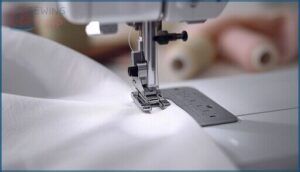
Once you attach the buttonhole foot to your machine, it acts as a guide that sizes and stitches each buttonhole automatically. The foot holds your button in place while the machine follows its measurements to create the opening.
Let’s walk through how the foot measures, marks, and stitches so you can use it with confidence.
The Buttonhole Sewing Process
Think of your sewing machine as the conductor and the buttonhole presser foot as the orchestra. Once you lower the presser foot and engage the buttonhole lever, automatic sequencing takes over—the machine stitches a dense zigzag down one side, forms a bartack, travels back up the opposite side, and finishes with a final bartack.
Proper fabric preparation and thread tension guarantee your buttonhole making produces clean, professional results every time.
For a similar hands-on approach to fabric manipulation, check out this guide on how to make rips in your jeans using the same stabilizing technique with a cutting mat.
Measuring Buttonhole Size With The Foot
Most buttonhole presser feet include a built-in guide scale that works with your needle plate markings for accurate buttonhole measurement. Place your button in the foot’s helper channel, then check how the resulting buttonhole size compares to your button’s diameter.
Key factors affecting measurement include:
- Fabric thickness and weave density
- Presser foot slot width relative to fabric edge
- Buttonhole setting and stitch width parameters
- Button shape (flat versus raised styles)
- Stabilizer type used between fabric layers
Always test on scrap fabric matching your project’s weave and stabilizer to confirm the finished buttonhole accommodates your button properly.
Using Markings and Guides Effectively
Red marks, center lines, and engraved scales on your buttonhole foot aren’t decorative—they’re precision tools for fabric alignment and guide calibration. Position your fabric’s start mark directly under the needle, aligning it with the foot’s front reference line. This establishes where stitching begins and ends.
For accurate button sizing, match your garment’s centerline marking with the foot’s vertical guide, ensuring consistent stitch optimization across multiple buttonholes using proper marking techniques.
Preparing Your Machine for Buttonhole Sewing
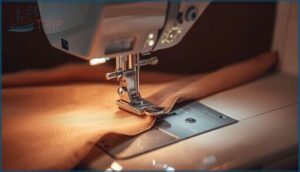
Before you start sewing buttonholes, you’ll need to get your machine ready—and it’s easier than you might think. The setup involves three quick steps: attaching the foot correctly, selecting the right stitch setting, and placing your button in the designated slot.
Let’s walk through each one so you can start making perfect buttonholes with confidence.
Attaching The Buttonhole Presser Foot
Attaching your buttonhole presser foot is as simple as a snap—literally, because that’s exactly how most of them connect to your machine.
First, remove your current presser foot by raising the presser bar and releasing the foot. Then, position the buttonhole foot directly under the presser bar attachment, and it’ll click into place. You’ll hear that satisfying snap when it’s secure—no tools needed for these snap-on presser feet.
Setting Up Buttonhole Stitch Options
Now that your buttonhole foot’s locked in, you’ll need to dial in the right stitch setting on your machine—and this step varies depending on whether you’ve got a mechanical workhorse or a digital whiz.
For mechanical machines with 4-step buttonhole settings:
- Select your buttonhole setting, usually marked as steps 1 through 4
- Adjust stitch length to match your fabric type—tighter for lightweight materials
- Check thread tension so your buttonhole stitches lay flat and even
- Match sewing speed to your comfort level, especially when learning
For digital machines with automatic buttonhole functions:
- Choose the one-step automatic buttonhole option from your stitch menu
- Let the machine calculate stitch length based on button size
- Verify presser foot pressure suits your fabric thickness
- Trust the sewing machine to handle tension automatically
Inserting The Button Into The Foot
Your buttonhole foot has a clever trick up its sleeve—a little slot at the back that holds your button and automatically measures the perfect buttonhole length for you. Just slide your button into that slot until it sits snug against the stopper.
This button alignment ensures foot calibration works perfectly, giving you sewing accuracy without guesswork. The presser foot now knows exactly how much fabric tension and stitch quality you’ll need for a faultless result.
Step-by-Step Guide to Sewing Buttonholes
Now that your machine is set up and ready, you’re just a few steps away from creating professional buttonholes. The process itself isn’t complicated, but following the right sequence makes all the difference between a clean, sturdy buttonhole and a frustrating mess.
Let’s walk through each step, from marking your fabric to sewing the final buttonhole on your project.
Marking Buttonhole Placement on Fabric
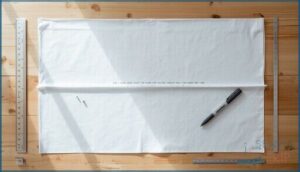
Before you clip on your buttonhole foot, you’ll need clear placement guidelines on your fabric—this step makes or breaks garment symmetry and sewing accuracy. Here’s how to mark buttonholes correctly:
- Find your garment’s center line (usually 5/8 inch from the edge) and draw it on-grain with fabric marking tools like chalk or washable pens.
- Space buttonholes evenly, usually 2 to 3.5 inches apart, using a seam gauge for consistency.
- Mark horizontal buttonholes so they start about 1/8 inch toward the edge from center, letting the button rest properly when fastened.
- Test your marks on scrap fabric first—buttonhole alignment affects how your finished garment hangs and fastens.
For vertical buttonholes, center them directly on your marked line. Horizontal ones work better for larger buttons and reduce gaping at stress points.
Positioning and Securing Fabric
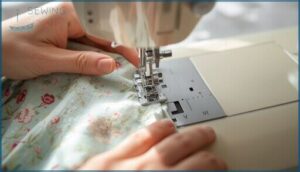
Once your marks are ready, align the buttonhole start with your presser foot’s center guide line, then lower the foot firmly—this holds fabric steady while you stitch. If you’re working with lightweight or stretchy material, slip a small stabilizer underneath to prevent puckering and keep those parallel sides crisp.
| Fabric Alignment Task | Technique |
|---|---|
| Position buttonhole mark | Center under needle guide |
| Secure fabric layers | Lower presser foot completely |
| Control feed on stretch fabrics | Add tear-away stabilizer beneath |
| Orient stitch direction | Match foot slider to machine’s sequence |
| Adjust tension for dense stitching | Test presser foot pressure first |
For knits or loosely woven textiles, combining interfacing on the wrong side with stabilizer use underneath gives you double insurance against distortion—your buttonhole foot can’t fix fabric that shifts mid-stitch. Guide the fabric lightly with your hands rather than pulling, letting the feed dogs do their job while the buttonhole foot’s grip maintains control.
Running a Test Stitch on Scrap Fabric

Before you touch your actual project, grab a scrap piece that matches your garment fabric—same weight, same weave, and fold it to mirror the number of layers you’ll stitch through.
Set your stitch width around 4 to 5 mm and length near 0.5, then run a full test buttonhole with your presser foot to check stitch quality, thread tension, and whether your button actually fits through.
Creating Buttonholes on Your Project
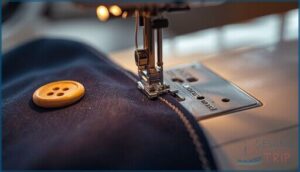
Once your test stitch looks clean and the button slides through without a fight, you’re ready to work on the real thing.
Double-check your buttonhole placement marks, position the fabric under the presser foot, and engage your sewing machine’s automatic buttonhole function. Keep your sewing speed steady—not too fast—so the machine maintains consistent stitch quality across all four sides of each buttonhole.
Troubleshooting and Buttonhole Foot Maintenance
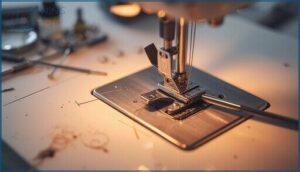
Even with the right setup, you’ll run into hiccups from time to time—fabric that won’t feed, stitches that skip, or buttonholes that turn out lopsided. Knowing how to troubleshoot these issues and keep your buttonhole foot in good shape will save you frustration down the road.
Let’s walk through the most common problems, basic maintenance, and how to make sure your foot works with your machine.
Common Buttonhole Sewing Issues
Even with the right foot attached, buttonholes can go sideways—literally—when fabric bunches, stitches skip, or the feed dogs refuse to cooperate.
Fabric distortion happens when you’re missing stabilizer underneath, while thread breakage points to tension that’s too tight. If your automatic buttonhole produces uneven stitch density or poor buttonhole alignment, adjust your presser foot pressure and check that your fabric tension isn’t fighting the sewing machine’s rhythm.
Cleaning and Storing The Presser Foot
A little presser foot maintenance goes a long way in keeping your buttonhole foot sharp and ready. Here’s how to protect this essential sewing accessory:
- Wipe it down after each project—use a soft brush or damp cloth with mild soap to lift lint and thread fragments from grooves.
- Dry thoroughly before storage to prevent rust on metal components.
- Store in a compartmentalized box with a small desiccant pack to control humidity.
- Attach and remove gently—forcing the snap-on mechanism stresses plastic housings and bends metal guides.
These simple sewing machine maintenance habits keep your buttonhole foot stitching clean, straight buttonholes for years.
Ensuring Compatibility With Your Machine
Not every buttonhole foot plays nicely with every sewing machine, so checking compatibility upfront saves you from frustration and wasted money.
Start by identifying your machine’s shank type—most low-shank household sewing machines accept snap-on presser feet directly, while high-shank models need adapters. Check your manual for specific buttonhole foot requirements, particularly whether your machine uses 1-step or 4-step buttonhole settings, since that determines which foot design you’ll need.
Frequently Asked Questions (FAQs)
Can you sew buttonholes on thick fabrics?
Can your sewing machine handle thick fabrics? Yes, but success depends on fabric thickness limits—usually 6-8mm.
You’ll need buttonhole stabilizers, proper presser foot pressure adjustments, and heavy-duty buttonholes with interfacing for coating wool or denim projects.
How do you add cording to buttonholes?
You’ll fold a length of cord in half, hook the loop over your buttonhole foot’s anchor pin, then let the zigzag stitches encase both strands as you sew for durable buttonhole reinforcement.
What thread works best for buttonhole stitching?
You’ll want all-purpose polyester thread for most buttonhole settings—it’s strong, flexible, and works across fabric types.
Cotton thread suits natural weaves, while heavy-duty options strengthen high-stress areas using specialized sewing techniques.
Can buttonholes be sewn on knit fabrics?
Wondering if your stretchy knit will hold a buttonhole? Yes, you can sew buttonholes on knit fabrics using your buttonhole foot, but you’ll need interfacing techniques and stabilizer materials to prevent fabric distortion and guarantee clean, lasting results.
How do you open buttonholes after sewing?
Use a seam ripper or buttonhole cutter to carefully slice between stitches, working from the center outward.
Insert pins at each end first—they’ll stop your blade and prevent accidental cuts through the bartacks.
Conclusion
That first buttonhole you sew with proper foot placement won’t look like guesswork—it’ll look intentional. The slider stops where you need it, the guide marks line up, and the stitches lock without puckering.
This buttonhole presser foot guide gives you the mechanical advantage to produce uniform results every time, whether you’re working with silk or canvas. Practice the sequence on scraps until muscle memory takes over, then watch your garment details transform from homemade to handcrafted.