This site is supported by our readers. We may earn a commission, at no cost to you, if you purchase through links.

The industrial sewing market is undergoing its most significant transformation in decades, driven by automation technologies that can cut labor costs by up to 50% while maintaining precision standards that were impossible just five years ago. IoT-enabled machines now communicate directly with production management systems, adjusting tension and stitch patterns in real time based on fabric density readings.
For manufacturers deciding between contract sewing partnerships and capital equipment investments, the calculus has fundamentally changed—especially as the global industrial sewing equipment market accelerates toward a projected $5.4 billion valuation by 2034.
Your choice between outsourcing to specialized providers or upgrading in-house capabilities now depends on factors that extend far beyond simple cost-per-unit calculations, encompassing lead time flexibility, material handling capabilities, and access to emerging smart textile technologies that are reshaping both apparel and non-apparel production sectors.
Table Of Contents
Key Takeaways
- Automation technologies in industrial sewing now cut labor costs by up to 50%, while IoT-enabled machines communicate with production systems in real time, adjusting tension and stitch patterns based on fabric density readings.
- Your choice between contract sewing and capital equipment investment depends on factors beyond cost-per-unit calculations, including lead time flexibility, material handling capabilities, and access to emerging smart textile technologies across both apparel and non-apparel sectors.
- The global industrial sewing equipment market is accelerating toward a projected $5.4 billion valuation by 2034, driven by AI-powered pattern recognition, servo motors that reduce energy consumption by 70%, and predictive maintenance systems that deliver 20-30% productivity gains.
- Material selection for protective covers and carrying cases hinges on four performance pillars—abrasion resistance measured in Martindale cycles, waterproof ratings via hydrostatic head, UV resistance validated through ASTM G154, and barrier properties meeting MIL-PRF-121 standards for industry-specific applications in medical, military, and industrial verticals.
Comparing Leading Commercial Sewing Services
Choosing the right commercial sewing service can make all the difference for your project’s success. You’ll want to weigh your options based on production needs, specialty capabilities, and flexibility.
Here’s how the leading solutions stack up.
Contract Sewing Vs. In-House Production
When you weigh contract sewing against in-house production, the differences are clear. Outsourcing slashes costs, boosts scalability, and shortens lead times. You also gain access to commercial sewing capabilities without hefty investments. Southeast Asia dominates sewing outsourcing, driven by lower labor costs. Here’s what sets them apart:
- Cost Comparison: Up to 50% savings
- Scalability Factors: Rapid adjustment
- Quality Control: Third-party checks
- Lead Times: 4–6 weeks
- Market Trends: Steady outsourcing growth
Specialty Sewing Capabilities (Apparel, Equipment Covers, Bags)
Shifting from cost comparisons, let’s talk specialty sewing. Today’s commercial sewing machines handle everything from precision Apparel Stitching to improved Cover Durability for equipment. Automation Integration boosts speed and accuracy, especially in Bag Customization. With modern Thread Technology, you can expect durable seams in Bags and Protective covers.
The Market size is currently at $10.7 billion. These capabilities are the backbone of high-quality Apparel Manufacturing and industrial sewing equipment.
Customization and Flexibility for Projects
Once you’ve nailed down specialty capabilities, your next challenge is matching project demands with Design Adaptability. Custom sewing solutions let you pivot quickly—Rapid Iterations fueled by digital pattern tools and Flexible Production cells that handle prototypes or full runs.
Material Expertise ensures you choose the right fabrics for durability, while Agile Outsourcing gives you Commercial sewing capabilities without tying up capital. Customization becomes your competitive edge.
Short Runs Vs. Large-Scale Contracts
Beyond customization, you need to assess run size against your bottom line. Short production runs of 50–100 units deliver 20–35% margins, yet higher per-unit costs challenge startups. Large-scale contracts spread fixed expenses, improving scalability advantages and production efficiency.
Consider three factors:
- Minimum Quantities—Select contractors accept 50 units; overseas facilities demand hundreds.
- Cost Differences—Mass production (5,000+ units) yields 8–15% margins versus 20–35% for small batches.
- Market Segmentation—Volume production sewing reached $10 billion in 2024, reflecting strong commercial contracts.
Protective Covers and Carrying Solutions
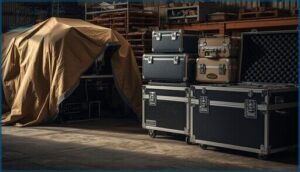
Protective covers and carrying cases do more than just shield your equipment—they keep operations running smoothly when gear moves between sites or sits exposed to the elements. Your choice of enclosure depends on what you’re protecting, where it’s going, and what threats it faces along the way.
Let’s look at the core options commercial sewing services produce for different protection and transport needs.
Types of Protective Covers for Equipment
Equipment covers aren’t one-size-fits-all—your machine needs protection suited to its environment. Heavy-duty PVC-coated polyester delivers waterproof environmental protection for outdoor machinery, while lightweight solution-dyed fabrics handle indoor dust and UV exposure.
Contract sewing services build protective cover manufacturing around material performance and industry standards, ensuring your equipment inventory stays operational longer.
Customization options let you specify cover lifespan based on real-world demands, from telescopic CNC way covers to sterile medical barriers.
Custom Carrying Case Manufacturing
Custom bag production transforms generic carryalls into custom logistics assets. Contract sewing services translate design specifications into durable solutions—cases that protect precision instruments, secure military gear, and organize trade show hardware.
Manufacturing processes leverage Berry-compliant textiles and ballistic fabrics to meet market demand across medical, defense, and industrial sectors. Quality control ensures your carrying cases perform in harsh environments.
Commercial sewing capabilities include:
- Holsters and zipper pouches for device-specific access
- Irregular soft cases fitted to surveying equipment
- Vests and irregular shapes configured for mobile systems
Material Selection for Durability and Protection
Material selection determines whether your protective gear survives the field or fails under pressure. You’ll choose fabrics based on four performance pillars—abrasion resistance measured in Martindale cycles, waterproof ratings via hydrostatic head, UV resistance validated through ASTM G154, and barrier properties meeting MIL-PRF-121. Quality control ensures raw materials deliver predictable results.
| Property | Performance Standard |
|---|---|
| Abrasion Resistance | 50,000 Martindale cycles (Cordura 1000D) |
| Waterproof Ratings | 1,500–3,000 mm hydrostatic head |
| UV Resistance | ASTM G154 accelerated weathering |
| Barrier Properties | MIL-PRF-121 puncture and seam strength |
| Composite Fabrics | Ripstop constructions, high-tenacity weaves |
Heavyweight materials like ballistic nylon and composite fabrics deliver superior protection when weaving reinforcement yarns into ripstop patterns, localizing damage before catastrophic failure occurs.
Industry Applications (Medical, Military, Industrial)
You’ll deploy protective textiles across three demanding verticals—medical, military, and industrial—each requiring custom solutions backed by compliance frameworks.
Medical applications demand ISO 13485 certification for wearable devices and surgical drapes, while military durability hinges on MIL-PRF-grade materials surviving extreme conditions.
Industrial automation drives protective equipment manufacturing using industrial sewing machines and commercial contract sewing capabilities, delivering covers and carrying cases engineered for workplace hazards and regulatory standards.
Evaluating Industrial Sewing Equipment
When you’re ready to invest in industrial sewing equipment, the right machine can make or break your production line. Your choice depends on the brands you trust, the automation features you need, and whether you’re working with specialty materials that demand heavy-duty performance.
Let’s walk through the key factors that’ll help you choose equipment that matches your operation’s demands.
Top Brands and Machine Types (Juki, Pegasus, Consew, Etc.)
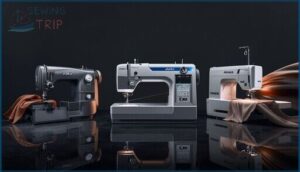
When you’re choosing industrial sewing machines, brand comparison comes down to matching your production needs to proven performance. Juki sewing machines dominate apparel manufacturing with high-speed lockstitch and overlock units accounting for roughly half their net sales—their 24% year-over-year growth reflects strong Juki performance across global markets.
Pegasus overlock machines deliver around 7,000 stitches per minute for sportswear and fashion apparel, while Consew durability shines in heavy-duty applications, with models like the P1206RB handling leather, vinyl, and canvas at 3,000 stitches per minute.
Machine segmentation by fabric weight guides your decision: lighter knits suit Pegasus sewing equipment, heavier upholstery demands Consew sewing power, and full-line suppliers like Juki cover both ends of the spectrum with specialized industrial sewing machines for lockstitch, buttonhole, and bartack operations.
Automation and Advanced Machine Features

Today’s industrial sewing machines integrate automation features that fundamentally reshape your production floor. Smart systems with servo motors cut energy use by up to 70%, while computerization benefits extend to programmable stitching, automated threading, and real-time quality monitoring.
Consider these Industry 4.0 advances driving sewing automation:
- IoT connectivity for predictive maintenance and remote diagnostics
- AI-powered pattern recognition ensuring quality consistency across runs
- Touchscreen interfaces with digital pattern storage reducing setup time
- CNC programmable stitching equipment executing complex geometries with minimal input
- Servo motor options delivering precise control and labor optimization
Manufacturers report 20–30% productivity gains when you deploy connected sewing automation equipment.
Equipment for Heavy-Weight and Specialty Materials
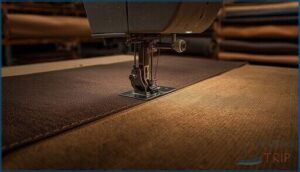
When you’re working with canvas, leather, or technical textiles, your machine needs more than speed—it needs punch. Heavy-duty machinery delivers penetration forces exceeding 150–200 newtons, enabling multi-layer stitching without motor stall. Consider which machine classes match your textile applications:
| Machine Class | Ideal For | Key Advantage |
|---|---|---|
| Walking-foot | Upholstery, luggage | Even feed on thick layers |
| Cylinder-bed | Bags, footwear | Works with tubular pieces |
| Post-bed | Shoe uppers, structured bags | Precise vertical seam placement |
| Long-arm flat-bed | Awnings, tarps, covers | Wide-panel handling |
The heavy-duty sewing machines segment reached $1.60 billion in 2024, with market scale projected at $2.50 billion by 2035.
Recent developments include Juki and Consew’s 2024 partnership on high-speed automotive machines, while Brother’s HD-9000 series targets leather and denim. Expect industrial sewing machines with specialized cutting equipment and weaving capabilities to command $4,000–5,000 per unit, reflecting reinforced frames and synchronized feed systems that conquer aramid, carbon fiber, and coated fabrics.
Sourcing OEM Parts and Maintenance Services

Genuine OEM parts from manufacturers like Juki cost 40–60% more than aftermarket alternatives, yet they deliver measurable downtime reduction. Structured maintenance can cut monthly stoppages from four hours to one, saving roughly $2,742.
When you’re sourcing replacement parts supply, weigh immediate savings against cumulative failure costs; non-OEM components often trigger repeat service calls.
Look for equipment parts and service contracts that bundle maintenance training with genuine parts benefits for long-term reliability.
Manufacturing Processes and Production Models
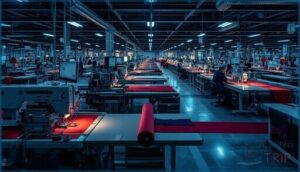
When you’re ready to move from concept to finished product, understanding how manufacturers handle the production process makes all the difference. Different production models offer varying levels of control, speed, and customization depending on your project needs.
Let’s compare the key manufacturing approaches and what each brings to your operation.
Cut and Sew Vs. Full-Service Manufacturing
When you’re weighing outsourced manufacturing processes, the service scope separates cut-and-sew contracts from full-service models. Cut-and-sew vendors handle fabric cutting and assembly once you supply materials, while full-service partners manage design, sourcing, and production timelines end-to-end.
- Cut-and-sew: 4–6 weeks, lower order minimums, you control upstream quality control
- Full-service: 6–8 weeks, higher MOQs, integrated quality control and sourcing
- Cost structure: CMT favors experienced brand profiles; FPP suits startups
- Risk allocation: Full-service consolidates supply-chain management under one roof
Fabric Cutting, Sewing, and Finishing Solutions
Fabric cutting sets the tone for your entire workflow—automated CNC blade and laser cutters now push marker efficiency past 85%, slashing the 13–23% material waste typical in manual layouts.
Automated CNC and laser cutters now deliver over 85% marker efficiency, cutting fabric waste by half compared to manual methods
Sewing equipment distribution channels supply IoT-enabled machines that lift line productivity 25% through predictive maintenance, while energy-optimized finishing quality systems cut utility costs and guarantee consistent handle across runs.
Integrated systems link all three stages, tightening tolerances and accelerating turnaround.
Prototype Development to Full-Scale Production
From first prototype to full-scale production, you’ll navigate Scaling Challenges and Cost Optimization with every step. Timeline Management hinges on rapid sample approvals and reliable supplier lead times, while Quality Assurance keeps your specs locked in as volumes grow. Operational Readiness? That’s your insurance—standard procedures and dependable equipment make the jump from custom sewing projects to repeatable production runs smooth.
- Prototype sampling and approvals
- Scaling Challenges and cost controls
- Quality Assurance checkpoints
- Operational Readiness for bulk runs
Material Management and In-House Design Support
When you’re balancing material management and in-house design, every decision counts. CAD optimization trims fabric waste, while inventory control keeps your workflow agile—not bogged down by excess stock. PLM integration bridges design services with production, supporting zero-waste design approaches. That’s how in-house design services and smart material selection turn challenges into advantages.
| Strategy | Benefit |
|---|---|
| CAD Optimization | Less Fabric Waste |
| Inventory Control | Agile Production |
| PLM Integration | Fluid Workflow |
| Zero-Waste Design | Higher Utilization |
| Inhouse Design | Custom Solutions |
Market Trends in Commercial Sewing Solutions

If you’re keeping an eye on where commercial sewing is headed, there’s plenty to watch in 2025. New technologies, shifting production centers, and changing market demands are shaping the landscape.
Here’s what you should know about the key trends driving the industry forward.
Growth of Automated and Smart Sewing Technologies
Imagine a production line where AI-powered sewing and robotic integration work in sync, transforming how you approach efficiency and quality.
Smart textiles, predictive maintenance, and digital twins are now central to sewing automation. With sophisticated sewing automation equipment, you gain real-time control, faster cycles, and fewer errors—making modern sewing machines and automation solutions indispensable for competitive manufacturing.
Global Production Hubs and Distribution Networks
You’re operating in an industry where Asia-Pacific commands over 62% of global apparel revenues, anchoring the sewing industry’s distribution flows. Yet nearshoring patterns are reshaping traditional routes as brands balance speed with scale.
- Asian dominance through China, Vietnam, and Bangladesh supplies most U.S. and EU markets via established global distribution networks.
- Nearshoring patterns in Turkey and Eastern Europe cut lead times for European textile industry buyers.
- Sourcing intermediaries in Hong Kong and Taiwan coordinate multi-country manufacturing and commercial contracts.
- Specialized products—military gear, medical PPE—anchor domestic U.S. sewing hubs serving strategic distribution channels.
Industry Statistics and Market Projections
The global sewing industry sits at a crossroads: industrial sewing machines climbed from USD 3.6 billion in 2024 to a projected USD 5.4 billion by 2034, driven by automation impact and IoT integration.
Market growth in the sewn products industry and textile industry reflects regional analysis showing U.S. consumption surging 21% year-over-year.
Segment forecasts point to smart machines pacing the apparel manufacturing industry and nonapparel sewing solutions alike, with trend drivers favoring precision over labor.
Emerging Demands in Apparel and Non-Apparel Sectors
Smart textiles are reshaping apparel as sensor-integrated fabrics climb from USD 2.43 billion in 2025 toward USD 6.42 billion by 2032.
Meanwhile, PPE demand and technical textiles push nonapparel growth past traditional garment rates—medical gowns, protective gear, and industrial covers require sewing capabilities that blend automation impact with precision.
Regional growth in Asia Pacific and renewed commercial contracts signal you’ll need sewing services ready for both sectors.
Frequently Asked Questions (FAQs)
What certifications do commercial sewing providers typically hold?
Reputable providers maintain ISO 9001 quality control certifications, OEKO-TEX chemical safety labels, and social compliance credentials like WRAP or SA
These buyer requirements validate your partner’s commercial sewing capabilities, training courses, and GOTS standard adherence for commercial contracts.
How do you calculate pricing for custom sewing projects?
You’ll calculate pricing by combining material sourcing costs (60-70% of total), labor costing at $18 per hour, overhead allocation, and profit margins using standard pricing models for contract sewing services.
What are typical turnaround times for sewing orders?
A small boutique brand needs 200 bags by month’s end—will your contract manufacturing partner deliver?
Typical sewing services complete prototypes in 10–18 days. Production capacity, material sourcing, order complexity, and shipping times determine final turnaround, especially when design changes arise.
How do you ensure quality control throughout production?
Quality control in manufacturing services starts with material defect checks, inline stitch inspections, and statistical process control. Pre-production samples verify specifications before scaling, while final shipment AQL standards make sure commercial contract sewing meets compliance requirements.
Conclusion
Picture your production line humming with the precision of synchronized robotics, fabrics moving through stations like a well-rehearsed orchestra. That’s where commercial sewing solutions are heading—whether you’re partnering with specialized contractors or investing in modern equipment.
Your decision hinges on matching capabilities to your specific production demands, understanding where automation delivers ROI, and recognizing that the smartest manufacturers aren’t choosing sides—they’re strategically blending both approaches to dominate their markets.
- https://www.expertmarketresearch.com/reports/industrial-sewing-machines-market
- https://www.grandviewresearch.com/industry-analysis/sewing-machine-market-report
- https://www.indexbox.io/blog/industrial-sewing-machine-world-market-overview-2024-3/
- https://www.datainsightsmarket.com/reports/automated-industrial-sewing-machinery-39079
- https://3laws.io/pages/Humanoids_and_the_Future_of_Cut_and_Sew_Apparel_Contractors.html