This site is supported by our readers. We may earn a commission, at no cost to you, if you purchase through links.
A rotary cutter without a mat is like a sharp knife on a glass countertop — something’s going to get damaged, and it won’t be the fabric.
Most beginners discover this the hard way, pressing a fresh 45mm blade straight into a wooden table and wondering why their cuts still look ragged.
The mat isn’t just a protective layer.
It’s the other half of the tool.
Cutting mats work with rotary cutters by absorbing blade pressure evenly, keeping the edge sharp, and giving you a stable, gridded surface that makes accurate cuts repeatable.
Get the right mat under your cutter, and precision stops being a struggle.
Table Of Contents
Key Takeaways
- A cutting mat isn’t just table protection — it actively works with your rotary cutter to distribute blade pressure evenly, keeping your edges clean and your blade sharp far longer.
- Mat thickness between 3.0 and 5.0 mm hits the sweet spot: sturdy enough to resist grooves, smooth enough to let your blade roll without drag.
- Match your mat size to your workspace first — a 24×36‑inch mat handles most quilt blocks without repositioning, while anything smaller than 18×24 inches will slow you down on bigger projects.
- When your mat shows deep grooves you can feel, it takes more pressure to cut through, or snags fabric mid‑stroke, it’s done — no amount of cleaning or care will bring it back.
Do Cutting Mats Work With Rotary Cutters?
Yes, cutting mats work extremely well with rotary cutters — they’re practically made for each other. The mat gives the blade a controlled surface to roll across, which keeps your cuts clean and your table scratch‑free.
If you’re setting up a dedicated space, browsing cutting mats designed for home sewing rooms can help you find the right size and grid markings for your workflow.
Here’s what makes that partnership work so well.
How Cutting Mats and Rotary Cutters Work Together
Pairing a rotary cutter with a self-healing cutting mat is straightforward once you understand how they work together. The mat’s layered PVC surface manages blade pressure distribution evenly, so the blade doesn’t dig in or skip.
Material compatibility matters too — the soft surface grips fabric while protecting your table.
Grid lines keep your cuts aligned, and the mat quietly absorbs noise reduction during each pass.
Why a Cutting Mat is Essential for Rotary Cutting
Without a protective surface underneath, a rotary cutter chews through blades quickly and damages your table. A self-healing cutting mat addresses both problems.
It gives you fabric glide control, so material stays put during each pass. It also maintains blade sharpness preservation by absorbing just enough pressure — not too much, not too little.
That balance alone makes it worth every cent for cost efficiency.
Benefits of Using a Mat for Fabric Cutting Precision
A mat does more than just protect your table. The self-healing cutting mat surface keeps your blade sharp longer by absorbing pressure evenly, which means better blade sharpness retention with every pass.
The grid lines support consistent cut angles and improved pattern alignment, so your pieces match up when it’s time to sew.
You also get reduced fabric stretch and minimized edge fraying — two wins that make precision cutting feel smooth.
Key Features to Look for in a Rotary Cutter Mat
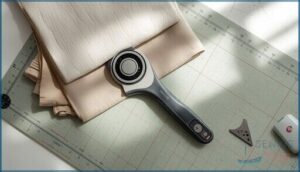
Not every cutting mat is built the same, and the differences matter more than you’d think.
The right mat can make your cuts cleaner, your blade last longer, and your whole workflow feel steadier.
Here are the key features worth paying attention to before you buy.
Self-Healing Surface Technology Explained
Think of a self-healing cutting mat as a surface with a kind of built-in memory. When your rotary cutter slices through, the PVC layers use reversible bonds and microcapsule release to close back up.
Protecting that self-repair mechanism is simple—check out these cutting mat storage and care tips for sewers and scrapbookers to keep your mat flat and away from the heat that breaks down those bonds over time.
A self-healing cutting mat remembers every slice, closing back up after each rotary cutter pass
Some mats rely on intrinsic healing — the material itself rebounds. Others use vascular networks that redistribute filler into cut channels.
Either way, your work surface protection stays intact cut after cut.
Grid Lines and Measurement Markings for Accuracy
Across most quilting mats, grid lines are printed in 1‑inch increments, with subdivision line clarity at ¼ and ⅛‑inch intervals for fine work.
Laser‑etched durability keeps measurement markings sharp after thousands of cuts.
Contrast color coding separates primary and secondary lines so your eye reads the surface fast.
Centerline alignment helps you match fabric grain, while angle guide precision — usually 45 and 60 degrees — keeps your rotary cutter on track.
Non-Slip Backing and Stability During Cuts
sliding mat ruins cuts before you even finish the stroke. That’s why a quality rotary cutter mat uses a rubberized underside paired with micro grip ridges along its chamfered edge design to keep everything locked down.
Some mats offer adhesive backing options for extra hold.
The nonslip surface on a self‑healing cutting mat, usually PVC material, reduces movement by up to 40 percent — giving you confident, steady cuts every time.
Self-healing cutting mats provide durable, long‑lasting surfaces that protect both blades and workbenches.
Thickness and Durability for Long-Term Use
Thickness matters more than most beginners expect.
A cutting mat in the 3.0 to 5.0 mm ideal thickness range gives you the right balance — durable enough to resist blade impressions, light enough for smooth rotary cutter travel.
Self‑healing layers made from quality PVC material close up after each cut. Combined with material density that provides warp resistance and edge reinforcement, your mat stays flat and reliable for years.
Choosing The Right Cutting Mat Size for Your Project
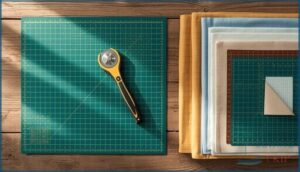
Mat size matters more than most beginners expect.
right fit depends on your workspace, the projects you tackle, and how much fabric you’re working with at once.
Here’s what to think about before you buy.
Common Mat Sizes for Quilters and Sewists
Mat size makes or breaks your workflow. Here are the most common options quilters and sewists rely on:
- Portable 12×18 — fits small tables and project bags
- Standard 18×24 — a go-to for everyday cutting mat and rotary cutter tasks
- 24×36 — accommodates most quilt blocks comfortably
- Full‑size 48×96 — ideal for wide fabric layouts
- Rollable foam core — lightweight and easy to store
Matching Mat Size to Your Workspace
workspace dimensions should guide every size decision. If your desk is around 30 inches wide, a 24- to 26-inch cutting mat fits without crowding your ruler or pins.
Leave at least 6 inches of edge clearance on your dominant cutting side.
For portability constraints, a lighter mat under 4 pounds repositions easily.
surface compatibility matters too — your mat must lay completely flat for clean rotary cutter cuts.
Best Sizes for Small Versus Large Fabric Pieces
The right cutting mat size comes down to what you’re cutting. A 12×18 inch mat accommodates small pieces like 6×6 inch squares cleanly — grid density at 1-inch intervals keeps your corners sharp. Large fabric pieces need at least 24×36 inches for full-width cuts without repositioning.
- Small pieces: high grid density, less mat edge clearance needed
- Large pieces: fabric weight compatibility demands stable, broad backing
- Portability tradeoffs favor smaller mats for travel kits
How to Cut Fabric With a Rotary Cutter on a Mat
Once you’ve got the right mat in front of you, the real work begins.
Cutting fabric well comes down to a few simple habits — and once you build them, clean cuts become second nature.
Here’s what to focus on each time you pick up your rotary cutter.
Setting Up Your Mat and Fabric Correctly
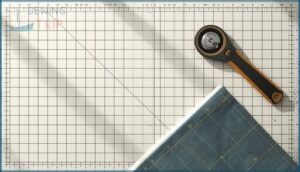
Before your rotary cutter touches the mat, surface preparation matters. Clean the self-healing cutting mat with mild soap and dry it completely.
Align your fabric so the grain runs parallel to the grid lines — this is grain alignment in practice. Smooth out wrinkles, then secure edges with fabric clips. Grid positioning means placing your cut zone within the center of the angle guides, not at the mat’s edge.
Using a Ruler as a Cutting Guide on The Mat
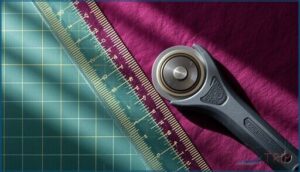
Once your fabric is flat and aligned, a clear acrylic slip-resistant ruler becomes your best cutting partner. Place it directly along the mat’s grid lines — that’s your grid-line calibration check.
Before cutting, run your finger along the ruler’s edge for any burrs from edge-burr inspection habit. Press firmly, guide your rotary cutter along the ruler, and your line stays true every time.
Safety Precautions When Using a Rotary Cutter
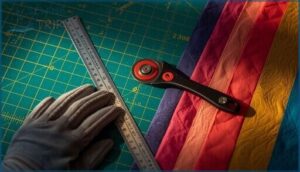
steady ruler hand means nothing if your blade stays open between cuts. blade retraction is non‑negotiable — close the rotary cutter the moment you lift it.
hand positioning, curl your fingers away from the blade’s path, never over the ruler’s edge. protective gloves on your ruler hand.
proper body posture, and keep your self‑healing cutting mat clear of pins or metal objects.
self-healing cutting mat protects the blade and fabric during cutting.
Common Cutting Mistakes and How to Avoid Them

Even with good safety habits in place, small technique errors can still throw off your cuts. Watch for these:
- Excessive Pressure digs grooves into your self-healing cutting mat.
- Ruler Misalignment causes strips to drift crooked.
- Wrinkled Fabric shifts under your rotary cutter mid-stroke.
- Worn Mat or dull blade forces an interrupted stroke and uneven edges.
One clean, continuous pass fixes most of these.
How to Maintain Your Cutting Mat for Rotary Cutting
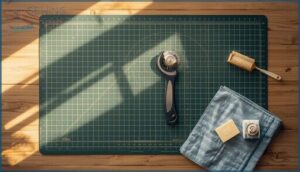
good cutting mat doesn’t take care of itself — but it doesn’t ask for much either. A little routine maintenance goes a long way toward keeping your cuts clean and your blades sharp.
Here’s what you need to know.
Cleaning Your Mat to Prevent Blade Drag
A dirty mat is the quiet culprit behind blade drag. Start lint removal by pressing a fresh tape strip across the surface — it lifts fuzz from felt, batting, and fleece far better than a lint roller.
For deeper cutting mat maintenance, a soap wash with warm water and gentle dish soap works well. Rub in circles, rinse thoroughly, then use the drying technique of laying it completely flat before your next rotary cutter session.
Storing Your Mat Flat to Prevent Warping
Lay your cutting mat flat — always. A self-healing mat stored on its edge or propped against a wall can develop a permanent curve, ruining your measurement accuracy.
For flat storage solutions, slide it under a bed or onto a wide shelf. Keep it in a temperature-stable environment away from radiators and windows. Light exposure management and smart weight distribution practices protect your mat’s workbench organization and protective surface long‑term.
Recognizing When Your Mat Needs Replacing
Knowing when to retire a cutting mat saves your blades and your work.
Watch for deep grooves you can feel with your fingertips, harder cutting pressure than usual, or fabric snagging mid‑stroke. Warped edges that won’t lie flat and visible wear across the grid lines are clear signals too.
Once self‑healing stops working, no amount of mat maintenance will restore a clean rotary cutter cut.
Tips to Extend Blade and Mat Life Together
Your blade and mat last longer when you treat them as a team — not two separate tools.
- Use light‑touch cutting: steady, minimal pressure lets the rotary cutter blade glide cleanly without grinding into the self‑healing surface.
- Make blade cleaning a habit after each session to clear debris that causes drag.
- Follow a mat rotation schedule if you own multiple mats to distribute wear evenly.
- Practice moisture‑free storage — air‑dry mats completely before putting them away.
- Do monthly blade maintenance checks; swap dull blades before they chew up your cutting mat.
Frequently Asked Questions (FAQs)
Do cutting mats work with rotary cutters?
Yes — cutting mats and rotary cutters are designed to work together.
The mat’s self-healing surface absorbs each pass of the blade, protecting your table while maintaining cutting precision and extending material longevity with every cut.
How to use a rotary cutter?
Hold your rotary cutter vertically and roll it in one smooth motion along a ruler edge.
Keep the blade retracted when not cutting, and never stack more than four fabric layers.
What is a rotary cutting mat?
rotary cutting mat is a flat, self-healing work surface designed to pair with your rotary cutter.
Its layered construction grips fabric, protects your table, and keeps edges clean and accurate.
Can a rotary cutter cut fabric?
A rotary cutter cuts fabric cleanly and precisely. The sharp blade glides through most fabric types with minimal cutting pressure.
For best results, don’t cut more than four layers at once.
Can you use a cutting board with a rotary cutter?
A kitchen cutting board is the wrong tool for the job. It causes blade dullness, surface damage, and safety risks fast. Use a self-healing cutting mat instead.
What can you use instead of a rotary cutting mat?
If you’re in a pinch, a plastic board, wooden board, thick neoprene, acrylic sheet, or corrugated cardboard can substitute your self-healing cutting mat — though none protect your rotary cutter blade as well long-term.
Is there a trick to using a rotary cutter?
Yes — keep the blade upright and let it roll with steady, even pressure.
Align fabric using grid lines, press the ruler firmly, and maintain a consistent cutting speed rhythm for clean results.
Can rotary cutters damage glass cutting mats?
Glass mats and rotary cutters are a shatteringly bad match. Blade scratching, edge chipping, and surface abrasion happen fast.
Skip the glass — a selfhealing cutting mat offers real blade protection without the safety hazards.
Are rotating cutting mats worth the extra cost?
Rotating cutting mats cost more upfront — a Martelli 16-inch runs $96 versus $20 for a basic mat — but the time saved trimming HST blocks and the long-term blade protection make them worth it for regular quilters.
Do cutting mats work on uneven surfaces?
flat surface requirement need a flat surface to work properly. A warped or uneven table causes the mat to flex, which throws off your cuts.
Non‑slip backing solutions help with stability on rough tables, but they can’t fix a rocking work surface.
Conclusion
Old-school quilters used to say: measure twice, cut once — and they weren’t wrong, but they also never skipped the mat.
Do cutting mats work with rotary cutters? Absolutely, and without one, you’re fighting your own tools.
The mat protects your blade, steadies your fabric, and turns guesswork into clean, repeatable lines.
Respect the setup, and the setup respects your work. That’s not a tip — that’s the whole system.