This site is supported by our readers. We may earn a commission, at no cost to you, if you purchase through links.
Scaling up an embroidery project sounds exciting—until your hoop keeps slipping, your fabric puckers at the edges, and you’re re-hooping the same section for the third time.
Large-scale work demands more than skill; it demands the right equipment holding everything steady while you focus on the stitching.
hoop that’s too small forces awkward repositioning, while one that’s poorly constructed loses tension halfway through a queen-size quilt back or a full jacket design.
The good news is that choosing the right embroidery hoops for large projects comes down to a handful of clear factors—size, material, and how well the hoop plays with your machine and stabilizer setup.
Get those right, and the rest follows naturally.
Table Of Contents
- Key Takeaways
- 9 Best Embroidery Hoops for Large Projects
- 1. Caydo 16 Inch Embroidery Hoops
- 2. Caydo Large Round Embroidery Hoops
- 3. Caydo Embroidery Hoops Set
- 4. Caydo Bamboo 12 Inch Embroidery Hoop
- 5. CroBlissful Large Wooden Embroidery Hoop Set
- 6. Meccanixity Bamboo Embroidery Hoop
- 7. Falzqq 12 Inch Adjustable Bamboo Embroidery Hoop
- 8. Bamboo Embroidery Hoop for Cross Stitch
- 9. Lemecima Square Rectangle Embroidery Hoops
- How to Choose Hoop Size
- Best Materials for Large Hoops
- Multi-Hooping Large Designs
- What Multi-hooping Means for Oversized Embroidery
- When Large Projects Require Multi-hooping
- Tools Needed for Accurate Re-hooping
- Splitting Designs With Embroidery Software
- Using Registration Marks for Clean Alignment
- Best Beginner-friendly Designs for Multi-hooping
- Difficult Designs to Avoid at First
- Step-by-step Process for Seamless Sections
- Hooping Tips for Oversized Projects
- Choosing Stabilizers for Large Embroidery Areas
- Marking Centerlines and Using Printed Templates
- Preventing Puckering, Gaps, and Overlaps
- Managing Fabric Tension Without Stretching
- Using Adhesive Sprays and T-pins Safely
- Reducing Hoop Burn on Delicate Fabrics
- Cleaning, Storing, and Maintaining Large Hoops
- Common Large-hoop Mistakes and Fixes
- Frequently Asked Questions (FAQs)
- Conclusion
Key Takeaways
- Choosing the right hoop size means measuring your design, adding a 1–1.5 inch buffer around it, and matching the hoop’s shape to your design’s proportions — round for symmetrical work, rectangular for wide horizontal pieces.
- Material matters more than most stitchers realize: wood and bamboo grip best on heavy fabrics, plastic causes hand fatigue on long sessions, and magnetic hoops win on speed when you’re repositioning a large piece repeatedly.
- When your design outgrows a single hoop, multi-hooping is your only clean option — but it only works if you use registration marks, build 4mm overlap zones at joins, and calibrate thread tension before every new section.
- Stabilizer choice is the foundation of every large project: use a single sheet of medium-to-heavyweight cut-away beneath the whole design, add a water-soluble topping on textured surfaces, and always align the stabilizer grain with your fabric weave.
9 Best Embroidery Hoops for Large Projects
Finding the right hoop for a big project can make or break your results. These nine options cover a solid range of sizes, materials, and use cases worth knowing about.
Whether you’re scaling up or just getting started, brushing up on your embroidery hoop terminology and sizing basics helps you choose with confidence.
Here’s what made the cut.
1. Caydo 16 Inch Embroidery Hoops
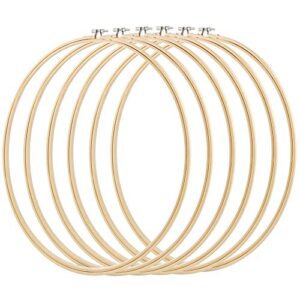
If you’re working on wall hangings, wedding wreaths, or dream-catchers, the Caydo 16 Inch Embroidery Hoops are worth a close look.
You get six hoops per set, each a full 16 inches in diameter, made from smooth, sanded bamboo with a brass adjustment screw.
The large size gives you plenty of room for big, ambitious designs without constant re-hooping.
Just tighten the brass screw by hand, and you’re ready to stitch.
| Best For | Crafters and hobbyists who work on large-scale projects like wall hangings, wedding wreaths, and dream-catchers and need a reliable, roomy hoop. |
|---|---|
| Material | Bamboo |
| Tension Screw | Brass screw |
| Quantity | 6 hoops |
| Shape | Round |
| Use Cases | Embroidery, cross-stitch, fabric painting |
| Smooth Finish | Yes, sanded burr-free |
| Additional Features |
|
- Six hoops in one set — great value, and you’ll always have one on hand when you need it
- The 16-inch size gives you room to work on big designs without constantly moving the hoop
- Smooth bamboo finish means no snagging, and the brass screw tightens easily by hand
- Some users find the adjustment screws stiff and hard to turn, especially right out of the box
- A few hoops have shown up slightly misshapen, which can mess with even tension
- Only one size in the pack — if you need something smaller or larger, you’ll have to shop elsewhere
2. Caydo Large Round Embroidery Hoops
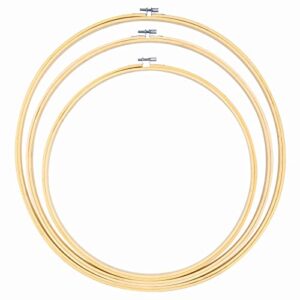
If six identical hoops aren’t quite what you need, the Caydo Large Round set gives you more flexibility.
You get three hoops — 14, 16, and 18 inches — all cut from smooth bamboo with a brass tension screw on each one. That 18-inch hoop is a real workhorse for oversized wall art, quilt panels, or statement pieces.
Each frame is lightweight but holds fabric drum-tight, and the natural wood finish looks clean enough to display your finished work as‑is.
| Best For | Embroiderers and fiber artists who work on large-scale projects like wall hangings, quilt panels, or decorative pieces that need serious hoop real estate. |
|---|---|
| Material | Bamboo |
| Tension Screw | Brass screw |
| Quantity | 3 hoops |
| Shape | Round |
| Use Cases | Embroidery, cross-stitch, needlework |
| Smooth Finish | Yes, sanded smooth |
| Additional Features |
|
- Three sizes in one set (14", 16", 18") means you’re covered for almost any project size
- Smooth bamboo surface keeps fabric snag-free and holds tension like a drum
- Natural wood finish is display-ready — no need to remove your work before hanging it
- Some users have reported cracked or broken hoops, so quality can be hit or miss
- Bamboo doesn’t love moisture — keep these dry or they may warp over time
- No protective caps on the brass screws, so overtightening could damage the frame
3. Caydo Embroidery Hoops Set
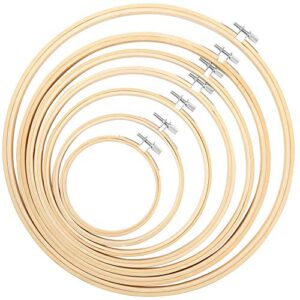
Not everyone needs three giant hoops. Sometimes you just want options.
The Caydo Embroidery Hoops Set gives you seven sizes in one package — 4, 5, 7, 8, 9, 10, and 12 inches — all made from bamboo with stainless-steel anti-skid screws. That range covers everything from small ornaments to decent-sized wall hangings without buying separate hoops each time.
The whole set weighs under a pound and costs $9.99, which is hard to beat for a beginner building out their toolkit.
| Best For | Beginners and hobbyists who want a full range of hoop sizes without spending a lot or making multiple purchases. |
|---|---|
| Material | Bamboo |
| Tension Screw | Stainless-steel screw |
| Quantity | 7 hoops |
| Shape | Round |
| Use Cases | Embroidery, cross-stitch, quilting |
| Smooth Finish | Yes, may need sanding |
| Additional Features |
|
- Seven sizes in one set means you’re covered for everything from tiny ornaments to larger wall hangings.
- Bamboo and stainless-steel construction keeps things lightweight without feeling flimsy.
- At $9.99, it’s one of the best value buys for anyone just starting out in embroidery or cross-stitch.
- The bamboo edges can run a little rough — you might need to do some light sanding before your first use.
- Wooden hoops can take a beating in shipping, so there’s a small chance yours arrives with some damage.
- No extras included — you’ll need to grab your own fabric, thread, and needles separately.
4. Caydo Bamboo 12 Inch Embroidery Hoop
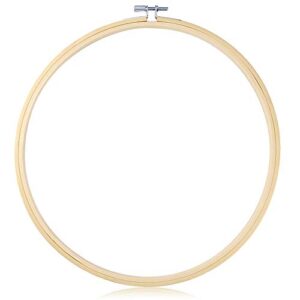
Sometimes you want one hoop that manages the heavy lifting. The Caydo Bamboo 12 Inch Embroidery Hoop does exactly that — a single, solid frame built from polished, splinter-free bamboo with a stainless-steel tension screw that locks your fabric drum-tight.
At roughly 0.13 lb and $8.99, it won’t weigh down your bag or your budget.
The 12-inch diameter suits floral panels, wide borders, and wall-display pieces beautifully.
Just note the rim runs thin, so handle it with care straight out of the bag.
| Best For | Crafters who want a reliable, affordable hoop for mid-sized embroidery, cross-stitch, or wall-display projects. |
|---|---|
| Material | Bamboo |
| Tension Screw | Stainless-steel screw |
| Quantity | 1 hoop |
| Shape | Round |
| Use Cases | Cross-stitch, embroidery, quilting |
| Smooth Finish | Yes, polished burr-free |
| Additional Features |
|
- Polished bamboo feels smooth in hand and looks good enough to frame your finished work
- Stainless-steel tension screw keeps fabric locked in place without slipping
- Lightweight and cheap at $8.99 — easy to toss in a bag and go
- Thin rim means it can snap if you’re not careful right out of the packaging
- Only comes in one size, so larger projects are a no-go
- Minimal packaging offers little protection during shipping
5. CroBlissful Large Wooden Embroidery Hoop Set
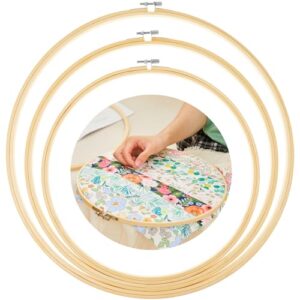
If you’re juggling multiple large projects at once, the CroBlissful Large Wooden Embroidery Hoop Set is worth serious consideration. You get three hoops — 12, 14, and 16 inches — for $29.99, which is solid value.
The smooth, burr-free wood and stainless-steel screws keep tension consistent across cotton, linen, and felt.
Sizes this generous let the hoop rest comfortably on your lap during long hand-stitching sessions.
Just tighten those screws firmly; a loose grip is the only real pitfall here.
| Best For | Crafters who work on multiple large-scale embroidery, quilting, or decorative projects at the same time and want a versatile, lap-friendly hoop set without breaking the bank. |
|---|---|
| Material | Wood |
| Tension Screw | Stainless-steel screw |
| Quantity | 3 hoops |
| Shape | Round |
| Use Cases | Quilting, embroidery, cross-stitch |
| Smooth Finish | Yes, burr-free |
| Additional Features |
|
- Three sizes in one kit — 12, 14, and 16 inches — so you’re covered for almost any project size
- Smooth, burr-free wood won’t snag delicate threads or fabric
- Large enough to rest on your lap, making long hand-stitching sessions way more comfortable
- The screw closures can be stiff and tricky to align, which gets frustrating fast
- Thinner wood means some users notice warping over time, especially with the larger hoops
- Fabric can slip if the screws aren’t tightened just right — tension takes a bit of trial and error
6. Meccanixity Bamboo Embroidery Hoop
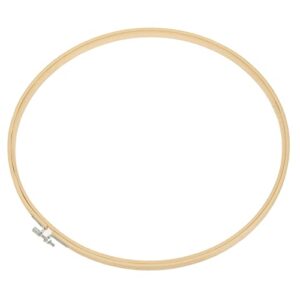
The Meccanixity Bamboo Embroidery Hoop keeps things simple without cutting corners. At roughly 13 inches across, it’s sized well for quilts, wall hangings, and oversized decorative pieces.
Pair it with the right cutting tools by checking out these tips for sewing with heavy fabrics to keep your project clean and frustration-free.
The natural bamboo is smooth and splinter-free, so your hands won’t complain during long sessions.
Its metal tightening screw adjusts tension quickly, and the balanced frame sits flat on a table without tipping.
At $12.29, it’s an affordable pick — just know that heavy fabrics like denim may push its limits.
| Best For | Crafters who want a reliable, budget-friendly hoop for embroidery, cross-stitch, or decorative wall displays. |
|---|---|
| Material | Bamboo |
| Tension Screw | Metal screw |
| Quantity | 1 hoop |
| Shape | Round |
| Use Cases | Embroidery, cross-stitch, quilting |
| Smooth Finish | Yes, splinter-free |
| Additional Features |
|
- Smooth, splinter-free bamboo makes it comfortable to handle during long stitching sessions
- The metal tightening screw adjusts tension quickly and holds fabric reasonably well for lightweight projects
- At $12.29, it’s an easy buy for beginners or anyone who needs an extra hoop without spending much
- Can feel a bit flimsy and may loosen over time, requiring frequent readjustment
- Slight imperfections in the circular shape can leave small gaps where fabric isn’t held tightly
- Not built for heavy fabrics or dense projects — it’s better suited to lighter needlecraft work
7. Falzqq 12 Inch Adjustable Bamboo Embroidery Hoop
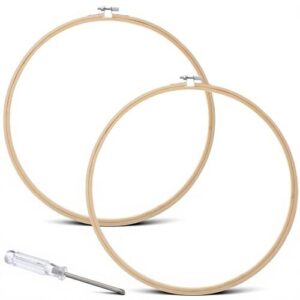
The Falzqq 12 Inch Bamboo Hoop is a solid pick if you’re working on large needlework or framing a finished piece for display. Each set includes two hoops and a screwdriver, so tension adjustments are straightforward from the start.
At roughly 90 grams per hoop, it won’t tire your hands during longer sessions. The smooth bamboo finish protects your fabric and threads from snagging.
Just tighten the metal hardware carefully — loose tension is the fastest way to ruin an otherwise clean project.
| Best For | Embroiderers of all skill levels who want a durable, lightweight hoop for large or detailed hand-stitching projects — or to display finished pieces. |
|---|---|
| Material | Bamboo |
| Tension Screw | Metal screw |
| Quantity | 2 hoops |
| Shape | Round |
| Use Cases | Embroidery, cross-stitch, needlepoint |
| Smooth Finish | Yes, smooth finish |
| Additional Features |
|
- Comes as a set of two with a screwdriver included, so you’re ready to go right out of the bag.
- Smooth bamboo finish keeps fabric safe from snags during long sessions.
- At ~90g per hoop, it’s light enough to use for hours without wearing out your hands.
- Fixed 12-inch size only — not a great fit if your projects vary in scale.
- Tension can slip if you don’t keep it snug, and the screwdriver is your only option for tightening.
- Natural bamboo means slight color differences between hoops are possible.
8. Bamboo Embroidery Hoop for Cross Stitch
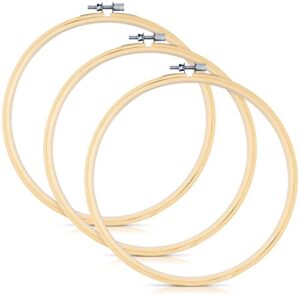
Three hoops for $12.99 — that’s hard to beat when you’re juggling multiple projects at once.
The TINDTOP 10-inch bamboo set gives you natural frames with stainless-steel screws, smooth edges, and a finish that won’t snag your fabric.
Each hoop supports hand embroidery, cross-stitch, and fabric painting without fuss.
Keep in mind the fixed 10-inch size works best for smaller designs, and tighten the screw gradually to avoid stressing the bamboo near the hardware.
| Best For | Hobbyists and beginners working on cross-stitch, hand embroidery, or fabric painting who want an affordable multi-hoop set for smaller projects. |
|---|---|
| Material | Bamboo |
| Tension Screw | Stainless-steel screw |
| Quantity | 3 hoops |
| Shape | Round |
| Use Cases | Embroidery, cross-stitch, fabric painting |
| Smooth Finish | Yes, smooth edges |
| Additional Features |
|
- Great value — three hoops for $12.99 means you can run multiple projects at the same time.
- Smooth bamboo edges keep fabric from snagging while you work.
- Versatile enough for embroidery, cross-stitch, fabric painting, and even light decorative crafts.
- The screw can be tricky to tighten, and over-torquing it may cause the bamboo to split near the hardware.
- Fixed 10-inch size won’t work for larger or oddly shaped projects.
- Not the best pick if you need a polished, display-ready finish — durability under heavy use can be hit or miss.
9. Lemecima Square Rectangle Embroidery Hoops
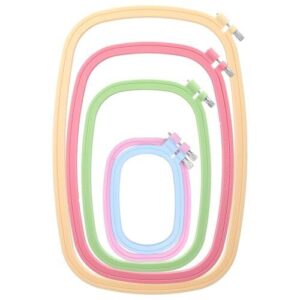
Square corners deserve square hoops — and that’s exactly what the Lemecima set delivers.
You get five color-coded ABS plastic hoops ranging from 3.15 × 4.7 inches up to 15 × 9.8 inches, so you can grab the right size at a glance. The adjustable tightening screw keeps fabric secure without distortion.
These shine on geometric patterns, appliqué borders, and rectangular projects where a round hoop just doesn’t make sense.
At $20.49 for the full set, it’s a practical addition to any embroiderer’s toolkit.
| Best For | Embroiderers who work on geometric designs, cross-stitch, or rectangular projects where circular hoops get in the way. |
|---|---|
| Material | ABS Plastic |
| Tension Screw | Adjustable screw |
| Quantity | 5 hoops |
| Shape | Square/Rectangular |
| Use Cases | Embroidery, cross-stitch, needlepoint |
| Smooth Finish | N/A, plastic construction |
| Additional Features |
|
- Five sizes in one pack, color-coded so you’re not squinting at measurements mid-project
- The tightening screw holds fabric snug, which keeps your stitches even and consistent
- At $20.49 for the set, it’s an easy, affordable upgrade over buying hoops one at a time
- ABS plastic won’t hold up as well as metal if you’re working with heavy canvas or high-tension fabric
- No circular hoops included, so this doesn’t replace your full hoop collection
- The screw can loosen over time if the hoops sit unused for a while
How to Choose Hoop Size
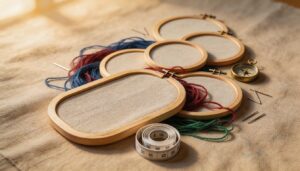
Picking the right hoop size can make or break a large embroidery project.
There’s more to it than just matching your design dimensions — shape, depth, and machine compatibility all play a role.
Here’s what to think about before you commit to a hoop.
Matching Hoop Size to Large Project Dimensions
Start by measuring your design’s bounding box, then add a 1–1.5 inch margin safety buffer around it. That buffer keeps tension even and prevents edge distortion.
For aspect ratio alignment, match your hoop’s shape to the design’s proportions.
Always factor in fabric thickness consideration and stabilizer compatibility when choosing the right extra large embroidery hoop for large embroidery projects.
Consider wooden hoop benefits for added grip on heavy fabrics.
Round Vs Square Vs Rectangle Hoops
Once you’ve nailed your measurements, hoop shape becomes your next decision.
Round hoops win on tension uniformity — they stretch fabric evenly in all directions, which suits symmetrical designs perfectly.
Square hoops risk corner distortion if you don’t tighten edges carefully.
Rectangle hoops shine for wide, horizontal designs, offering strong alignment precision with less vertical fabric stretch.
Match shape to design fit first.
Best Hoop Sizes for Quilts, Jacket Backs, and Banners
Shape gets you close — size seals the deal. For quilt back span, a 14- or 16-inch hoop covers wide panels and cuts down rehooping considerably.
Jacket back clearance calls for an 8×12-inch hoop for standard fits, or 12×12 for oversized cuts.
Banner width guidance points to 10×16 or 12×18 inches for long horizontal runs.
Square hoop preference works best for dense quilting patterns, while deep frame requirements kick in whenever thick batting or interfacing is involved.
Single-hoop Capacity Vs Multi-hooping Needs
Once you’ve nailed the right size, the next call is whether one hooping covers your full design — or whether you’ll need to stitch it in sections. Single-hoop capacity keeps Stabilizer Consistency tight and Fabric Stretch Management simpler.
But when hoop-size restrictions kick in, the Multihooping technique for large embroidery projects becomes your best move. Design Continuity Strategies and Time Cost Analysis both matter here, misalignment costs more than setup time.
When large designs outgrow your hoop, multi-hooping becomes essential — because misalignment costs more than setup time
Checking Embroidery Machine Compatibility
Before you buy a jumbo hoop, check your machine’s specs first — not after. Embroidery machine compatibility covers more than just frame size. Confirm your machine supports File Format Compatibility (PES, DST, EXP), Stitch Count Capacity for dense large designs, and Hoop Clearance Checks, so the frame never collides with moving parts.
- Verify Firmware Logging Features track hoop selection and stitch parameters.
- Run Stabilizer Support Verification for cut-away types on thick fabrics.
- Check Machine Compatibility with Jumbo Hoops against your brand’s published frame limits.
- Confirm Magnetic Hoop Technology for Embroidery aligns with your machine’s mounting posts.
Selecting Hoop Depth for Thick Fabrics
Thick garments and heavy fabrics need more than just a wide hoop — they need the right depth. Match hoop depth to your fabric thickness so the inner edge doesn’t interfere with your needle path.
Adjustable depth mechanisms let you compensate when layering stabilizers.
Keep designs centered for visibility and alignment, and check for air pockets that distort stitches on large-scale embroidery.
Best Materials for Large Hoops
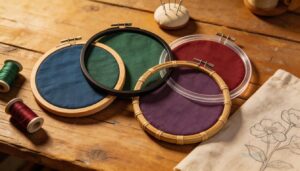
The material your hoop is made from matters more than most people realize, especially when you’re working on something big. Different materials handle tension, weight, and repositioning in completely different ways.
Here’s breakdown of the main options so you can pick what actually fits your project.
Bamboo and Wood Hoops for Strong Grip
Wood and bamboo hoops earn their reputation for a reason — they grip fabric like they mean it. Straight Grain Orientation resists warping, while a smooth Surface Finish protects your threads. A rounded Inner Rim Shape prevents puckering, and solid Clamp Tension keeps things locked in.
Moisture Management is key too — store them dry.
- Choose tight-grained hardwood for heavy fabrics
- Opt for matte or satin finishes to reduce slipping
- Prioritize rounded inner rims for even fabric seating
- Use calibrated screws for repeatable Clamp Tension
- Wipe with mineral oil occasionally — never soak
Plastic Hoops for Lightweight Handling
When your arms start aching mid-project, plastic hoops become your best friend. Weighing just 150–350 grams, they deliver real hand fatigue reduction during long sessions.
Eco-friendly polymers resist moisture and rust, keeping tension consistency steady even in humid workrooms.
Color-Coding Benefits help you sort sizes instantly, while Grip Enhancements and quick-release mechanisms make repositioning extra-large embroidery hoops easy.
Magnetic Hoops for Fast Repositioning
Magnetic hoop technology for embroidery changes everything when you’re working on extra large embroidery hoops. Magnets grip fabric instantly — no screw tightening, no fuss.
Alignment Guides and built-in grid marks make rehoop and alignment almost foolproof for multiposition hooping. Rapid Release lets you reposition in seconds, boosting Production Throughput substantially.
Ergonomic Positioning reduces wrist strain, and Magnet Calibration automatically adjusts for fabric thickness.
Spring-tension Hoops for Even Fabric Hold
Spring tension systems shine when you need consistent fabric tension control across extra large embroidery hoops.
metal inner ring and plastic outer ring work together, delivering uniform pressure around the full circumference — so fabric slippage stays minimal.
quick release lever makes repositioning fast, and the corrosion-resistant build manages long sessions reliably.
No fabric bite, no guessing — just solid ring tension and clean results.
Weight, Durability, and Long-session Comfort
Long sessions demand smart material choices.
Bamboo and wood hoops (200–600g) stay warm in your hands, but fatigue your wrists over time. Plastic and aluminum options with hollow frame design cut that load considerably.
Look for ergonomic grips with moisture resistant coating and weighted balance distribution — they reduce grip strain fast.
Magnetic hoop advantages shine here too, adding almost no extra fabric-side weight.
Which Material Reduces Slippage Best
Slippage is where material choice really shows its character. Rubber Edge Grip and Silicone Coated Rims top the Material Comparison for Large Hoops — both create micro-tack that keeps fabric locked in place.
Cork Textured Rims and Polyurethane Overlay work well on slippery polyester.
For Preventing Fabric Slippage in Large Hoops, Wood and Bamboo outperform Plastic Hoops, while Magnetic Hoops with Matte Inner Finish deliver the steadiest hold overall.
Multi-Hooping Large Designs
Sometimes your design is just too big for one hoop — and that’s where multi-hooping comes in. It’s a technique that breaks a large design into connected sections, stitched one at a time with precision alignment.
Here’s what you need to know to pull it off cleanly.
What Multi-hooping Means for Oversized Embroidery
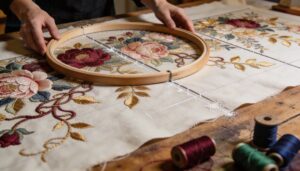
Think of multihooping as stitching a mural one frame at a time. When oversized designs outgrow your extra large embroidery hoops, design splitting breaks them into manageable sections.
Good software manages Software Section Mapping automatically, generating registration marks that keep everything aligned.
Here’s what the technique controls:
- Stitch Density Planning across sections
- Tension Balance Techniques at seams
- Color Gradient Blending between passes
- Fabric Shift Prevention during repositioning
When Large Projects Require Multi-hooping
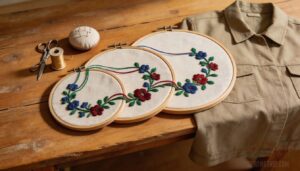
Once a design pushes past your extra large embroidery hoops’ limits, multihooping embroidery projects become the only practical path forward.
Jacket backs, quilt panels, and wide banners all hit hoop size restrictions fast.
That’s when Project Timeline Management and Fabric Allocation Planning matter — you’ll need Yield Estimation Strategies, Stitch Order Optimization, and solid Documentation Practices to track each section cleanly through the 5‑step multihooping process.
Tools Needed for Accurate Re-hooping
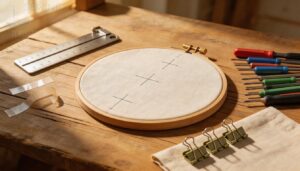
With your multi-hooping plan in place, the right tools make the difference between clean seams and frustrating gaps.
- Hoop Alignment Jig – keeps your extra large embroidery hoops positioned consistently every time
- Registration marks – guide each section into place with under 2mm error
- Micro-ven Tape – secures the hoop rim for repeatable alignment
- Fabric Clip System – holds backing steady during repositioning
- Precision Screwdriver Set – maintains correct clamp tension without over-tightening
A flat work surface with good lighting ties it all together.
Splitting Designs With Embroidery Software
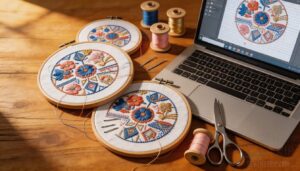
Once your sections are mapped out, embroidery software does the heavy lifting. An Intelligent Split Algorithm divides your design to fit design splitting for small machine hoops without touching stitch density.
Color Continuity Management keeps thread sequences consistent across segments, while Overlap Adjustment Techniques handle minor shifts.
Software autosplit tools also handle Registration Mark Generation and Batch Export Workflow automatically, making splitting and aligning embroidery designs surprisingly straightforward.
Using Registration Marks for Clean Alignment
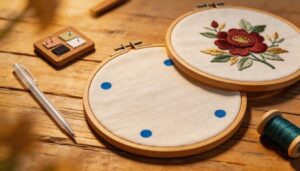
Registration marks are your secret weapon for smooth design merging across sessions. Place marks at all four corners using Mark Placement Strategies that keep them outside your stitch area.
Choose Temporary Permanent Marks based on your fabric — water-soluble ink works great for testing, while stitched marks anchor your multihoop workflow long-term. Run Calibration Test Swatches first, and add Mid-Design Alignment points for extra large embroidery hoops to nail Contrast Optimization every time.
Best Beginner-friendly Designs for Multi-hooping
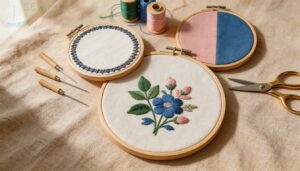
Starting simple is the smartest move you’ll make. Simple Block Motifs, Symmetric Border Patterns, and Easy Floral Sections give both beginners and experienced crafters clean split points that hide minor shifts beautifully.
Color Block Layouts and Alphabet Edge Designs keep your Multihoop workflow low-stress by limiting thread changes per section. These designs ease you into MultiPosition and Repositional Hooping Methods before you tackle anything demanding.
Difficult Designs to Avoid at First
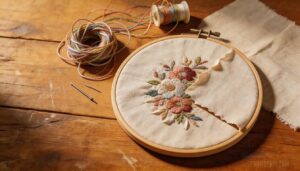
Some designs will fight you every step of the way — especially when you’re still learning multi‑hooping.
Avoid these when starting out with extra large embroidery hoops:
- Dense Fill Patterns — fine detail raises thread breakage risk by up to 28 percent
- Thin Line Stitches — disappear on heavy fabric without thick underlay support
- High Color Changes — slow your large-scale embroidery workflow and invite tangles
- Satin Stitch Edges — long zigs lift without solid stabilization across your hoop size
- Complex Registration designs — misalignment gaps of 0.5–1.5 mm become obvious in design splitting for small machine hoops
Step-by-step Process for Seamless Sections
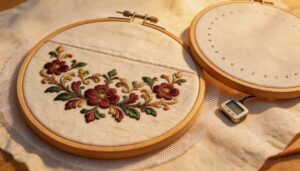
Think of multi-hooping like tiling a floor — every piece must meet perfectly or the whole pattern breaks down.
| Step | Action | Key Detail |
|---|---|---|
| 1. Stabilizer Application | Cover full project area | Single burst-resistant layer |
| 2. Registration Marks | Mark quadrant points on fabric edges | Prevents skewed rehooping |
| 3. Overlap Zones | Build 4 mm overlaps at joins | Fills density gaps |
| 4. Tension Calibration | Check thread tension each pass | Use digital gauge |
With Stitch Path Optimization and smart splitting and aligning embroidery designs across extra‑large embroidery hoops, your step‑by‑step guide to multi‑hooping large quilts stays on track — ensuring invisible seams in multi‑hoop embroidery every time.
Hooping Tips for Oversized Projects
Working with oversized projects means more can go wrong — and more can go beautifully right.
A few smart habits will keep your fabric flat, your alignment tight, and your finished piece looking intentional. Here’s what experienced embroiderers do differently when the project gets big.
Choosing Stabilizers for Large Embroidery Areas
Your stabilizer choice can make or break a large project. Use a single large piece of medium to heavyweight cutaway stabilizer beneath the entire design for permanent fabric stabilization — it’s your foundation.
Cut-away layering works best for dense fills, while a water-soluble topping prevents puckering on textured surfaces. Avoid tear-away bulk on heavy fabrics, and always align stabilizer grain with your fabric weave.
Marking Centerlines and Using Printed Templates
Once your stabilizer is locked in, accurate placement is next. Use a fabric chalk or erasable pen to draw vertical and horizontal centerlines — your hoop alignment anchors. On dark fabrics, contrast marking with white chalk keeps lines visible.
Print templates with template adhesive or temporary spray adhesive, align them to your centerlines, and transfer registration marks before stitching begins.
Preventing Puckering, Gaps, and Overlaps
Even perfect centerlines won’t save you if your fabric preparation is off. Start with proper stabilizer selection — cut-away works best for large-scale embroidery. Match your needle size to your fabric weight, then calibrate machine tension before the first stitch.
Underlay stitching creates a smooth base that prevents top stitches from pulling inward. These steps together handle fabric distortion prevention before it starts.
Managing Fabric Tension Without Stretching
Proper tension is all about balance — not pulling tight, but holding flat.
Pre-press fabric before hooping to relax the fibers evenly, then hoop with gentle, consistent pressure.
Install an even feed foot to sync fabric layers smoothly.
Use tension distribution techniques like pinning edges strategically and layering stabilizers for large-scale embroidery.
Balanced thread tension keeps everything tracking clean.
Using Adhesive Sprays and T-pins Safely
Once your fabric tension is balanced, adhesive sprays and T-pins become your best allies — if you handle them right.
Always follow proper Ventilation Practices: spray your temporary spray adhesive in an open area, away from heat sources for Fire Hazard Prevention.
Wear gloves for safe Glove Use, choose rust-free pins for smart Pin Material Selection, and use a soft cloth for Residue Removal Techniques.
Reducing Hoop Burn on Delicate Fabrics
Delicate silks and chiffons can bruise easily under hoop pressure, leaving shiny hoop burn lines that ruin your work.
A Soft Buffer Layer — thin cotton muslin or knit interfacing — cushions contact points and distributes Gentle Hoop Pressure evenly.
Try the Floating Stabilizer method to keep fabric free from direct clamping. Add Edge Padding using felt strips, and your fabric preparation before hooping becomes a truly significant improvement.
Cleaning, Storing, and Maintaining Large Hoops
Caring for your hoops is just as important as using them well. After each session, wipe wooden and bamboo frames with a damp cloth — moisture control matters here, so dry thoroughly.
Routine inspection every two weeks catches loose screws early.
Condition wood every few months to prevent splitting.
For magnet care, use only a dry cloth.
Store hoops flat, away from sunlight, using bags for dust prevention.
Common Large-hoop Mistakes and Fixes
Even experienced stitchers hit snags with large hoops.
Here are five mistakes worth knowing:
- Skipping proper backing causes sunken stitches
- Forgetting to level hoop edge creates fabric drag
- Ignoring anti-slip pads leads to drift
- Setting incorrect hoop height causes bunching
- Failing to secure hoop position mid-session invites wobble
Fix each one early, and your tension control stays solid throughout.
Frequently Asked Questions (FAQs)
What is an alternative to embroidery hoops?
Several solid alternatives exist: a Magnetic Hoop, Scroll Frame, Slate Frame, Hand Stabilizer, or Embroidery Grid each hold fabric taut without traditional hoops, giving you flexibility for any project size.
What is the maximum size for embroidery?
The maximum stitch area depends on your machine bed size and hoop capacity. Home machines usually top out around 9×14 inches, while industrial setups can reach 20×24 inches or beyond.
Are Q snaps better than hoops?
Q snaps offer better tension consistency and fabric damage prevention than traditional hoops, but magnetic hoops win on setup speed.
Your best pick depends on project size, portability needs, and budget.
Can magnetic hoops handle embroidery on stretchy knits?
Yes, magnetic hoops handle stretchy knits like a charm — just clean fabric and magnets for Fabric Magnet Cleanliness.
Use stabilizers, and always run a Test Stitch Procedure first to nail Knit Tension Control.
How do extension tables support jumbo hoop machines?
Extension tables give jumbo hoop machines a stable work surface, alignment rails, and load-bearing support that prevents tilt and vibration damping keeps stitches clean across large-scale embroidery runs.
Which hoop brands work with over 200 machines?
MaggieFrame and Melco Mighty Hoops both publish full compatibility matrices covering 200-plus machines.
Cross-brand adapters and ISO frame standards make universal hoop kits work seamlessly across Brother, Janome, Bernina, and Husqvarna Viking platforms.
How long does slate frame tension setup take?
Setup time ranges from 90 minutes to 3 hours depending on frame size and operator skill. Larger slate frames need gradual tension adjustment across both axes before you stitch a single thread.
What stand types work best for large hoops?
For large hoops, your best options are Weighted Base Stands, Adjustable Height Frames, and Magnetic Quick Release systems.
Floor and sofa stands offer hands-free embroidery, while Wheel Mobility Systems and Triangular Rigid Bases add stability.
Conclusion
With the right embroidery hoops for large projects, your stitching game is about to get a major "thread" of confidence. You’ve got the top picks and pro tips to keep your fabric steady and your creativity soaring.
By choosing wisely and hooping smart, you’ll conquer even the most ambitious designs. Your embroidery machine and stabilizer setup will thank you.
Now, go ahead and stitch big – with precision and ease, every time, using the best embroidery hoops for large projects.