This site is supported by our readers. We may earn a commission, at no cost to you, if you purchase through links.
embroidery problems on hats don’t start with the machine—they start before the first stitch drops. Curved panels flex, fabrics shift, and without the right foundation underneath, even a clean digitized logo ends up puckered, misregistered, or pulling at the seams. That’s not a machine problem. That’s a stabilizer problem.
Hat embroidery demands more than flat-garment work because nothing about a cap is cooperative. The curve fights your frame, the grain direction fights your stitches, and soft or unstructured fronts move under tension in ways that buckram-backed caps never will. Choosing the wrong stabilizer—or skipping it entirely—turns a straightforward logo job into a troubleshooting session.
Get the backing right, and the rest of the process follows. This guide covers every stabilizer decision you’ll face on hats, from weight selection to hooping technique to fixing the problems that show up mid-run.
Table Of Contents
Key Takeaways
- Stabilizer choice—not machine settings—determines whether your hat embroidery holds clean registration or falls apart at the first stitch.
- Structured caps take tear-away for easy removal, while unstructured or soft-front caps need cut-away backing to keep the panel stable through wear and washing.
- Match stabilizer weight to stitch count: under 8,000, use lightweight, 8,000–12,000, go medium, and anything above 12,000 demands 3.0 oz heavyweight.
- Tight hooping, brim control, and a basting box aren’t optional extras—they’re what keep your stabilizer choice from being wasted when the needle starts moving.
Why Hats Need Stabilizer
Hats aren’t flat, and that’s exactly what makes them tricky to embroider. The curved panels, thick seams, and shifting fabric can turn a clean design into a puckered mess before you’ve finished the first color.
Here’s what’s actually happening under the needle — and why stabilizer changes everything.
Stabilizer affects how the fabric behaves beneath your needle, so pairing it with steady tension is where it all clicks — the hand stitch guides at Sewing Trip break down exactly how these two elements work together.
Why Curved Cap Panels Shift During Embroidery
Curved panels don’t sit still — panel curvature tension pulls the fabric in multiple directions, the moment your needle starts moving.
Three forces drive this:
- grain direction effect shifts how the curve bends after each penetration
- stitch density impact compounds micro‑slippage across the crown
- frame alignment drift lets fabric rotate inside rotating cap frames
fabric thickness variance makes every hat behave differently.
How Stabilizer Reduces Puckering and Misregistration
Stabilizer fixes what shifting fabric starts. It manages hoop force absorption so your cap stays flat, then spreads stitch tension across a wider zone — that’s tension distribution doing its job.
Fiber stabilization keeps surface yarns locked in place, while consistent needle points and stitch drift control keep your letters tight and your outlines where you put them.
No puckering, no registration slips.
Why Embroidering Directly Onto a Hat Causes Problems
Skip the stabilizer and the hat fights back. Fabric moisture expansion warps your panel mid-run.
Heat puckering builds from stitch density stiffness. Edge fraying risk opens up where the needle penetrates repeatedly.
Flagging, registration slips, thread breakage — they all stack fast. Needle penetration depth becomes inconsistent on foam-backed panels, and stitch quality collapses before you finish the first color.
How Stabilizer Improves Lettering, Outlines, and Stitch Quality
Good stabilizer is the difference between letters that pop and letters that bleed. It maintains even thread tension so each stitch lands clean, preserves letter height consistency across the curved panel, and locks in crisp corner points on tight logos.
Good stabilizer is what separates letters that pop from letters that bleed
Outline radius control stays true, and uniform stitch length holds throughout.
That’s how stabilizer density and ply selection directly drive embroidery design crispness.
Best Stabilizers for Hat Embroidery

Not every hat takes the same stabilizer, and using the wrong one is usually where things go sideways. Your best results come down to matching the backing type to the hat’s structure, fabric, and design demands.
Here’s a breakdown of the options that work best for cap embroidery.
Tear-away Stabilizer for Structured Caps
For structured caps, tear-away stabilizer is the go-to cap embroidery backing — and for good reason. The firm buckram front panel holds its shape, making clean tear-away removal straightforward after stitching. Consider using the heavy weight stabilizer for dense logos.
- Cap Frame Fit keeps pre-cut backing aligned with the curved embroidery zone.
- Structured Cap Benefits include temporary support that peels away without residue.
- Stabilizer weight selection starts at 3.0 oz for dense logos.
- Hooping methods for baseball caps require tight, flat placement every time.
Cut-away Stabilizer for Unstructured Hats
Unstructured caps don’t have buckram to fall back on — that’s exactly why cutaway stabilizer is the right call here. Unlike tear-away, it stays put after stitching, giving the soft front panel long-term support through wear and washing.
Cutaway’s lasting hold is especially critical for soft panels, where proper technique makes all the difference — see how embroidery stabilizer placement affects stitch accuracy on unstructured materials.
Use a lightweight Fusible Cut-away to lock fabric before hooping, or No-show Mesh for a softer inside finish.
Apply the Trim Edge Technique to keep bulk minimal while maintaining a Stability Flexibility Balance.
For these softer hats, a medium-weight cut-away backing is recommended to provide the necessary extra stability.
Water-soluble Topping for Puff and Textured Areas
Water-soluble topping is your go-to layer for 3D puff embroidery support using stabilizers and dense texture fills.
Lay the water-soluble film directly over the hat surface before stitching — it bridges thread gaps, boosts Puff Stitch Loft, and locks Texture Fill Support in place.
- Rinse off with warm water (40–60°C) after stitching
- Compatible with rayon, polyester, and knit hat fabrics
- Apply 0.05–0.15mm thickness depending on stitch density
- No special machine settings needed
When Adhesive Support Helps Soft or Slippery Hats
Soft, slippery, or hard-to-hoop caps are where embroidery adhesive spray earns its place. Float the hat on your stabilizer using the Floating Method — spray a light coat for Adhesive Bonding, lay the fabric down, and let that Stretchy Fabric Grip do the work.
It locks unstructured caps in place for clean Multi-Color Registration without aggressive hooping tension. Go light — heavy buildup means Residue Cleanup headaches.
Tear-away Vs Cut-away for Common Hat Styles
The right call comes down to one question: how stiff is the front panel?
Structured caps — snapbacks, fitted, trucker hats — favor tearaway embroidery stabilizer backing for caps and hats. The removal process stays fast and the inside finish stays clean.
Low profile and unstructured caps need cut-away for support longevity. Fabric flexibility demands it. Without that permanent layer, stitch distortion creeps in after the first few washes.
Choosing Stabilizer Weight for Hats
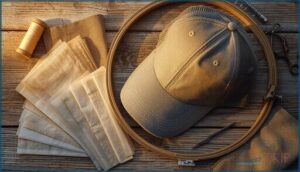
Getting stabilizer weight right makes the difference between a clean finish and a job you’ll be ripping out. Every hat style has its own needs, and matching the weight to your fabric and design keeps everything locked in place.
Here’s what you need to know for each situation.
Lightweight Options for Soft, Thin Hats
Thin, floppy hats punish heavy stabilizers fast — expect stiffness, bulk, and hooping distortion.
For low profile and unstructured caps, Ultra-Light Backing weighing 0.2 to 0.5 ounces keeps panels natural.
Tearaway Blends and Flexible Cutaway options both work well on delicate fabrics.
Use Delicate Fabric Topping to protect snag-prone surfaces, and Spray-Friendly Backings to lock placement without adding stiffness.
Medium-weight Backing for Standard Caps
Step up from ultra-light and medium-weight backing — around 2.5 oz — becomes your go‑to for standard structured caps. Products like EZee Cap Just Right 2.5 oz deliver balanced support without over‑stiffening the panel.
Pre-cut dimensions (usually 4.5 x 7 inches) drop straight into your cap frame for clean frame seating. Black backing benefits show when linings are thin.
Moderate design support checklist:
- Single sheet manages most small-to-medium logos cleanly
- Maintains sharp lettering edges through the full run
- Keeps thread tension consistent across multiple caps
- Tears away without leaving bulk inside the finished hat
Heavyweight Stabilizer for Dense Hat Designs
When designs cross the stitch count threshold — think dense logos, full-front graphics, or 3D puff embroidery support work — heavyweight 3.0 oz backing is what keeps your cap panel reinforcement solid. It controls thread tension management through every needle hit without letting the curved panel creep.
Heavy duty cap embroidery demands material compatibility, you can trust. One sheet, zero compromise.
Matching Stabilizer Weight to Stitch Count
Stitch count tiers drive your stabilizer weight decisions more than anything else.
Under 8,000 stitches, lightweight backing holds fine.
Push into the 8,000–12,000 range and you need medium-weight — that’s your weight-count correlation in action.
Cross 12,000, and stitch density guidelines demand 3.0 oz.
Fabric impact matters too: knits and synthetics often need one weight heavier than the stitch count alone suggests.
When to Use One Layer or Two
Weight gets you most of the way there — but stabilizer ply selection seals the deal. Single ply manages clean, lower stitch count designs on stiff caps where cap stiffness does the heavy lifting.
For high stitch count applications or soft fronts that flex under the needle, an extra fold of backing restores control. Design density, bulk comfort, and removal ease together tell you when one layer is enough.
Choosing Backing for Buckram, Knit, and Trucker Caps
Each hat type has its own stabilizer personality. Buckram panel support calls for medium tear-away — firm enough to steady the front without stiffening the finish. Knit elasticity match means going cut-away to preserve stretch and prevent fraying edges.
- Trucker mesh reinforcement works best with tear-away for clean removal
- Knit caps need stretch-compatible cut-away for stitch density alignment
- Edge trimming technique keeps buckram backing invisible inside the crown
Hooping Hats With Stabilizer
Hooping a hat correctly is where good stabilizer choices either hold up or fall apart. The curved front panel, stiff buckram, and awkward brim all demand a specific sequence to keep everything locked in place.
Here’s how to work through each step without second-guessing yourself.
Preparing The Hat Before Hooping
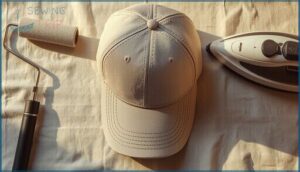
Before the hoop even touches your cap, the prep work determines everything.
Start with lint removal — roll the surface clean so stray fibers don’t get trapped under stitches. Do a quick panel inspection for stretching or misalignment.
A pre-press warmup relaxes wrinkles, while seam flattening reduces bulk.
Mark your center point, then secure the brim before moving forward.
Placing Stabilizer in Cap Frames Correctly
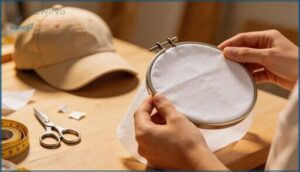
Once the hat’s prepped, placement is where precision starts paying off. Lay your stabilizer flat inside the cap frame — edge alignment matters, so match the stabilizer edges to the frame opening for full contact.
Smooth out any wrinkles; bubble elimination before hooping prevents pressure marks later. Pre-cut sizing helps here: trim slightly smaller than the frame opening.
Do a quick moisture inspection, then calibrate height so lettering stays parallel to the bill.
Tight Hooping Methods for Curved Fronts
Curved fronts demand precision — slack here means registration slip later.
Pull the sweatband fully down for Sweatband Pre-tension, then fasten the Metal Strap Notching at the furthest back notch.
Apply Hoop Release Spray and wrap inner rings with Bias Tape Wrapping to protect twill.
Frame Tension Calibration across rotating cap frames ensures a smooth hooping surface and consistent fabric tension control throughout.
Securing Brims and Seams Out of The Way
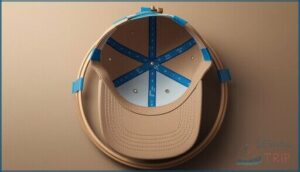
Brims and seams are the troublemakers that derail even a well‑tensioned hoop. Lock them down before the needle ever moves.
- Fold and tape the brim edge back for clean Brim Edge Control
- Apply Seam Shielding strips behind cap seam softening zones
- Secure Curve Fronts using frame alignment guides at the center seam
- Tuck sweatbands to prevent throat blockage in embroidery machines
- Use hooping techniques for baseball caps on hard-to-hoop caps for Brim Stabilization
Basting and Spray Techniques for Extra Hold
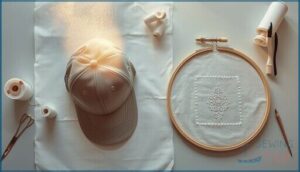
When floating a cap onto stabilizer, spray the stabilizer—not the hat—with a light adhesive mist before placement. That controlled tack manages hard-to-hoop caps without residue.
Run a basting box around your design area for extra stability; those temporary stitches lock the fabric against your tear-away stabilizer throughout the run. Pull them out cleanly once embroidery finishes.
Preventing Common Hat Embroidery Problems
Even the best stabilizer won’t save a hat embroidery job if the small details aren’t dialed in. Shifting, thread breaks, registration drift — these problems follow predictable patterns, and they’re fixable once you know where to look.
Here’s what to watch for and how to correct it before it ruins your run.
Fixing Shifting on Unstructured Caps
Unstructured caps are the trickiest hats you’ll work with — soft panels flex, crowns shift, and registration slips fast. Start with pre-hoop steam to relax the fabric, then verify cap frame alignment before loading.
Use adhesive-backed stabilizer with proper edge overlap beyond your design. Keep stitch density control balanced across curved areas, and re-tension the frame mid-run for low-profile and unstructured cap embroidery challenges.
Preventing Thread Breaks and Needle Deflection
Once your cap sits firmly, thread breaks become the next fight. Needle deflection on curved panels sneaks up fast — fix it with these four checks:
- Needle Selection: Use 75/11 or 80/12 sharp-point needles matched to your thread weight
- Thread Tension: Set tension per material, not per habit
- Underlay Stitching: Lay foundation stitches before fill to stabilize fabric tension
- Design Segmentation: Break large logos into blocks to reduce continuous needle stress
Lower machine speed on curved runs, and deflection drops substantially.
Avoiding Perforation on Dense Logos
Dense logos punch hard — and when stitch density climbs past 14–18 stitches per millimeter, fabric perforations follow.
Your layered stabilizer strategy starts here: pair a premium high-performance hat backing with a light cutaway to distribute needle pressure evenly.
Stitch length adjustment and underlay tension control reduce surface strain.
Moisture management and needle heat management keep micro-tears from forming under tight fills.
Improving Registration on High Stitch Counts
Registration slips on high stitch count designs come down to four controllable factors:
- Stabilizer Layering Strategy — use two sheets of medium tear-away to resist compression under dense satin fills
- Underlay Stitch Design — digitize center-out paths to anchor fabric before fill stitches land
- Machine Speed Calibration — drop to around 800–900 spm on structured caps
- Tension Balancing Techniques — even bobbin pressure prevents front-surface skew
Reducing Bulk Inside Finished Hats
Keeping a finished hat comfortable starts before you even touch the needle. Turn back the sweatband — Sweatband Management — so dense stitches don’t compress multiple layers into the crown.
Practice Backing Trim Control by cutting the backing away flush to the stitch line. Clear seam hardware for proper Seam Clearance, balance Design Density, and finish with Interior Cleanup.
Single-ply stabilizers on low profile caps leave little to no excess stabilizer behind.
Stabilizer Tips for Cleaner Tear-away Removal
Before you rip anything away, set yourself up for a clean pull. Use a perforated tear-away so sectional tearing follows the stitch lines naturally.
Apply light finger pressure along the edge extension rather than yanking.
A spray adhesive edge keeps alignment locked before stitching, so removal stays controlled.
Done right, tear away backing peels away without snagging a single stitch.
Frequently Asked Questions (FAQs)
Do you have to use stabilizer when embroidering a hat?
Yes, you have to use stabilizer when embroidering a hat. Without it, the curved front panel shifts, puckers form, and your lettering loses registration fast.
Tear away stabilizer is the standard starting point.
Can you embroider directly onto a hat?
Technically, yes — but you’ll regret it.
Without backing, the curved panel shifts, stitches pucker, and lettering loses definition fast. Proper stabilizer isn’t optional; it’s what separates clean results from a ruined hat.
Is tear away or cut away stabilizer better?
Neither is universally better — it depends on your hat and design.
Tear away stabilizer suits structured caps with clean removal. Cut away wins on durability over time for dense, high-stitch designs.
Can I reuse stabilizer across multiple hat runs?
Technically, yes — but stabilizer longevity depends on what you ran first. Tear-away loses firmness after one pull. Cut-away holds up better if there’s no thinning or residue.
How do I store unused stabilizer rolls properly?
Store rolls upright in labeled bins using a clear Labeling System.
Control Humidity with silica packs, track Shelf Life by purchase date, maintain Inventory Rotation, and keep Roll Orientation consistent, so ends stay accessible.
Which stabilizer works best for leather cap panels?
For leather cap panels, use a medium-weight tear-away backing. Its balanced support suits curved panel alignment without stiffening the leather.
Add adhesive spray grip to prevent sliding, and lay a moisture barrier topping over the surface.
Does stabilizer affect the finished hats comfort?
Yes — and ironically, the stabilizer you barely notice during stitching shapes how every finished hat feels on your head.
Interior Softness, Stiffness Control, and Trim Edge Comfort all trace back to your backing choices.
Conclusion
Mastering embroidery stabilizers for hat embroidery is like finding the right anchor in a storm—it keeps your work steady and your results perfect. With the right backing, curved panels and shifting fabrics become manageable.
Choose tear-away or cut-away based on your hat style, and match the weight to your design’s density.
Proper hooping and securing techniques guarantee your stitches stay true. Avoid common pitfalls by addressing shifting, thread breaks, and bulk early.
Your stabilizer choices are the foundation of professional-grade hat embroidery.
- https://embroideryhooping.com/da/blogs/20251015-072352/tagged/stabilizer-weight
- https://www.cw-katerstraat.nl/Caps-Hats-Machine-Embroidery-Stabilizer/682907
- https://www.maggieframes.com/id/blogs/embroidery-blogs/brother-embroidery-machine-for-hats-expert-setup-techniques-model-guide
- https://www.hooptalent.com/blogs/news/ultimate-guide-to-hat-embroidery-design-sizes-ideas-and-expert-techniques
- https://omlembroidery.com/cutaway-vs-tearaway-stabilizer-explained/