This site is supported by our readers. We may earn a commission, at no cost to you, if you purchase through links.
A 6×10 hoop turns a manageable project into a high-stakes commitment. The bigger the design field, the more fabric moves, threads pull, and stabilizer choices compound into either a crisp finished piece or a puckered mess you can’t salvage.
Most embroiderers who struggle with large hoop work aren’t making digitizing errors or running wrong tension settings—they’re under-supporting the fabric from the start. Choosing the right embroidery stabilizers for large hoop designs comes down to three variables: fabric structure, stitch density, and hooping technique. Nail all three, and your 25,000-stitch back panel lands flat every time.
Table Of Contents
- Key Takeaways
- Choose Stabilizers by Fabric Type
- Match Weight to Stitch Density
- Hoop Large Designs Without Distortion
- Top 8 Stabilizers for Large Hoops
- 1. Brothread Tear Away Embroidery Stabilizer 8×8
- 2. Brothread Medium Cut Away Embroidery Stabilizer
- 3. Brothread No Show Mesh Embroidery Stabilizer
- 4. New Brothread Tear Away Embroidery Stabilizer
- 5. Brothread Water Soluble Embroidery Stabilizer
- 6. HBI Cut Away Embroidery Stabilizer
- 7. Brothread Clear Water Soluble Embroidery Film
- 8. HBI Water Soluble Embroidery Stabilizer
- Fix Puckering and Backing Problems
- Frequently Asked Questions (FAQs)
- Conclusion
Key Takeaways
- Matching your stabilizer to fabric type is the single most critical decision — tear-away for stable wovens, cut-away for knits, and wash-away for delicate sheers.
- Stitch count drives stabilizer weight: stay under 5,000 stitches with lightweight backing, scale to medium-weight (2.5 oz) up to 20,000, and go heavy cut-away (3.0–3.5 oz) beyond 25,000.
- Always cut your stabilizer 1–2 inches beyond every hoop edge — skipping this step is the fastest way to get shifting, puckering, and ruined large-field designs.
- Most puckering and show-through problems are not digitizing errors — they come down to wrong stabilizer weight, misaligned fabric grain, or skipping a pre-wash test on scraps.
Choose Stabilizers by Fabric Type
Fabric type is the first thing you should nail down before grabbing any stabilizer off the shelf. The wrong match can cause puckering, distortion, or a backing that shows through on finished pieces.
Matching stabilizer to fabric is one of those make-or-break decisions, so it helps to have a solid reference like this guide to embroidery stabilizer backing tips and tricks before you start cutting.
Here’s how each stabilizer type lines up with common fabrics.
Tear-away for Stable Woven Fabrics
When your fabric is tightly woven — think cotton canvas, linen, or denim — tearaway stabilizers are your go-to. The stable fiber structure holds firm under needle pressure, so tearaway removes cleanly without fraying.
Match stabilizer color matching to your fabric, align with the fabric grain, and size it beyond your hoop edges.
For stitch density under 10,000, medium-weight tearaway performs the job perfectly.
Cut-away for Knits and Stretch Fabrics
Knits play by different rules. Unlike woven cotton, a jersey or interlock stretches under tension — and that’s where tearaway falls short.
Choose a flexible cut-away stabilizer instead. It delivers knit fabric support by staying in place permanently, maintaining grain alignment and controlling edge ripple on curved areas.
Match your stabilizer weight guidelines to stretch tolerance: medium-weight works with most jerseys without killing the drape.
No-show Mesh for Light-colored Garments
No-show mesh takes cut-away a step further. Its soft nylon feel and embossed pattern stability give you multi-directional support without bulk.
Weighing just 1.5–1.8 oz, it’s built for light fabric compatibility — think white polos, pastels, and baby garments on 4×4 and 6×6 hoops.
Sheer texture benefits shine here: the mesh stays invisible. After stitching, edge trimming techniques keep it tidy.
For more options, see the non‑woven cut‑away stabilizer range.
Wash-away for Sheer and Delicate Fabrics
Where no-show mesh keeps things invisible on knits, a washaway stabilizer for delicate fabrics takes a different approach—it disappears entirely.
Dissolve speed runs 5–15 minutes in lukewarm water, leaving a residue-free finish that restores drape on chiffon, organza, and silk blends.
Color protection stays intact across most hoop sizes.
Trim excess before soaking, rinse gently, and air dry flat for eco-friendly disposal.
Toppings for Towels, Fleece, and High-pile Fabrics
Towels and fleece eat stitches alive — that’s where water-soluble topping earns its place. Lay a clear film over high-pile fabrics before you stitch, and it smooths the surface just enough for pile control and crisp detail.
Film thickness around 25 microns works well for 4×4 and 6×6 hoops. Cold water removal dissolves it cleanly, leaving no residue behind. It prevents thread sinking.
Sticky and Fusible Options for Hard-to-hoop Items
Some items just won’t sit flat in a standard hoop — pockets, cuffs, collars, and backpack panels are the usual suspects. That’s where sticky and fusible stabilizers save the day.
- Peel-away liner stabilizers let you hoop first, then press fabric onto the adhesive for precise pocket hooping and collar stabilization
- Temporary bonding fusibles bond with heat, reducing shifting on knits across all hoop sizes
- Sticky Water Soluble with adhesive backing dissolves cleanly after washing — no residue
A MaggieFrame magnetic hoop system takes this further, letting you snap fabric in without clamps, which pairs perfectly with adhesive-backed stabilizers for awkward panels.
Match Weight to Stitch Density
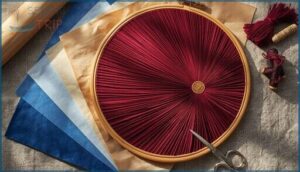
Getting the fabric type right is only half the equation — stabilizer weight is where most large hoop projects succeed or fail. The heavier and denser your design, the more support you need underneath it.
Here’s how to match your stabilizer weight to your stitch count so your work holds up from the first stitch to the last.
Lightweight Stabilizers for Low-density Designs
Featherweight stabilizer benefits shine brightest on low-density designs — think 6 to 12 stitches per millimeter on sheer or fine fabrics. At just 1.2 to 1.4 oz, lightweight backing keeps breathable fabric support intact without stiffening the hand.
Minimal underlay strategies prevent texture buildup, and adhesive front-back options hold your fabric flat across large hoop sizes.
Quick peel removal leaves almost no residue behind.
Medium-weight Stabilizers for Everyday Large Hoop Projects
Medium-weight stabilizers are your everyday workhorse for large hoop projects.
A medium-weight 1.8 oz tear-away grip design up to around 8,000 stitches, while a medium-weight 2.5 oz cutaway stabilizer covers the 8,000–20,000 stitch range with reliable Stitch Count Balance.
Follow Edge Overlap Guidelines — extend at least half an inch beyond the hoop.
This maintains Drape Preservation without sacrificing support.
Heavy-weight Stabilizers for Dense Fills and Satin Columns
Dense fills and satin columns are where lightweight options simply give up.
For designs pushing past 25,000 stitches, you need a heavy-duty cut-away — ideally 3.0 to 3.5 oz — to handle high stitch count support and Column Collapse Prevention.
Stabilizer Grain Direction also matters here. Align it with your fabric grain to improve Stitch Tension Management and Thread Pull-Through Control, especially on heavy knits.
Stitch-count Guidelines for Large Designs
Think of stitch count as your stabilizer’s road map.
Under 5,000 stitches, lightweight backings handle the load. Between 5,000 and 15,000, apply density scaling rules and step up to medium-weight. Beyond 15,000, count-driven weight selection and stabilizer weight guidelines push you toward heavy cut-away.
For 44 and 66 hoops, design size mapping and stitch-per-inch calculations keep your stitch density guidelines honest.
When to Layer Two Stabilizers
Sometimes one layer isn’t enough. Dense Fill Reinforcement kicks in when your stitch count clears 15,000 — a second lighter sheet beats switching to one bulky backing.
Stretch Fabric Control on knits and Lightweight Fabric Support on delicate fabrics both call for layering stabilizers. Edge Tension Management on wide fields also benefits. Keep Second Layer Benefits real: stop at two or three layers total.
Balancing Support With Fabric Drape
Layering fixes density, but it can kill drape. That’s where Stabilizer Drape Ratio matters — matching stabilizer weight to fabric weight keeps things from going board‑stiff.
Use Selective Base Layering and Tension Distribution Techniques to manage Fabric Elasticity Management on knits.
Edge Tension Control prevents scalloping along wide fields.
Follow stabilizer weight guidelines: temporary support for sheers, permanent support for stretch. Let the fabric breathe.
Hoop Large Designs Without Distortion
Getting a large design into the hoop without warping or stretching the fabric is half the battle.
The method you choose — and how you size your stabilizer — makes all the difference between a crisp finish and a puckered mess.
Here are the key techniques that keep big designs locked in and distortion‑free.
Sizing Stabilizer Beyond The Hoop Edges
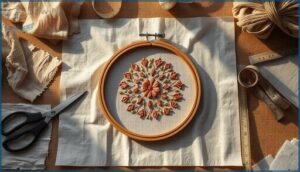
Cut your stabilizer at least 1 to 2 inches beyond every hoop edge — this overlap safety buffer is what keeps the backing locked under the clamp during stitching. Without that stabilizer margin, edge support techniques break down quickly, especially on dense fills.
A 5×7 hoop needs roughly 9×12 backing.
Extended backing benefits both cutaway and tearaway options by reducing fabric shift across the full design field.
Standard Hooping for Large Embroidery Fields
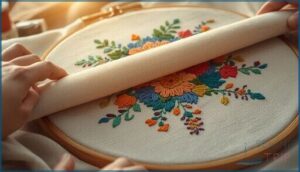
Once stabilizer margin is set, lock fabric and backing together in the hoop — grain squared to the frame, center marks aligned. Keep hoop tension drum-tight without overstretching, since fabric pre-stretch causes rebound puckering.
Match hoop sizes to your design field so edge overlap stays consistent.
For denser stitch density, favor cutaway and a heavier stabilizer weight to prevent fabric stretch from shifting mid-run.
Floating Fabric on Hooped Stabilizer
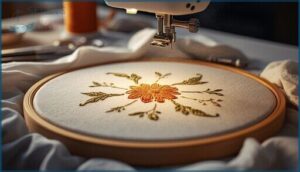
When the hoop can’t grip your fabric cleanly, floating is the fix. Hoop the stabilizer drum-tight, then lay your fabric on top using temporary adhesive methods or a basting box technique to hold it in place.
Keep these essentials in mind:
- alignment markers to center the design accurately
- Match stabilizer weight to prevent fabric drape issues
- Maintain edge tension control throughout the run
Using Adhesive-backed Stabilizers for Placement
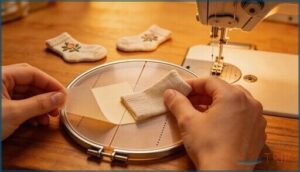
Sticky stabilizer solves one of embroidery’s most frustrating problems — placing hard-to-hoop items like cuffs, collars, and socks with confidence.
Paper Release Technique: score and peel the backing only inside the hoop area, then press fabric smoothly onto the adhesive to make sure Bubble Prevention. Alignment Marking before contact is essential, since repositioning weakens hold. Add Basting Reinforcement stitches for tricky knits, and practice Residue Management by cleaning needle and hoop regularly.
Cross-layering Mesh for Extra Support
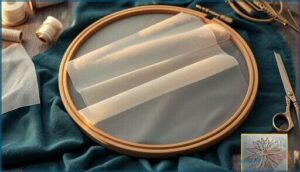
When one mesh layer isn’t enough, cross-layering gives you the Stress Distribution that dense designs demand. Place your first no-show mesh straight, then rotate the second at 45° for true Multi-directional Support across your hoop sizes.
- Angle Configuration locks lettering and fill shapes in place
- Fabric Drape Balance keeps knits soft, not board-stiff
- Layer Trim Techniques reduce bulk — trim close, never tear
Adding Water-soluble Topping on Textured Surfaces
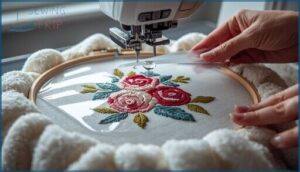
Textured fabrics like terry and fleece swallow stitches whole — that’s where water-soluble topping earns its place.
Surface Preparation starts with a quick lint roll to manage fabric nap management before application.
Spread topping evenly using proper Application Technique, then follow Drying Guidelines: wait 60–90 seconds.
Material Compatibility favors natural fibers across most hoop sizes.
Removal Process is simple — warm water dissolves everything cleanly.
What to Do if The Design Exceeds Hoop Size
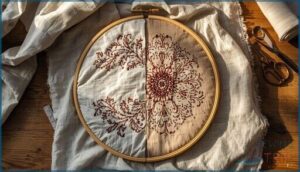
When your design is bigger than your hoop, don’t panic — just segment it. Split the artwork into sections, stitch each using multiple hoops, then rotate fabric carefully to align registration marks. Use a cutaway roll or pre‑cut sheets for material waste reduction. Leave an overlap allowance between sections, and rely on permanent backing for managing fabric stretch across every join.
Segment oversized designs, align registration marks, and let permanent backing hold every join steady
- Trim pattern edges cleanly before re-hooping
- Techniques for hooping with different stabilizers keep sections flat
- Match stabilizer type across all segments for consistency
Top 8 Stabilizers for Large Hoops
Not all stabilizers are built the same, and when you’re working with a large hoop, the wrong pick can ruin an otherwise solid design. These eight options have proven themselves across different fabric types, stitch densities, and project sizes.
Here’s what’s worth keeping in your workroom.
1. Brothread Tear Away Embroidery Stabilizer 8×8
If you’re just getting into embroidery or need a reliable everyday backing, the Brothread Tear Away Stabilizer 8×8 is worth keeping in your kit. Each pack gives you 100 precut sheets at 1.8 oz — medium weight that manages light to moderate stitch counts without adding bulk.
The polyester material is acid and lead free, which matters for skin-contact projects.
It tears cleanly in both directions after stitching.
Best results come on stable woven fabrics and natural fibers, not stretchy knits.
| Best For | Beginners and everyday embroiderers working with natural fibers and stable woven fabrics who need a clean, no-fuss tear-away backing. |
|---|---|
| Stabilizer Type | Tear-Away |
| Material | 100% Polyester |
| Weight | 1.8 oz |
| Acid/Lead Free | Yes |
| Embroidery Compatible | Machine & Hand |
| Format | 100 Precut Sheets |
| Additional Features |
|
- 100 precut sheets ready to go — no measuring or cutting needed
- Tears cleanly in both directions without leaving a mess behind
- Acid and lead free, so it’s safe for projects worn close to skin
- Not great for dense designs — you may need to stack multiple layers
- Skips poorly on stretchy knits or loosely woven fabrics
- Some buyers have reported receiving the wrong product
2. Brothread Medium Cut Away Embroidery Stabilizer
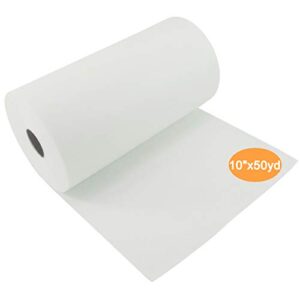
Where tear-away works for stable fabrics, knits, and fleece need something that stays put.
That’s where the Brothread Medium Cut Away Stabilizer earns its place.
At 2.5 oz and 100% polyester, it holds its shape through washing without breaking down.
The 10" x 50-yard roll lets you cut exactly what each hoop requires.
It’s a solid pick for jersey knits, sweatshirt fleece, and denim — fabrics that shift under the needle without proper permanent backing.
| Best For | Embroiderers working with stretchy or unstable fabrics like knits, fleece, and denim who need a backing that holds up wash after wash. |
|---|---|
| Stabilizer Type | Cut-Away |
| Material | 100% Polyester |
| Weight | 2.5 oz |
| Acid/Lead Free | Yes |
| Embroidery Compatible | Machine & Hand |
| Format | 10″ x 50 Yd Roll |
| Additional Features |
|
- Stays permanently in place, so your design doesn’t shift or distort over time
- 50-yard roll gives you plenty of material to cut custom sizes for any hoop
- Works across a wide range of fabrics, from jersey knits to heavy denim
- Dense designs may need multiple layers, which adds cost and bulk
- Cut-away style means extra trimming work after each project
- At 2.5 oz, it won’t suit everyone — those needing lighter or heavier support will have to look elsewhere
3. Brothread No Show Mesh Embroidery Stabilizer
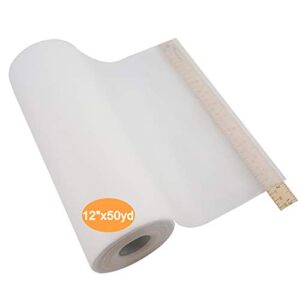
Sometimes you need a cut-away that practically disappears. The Brothread No Show Mesh Stabilizer is built for exactly that — light-colored knits, polo shirts, baby garments, anything where a thick white backing would show right through the fabric.
At roughly 1.8 oz and made from 100% embossed nylon, it’s soft against skin and stays flexible after washing. The multi-directional embossing keeps stitches locked in place without adding stiffness. One layer manages most light-density chest logos cleanly.
| Best For | Embroiderers working with light-colored knits, polo shirts, baby clothes, or delicate fabrics like silk and satin where backing visibility is a real concern. |
|---|---|
| Stabilizer Type | Cut-Away |
| Material | 100% Nylon |
| Weight | 1.8 oz |
| Acid/Lead Free | Yes |
| Embroidery Compatible | Machine |
| Format | 12″ x 50 Yd Roll |
| Additional Features |
|
- Sheer and lightweight at ~1.8 oz, so it stays invisible under light fabrics without adding bulk or stiffness
- Soft enough to leave on the garment — no scratchy feeling against skin after stitching
- Multi-directional embossing locks stitches from every angle, giving solid support for most everyday designs
- Not enough on its own for dense or heavy stitch counts — you’ll need to add a tear-away layer underneath
- The fixed 12-inch width means extra cutting steps for smaller or oddly shaped projects
- A few buyers have reported rolls arriving damaged, so packaging during shipping could be better
4. New Brothread Tear Away Embroidery Stabilizer
Not every project calls for a permanent backing. When you’re stitching on cotton, linen, or other firmly woven fabrics, the New Brothread Tear Away Stabilizer keeps things simple.
At 1.8 oz, it accommodates light to medium stitch densities comfortably — think chest logos, monograms, and appliqué work.
The 100% polyester construction is acid-free, lead-free, and skin-friendly, so it won’t irritate on garments worn close to the body.
Dense fills may need a second layer, but for everyday projects, one sheet does the job cleanly.
| Best For | Embroiderers working with cotton, linen, or other natural fabrics who need a clean, no-fuss stabilizer for everyday projects like monograms, chest logos, and appliqué. |
|---|---|
| Stabilizer Type | Tear-Away |
| Material | 100% Polyester |
| Weight | 1.8 oz |
| Acid/Lead Free | Yes |
| Embroidery Compatible | Machine & Hand |
| Format | 10″ x 25 Yd Roll |
| Additional Features |
|
- Tears away cleanly with no residue, so finishing your project is quick and easy
- Skin-friendly and free of acid and lead — safe for garments worn right against the skin
- Works for both machine embroidery and hand sewing, so it’s versatile enough for most setups
- Not a great fit for stretchy or loosely woven fabrics, which can shift or distort during stitching
- Dense designs may require layering two sheets, which adds a bit of time and material cost
- Can tear unevenly if you’re not careful, so a slow, steady pull works better than a quick rip
5. Brothread Water Soluble Embroidery Stabilizer
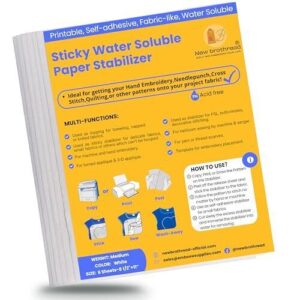
Some projects call for a backing that simply disappears — and that’s exactly what the Brothread Water Soluble Stabilizer does. It’s cold-water soluble, medium weight, and printable, so you can draw or print your pattern directly onto it before stitching.
That’s a real time-saver for intricate lettering or freestanding lace. It’s also self-adhesive, which keeps delicate and sheer fabrics from shifting mid-stitch. Once you’re done, a quick rinse removes everything cleanly, leaving zero residue on skin-touch garments.
| Best For | Embroiderers working with delicate, sheer, or napped fabrics who want a stabilizer they can print patterns on and rinse away completely. |
|---|---|
| Stabilizer Type | Water-Soluble |
| Material | 100% Natural |
| Weight | Medium |
| Acid/Lead Free | Yes |
| Embroidery Compatible | Machine & Hand |
| Format | 8.5″ x 11″ Sheets |
| Additional Features |
|
- Printable and self-adhesive — you can transfer your pattern directly onto it and it stays put while you stitch
- Cold-water soluble with no residue, making it safe for skin-touch garments
- Works great for small, delicate projects like freestanding lace and intricate lettering
- The adhesive can take a moment to kick in, so you may need to wait before it grips properly
- Washing it out can be a bit tedious, especially on more complex pieces
- Printed patterns may come out slightly faded, which could make fine details harder to follow
6. HBI Cut Away Embroidery Stabilizer
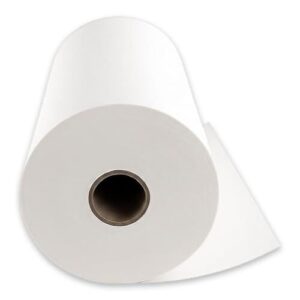
When your design runs 40,000+ stitches in a 5×7 inch hoop, you need a backing that won’t quit. The HBI Cut Away Stabilizer weighs in at 2.5 oz — heavy enough to anchor dense fills and satin columns on knits, fleece, and stretch fabrics without distortion.
It comes on a generous 12-inch by 50-yard roll, so you’re never cutting corners on coverage. Trim it to within a quarter inch of your design, and it stays put through repeated wash cycles, keeping your logo crisp long-term.
| Best For | Embroiderers working with dense, stitch-heavy designs on stretchy or layered fabrics who need a stable, long-lasting backing that holds up through repeated washes. |
|---|---|
| Stabilizer Type | Cut-Away |
| Material | Polyester |
| Weight | 2.5 oz |
| Acid/Lead Free | Yes |
| Embroidery Compatible | Machine & Hand |
| Format | 12″ x 50 Yd Roll |
| Additional Features |
|
- Handles dense designs (40k stitches) without puckering or distortion on knits, fleece, and stretch fabrics
- Comes on a big 12×50 yd roll, so you can cut exactly what you need for any hoop size
- Stays soft after laundering, keeping finished garments comfortable to wear
- Feels stiff and paper-like right out of the roll — takes a wash or two to soften up
- Too heavy for delicate or fine fabrics where a lighter stabilizer would do better
- Beginners used to tear-away backings may find the cut-away style a bit of an adjustment
7. Brothread Clear Water Soluble Embroidery Film
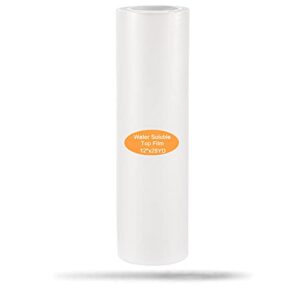
Working on velvet or terry cloth? That’s exactly where the Brothread Clear Water Soluble Embroidery Film earns its spot.
Lay this 25-micron transparent film over your high-pile fabric before stitching, and your stitches stay on top instead of sinking into the texture.
It dissolves completely in cold or warm water after you’re done — no residue, no sticky leftovers.
At $19.99 for a 12-inch by 25-yard roll, you cut only what you need and skip wasted material.
| Best For | Embroiderers who regularly work with high-pile or textured fabrics like velvet, terry cloth, fleece, and towels — whether hobbyist or small business. |
|---|---|
| Stabilizer Type | Water-Soluble Topping |
| Material | Natural Polymer |
| Weight | 25 Microns |
| Acid/Lead Free | Yes |
| Embroidery Compatible | Machine & Hand |
| Format | 12″ x 25 Yd Roll |
| Additional Features |
|
- Keeps stitches sitting on top of fluffy fabric instead of sinking in, so your design actually shows up clean
- Dissolves completely in water with zero residue, so no digging out stabilizer after the fact
- Cut-to-size roll keeps waste low and makes it easy to stretch across a range of project sizes
- Hard to see placement lines on dark fabrics — you’ll likely need to mark your design separately
- The film can feel slippery and stretch a little under hoop tension, so you have to be careful when hooping up
- Needs a solid soak to fully dissolve — a quick rinse might leave faint residue behind
8. HBI Water Soluble Embroidery Stabilizer
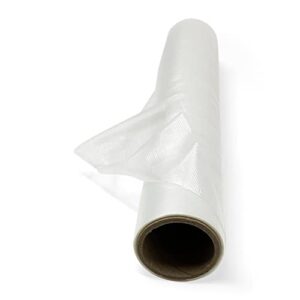
Need a wash-away option that won’t break the bank? The HBI Water Soluble Embroidery Stabilizer comes in a 12-inch by 25-yard roll and weighs in at 1.5 oz — right in the lightweight range for low-to-medium density designs.
It dissolves cleanly in warm water, making it a solid pick for free-standing lace, bookmarks, and textured fabrics where tearaway fibers aren’t an option. Layer two pieces when your stitch count climbs higher than the single sheet can handle.
| Best For | Embroiderers working with high-pile or textured fabrics like towels, fleece, and velvet who need a clean wash-away solution for machine or hand projects. |
|---|---|
| Stabilizer Type | Water-Soluble Topping |
| Material | Not Specified |
| Weight | Light |
| Acid/Lead Free | Not Specified |
| Embroidery Compatible | Machine & Hand |
| Format | 12″ x 15 Yd Roll |
| Additional Features |
|
- Dissolves fully in warm water or steam, leaving no residue behind
- Works as both a topping and a light stabilizer, so it pulls double duty
- Made in the USA and comes in a generous roll, keeping costs down over time
- Thin material tends to roll up and can be tricky to hoop
- May need to be doubled up for denser stitch counts
- Some users find it pricey for what you get
Fix Puckering and Backing Problems
Even the best stabilizer choice won’t save a project if your technique is off. Puckering, shadowing, and messy backing are usually fixable once you know what’s causing them.
Here’s what to check when things go wrong.
Preventing Puckering During Long Stitch Runs
Puckering usually starts before you even thread the needle. Fabric grain alignment, embroidery hoop tension, and stitch count planning all have to work together.
| Problem | Cause | Fix |
|---|---|---|
| Ridge lines | Tight thread tension adjustment | Lower upper tension slightly |
| Wavy fills | Poor layered stabilizer strategy | Add second stabilizer layer |
| Edge pull | High machine speed control | Slow down on dense passes |
stabilizer weight classes to your stitch density guidelines, and test first.
Avoiding Stabilizer Show-through on The Back
Show-through happens when the wrong stabilizer weight or color contrasts with your fabric. Use no-show mesh cutaway stabilizer on light garments — it’s thin enough to disappear. Color-matched backing reduces visible edges without extra trimming.
For dense fills, stitch density masking improves with precise edge trimming after stitching.
Washaway stabilizer eliminates backside fabric smoothing issues entirely on sheers.
A dual-layer stabilizer setup? Save that for tearaway projects needing extra bulk control.
Removing Tear-away, Cut-away, and Wash-away Cleanly
Each stabilizer type has its own exit strategy — and getting it wrong can undo an otherwise perfect stitch-out.
- Tearaway removal: Start at the outer edge, tear inward in small sections to protect stitches.
- Cutaway trimming: Use scissor precision to trim 1/8–1/4 inch from the design edge.
- Washaway dissolving: Run warm water over dense areas; apply gentle finger pressure for residue rinsing.
- Tweezers cleanup: Pick trapped fibers from detailed lettering without disturbing thread tension.
- Fabric support: Lay the piece flat during finishing to prevent stretching along edge trimming lines.
Solving Residue From Water-soluble Stabilizers
Water-soluble stabilizer leaves a stiff or tacky film when it doesn’t fully dissolve. A lukewarm rinse around 32°C keeps washaway dissolving controlled and even. Active rinsing techniques — running water plus gentle finger pressure — clear residue from dense satin areas.
stubborn spot removal, use a cotton swab while fabric is still wet.
Always finish with drying inspection and fabric safety testing on scraps first.
Wash-durability Checks for Large Hoop Embroidery
Once residue is gone, it’s time to check how your finished design holds up over time. Run a Rinse Test on a scrap first, using lukewarm water at around 32°C. Then do a Fabric Flex Test — bend and stretch the stitched area. Post-wash Inspection reveals puckering early.
For washaway stabilizer for delicate fabrics, fabric washing endurance depends on matching stabilizer weight guidelines to your stitch count.
Common Stabilizer Mistakes Beginners Should Avoid
Even after a clean wash test, beginners still trip over a few fixable habits.
Improper Stabilizer Cutting leaves rough edges that scratch finished garments. Excessive Stabilizer Layers stiffen soft knits unnecessarily. A Hoop Tension Mistake stretches fabric before the first stitch lands. Pre-wash Test Omission skips the one check that catches puckering early.
Match stabilizer weight to your fabric category, and removal gets cleaner every time.
Frequently Asked Questions (FAQs)
What if the embroidery design is larger than the hoop size?
Split it into sections using Design Segmentation and Modular Hooping, then stitch each part together with careful Stitch Overlap.
A MaggieFrame magnetic hoop or Alternative Hoops can simplify repositioning without distortion.
How to embroider on large areas?
Break large areas into sections using Design Partitioning and careful Stitch Planning.
Manage Thread Management and Machine Settings per zone.
Use Edge Reinforcement with cutaway roll, tearaway roll, or washaway stabilizer matched to your stabilizer weight and stitch density.
How to know what kind of stabilizer to use?
Your fabric stretch assessment, design complexity rating, and project durability require each point assigned to a different stabilizer.
Check heat sensitivity and color bleed prevention too — those details narrow your choice quickly.
Can stabilizers be reused across multiple embroidery projects?
Yes, some stabilizers can be reused. Tear-away reuse works on stable wovens if needle holes are minimal.
Cut-away scrap stitching extends leftover pieces. Wash-away scrap handling stops there — moisture ends it.
How does thread color affect stabilizer selection?
Thread color is a contrast-driven stabilizer cue. Dark thread backing on light fabric needs color-matched stabilizer to prevent color showthrough.
High-contrast stitching reveals edges fast, so match stabilizer weight and color to your fabric.
Which stabilizers work best in hot or humid environments?
Cutaway and tearaway are your best bets. Heat-tolerant cutaway won’t break down with moisture, and humidity-proof tearaway stays reliable. Avoid washaway or sticky options — heat and humidity wreck both fast.
How do you store stabilizers to prevent degradation?
Store stabilizers in cool dry storage, away from heat and moisture. Use airtight packaging to prevent degradation.
Keep flat roll handling consistent. Add moisture control with silica packs.
Light dust protection extends shelf life considerably.
Conclusion
Mastering the maze of materials turns frustration into perfect finishes. When you match stabilizers to fabric, stitch density, and technique, embroidery stabilizers for large hoop designs transform puckered messes into immaculate masterpieces.
Your projects deserve this precision—no more guesswork, just confident stitching. Watch dense designs lay flat, delicate fabrics hold strong, and every thread tells your story.
Start stitching with certainty; let your next large hoop creation speak for itself.
- https://rnk-floriani.com/wp-content/uploads/2023/10/FlorianiWorkbookStabilizer.pdf
- https://oesd.com/content/PDF/OESD_Stabilizers.pdf
- https://newbrothread-official.com/blogs/%E6%96%B0%E9%97%BB/which-stabilizers-to-use-for-machine-embroidery
- https://americanemb.com/pages/choosing-the-right-stabilizer-for-embroidery-on-performance-wear
- https://www.threadart.com/products/no-show-fusible-mesh-9-5x10yd-roll