
This site is supported by our readers. We may earn a commission, at no cost to you, if you purchase through links.

You’re mid-recipe, mixing bowl ready, and you grab a box of Jell-O from the pantry—only to second-guess yourself. Is this the right size? Will it make enough? A large box of Jell-O contains 6 ounces of dry mix, which Kraft labels as "Family Size" on the package.
That single number matters more than most people realize. Sugar-free versions of the same "large" box weigh only 0.6 ounces—a tenfold difference—because high-potency sweeteners need far less volume to do the same job.
Knowing your box size means knowing your yield: servings, water ratios, and whether two small boxes can stand in for one large. It all connects.
Table Of Contents
Key Takeaways
- A large box of Jell-O contains 6 ounces of dry mix (labeled "Family Size"), yielding 4 cups of prepared gelatin and 8 half-cup servings when combined with 2 cups boiling water and 2 cups cold water.
- Sugar-free Jell-O’s "large" box holds only 0.6 ounces of dry mix—a tenfold difference from regular—because high-potency sweeteners like aspartame require far less volume to deliver the same sweetness.
- Two 3-ounce small boxes are a perfect substitute for one large box, producing identical yield, texture, and water ratios with no adjustments needed.
- Fresh fruits like pineapple, kiwi, papaya, figs, and mango contain enzymes that prevent gelatin from setting—always use canned or cooked versions to avoid a batch that won’t firm up.
A Large Jell-O Box is 6 Ounces
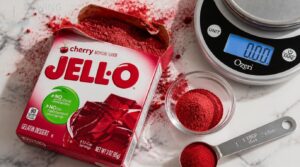
A large box of Jell-O holds 6 ounces of dry powder — and once you know that, a lot of recipe math starts to click. There are a few key things worth knowing about what that 6-ounce box actually means. Here’s what the label, the weight, and the mix can tell you.
Regular Jell-O Box Weight
A large box of Jell-O holds 6 ounces of dry gelatin mix. That’s about 170 grams if you’re working in metric. The weight stays the same across most flavors you’ll find on store shelves.
Whether you grab strawberry or cherry, your box still clocks in at 6 ounces of powder — consistent and reliable. For even larger quantities, large Jello boxes often contain 12 ounces of mix.
Family Size Labeling
Jell-O calls its 6-ounce box "Family Size" on the label. That name signals more servings and better value per ounce compared to the smaller box.
Watch for shrinkflation, though. Some brands quietly reduce the amount inside while keeping the same packaging and price. Always check the net weight on the label before assuming you’re getting the same amount.
Dry Mix Measurement
The net weight on the package tells you exactly how much powder you’re getting. For a large box, that’s 6 ounces or about 170 grams.
When measuring, use a spoon and level technique — scoop gently, then sweep a straight edge across the top. Packing the powder in can add up to 10 percent extra, throwing off your recipe.
Common Fruit Flavors
Jell-O comes in several fruit flavors, and most follow the same 6-ounce format. The flavor changes, but the weight doesn’t.
You’ll find citrus flavor profiles like orange and lemon — bright, tangy, and sharp. Zesty lemon and tangy grapefruit profiles lean more tart. Strawberry brings berry aroma balance, while mango adds tropical mango notes with floral sweetness.
Large Versus Small Jell-O Boxes
Jell-O comes in two sizes, and knowing the difference saves you from guessing at the store. The large and small boxes aren’t just different in name — the gap between them is bigger than you’d think. Here’s how the two sizes stack up.
6. ounce Large Box
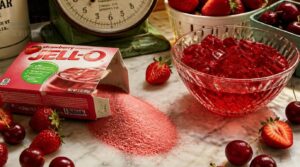
The large Jell-O box holds 6 ounces of dry gelatin powder. That weight is printed right on the package as the net weight. You’ll find this size across popular fruit flavors like strawberry and cherry.
Jell-O labels it "Family Size" — a signal that one box is meant to stretch across multiple servings for a group.
3. ounce Small Box
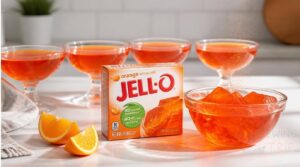
The small box holds 3 ounces of dry mix — exactly half the large size. That’s about 85 grams of gelatin powder packed into lightweight, recyclable cardboard.
It fits easily on a pantry shelf and works well for individual servings. One small box yields four cups of prepared gelatin, enough for roughly four people.
Two Small Boxes Equal Large
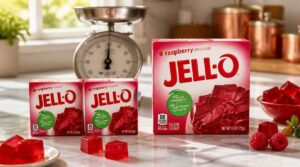
Two small boxes work just as well as one large box. Each small box holds 3 ounces of dry mix, so two together give you the full 6-ounce total.
The gelatin amount is identical. Your recipe won’t know the difference — the yield, texture, and prep steps stay exactly the same.
Grams Comparison
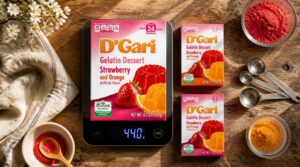
If you’re working in grams, the difference is easy to see. A large box holds 170 grams of dry mix. A small box holds half that — just 85 grams. Together, two small boxes match the large exactly. A kitchen scale confirms this fast if your packaging looks unclear.
Sugar-Free Jell-O Box Weight
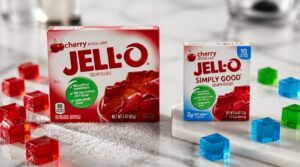
Sugar-free Jell-O is a different story regarding weight. Without all that sugar, the box is noticeably lighter than what you’re used to. Here’s what you need to know about the weight difference and why it happens.
Lighter Package Size
Sugar-free Jell-O comes in a much lighter package than the regular version. That’s because the formula swaps out sugar — the heaviest ingredient — for artificial sweeteners like aspartame and acesulfame potassium.
Sugar takes up real weight. Sweeteners don’t. So the same box size holds far less dry mix by weight, making the package feel almost empty compared to regular Jell-O.
About 0.6 Ounces
A large sugar-free Jell-O box contains just about 0.6 ounces of dry mix. That’s a dramatic drop from the 6 ounces in a regular box.
Aspartame and acesulfame potassium weigh almost nothing compared to sugar. The low-calorie gelatin mix is far lighter by design — the sweetener-based formula simply doesn’t need much powder to flavor the whole batch.
No Sugar Weight Difference
The weight difference might surprise you. Even though a sugar-free box feels lighter on the shelf, the final prepared gelatin weighs the same as regular Jell-O once you add water.
A sugar-free Jell-O box feels nearly empty, yet once water is added, the final gelatin matches regular exactly
- Dry mix grams per box stay consistent across varieties
- Serving count and total yield don’t change
- Final gel mass matches regular after chilling
The sweetener swap cuts calories, not volume.
Sweetener-based Formula
The calorie drop in sugar-free Jell-O comes down to one thing: high-potency sweeteners. Aspartame, for example, is about 200 times sweeter than sugar, so only a tiny amount goes into the mix.
Since there’s far less material by weight, bulking agents like maltodextrin are added to give the powder body — keeping the texture and yield familiar.
How Much Jell-O It Makes
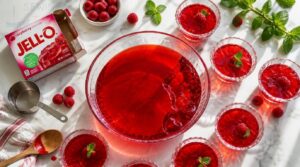
One large box of Jell-O goes further than you might expect. Once you mix it up, that 6-ounce package turns into a decent amount of dessert — enough to feed a crowd or meal-prep for the week. Here’s what you can count on regarding yield, servings, and planning your recipe.
Four Cups Prepared Gelatin
One 6-ounce large box of Jell-O makes exactly four cups of prepared gelatin. That’s enough to fill a standard mold or a medium serving dish.
The dry mix dissolves in hot water first, then cold water brings the total liquid to four cups. Your finished gelatin sets firm enough to slice or unmold cleanly.
Eight Standard Servings
Four cups of prepared gelatin splits into eight half-cup servings. Each one gives you about 80 calories and 18 grams of sugar.
That’s a clean, manageable portion for dessert. You don’t need to guess — the math is already done on the nutrition label.
Serving Size Explained
The label tells you exactly what you’re working with. Each 21-gram serving of dry mix equals roughly one portion of prepared dessert. That gram weight is the anchor — it’s what the 80-calorie count is tied to.
Household measures like half a cup make tracking easier, but the grams don’t lie. Check the label first.
Recipe Yield Planning
Eight servings is the promise on every large box. Hit that target reliably by treating yield as a system, not a guess.
- Scale batches accurately — two small boxes equal one large
- Track portion drift — measure actual servings against expected
- Plan waste in — small spills and mold residue add up
Check your numbers before you pour.
Water Needed for Large Jell-O
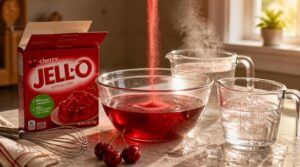
Getting the water right makes all the difference between Jell-O that sets perfectly and one that ends up too runny. A large 6-ounce box has a simple formula—you just need to know the amounts and order. Here’s what you’ll need to mix it correctly.
Two Cups Boiling Water
Start with 2 cups of boiling water when you make a large Jell-O box. The heat — right around 100°C — breaks down the powder fast and keeps clumps from forming. That’s about 16 fluid ounces of liquid dissolving all the sugar and flavoring evenly.
Stir well as you pour. This step fully hydrates the gelatin mix.
Two Cups Cold Water
After the boiling water does its job, you add 2 cups of cold water — that’s 16 fluid ounces, or about 473 milliliters.
- Cold water drops the temperature fast
- Helps the gelatin start to firm up
- Makes daily hydration tracking easier
- Can briefly boost your metabolic rate
- Counts toward your daily water intake
Don’t skip this step. It sets the mixture up to chill properly.
Correct Mixing Ratio
The total comes down to one simple rule: 4 cups of water per 6-ounce box — 2 boiling, 2 cold. The boiling water dissolves the jello powder completely. No clumps, no grainy bits. Then the cold water brings the temperature down.
Measure precisely. Even a small deviation can leave your gelatin mix too soft to hold its shape.
Avoid Watery Gelatin
Too much water is the most common reason gelatin won’t set. If you go past 4 cups total, your jello instructions won’t work as intended — the gelatin mix becomes too dilute to firm up properly.
Stick to the exact ratio. Dissolve the powder fully in boiling water first, then add cold water. That’s the only way to get the right food texture.
Measuring Jell-O for Recipes
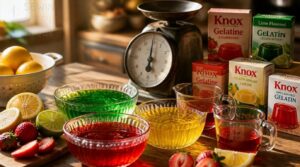
Getting the measurements right can make or break your recipe. Whether you’re swapping box sizes or scaling things up, a few simple rules keep everything on track. Here’s what you need to know when measuring Jell-O for your next dish.
Substituting Small Boxes
Two 3-ounce small boxes equal one large 6-ounce box. Check that both small boxes are the same flavor before mixing.
Pour both packets together before adding water. This keeps the gelatin strength consistent. Don’t change the water amounts — use two cups boiling and two cups cold, same as the large box directions.
Scaling Gelatin Recipes
Once you’ve swapped boxes successfully, scaling up is the next step. Double every ingredient — if one large box needs 2 cups boiling water and 2 cups cold, two boxes need 4 cups of each. Keep that same ratio.
A bigger batch can set more slowly, so give it extra fridge time and check the texture before serving.
Checking Package Labels
Labels can fool you if you rush past them. Before you measure anything, flip the box and check a few things:
- Net weight and serving size listed clearly
- Ingredient order by weight, heaviest first
- Expiration date visible and readable
The box should tell you exactly how many grams per serving and how many servings total.
Common Measurement Mistakes
Even after reading the label carefully, small errors add up fast.
| Mistake | Cause | Fix |
|---|---|---|
| Parallax misreading | Eyes off-center on analog scale | Look directly above the mark |
| Unit mix-up | Ounces and grams confused | Convert to one unit first |
| Early rounding | Rounding mid-calculation | Keep full precision until the end |
| Wrong box size | Small box used instead of large | Check net weight on package |
| Uncalibrated scale | Scale not zeroed before use | Reset before every measurement |
Using the wrong box size is the most common slip — a 3-ounce box instead of a 6-ounce one cuts your yield in half. Always zero your scale before measuring. Parallax errors on analog scales misread dry mix weight; early rounding mid-recipe throws off the final set.
Frequently Asked Questions (FAQs)
What size is the big box of Jell-O?
The big box of Jell-O holds 6 ounces of dry powder. It’s sold as the Family Size option. That’s 170 grams of gelatin mix — enough for eight servings.
What is a 3 oz box of Jell-O?
A 3 oz box of Jell-O holds 85 grams of dry gelatin mix. It makes several servings using 1 cup boiling water and 1 cup cold water. Strawberry and lime are common flavors.
What other liquids can I use instead of water for Jello?
You can swap water for fruit juice, milk, or brewed tea. Avoid pineapple juice — it prevents setting. Carbonated drinks can weaken the gel. Coconut milk adds a creamy texture.
What is the difference between store-bought and bulk Jello packages?
Store-bought boxes offer one flavor, set servings, and clear labels. Bulk gelatin costs less per ounce, cuts packaging waste, and lets you mix flavors or control ingredients — but requires careful measuring.
Is Jello kosher or halal?
Most Jell-O uses pork-derived gelatin, making it neither kosher nor halal by default. Look for a certification symbol on the label. For safe choices, agar agar-based alternatives work for both diets.
What is the history of Jello?
Gelatin powder was patented in Pearle Wait mixed it with fruit and sugar in 1897, creating Jell-O. Orator Woodward bought the brand and built it into an American household name through aggressive marketing.
Are there any creative ways to serve Jello dessert?
Yes. Pour Jell-O into decorative silicone molds, layer colors in glasses, or build jelly jar parfaits. Cut set Jell-O into cubes and skewer them for parties.
How long does prepared Jell-O last in the refrigerator?
Prepared Jell-O lasts 7 to 10 days in the refrigerator. Keep it in an airtight container at 35–40°F. Discard it if you spot mold, a sour smell, or a slimy texture.
Can you freeze Jell-O to make it set faster?
You can freeze Jell-O briefly to speed up setting, but ice crystals form fast. Use shallow containers and move it to the fridge after 20 minutes to protect texture.
Which fruits prevent Jell-O from setting properly?
As the old saying goes, not all fruits play nice. Fresh pineapple, kiwi, papaya, figs, and mango contain enzymes that break down gelatin. Use canned or cooked versions instead.
Conclusion
Now you’re in the know — no more guessing when you grab that box off the shelf. How many ounces is a large box of Jell-O? Six. That’s your number.
A large box gives you eight servings and four cups of prepared gelatin when you follow the two-plus-two water rule. Sugar-free runs much lighter at 0.6 ounces — same "large" label, completely different weight. Check the label, trust the math, and your recipe won’t wobble.
- https://www.verywellfit.com/jello-nutrition-facts-calories-and-health-benefits-4111292
- https://math.answers.com/diet-and-nutrition/How_many_ounces_in_a_box_of_jell-o
- https://jellojoy.com/how-to-make-jello
- http://foodpro.unh.edu/label.asp?locationNum=80&locationName=Holloway+Commons&dtdate=11%2F20%2F2019&RecNumAndPort=800201%2A4
- https://tools.myfooddata.com/nutrition-facts/1142735/wt1