This site is supported by our readers. We may earn a commission, at no cost to you, if you purchase through links.
Most embroidery disasters don’t happen during the stitching—they happen before the needle ever moves. A hoop attached at the wrong angle, a fabric that shifts a millimeter mid-project, a tension screw tightened one turn too far: these small mistakes compound into crooked designs and frustrated afternoons. The gap between a beginner’s results and a professional’s often comes down to one skill that rarely gets the attention it deserves.
Knowing how to attach an embroidery hoop to your sewing machine correctly transforms the entire process. Fabric stays locked in place, your design registers where you intended it, and your machine runs without fighting the material underneath it.
From choosing the right stabilizer for your fabric type to securing the hoop onto the carriage with proper clearance, every step builds toward a cleaner result.
Table Of Contents
Key Takeaways
- Most embroidery mistakes happen before you stitch a single thread — proper fabric prep, stabilizer choice, and hoop alignment are what separate clean results from a crooked mess.
- Matching your hoop size to your fabric type and your machine’s compatibility list is non-negotiable; a mismatched hoop throws off registration and ruins your design placement.
- Tension is a balancing act — tighten until the fabric feels drum-tight, then back off a quarter turn, and let your stabilizer do the heavy lifting instead of the hoop screw.
- Before hitting start, always run your machine’s trace function to catch needle clearance issues and confirm your design lands exactly where you planned.
Preparing Fabric and Selecting The Right Hoop
Before a single stitch hits the fabric, the prep work you do beforehand makes or breaks your results. Getting your fabric ready and picking the right hoop aren’t just formalities — they’re what keeps everything stable and accurate while your machine runs.
If you want to go even deeper, advanced garment sewing techniques cover exactly how precision prep translates into cleaner, more professional results.
Here’s what to work through before you load anything onto your machine.
Pre-treating and Stabilizing Fabric for Embroidery
Preparation is what separates clean embroidery from a puckered mess. Start by prewashing your fabric — cotton shrinks up to 5% without it, which warps your design after stitching. Then pick your stabilizer based on fabric type:
- Knits and stretchy fabrics: cut-away stabilizer
- Woven cottons: tear-away stabilizer
- Sheer or delicate fabrics: wash-away stabilizer
Proper fabric stabilization keeps embroidery tension even from first stitch to last. Understanding stabilizer types is essential for achieving professional results.
Choosing The Correct Hoop Size and Type
Now that your fabric is stabilized, hoop selection is your next decision point.
| Hoop Size | Best Fabric Type | Ideal Project |
|---|---|---|
| 4×4 inches | Delicate knits, silk | Baby clothes, cuffs |
| 5×7 inches | Woven cottons | Shirts, tote bags |
| 6×10 inches | Denim, fleece | Jackets, blankets |
Match your embroidery hoop to your machine’s compatibility list — mismatched hoops cause registration problems fast.
Aligning Fabric and Hoop for Accuracy
Once you’ve nailed hoop selection, alignment is where accuracy actually happens. Mark your fabric center with a water-soluble pen — one vertical line, one horizontal — then match those lines to your hoop’s engraved guides.
For fabric alignment, always check grain matching first: warp threads should run straight, not diagonal. Proper tension control and stitch registration depend entirely on getting this right before the needle moves.
Step-by-Step: Attaching The Hoop to Your Machine
Now that your fabric is hooped and ready, it’s time to get everything locked onto your machine. The process moves in a clear sequence, and skipping a step can throw off your whole design.
Start by working through the tension discs and every thread guide in order—proper machine threading techniques make the difference between a clean first stitch and a tangled mess.
Here’s exactly what to do, from powering on to confirming your needle’s got room to run.
Powering on and Preparing Your Embroidery Machine
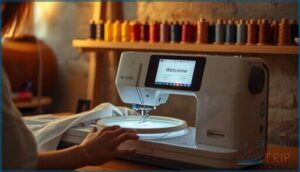
Before touching your embroidery hoop, get your machine setup right. Plug into the correct voltage outlet — 110–120V in North America — then power on and wait for the welcome screen. Your machine needs that power initialization moment to calibrate internally.
Switch into embroidery modes, confirm thread tension defaults, needle alignment, and hoop selection on the screen. Don’t skip this — it matters.
Positioning The Hoop Unit or Embroidery Arm
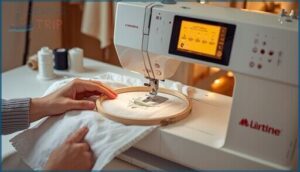
Slide the embroidery arm onto the carriage rails until it clicks fully into place — that’s rail engagement done right. Your machine should auto-drive to its home position, so hoop alignment starts straight. Check the screen confirms your hoop size. Then lower the needle by hand to verify needle clearance before anything moves. Arm calibration handled, embroidery optimization begins.
Securing The Hooped Fabric Onto The Machine Carriage
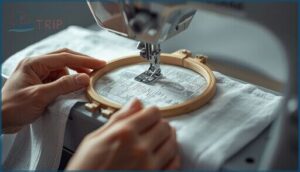
With your hooped fabric ready, push the hoop bracket design firmly onto the carriage mounting points until you hear that satisfying click — that’s your embroidery stability locked in. The bracket’s notches must seat fully over both carriage tabs. Any wobble here means misaligned stitches later.
Check that your embroidery hoop sits flush, with zero tilt, before moving forward.
Ensuring Proper Alignment and Clearance
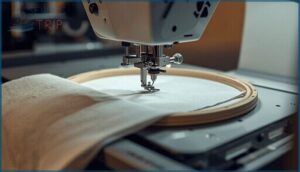
Before you hit start, run your machine’s trace function — it walks the embroidery hoop through the full design boundary so you can spot any clearance problems instantly. This is your machine calibration safety net.
Check these four things first:
- Hoop alignment: fabric grain runs straight, center marks match
- Needle clearance: handwheel test confirms space at every corner
- Fabric tension: drum-tight but not distorted
- Embroidery safety: hands clear of the moving frame
Tips for Tightening and Adjusting The Hoop
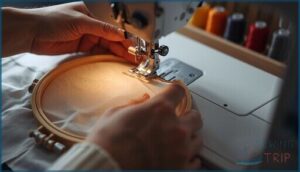
Getting the tension right on your hoop can make or break your entire embroidery project. A few small adjustments — done in the right order — are all that stand between clean, even stitches and a wrinkled mess.
Here’s what you need to know to dial it in every time.
Adjusting Hoop Tension With Screw Mechanisms
The screw mechanism is your main tool for tension control — and a little goes a long way. Start with a light finger-snug fit, then add just one-eighth to one-quarter turn for hoop tension that keeps fabric stability without crushing it.
Check hoop balance by tapping the center; it should feel like a drum. That consistent resistance means your screw adjustment is dialed in perfectly.
Preventing Fabric Slippage and Puckering
Even perfect fabric tension control can unravel fast if slippage sneaks in. Keep your fabric flat and relaxed inside the hoop — never stretched tight.
Proper fabric preparation, including pre-washing and pressing, removes sizing that causes shifting. Match your needle type choices to your fabric weight, run embroidery speed optimization around 600–700 spm, and dial in thread tension adjustment to eliminate puckering before it starts.
To prevent fabric slippage, consider using hoop binding methods for a more secure hold.
Using Stabilizers and Tapes for Extra Hold
Think of stabilizers as your fabric’s safety net. Adhesive stabilizers grip slippery or bulky materials — like velvet or sweatshirts — where standard hooping techniques fall short. Tacky backings and water-soluble options handle delicate sheers beautifully.
Stabilizers are your fabric’s safety net, gripping slippery materials where standard hooping techniques fall short
For floating fabric, hoop taping at the corners locks everything flat. These fabric stabilization methods give you real tension control without over-tightening your embroidery hoop.
Troubleshooting Common Hoop Attachment Issues
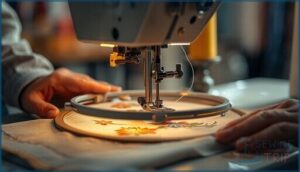
Even with the best prep work, hoop issues can still sneak up on you mid-project. The good news is that most problems have straightforward fixes once you know what to look for.
Here are the most common hoop attachment issues and exactly how to solve them.
Addressing Hoop Marks and Uneven Tension
Hoop marks and uneven tension are two of the most frustrating results of an overly tight embroidery hoop. For hoop mark removal, lightly steam the wrong side and press with a damp cloth.
Tension control starts before stitching — tighten until drum-tight, then back off a quarter turn. On knits, let your stabilizer selection carry the load, not the hoop itself.
Solutions for Warped or Misaligned Hoops
A warped embroidery hoop throws off your embroidery alignment fast. Before replacing anything, try these warp correction steps:
- Soak plastic hoops in warm water for 10–15 minutes, then clamp flat to cool.
- Test your embroidery machine’s trace function to confirm frame calibration before stitching.
- Add non-slip tape or felt pads for hoop stabilizers against carriage rocking.
- Offset your design 1–2mm if hoop realignment isn’t fully fixable.
Preventing Needle Collisions and Fabric Shifting
Beyond alignment fixes, needle collisions and fabric slippage can derail a project just as fast. Before stitching, use your embroidery machine’s trace function to confirm needle clearance around every edge. Keep stitch density moderate — overpacking causes fabric tension to shift.
Lock stabilizers with spray adhesive to stop fabric slippage, and position your hoop screw away from the needle path during machine calibration.
Top Products for Easier Hoop Attachment
The right tools can make hoop attachment feel almost seamless. A few well-chosen products solve the most frustrating problems — slipping fabric, uneven tension, and tricky positioning — before they even start.
Here are three worth keeping at your embroidery station.
1. Hoop Mat For Machine Embroidery
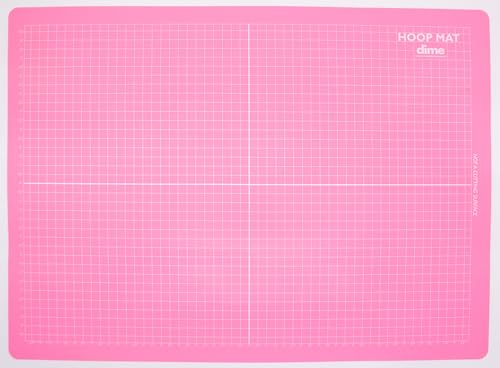
If your hoop keeps sliding across the table mid-tighten, the DIME Hoop Mat (model HPMAT2) is a genuine breakthrough. Made from 100% silicone, it grips your work surface so the hoop stays exactly where you put it — no extra hands needed.
The built-in 24" x 17" grid helps you center any hoop size quickly and square up your fabric grain before you ever touch the machine.
Clean it with a damp cloth. Just don’t iron on it.
| Best For | Embroiderers who hoop solo and want a no-fuss way to center and stabilize any hoop without it sliding all over the table. |
|---|---|
| Material | Silicone |
| Primary Use | Machine Embroidery |
| Reusability | Reusable |
| Non-Damaging | Non-skid, no marks |
| Easy Cleanup | Wipe clean |
| Color | Pink |
| Additional Features |
|
- The non-skid silicone surface keeps your hoop locked in place while you tighten — no death grip on the table required.
- The printed 24" x 17" grid makes centering a breeze, no matter what size or brand of hoop you’re using.
- At just 14.4 oz, it’s light and easy to tuck away when you’re done.
- It only comes in one size, so if you need something smaller for a tight workspace, you’re out of luck.
- It’s not a cutting or pressing mat — it does one job, so don’t expect it to pull double duty.
- Some folks find the price a bit steep for what is, at the end of the day, a silicone mat.
2. Neat Solutions Silicone Placemat
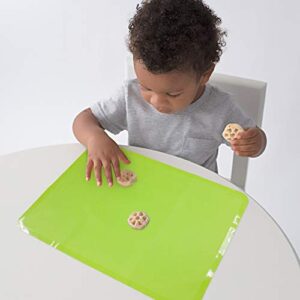
Budget-friendly and clever — the Neat Solutions Silicone Placemat pulls double duty in your embroidery setup. At 15 x 11 inches, it covers most machine beds comfortably, and the tacky underside grips smooth surfaces without leaving any sticky residue.
Set it under your hoop while you tighten the screw, and everything stays put. It’s dishwasher-safe, BPA-free, and comes in a six-pack with high-visibility colors — so small screws and clips are actually easy to spot.
| Best For | Parents and caregivers who want a budget-friendly, easy-to-clean surface that keeps kids’ dishes from sliding around at home or on the go. |
|---|---|
| Material | Silicone |
| Primary Use | Surface Grip |
| Reusability | Reusable |
| Non-Damaging | BPA/PVC free |
| Easy Cleanup | Dishwasher safe |
| Color | Multi (Green, Blue, Red) |
| Additional Features |
|
- Comes in a six-pack with bright colors, so you get plenty of mats and can actually spot small items on them
- Food-grade silicone means it’s BPA-free and dishwasher-safe — cleanup is genuinely easy
- The tacky underside grips smooth surfaces without leaving any residue behind
- Can tear if you’re not careful with how you handle or pull it
- May not stick as well as expected on certain table surfaces
- Needs to be dried thoroughly or it can leave water spots
3. Odif Temporary Fabric Adhesive Spray
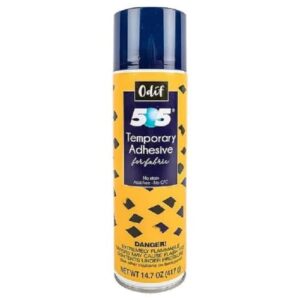
A can of Odif 505 is honestly one of those quiet game-changers you’ll wonder how you managed without. Spray a light mist — about 10 inches from your stabilizer — and it bonds fabric instantly without gumming your needle or leaving marks. It’s odorless, colorless, and washes out completely when you’re done.
Perfect for floating delicate pieces onto hooped stabilizer without re-hooping. Acid-free and CFC-free, it works across cotton, linen, and polyester. Just spray in a ventilated area — it’s flammable.
| Best For | Quilters, embroiderers, and sewists who need a reliable temporary hold for basting, appliqué, and machine embroidery without the hassle of pins. |
|---|---|
| Material | Liquid Spray |
| Primary Use | Fabric Adhesion |
| Reusability | Single-Use Can |
| Non-Damaging | Acid-free, no gumming |
| Easy Cleanup | Washes out easily |
| Color | Clear |
| Additional Features |
|
- Bonds fabric instantly and holds securely without gumming your needle or leaving residue
- Odorless, colorless, acid-free, and washes out completely when you’re done
- Makes building a quilt sandwich or floating delicate pieces onto stabilizer quick and easy
- May leave marks on certain sensitive materials, so test first
- Only a temporary bond — not a substitute for permanent adhesive when that’s what you need
- Some sewists still like to back it up with safety pins for extra security on bigger projects
Frequently Asked Questions (FAQs)
Can you embroider on viscose?
Yes, you can embroider on viscose — just don’t expect it to behave like cotton. Use a 70/10 needle, lightweight cutaway stabilizer, and slow your machine to around 600 stitches per minute.
Can you use embroidery hoops on regular sewing machines?
Technically, you can place a hand embroidery hoop on a regular sewing machine — but it won’t attach. It simply rests on the needle plate while you manually guide it using free motion technique.
How do magnetic hoops differ from traditional screw hoops?
Magnetic hoops snap fabric flat using magnets — zero ring-wrestling. Traditional screw hoops clamp fabric between two rings tightened by a screw.
Magnets are faster and gentler; screws offer more precise tension control for slippery fabrics.
What fabrics are too delicate for standard hooping methods?
Sheer fabrics like chiffon, tulle, and organza crush easily under hoop pressure, leaving permanent rings. Velvet, silk charmeuse, sequined mesh, and stretch knits distort badly — float these on stabilizer instead.
How often should embroidery hoops be replaced or retired?
A hoop that looks fine can quietly ruin your work. Replace it when tension fails, warping appears, or the carriage connection loosens — usually every three to five years for home use.
Conclusion
Mastering how to attach an embroidery hoop to your sewing machine unlocks a thousand perfect stitches you never thought possible. Fabric that stays locked, designs that land exactly where you planned, and a machine that runs like it’s reading your mind—that’s what proper hoop attachment delivers.
Every step you’ve learned here builds that foundation. Trust the process, respect the tension, and your next project won’t just look good. It’ll look intentional.
- https://www.maggieframes.com/blogs/embroidery-blogs/how-to-attach-an-embroidery-hoop-secure-fabric-like-a-pro
- https://www.hooptalent.com/blogs/news/ultimate-brother-cap-hoop-guide-setup-techniques-troubleshooting
- https://www.echidnasewing.com.au/echidna-hooping-station-various-sizes
- https://weallsew.com/embroidery-for-beginners-hoops-and-hooping/?utm_source=weallsew&utm_medium=blog&utm_campaign=embroidery_linkypost
- https://www.youtube.com/channel/UC9mQiNJuVXtaVyvOcXhAWHg