This site is supported by our readers. We may earn a commission, at no cost to you, if you purchase through links.
Loose fabric mid-project is one of those small frustrations that quietly ruins embroidery. You’re halfway through a detailed flower petal, and suddenly the fabric sags, your stitches pucker, and the whole design starts to shift.
It happens to beginners and experienced stitchers alike—because keeping fabric tight in an embroidery hoop isn’t just about pulling hard and hoping for the best. The right hoop, proper fabric prep, and a few key techniques make the difference between a drum-tight surface and a saggy mess.
Once you understand what actually causes tension to fail, fixing it becomes straightforward.
Table Of Contents
- Key Takeaways
- Why Fabric Loosens in Embroidery Hoops
- Choosing The Right Embroidery Hoop
- Preparing Fabric for Tight Hooping
- Step-by-Step Guide to Hooping Fabric Tight
- Tips to Maintain Tension During Embroidery
- Troubleshooting Common Hooping Problems
- Best Practices for Consistent Hoop Tension
- Frequently Asked Questions (FAQs)
- Conclusion
Key Takeaways
- Choosing the right hoop material matters — beech or birch wood grips fabric far better than plastic or cheap bamboo, giving you a stable foundation before you stitch a single thread.
- Prep your fabric like a drumhead: iron it flat, cut a 2–3 inch border beyond the hoop, and align the grain vertically so your tension holds instead of fighting you mid-project.
- Environmental conditions work against you quietly — keeping your workspace between 45–55% humidity and 20–25°C stops natural fibers from absorbing moisture and going slack.
- Matching your stabilizer to your fabric type (tear-away for woven cotton, cut-away for knits, wash-away for sheers) is what keeps your hoop drum-tight from your first stitch to your last.
Why Fabric Loosens in Embroidery Hoops
Even when you start with perfectly taut fabric, it has a way of going slack before you’re halfway through a project.
Choosing beginner-friendly practice fabrics that hold tension well can save you from that frustrating mid-project sag.
There are a few specific reasons this happens, and knowing them makes it a lot easier to prevent. Here’s what’s actually working against your tension.
Natural Fabric Stretch and Handling
Every natural fabric behaves differently in a hoop. Cotton holds fairly well, but its fibers gradually relax under repeated handling. Linen resists stretch but creases fast.
Knits sag almost immediately without heavy stabilizing. Weave density matters too — a tight plain weave grips the rings far better than a loose one.
Understanding your fabric’s elasticity and grain direction is the foundation of solid hoop tension management. Choosing stabilizers and practicing proper hooping techniques also plays a key role in keeping fabric taut.
Environmental Factors (Humidity, Temperature)
Handling isn’t the only thing working against your hoop tension — your room is, too. Humidity effects hit natural fibers hard. Cotton and linen absorb moisture from damp air and swell, loosening their grip on the rings.
Temperature impact is just as real: warm rooms make fibers more flexible, letting fabric stretch and creep. Aim for 45–55% humidity and 20–25°C for consistent fabric tension.
Hoop Size and Mechanism Issues
Your hoop itself can quietly sabotage fabric tension.
An oversized embroidery hoop leaves the center unsupported, so fabric sags as you stitch. Go too small, and you’re re-hooping constantly.
Screw threads strip faster than you’d expect — once worn, ring warping follows, and fabric grip disappears entirely. Hoop size and hoop material both shape your tension control, so treat hoop selection and use as seriously as your stitching technique.
For more on choosing the ideal materials and styles, explore this ultimate guide for perfect fabric tension.
Choosing The Right Embroidery Hoop
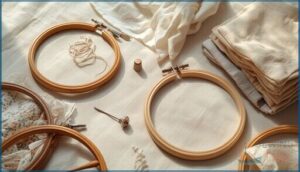
The hoop you choose matters more than most beginners expect. Not every hoop grips fabric the same way, and the wrong one can make tension an uphill battle from the start.
Here’s what to look for before you buy or reach for what’s in your kit.
Hoop Material (Wood Vs. Plastic)
Wooden embroidery hoops — especially beech or birch — grip fabric firmly and hold tension well through long stitching sessions. That’s a clear wooden hoop benefit over circular plastic hoops, which can flex or warp with heat.
Hardwood also wins on material durability and eco-friendly options since it’s biodegradable. For embroidery hoop stability, wood is simply the more reliable choice.
Proper Hoop Size Selection
Size matters more than most beginners realize. A solid hoop size guideline is to choose a hoop 1 to 2 inches larger than your design on all sides — this gives you enough room for fabric tension control without crowding the edges.
For machine embroidery, using the smallest hoop that comfortably fits your design optimizes embroidery hoop stability and keeps stitch density management consistent throughout.
Features That Improve Tension (No Slip, Adjustable Screws)
Beyond basic sizing, the right features make a real difference in keeping fabric tension stable.
Features like locking mechanisms and grip surfaces help maintain consistent tension, as covered in these embroidery hoop tightening and stability tips.
No slip hoops with a tongue groove design lock both rings together so fabric can’t budge once you tighten the screw.
Adjustable screws give finer control than snap closures. Textured surfaces, hoop binding, and magnetic frames also help — especially for slippery fabrics that shift mid-stitch.
Preparing Fabric for Tight Hooping
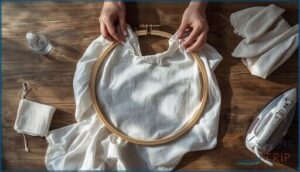
Before the needle even touches thread, how you prep your fabric makes all the difference.
A few simple steps taken beforehand will save you from fighting loose cloth halfway through your design.
Here’s what to do before you place your fabric in the hoop.
Cutting Fabric to Size With Extra Border
Think of your fabric as a drumhead — it needs enough material around the edges to pull taut. Cutting with a generous border dimension of 2 to 3 inches beyond your embroidery hoop on every side gives you real leverage for tight fabric tension.
Treat your fabric like a drumhead: leave 2 to 3 inches of border beyond the hoop for true, lasting tension
This finishing allowance also simplifies centering design placement and aids proper hooping technique for any fabric type needs.
Ironing and Straightening The Fabric
Wrinkled fabric is the enemy of drum-tight tension. Before hooping, iron your fabric using the right ironing temperatures — cotton withstands around 400°F with steam, while synthetics need low heat below 300°F. Steam benefits thicker weaves by releasing deep creases fast.
Follow these fabric preparation steps:
- Press along the grain lines, not diagonally, to keep grain alignment true
- Lift and lower the iron rather than dragging it to avoid stretching
- Let the fabric cool completely flat before hooping
Using Stabilizers for Added Support
A stabilizer is your fabric’s silent partner — it holds everything steady so your hoop tension doesn’t drift mid-project. Choosing the right one makes a real difference.
| Stabilizer Type | Best Fabric Match |
|---|---|
| Tear-away | Woven cotton, linen |
| Cut-away | Stretchy knits, jerseys |
| Wash-away | Sheer organza, tulle |
| Heat-away | Delicate, moisture-sensitive fabric |
| Topping | Towels, fleece, pile fabrics |
Match your stabilizer weight to your design’s density, and your embroidery hoop stays drum-tight from start to finish.
Step-by-Step Guide to Hooping Fabric Tight
Getting your fabric seated in the hoop makes everything that follows easier — your stitches, your tension, your results.
The process isn’t complicated, but the order matters. Here’s exactly how to do it, step by step.
Separating and Placing Hoop Rings
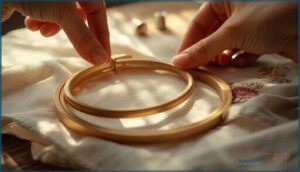
Start every hoop assembly by fully separating the rings. Turn the screw counterclockwise until the outer ring lifts free, then lay the inner ring flat on your table. This single step sets up clean ring engagement and makes fabric centering much easier.
Press the outer ring straight down over your fabric — no rocking — to keep fabric tension even and the hooping technique clean.
Centering and Aligning The Fabric Grain
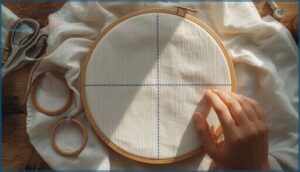
Once the rings are separated, lay your fabric over the inner hoop and find the straight grain before anything else. The straight grain — the least stretchy direction — should run vertically. Misaligned grain leads to crooked stitches and poor tension control.
- Mark a vertical and horizontal center line with a removable pen
- Match those lines to your hoop’s center markings for precise hoop placement
- Pull gently along the straight grain, never the stretchy bias, to maintain fabric tension
Grain alignment is the foundation of embroidery precision.
Tightening The Screw and Adjusting Tension
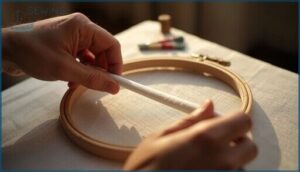
With your grain aligned, screw mechanics take over. Start finger-tight, then work around the hoop — pulling fabric at four compass points before each small turn. That “drum tight” feel you’re after? A light flick should give a crisp snap, not a dull thud. That’s your tension control sweet spot.
| Tightening Stage | Hoop Adjustment Action | Fabric Grip Result |
|---|---|---|
| Finger-tight | Snug outer ring loosely | Fabric held, not locked |
| Quarter-turn increments | Pull fabric at compass points | Even hoop tension develops |
| Firm resistance | Stop turning comfortably | Tight fabric achieved |
| Test with fingertip flick | Listen for crisp snap | Correct embroidery hoop tension |
| Final check | No slipping under moderate tug | Reliable tension management confirmed |
Small turns beat big cranks every time.
Smoothing Out Wrinkles and Slack
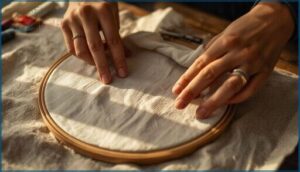
Once your screw holds firm, your hands finish the job. Work around the embroidery hoop in opposite pairs — north to south, then east to west — to keep fabric tension balanced as you smooth.
- Press fingertips outward toward the hoop edge
- Lightly drum across the surface to feel loose spots
- Pull tight fabric every 2–3 cm around the rim
- Check that your hooping technique leaves no diagonal ripples
Good fabric preparation and handling pays off right here.
Tips to Maintain Tension During Embroidery
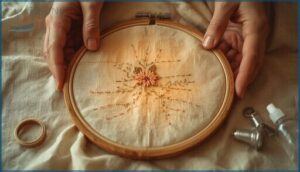
Getting the fabric tight is only half the battle — keeping it that way is where most people struggle.
A few simple habits can make a real difference as your work progresses.
Here’s what to do to hold that tension from the first stitch to the last.
Regularly Checking and Re-tightening Fabric
Fabric relaxation is sneaky — it happens gradually, so you won’t always notice until your stitches start looking loopy or uneven.
Make tension checks part of your natural rhythm by checking hoop tension every 10–20 minutes. Tap the surface; it should sound like a small drum.
When it thuds softly, do a gentle hoop adjustment, tugging the fabric evenly around the edge to restore tight fabric and protect stitch quality.
Securing Excess Fabric With Clips or Pins
Around the hoop, your hooping technique matters as much as the screw itself. Roll excess fabric inward and secure it using low-profile binder clips at the 2, 7, and 10 o’clock locations — this keeps tension control balanced and maintains tight fabric without pulling unevenly.
For pin placement, angle pins over the hoop edge. Always check hoop clearance so clips don’t snag your machine during embroidery.
Using Quality Stabilizers and Adhesives
Stabilizer types do a lot of heavy lifting regarding fabric tension. Cutaway stabilizer bonds well with stretchy knits, keeping your hoop area from sagging mid-stitch. Tearaway works cleanly on woven fabrics.
For hoop preparation on tricky pieces, adhesive options like peel-and-stick tearaway hold awkward edges without extra spray. Good fabric bonding means your stitches stay even from the first stitch to the last.
Troubleshooting Common Hooping Problems
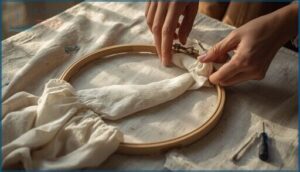
Even when you do everything right, hooping problems can still sneak up on you.
Most issues come down to a handful of common causes, and once you know what to look for, fixing them is straightforward.
Here’s what to watch out for and how to handle it.
Fabric Shifting or Slipping
Slipping fabric is one of the most frustrating mid-project problems you’ll face. It usually comes down to hoop surface texture — smooth bamboo or varnished wood simply don’t grip well enough.
Try a nonslip hoop, or wrap your inner ring with cotton twill tape for better fabric grip solutions. Check your tension adjustment techniques every 15–20 minutes, and use light adhesive spray to keep fabric secure.
Puckering and Distortion
Puckering usually means your thread tension and stitch density are fighting against your fabric stability. Dense fills drag fabric inward, creating those telltale rings of embroidery puckers around a design. Fabric distortion isn’t always a hooping mistake — sometimes it’s the digitizing itself.
Keep fabric tight and manage tension with these fixes:
- Lower stitch density on thin or stretchy fabrics
- Add heavier stabilizer for designs exceeding 8,000 stitches
- Check fabric tension every 15–20 minutes and re-tighten
- Balance thread tension so hoop tension does all the holding
Hooping Technique Adjustments for Different Fabrics
Not all fabrics behave the same in an embroidery hoop, so your hooping technique needs to adapt.
Knits need minimal stretch and firm cutaway stabilizer for clean fabric tension management.
Delicate sheers need lighter screw pressure and water-soluble backing.
Heavy denim benefits from magnetic frames for even tension adjustment.
Match your stabilizer choices and hoop size selection to the fabric first — everything else follows.
Best Practices for Consistent Hoop Tension
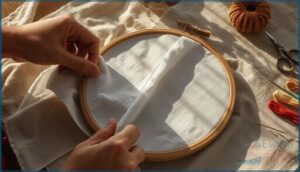
Good technique gets you started, but consistent habits are what keep your work looking clean over time.
A few simple practices make a real difference in how well your hoop holds tension from the first stitch to the last.
Here’s what’s worth building into your routine.
Selecting Quality Hoops and Fabric
Your tools matter more than your technique sometimes. Choosing the right embroidery hoop and fabric sets the foundation for reliable tension control from the very first stitch.
- Hoop Material — Beech or birch wood grips natural fibers better than cheap bamboo or flimsy plastic that warps under screw pressure.
- Hoop Selection — Match your embroidery frames to your project size; a slightly oversized hoop loses its grip fast.
- Fabric Weight — Medium-weight cotton around 150–200 gsm hits the sweet spot for fabric tension without tearing or over-stretching.
- Stabilizer Types — Tear-away works under stable cottons; cut-away backs stretchy knits where fabric quality alone isn’t enough.
- Fabric Preparation — Press everything flat before hooping — wrinkles trapped under the ring sabotage even the best embroidery hoop setup.
Keeping Workspace Organized
Your workspace layout shapes your results more than you’d think. Dedicated tool stations — one for hoops, one for cutting, one for pressing — keep fabric preparation and handling smooth and focused.
Smart storage solutions for stabilizers, clips, and screws mean less scrambling mid-project. Good supply management and an ergonomic setup remove friction, so your embroidery hoop tension stays consistent from start to finish.
Practicing Patience and Attention to Detail
Good organization sets the stage — but patience is what keeps the performance clean. Mindful Stitching means pausing every 20–30 minutes to recheck hoop tension before small loosening becomes visible ripples.
Build simple embroidery routines around these habits:
- Tap-test fabric tension before each session starts
- Observe fabric behavior as stitch density shifts
- Apply precision techniques for fine-tuned tension control
Consistent fabric preparation and handling elevates every finished piece.
Frequently Asked Questions (FAQs)
How to make sure no gapping happens with embroidery?
Think of your embroidery like a drumhead — when tension control is right and hoop preparation is solid, stitches land cleanly with no gaps opening between fills and outlines.
Can I reuse a hoop for multiple projects?
Yes, you can reuse an embroidery hoop across many projects. As long as the screw tightens firmly and the rings hold even tension, it’s ready for the next piece.
How do I hoop fabric without a helper?
Solo hooping is completely manageable with the right setup.
Use a flat table, start with a slightly loose screw, then alternate between pulling fabric edges and tightening gradually until it feels drum tight.
Does thread type affect fabric tension in hoops?
It does. Thread weight, fiber type, and stitch density all pull on your fabric differently.
Heavier threads need firmer hoop tension. Mismatched tension settings let even a drum-tight embroidery hoop go slack fast.
How do I store hooped fabric between sessions?
Store hooped fabric flat in a shallow tray, away from sunlight and moisture.
Loosen the screw slightly before long breaks to ease tension without losing your place.
Cover it with a clean cloth to keep dust off.
Can embroidery hoops damage delicate or sheer fabrics?
Embroidery hoops can damage delicate fabrics. Hoop burn, snags, and fabric distortion are real risks on silk, chiffon, or velvet. Proper stabilizer selection and gentle tension management protect your material.
Conclusion
Picture a student who kept re-hooping the same linen piece six times, frustrated every session. Once she started ironing first, cutting a wider border, and pre-tightening the screw before final tensioning, her fabric held firm from start to finish.
That shift came from understanding the process, not just working harder. Knowing how to keep fabric tight in an embroidery hoop turns a constant struggle into a solved problem—so your stitches can finally speak for themselves.
- https://www.bethcolletti.com/blog/how-do-i-keep-fabric-from-slipping-in-my-embroidery-hoop
- https://crewelghoul.com/blog/keep-fabric-tight-in-embroidery-hoop/
- https://www.needlework-tips-and-techniques.com/how-to-use-embroidery-hoops.html
- https://makersgottamakebox.com/
- https://emblibrary.com/blogs/projects/how-to-avoid-puckering-when-embroidering