This site is supported by our readers. We may earn a commission, at no cost to you, if you purchase through links.
An oversized hood can completely transform a garment—turning a basic sweatshirt into something that looks intentional, architectural, almost editorial.
The difference between a hood that flops flat and one that frames the face beautifully comes down to pattern, fabric, and a handful of construction choices most tutorials skip over.
Once you understand those details, sewing an oversized hood stops feeling intimidating and starts feeling like one of the most satisfying projects in your repertoire.
This guide walks you through every step, from measuring and drafting to the final topstitch.
Table Of Contents
Key Takeaways
- Midweight fleece (280–360 gsm) is your best fabric choice for an oversized hood because it holds shape without adding bulk.
- Getting your pattern measurements right — head circumference, neckline length, and face arc — is the single most important step, since no fabric can fix a bad pattern.
- Clipping curves every quarter‑inch and grading your seam allowances are the two construction details most beginners skip, but they’re what give your hood a clean, professional drape.
- Finishing moves — understitching, pressing over a tailor’s ham, and matching your thread color — are what separate a homemade-looking hood from one that looks store-bought.
Essential Supplies for Sewing an Oversized Hood
Before you cut a single piece of fabric, getting the right supplies together makes everything go smoother. An oversized hood has a few more moving parts than a standard one, so your materials need to hold up to that extra volume and structure.
Here’s what you’ll want to have on hand before you start.
Best Fabrics for Oversized Hoods
The fabric you pick makes or breaks your oversized hoodie. For structure without bulk, midweight fleece between 280–360 gsm is your sweet spot — it holds shape and nails colorfastness through repeated washes.
If you want to dial in the exact weight for your build, this guide on best materials for hoodies breaks down how GSM affects drape, warmth, and long-term wear.
French terry offers breathability and natural stretchability for a lighter drape.
Want eco‑friendly options? Organic cotton fleece checks that box beautifully. Your fabric selection truly defines the finished look.
Opting for sustainable fabrics reduce impact is a smart choice for eco‑conscious designers.
Choosing Lining and Interfacing
Once your outer fabric is set, the lining and interfacing choices pull everything together.
Lining Weight Matching matters more than most beginners realize — a too-heavy lining drags the hood backward. Breathable Fabric Choices, consider these options based on your garment:
- Cotton jersey — soft, breathable, everyday comfort
- Rayon — moisture-wicking, cool against skin
- Polyester — best for cold-weather hoods
- Silk habotai — smooth, ideal for special pieces
- Knit interfacing — maintains Stretch Compatibility in pull-over styles
For Interfacing Type Selection, fusible works great on structured edges, while sew-in preserves natural drape on delicate knits.
Recommended Sewing Tools and Notions
Good tools make all the difference.
For Needle Types, grab Schmetz stretch needles in size 90/14 — they glide through knits without skipped stitches.
Pair your Sewing Machine with a walking foot for even Presser Feet performance on bulky layers.
Use sharp Scissors or Cutting Tools like 8‑inch dressmaker shears.
Marking Tools, Clip Varieties, Pins, Thread, and Interfacing round out your kit.
For best stitch quality, consider using ballpoint needles for knits.
Optional Trims and Drawstrings
Now that your tools are sorted, let’s talk about the finishing touches.
Drawstring Materials range from soft cotton round cords to water-resistant polyester — both work beautifully for oversized hoods.
If you’re unsure which cord weight works best for your project, this Fae Cardigan duster pattern review shows how drawstring choices play out in a real finished garment.
Casing Construction, sew a 1-inch channel along the front edge.
Grommet Placement sits about 2 inches up from the bottom.
Add Cord Lock Options for easy adjustment, or try Ribbon Trim Ideas like grosgrain for a polished look.
How to Draft or Adjust an Oversized Hood Pattern
Getting the pattern right is where everything starts — mess this up and even the nicest fabric won’t save you.
A perfect pattern is the foundation of every great hood — get it wrong and no fabric can save you
An oversized hood needs few specific adjustments beyond a standard pattern, so it’s worth taking this part slowly.
Here’s exactly what you need to work through.
Measuring Head and Neck for Fit

Start with your measuring tape — it’s the foundation of everything.
Wrap it around the widest part of your head for head circumference, then measure your neckline length, back-to-front height, face arc, and shoulder-to-crown span.
For an oversized fit, add 4 to 6 cm ease.
These five numbers are your pattern making blueprint before any sewing techniques begin.
Creating or Tracing a Hood Pattern
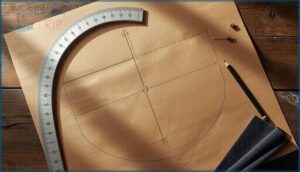
Tracing an existing hood is the fastest way to build your pattern — just lay it flat on paper and trace the edges. For drafting from scratch, use Curve Ruler Techniques and French Curve Usage to draw smooth arcs over the crown. Here’s what to focus on:
- Drafting Crown Width: Draw line A-B at half your head circumference plus 2–3 inches
- Pattern Grainline Alignment: Keep the center-back panel on the straight grain, running vertically
- Seam Allowance Calculation: Add 1–1.5 cm around all edges before cutting
- Hood Pattern Accuracy: Transfer notches clearly so your DIY hood panels align during sewing
Adjusting Pattern for Extra Volume
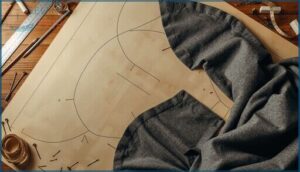
Bumping your pattern up for extra volume is where the real magic happens. Add 2–5 cm for height increase at the crown and 2–4 cm for front depth at the opening edge.
Width expansion works best above the neckline only.
Multi‑panel design with curve shaping keeps the hood balanced.
Redraw all new lines using smooth curves — sharp angles cause twisting during garment construction.
Adding Seam Allowances
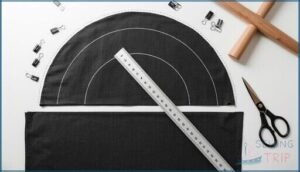
Seam allowance is the buffer between your stitching line and the fabric edge — skip it, and your hood won’t fit. Here’s how to add it cleanly:
- Use Seam Gauge Techniques to mark 1.5 cm along straight edges
- Apply a narrower Curved Edge Allowance of 0.6–1 cm at the crown
- Leave the Center-Back Fold edge with no allowance
- Use Seam Allowance Grading after sewing curves to reduce bulk
- Make sure Matching Lining Allowance on every panel for clean bagging
Cutting and Preparing Your Hood Pieces
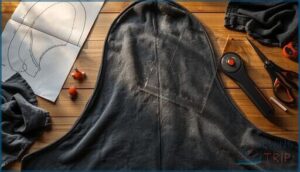
With your pattern ready, it’s time to move to the cutting table. This stage sets the foundation for how your finished hood will look and fit, so a little care here goes a long way.
Here’s what you need to work through before you sew a single seam.
Laying Out and Cutting Fabric and Lining
Getting your fabric ready is where precision meets intention. Lay your fabric on a flat surface, smoothing out every wrinkle before placing your pattern. Grainline Alignment matters here — check that the grainline arrow sits parallel to the selvedge on every piece.
| Step | Outer Fabric | Lining Placement |
|---|---|---|
| Folding Techniques | Fold right sides together | Mirror outer layout |
| Pattern Anchoring | Use weights on fleece | Pin slippery fabrics to paper |
| Cutting Accuracy | Long shears for curves | Rotary cutter for knits |
| Seam Allowance | Confirm before cutting | Match outer measurements |
| Grainline Check | Parallel to selvedge | Same direction as outer |
This sewing tutorial approach keeps both layers consistent and twist‑free after washing.
Marking Notches and Seam Lines
Think of notches as your hood’s personal GPS. Use single notches at side seams and double notches at the back edge — those Notch Types keep your pieces from flipping.
For Marking Tools, water-erasable pens work great on cotton, while chalk grips fleece fast. Mark only on the wrong side. Keep notches shallow — just 2–3mm — so your seam allowance stays strong.
Preparing Center and Side Panels
Now that notches are in place, it’s time to prep your panels before any sewing starts.
For the center panel, align the grain straight up and down — that keeps the hood stable at the neckline.
Side panels get their stretch running front-to-back.
Staystitch the curved neckline edge just inside your seam allowance to lock the shape in and prevent stretching later.
Sewing The Oversized Hood Step-by-Step
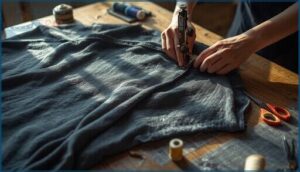
Now comes the part where everything clicks into place.
You’ve got your pieces cut, pressed, and ready — so it’s time to actually sew this hood together. Here’s exactly how to do it, step by step.
Assembling Center and Side Panels
Pinning your panels correctly makes all the difference in sewing a hood that sits right.
Match your notches on the curved edges of each side panel to the center panel first — Notch Alignment here is everything.
Use Panel Pinning from top to bottom, then clip curves every half inch for smooth Curve Matching.
Trim your seam allowance to ¼ inch and grade seams to reduce bulk before moving on.
Sewing Lining and Outer Hood Together
With your panels assembled, it’s time to marry the lining to the outer hood.
Place both pieces right sides together, matching center back seams and notches precisely. Then stitch the front curved edge with a 5/8-inch seam allowance.
- Align exterior and interior layers carefully
- Pin every inch along curves
- Sew with a 2.5mm stitch length
- Grade seam allowance — outer to ¼ inch, lining to ⅜ inch
- Clip curves every ¼ inch
Turn right-side-out through the open neckline.
Pressing and Finishing Edges
Once turned right-side-out, grab your iron — this step makes or breaks the final look.
Use a pressing cloth to protect your fabric, and work curved seams over a tailor’s ham for smooth, rounded edges. Seam grading and the curved clip technique really shine here. Understitch the edge to keep the lining hidden, then press flat using light steam.
Creating a Clean Hood Opening
Getting a clean hood opening comes down to picking the right finishing method. Bias tape binding encloses raw edges neatly — center it on the seam allowance, fold it over, then topstitch 0.3 cm from the edge.
Prefer a polished look? The front edge facing and self facing technique both hide seams beautifully. For any turning method, leave a small gap, push curves out firmly, then close it invisibly.
Attaching and Finishing The Oversized Hood
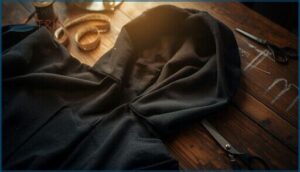
You’ve built the hood — now it’s time to make it part of the garment. This stage is where everything comes together, and the details you add here are what separate a good hood from a great one.
Here’s how to attach and finish it the right way.
Pinning and Aligning Hood to Neckline
Before you stitch anything, alignment is everything. Start with Key Notch Matching — pin the hood’s center back seam directly to the garment’s center back neckline, then work outward toward the front edges.
For smooth Curved Seam Pinning, focus on:
- Matching shoulder seam landmarks for Even Distribution Pins
- Aligning raw edges along the stitch line, not the outer edge
- Using Seam Allowance Alignment at consistent 1.5 cm widths
- Letting Interfaced Neckline Support bear the hood’s weight
Stitching and Securing Seams
Locking in your seams is where good garment construction really holds up.
Set your stitch length to 2.5–3mm, then backstitch two to three stitches at both ends.
Trim and grade the seam allowance down to about 6mm so it curves cleanly.
Add clear elastic reinforcement along the neckline edge, and use bar tack reinforcement near the front openings where stress builds fastest.
Topstitching and Decorative Details
Now your hood gets its personality. Thread weight is the first decision — heavier topstitching thread gives you that bold, 6mm contrast stitching line along the face opening that looks intentional and clean.
- Use coverstitch finishes for sporty parallel rows on knit hoods
- Plan embroidery placement away from the edge so weight doesn’t pull
- Install eyelet reinforcement before drawstring insertion for clean results
Tips for a Professional Finish
Small details make the biggest difference between a hood that looks homemade and one that looks store-bought.
Match your thread color closely to your fabric, press every seam immediately after stitching, and don’t skip interfacing placement along the front opening.
| Step | Technique | Why It Matters |
|---|---|---|
| Seam finishing | Serge or bias-bind raw edges | Prevents fraying over time |
| Edge reinforcement | Understitch neckline seam allowance | Stops seam rolling outward |
| Pressing methods | Use a tailor’s ham on curves | Keeps the crown shape smooth |
Frequently Asked Questions (FAQs)
What to do if my hood is too big?
If your hood feels too big, don’t panic — it’s an easy fix.
Try darts for fit, pleat adjustments, drawstring tightening, or simple seam reduction.
A little tailoring goes a long way.
How to style extremely baggy hoodies?
Funny how the baggiest hoodie can look the most polished. Pair it with slim jeans, chunky sneakers, and a structured bag. A French tuck or belted waist defines everything instantly.
What is the hardest clothing to sew?
Custom jackets, lingerie construction, sheer gowns, formal eveningwear, and denim jeans top the list.
Each demands precise sewing techniques, exacting pattern work, and fabric control that can humble even experienced sewists.
How much fabric is needed to make a hood?
For a lined hood, plan on about ½ yard of 60-inch fabric. Yardage estimation shifts with fabric width effect, seam allowance, and waste margin — so always round up.
Can you sew a hood?
Yes, you can sew a hood — even as a beginner.
With a simple pattern, basic sewing skills, and a modest time investment, it’s a straightforward DIY project most home sewists handle confidently.
How do you make a hood?
Making a hood comes down to four steps:
draft a hood pattern, cut your fabric, sew the pieces together on a sewing machine, and attach it to your garment using basic sewing techniques.
How to make a hood with a sewing machine?
You can make a hood with a sewing machine using a simple hood pattern, the right fabric, and basic stitches.
Thread selection, stitch length, and seam finishing all shape how your finished hood looks and holds up.
Can you make a hood without a pattern?
You absolutely can. Patternless drafting works well for hoods — just use body measurement techniques, trace a favorite hoodie, or build from simple geometry shapes.
Fabric prototypes first, then reuse that traced pattern for future DIY fashion projects.
How do you make a hood out of fabric?
Funny how a few fabric scraps and a pattern can turn into something you’ll wear every single day. Cut, sew the seams, and attach it to your neckline.
How do you sew a hood lining?
Sew the lining pieces right sides together using a stretch zigzag stitch, then understitch the seam allowance toward the lining.
Prewashed fabric prevents shrinking, and lining grain alignment keeps everything smooth inside.
Conclusion
You measured carefully, cut with intention, and stitched every seam with purpose—and now you know exactly how to sew an oversized hood that looks like it belongs on a designer rack.
That structure, that drape, that face‑framing volume didn’t happen by accident. It happened because you understood the details most people skip.
Keep that pattern. Polish it on your next project.
The hood that once felt complicated is now just another technique you own.
- https://www.muellerundsohn.com/en/allgemein/basic-hood-constructions/
- https://sewandrew.com/2021/12/27/into-the-hoods-diy-how-to-draft-sew-a-hood/
- https://curvysewingcollective.com/hoodie-hacks-drafting-a-hood-from-scratch/
- https://iampatterns.fr/en/rainbow-how-to-line-a-hood-on-a-sweatshirt/
- https://shkatulka-sew.ru/pattern/vykroyka-tolstovki-hudi-iren596/