This site is supported by our readers. We may earn a commission, at no cost to you, if you purchase through links.
Most sewists reach for a French seam when transparency matters, but there’s a faster route to that same professional finish. The mock French seam finishing technique delivers clean edges on sheer fabrics without the double stitching or bulk of its traditional counterpart.
You’ll trap raw edges in a single folded pocket that sits flush against your fabric, creating an almost invisible seam line. This approach shines on delicate blouses, lingerie, and lightweight jackets where every stitch shows through.
Master the alignment and folding sequence, and you’ll cut your finishing time in half while maintaining the polished look that makes sheer garments wearable.
Table Of Contents
Key Takeaways
- Mock French seams enclose raw edges with a single fold and topstitch instead of double stitching, cutting finishing time in half while maintaining a clean, professional look on sheer fabrics.
- This technique works best on lightweight materials weighing 20 to 70 gsm like chiffon, organza, and voile, where you need invisible seam lines without bulk.
- Start with right sides together, stitch once, fold both seam allowances inward at ¼ inch, press firmly, then topstitch close to the fold to lock everything in place.
- Keep seam allowances between 6 to 8 mm for light fabrics, use shorter stitch lengths to prevent fraying, and press curves with a tailor’s ham to avoid puckering.
What is The Mock French Seam Technique?
A mock French seam gives you the polished look of a traditional French seam without the extra steps. This technique encloses raw edges with a single fold and topstitching, making it faster while still delivering that clean, professional finish on sheer fabrics.
For a complete breakdown of this method and other clean finish seam techniques, you’ll find step-by-step guidance tailored to different fabric weights.
Let’s break down what makes this method work and when you’ll want to reach for it.
Definition and Key Features
A mock French seam finish creates a clean edge on lightweight fabrics by encasing raw edges within a folded seam. This seam construction technique uses two folds to trap the edge in a compact pocket, delivering excellent stitch quality and seam stability.
The finished seam lies flat against the garment with a softly rounded edge. Unlike traditional French seams, mock French seams require just a single initial stitch line.
How It Differs From French Seams
While both methods give you a clean interior, the seam comparison reveals distinct differences. French seams enclose raw edges between two stitch lines by sewing wrong sides together first, then right sides together. Your mock French seam finish uses fabric orientation with right sides together from the start, folding the allowance inward once. This alters stitch techniques and durability factors:
- French seams create a fully enclosed double-layer interior with nearly invisible edges
- Mock French seams produce a neat single fold that sits flush but may show slight bulk
- Edge finishing speed favors mock versions for quick projects where maximum strength isn’t critical
For more on preventing fraying, see this guide to.
Ideal Uses and Applications
You’ll find this mock French seam finish most effective with delicate blouses and lingerie where both fabric sides remain visible. The edge treatment delivers nearly invisible seam finishing on sheer fabrics like chiffon and voile.
It works beautifully for scarves and lightweight jackets where garment construction methods demand clean lines without bulk.
Your fabric selection determines success when working with sheer fabrics that can’t hide raw edges.
Best Fabrics for Mock French Seams

Not every fabric plays well with mock French seams. You’ll get the best results with sheer and lightweight materials that can fold cleanly without adding bulk.
Let’s look at which fabrics work, how to prep them properly, and what challenges you might face along the way.
If you’re exploring silky options, understanding the differences between sateen and satin can help you choose the right finish for your project.
Suitable Sheer and Lightweight Fabrics
Sheer textiles like chiffon, organza, and voile work best with the mock French seam finish. Silk and polyester blends offer improved durability for fabric selection.
These lightweight materials usually weigh 20 to 70 gsm and need delicate handling to preserve transparency effects. The high thread count in sheer fabrics creates a natural sheen but shows construction clearly.
Choose fabrics with good drape for seam stability.
Fabric Preparation Tips
Fabric preparation separates amateurs from experts. Start with these critical fabric stabilization steps:
- Prewash your sheer fabrics using warm water to achieve shrinkage control before cutting—expect 3 to 5 percent reduction in cotton and linen.
- Verify grain alignment by trimming edges straight and checking that fibers run parallel.
- Finish raw edges with a narrow zigzag stitch for edge finishing that prevents fraying during sewing and pressing techniques.
Common Seam Challenges With Fabrics
Lightweight satins and plains slide under the needle, creating seam slippage that produces wavy stitching. Fabric puckering appears when thread tension doesn’t match your fabric weight—adjust your tension setting and check stitch length.
Edge distortion happens with overly dense stitching that strains delicate fabrics.
Control fraying by using appropriate seam allowances and fray prevention techniques like overlocking before you begin mock French seam construction.
Step-by-Step Mock French Seam Instructions
You don’t need special equipment or years of experience to master this technique. The process breaks down into four manageable steps that build on each other.
Here’s everything you need to create a clean, professional finish on your sheer fabrics.
Materials and Tools Needed

You’ll need sharp dressmaking scissors with 9-centimeter blades, lightweight silk thread, and ball point sewing pins for fabric manipulation. Gather a sewing machine, chalk fabric markers for precise seam gauges, and interfacing types ranging from 12 to 25 grams per square meter.
These sewing notions enhance your sewing skills when creating a mock French seam versus a traditional French seam finish. Thread colors should match your fabric.
Fabric Alignment and First Stitch

Start with your fabric pieces right sides together—this is where seam edge control makes all the difference. Proper fabric tension prevents shifting during your first stitch, which sets up the entire mock French seam finish.
- Align raw edges perfectly along the seam line using a straight stitch with balanced tension
- Set your sewing machine stitch length slightly longer than standard to reduce bulk
- Secure with backstitching at both ends to anchor the seam firmly
Edge trimming comes after pressing techniques improve your French seam finish.
Folding and Pressing Edges

Once your seam is stitched, open it flat with your iron—this crease forms your foundation. Fold both seam allowance edges inward toward the seamline at exactly ¼ inch, bringing them together like closing a book. Press firmly with a sharp, narrow iron tip to set the fold.
Edge Folding Techniques and proper Pressing Tools transform raw edges into a clean envelope, essential for mastering Mock French Seam Garment Construction Techniques.
Final Stitch and Finishing Touches
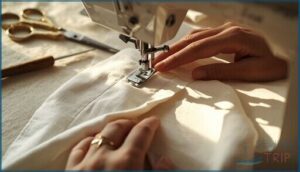
Position your folded edges under the presser foot and stitch close to the fold—this final pass locks everything in place. Use a shorter Stitch Length to minimize thread visibility and boost Seam Security. Adjust Fabric Tension so stitches lie flat without puckering.
Clip threads, press from the seam allowance side, and your Edge Treatment is complete—a hallmark of refined Garment Construction Techniques. For further insight, learning about can enhance your results and make the process more predictable.
Mastering seam allowance finishing techniques gives you the control to match the right method to your fabric and achieve consistently professional results.
Tips for Perfect Mock French Seams

Mastering mock French seams requires attention to a few key techniques that separate amateur work from professional results. Even experienced sewers face challenges with seam allowances, fabric fraying, and curved edges.
Here’s what you need to know to achieve impeccable finishes every time.
Managing Seam Allowance
For light fabrics, aim for a 6 to 8 mm allowance to maintain seam margin control without excess bulk. Fabric thickness dictates your approach—sheer materials benefit from narrower margins while still allowing proper seam finishing techniques.
Trim and grade after stitching to employ bulk reduction techniques effectively. Consistent seam allowance management across all garment construction stages ensures mock French seams lie flat and press cleanly without puckering.
Handling Curved Seams
When working with curved seams in mock French seam construction, curve easing becomes your control mechanism. Match midpoints first along convex and concave segments to prevent distortion.
Use seam notching with small V-shaped cuts on the seam allowance after stitching to reduce bulk.
Pressing techniques require a tailor’s ham and light steam for curve smoothing. Guide the fabric steadily through tight arcs using your fingertips for professional edge finishing.
Preventing Fraying and Unraveling
To control fraying, reduce your stitch length to 2mm or less on exposed edges—shorter stitches create a tight barrier that locks fibers in place. Apply edge sealants sparingly along the seam allowance to reinforce fabric stability without stiffness.
For extra protection, consider overlocked edges before constructing your mock French seam. These seam finishing techniques prevent unraveling and extend garment life while maintaining clean lines in your seam finishing work.
Troubleshooting Common Issues
Even with careful preparation, you’ll face challenges. Here’s how to solve common mock French seam obstacles:
- Seam alignment errors — Recheck your seam allowance and re-sew with precise guiding to fix misaligned edges and fabric slippage.
- Thread breakage — Replace with compatible thread for your fabric type.
- Needle problems — Switch to appropriate size to eliminate skipped stitches.
- Pressing issues — Use lower heat to avoid scorching synthetic fibers.
Alternatives to Mock French Seam Finishes

Mock French seams aren’t your only option when you need clean, professional edges on sheer or lightweight fabrics.
Different projects call for different techniques, and understanding the alternatives helps you choose the right finish for what you’re making.
Here’s how other seam methods stack up and when you’ll want to reach for them instead.
Traditional French Seam Comparison
Traditional French seams use two stitching passes—wrong sides together at 1/4 inch, then right sides together after trimming to 1/8 inch—enclosing raw edges inside the seam.
Mock French seams mimic this finish with a single pass and topstitched fold, saving time while delivering a clean edge for garment construction.
| Feature | French Seam | Mock French Seam |
|---|---|---|
| Stitching passes | Two separate passes | One pass plus topstitch |
| Seam allowance | 1/4″ then trimmed to 1/8″ | Varies by fabric weight |
| Best fabric selection | Lightweight, stable weaves | Light to medium weight |
Other Seam Finishing Methods
You have several alternatives when mock French seams don’t fit your project.
Hong Kong finish uses seam binding for crisp edge finishing on unlined jackets. Flat-felled seams deliver sturdy fabric stabilization in denim and workwear. Double stitched seam finish works well with garment interfacing.
Hand rolled hem finish suits delicate edges. Each sewing technique offers distinct advantages depending on your fabric and garment requirements.
Choosing The Right Seam for Your Project
Your fabric durability and garment function drive seam selection. Match edge finishing to fabric weight—delicate textiles need enclosed seams while heavy materials require topstitched strength.
Consider these factors for seam finishing techniques:
- Seam visibility affects garment construction appearance inside and out
- Pattern placement determines cross seam tension and drape
- Machine capabilities limit available sewing techniques
- Care requirements influence longevity of your seam finishing choice
Mock French seam works best for unlined pieces in lightweight fabrics.
Frequently Asked Questions (FAQs)
What is the difference between mock French seam and French seam?
A French seam starts wrong sides together, then encloses raw edges in a second fold.
Mock French seams begin right sides together and use topstitching to mimic that clean, enclosed finish with fewer steps.
When should you not use French seams?
Skip this seam finishing technique on very thin fabrics where bulk shows through, heavy textures that create stiffness, and sharply curved edges requiring excessive clipping.
Also avoid it on delicate materials prone to distortion from double stitching.
What is a mock seam?
A mock seam finishes raw edges by folding seam allowances inward and stitching them together.
This edge finishing technique creates clean seam enclosure on garment construction projects without exposing frayed fabric edges inside.
How to sew a mock French seam?
Want crisp, enclosed edges without the fuss? Align your lightweight fabric with right sides facing, sew the initial seam, press open, fold seam allowances inward, then stitch close to the folded edge.
What is a mock French seam?
A mock French seam encloses raw edges with topstitching visible on one side. You sew right sides together first, fold edges inward, then stitch again—creating a clean finish faster than traditional French seams.
Can you sew a French seam on a curved seam?
Yes, but gentle curves work better than tight ones. Clip strategic notches along the seam allowance to ease tension. Press carefully to shape the curve and prevent puckering throughout your edge finishing process.
Are you ready to sew a full French seam?
Traditional French seams fully enclose raw edges through two stitching passes on lightweight fabrics. This garment construction method requires careful fabric selection and seam preparation.
Both sewing techniques deliver clean edge finishing, though the mock French seam simplifies the process.
How do you make a mock seam?
Ready to tackle a cleaner seam finish? Start by sewing a plain seam with right sides together. Fold each raw edge toward the center, press, align both folds, then stitch through all layers.
Is a regular French seam a good quality?
French seams deliver outstanding seam quality through double stitching that boosts stitch strength and fabric durability. This edge finishing method prevents fraying on delicate fabrics, ensuring enhanced garment longevity compared to plain seam finishing techniques in garment construction.
How to troubleshoot common mock French seam issues?
When edges fray or your seam allowance shifts, check stitch tension first.
Pressing techniques matter—use a firm press to set folds.
Trim evenly before the final stitch to prevent fabric distortion.
Conclusion
You’ve just unlocked a seam finish that’ll transform every sheer project you touch. The mock French seam finishing technique delivers professional results without the time investment traditional methods demand.
Your delicate fabrics now have a reliable ally—one clean fold instead of double stitching. Apply this method to your next blouse or slip dress.
Watch raw edges disappear behind that single enclosed seam. You’ve earned the confidence that comes with invisible, durable finishes.