This site is supported by our readers. We may earn a commission, at no cost to you, if you purchase through links.
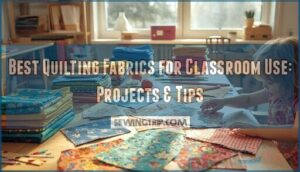
Quilting turns a classroom into a creative workshop—but the wrong fabric can derail an entire project before the first stitch.
Fraying edges, bleeding dyes, and shrinking squares frustrate students and eat up precious lesson time.
Choosing the right quilting fabrics for classroom use doesn’t require a textile degree.
From 100% cotton quilting cuts that hold their color through repeated washing, to precut charm packs sized perfectly for small hands, the right materials make teaching quilting genuinely enjoyable.
This guide covers the best fabric types, top classroom‑friendly collections, and practical tools that keep your projects running smoothly from start to finish.
Table Of Contents
Key Takeaways
- 100% cotton with a tight 68×68 thread count is the most durable and classroom-safe fabric choice, holding color through repeated washing when prewashed first.
- Precuts like charm packs and layer cakes save prep time and fit small hands well, making them ideal for beginners and group quilting projects.
- freezer paper templates, a lightweight travel iron, and iron‑on adhesive keep projects moving without overwhelming students with complex techniques.
- Buying in bulk from wholesale suppliers and sourcing donated or thrifted cotton can cut costs significantly when outfitting a full classroom.
Best Fabric Types for Classroom Quilting
Picking the right fabric makes all the difference when you’re quilting with a group.
Whether you’re going bold or keeping it classic, browsing quilting fabrics curated for quilting clubs can spark ideas and help everyone land on something they love.
Some materials hold up better under little hands, repeated washing, and classroom wear and tear.
Here are the best fabric types to keep your projects running smoothly.
100% Cotton Fabrics for Durability
For classroom quilts that actually hold up, 100% cotton is your best friend. Look for school quilting fabric with a thread count around 68×68 — that tight weave means real fiber strength and better colorfastness through dozens of wash cycles.
White cotton fabric and fabric by the yard both offer great shrinkage control when prewashed.
Many options carry eco-friendly certifications, making them smart, safe teacher resources.
When selecting fabrics, consider the benefits of quilting cotton fabrics for durability and ease of use.
Precut Quilt Panels and Their Uses
Precut quilt panels make classroom quilt projects so much easier. Standard panel size guides range from 30×40 inches up to 50×65 inches — perfect for student-made quilts without complex piecing.
Theme matching is simple too, with dinosaur, alphabet, and animal designs built right in. Assembly techniques stay beginner‑friendly since the artwork is preprinted. That means your educational sewing projects stay focused on borders and finishing skills. The benefits of precut fabric bundles are widely recognized in quilting education.
Layer Cakes Vs. Charm Packs
Both options are fabric squares — layer cakes measure 10×10 inches, while charm packs give you smaller 5×5 squares.
For cost efficiency in educational craft projects, one layer cake bundle stretches further across a Back to School fabric quilt. Charm packs shine for individual student work and classroom storage since smaller fabric squares are easier for little hands. Cutting techniques can bridge both sizes.
Washable and Easy-Care Fabrics
Charm packs make individual projects easy — and when fabric choice matters just as much as design, it’s time to wash those finished pieces.
Pure cotton shrinks 3–5%, so a quick shrinkage prewash before cutting saves headaches later. Poly-cotton blends shrink only 1–3%, making them washable and durable textiles for repeated classroom use.
- Colorfastness testing prevents dye bleeding between light and dark fabrics
- Stain-resistant finishes wipe clean with mild soap and water
- Low-heat drying protects seams and preserves color
- Machine wash and dry cycles work well with durable polyester fabrics
- Poly-cotton blends are easy to use and hold their shape wash after wash
Popular Classroom-Friendly Fabric Collections
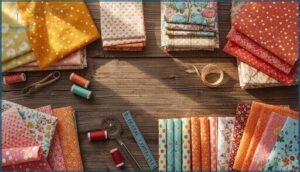
Picking the right fabric collection can make or break a classroom quilting project.
Some collections just fit the school setting better — the colors, the themes, the energy they bring to a student’s hands.
Here are a few worth knowing about.
Back to School Themed Fabrics
Back to school fabric lines are built around Motif Symbolism — crayons, pencils, chalkboards, and buses that kids instantly recognize.
Stacy Iest Hsu’s collection alone offers 23 pieces packed with Student Engagement Strategies through bold Color Palette Trends in primary hues.
These Seasonal Fabric Releases work beautifully for educational craft ideas like teacher fabric accents, classroom storage solutions, and even Back to School Lunch Bags.
Enchantment and Reef Collections
Two collections worth knowing about are Enchantment by Sweetfire Road and Reef by Kate Spain — both available through Missouri Star Quilt Company and other quilting and sewing supplies shops.
- Enchantment uses Woodland Motif Integration with soft blush, caramel, and teal Color Palette Contrast.
- Reef brings Marine Theme Education alive with coral, aqua, and navy.
- Both offer Precut Size Benefits in charm packs and layer cakes.
Seasonal Design Variations make these school themed fabric lines perfect for classroom quilts year‑round.
Designs by Kate Spain
Kate Spain’s designs stand out for their Floral Garden Motifs and Nature-inspired patterns drawn straight from real gardens and coastlines. Her Garden Color Palettes mix botanical print themes with Vibrant Garden Hues — cool sea glass blues, warm corals, and rich greens.
With 3 items available, her school-themed fabric works beautifully for classroom quilts and educational craft ideas through Missouri Star Quilt Company.
Stacy Iest Hsu’s Educational Prints
Stacy Iest Hsu brings 23 items to the catalog — more than any other designer here.
Her school fabric prints are built for the classroom, from Alphabet Panels and Number Motifs to Cut Sew Panels with llamas and unicorns.
Each one facilitates Interactive Learning Quilts and educational craft ideas with ease:
- Alphabet Panels include cute illustrations for every letter
- Number Motifs coordinate with Classroom Color Schemes on white backgrounds
- Cut Sew Panels feature 15 beginner projects for kids
- back to school print fabric is 100% cotton, 44 inches wide
- Designs double as classroom decor and quilting and sewing supplies
Sweetfire Road Unique Fabrics
Sweetfire Road brings a quieter kind of beauty to your classroom.
Jackie MacDonald designs from Maine’s rocky coastline — her Coastal Inspiration and Romantic Palette shine through blush pinks, caramel, and soft neutrals. Her Enchantment collection carries real Sentimental Motifs rooted in Family Heritage and Maine Craftsmanship.
One item is currently available, making it a distinctive pick for educational crafts and classroom decor.
Top Products for Classroom Quilting Projects
The right tools can make or break a classroom quilting project. Beyond fabric, a few key supplies help everything come together smoothly — from prepping cuts to adding finishing details.
Here are the top products worth keeping on hand.
1. Reynolds Kitchens Plastic Coated Freezer Paper
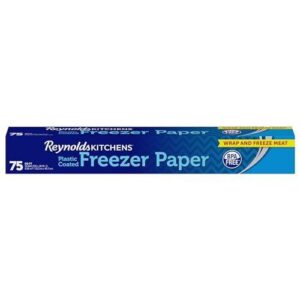
Reynolds Kitchens Plastic Coated Freezer Paper is a classroom quilting staple.
The roll measures 18 inches wide by 16‑2/3 yards, so you can cut exactly what you need.
Iron the shiny side onto cotton fabric, trace your shapes, then peel it off clean — no residue, no pins, no finger‑prick worries.
Templates hold through two or three pressings before you need a fresh piece.
You can even run it through an inkjet printer for perfectly precise shapes every time.
| Best For | Home cooks, hunters, and crafters who need a reliable way to freeze food without freezer burn or want a versatile paper for quilting and DIY projects. |
|---|---|
| Primary Use | Food & Crafts |
| Craft Compatible | Yes |
| Quilting Relevant | Surface protection |
| Age Suitability | All ages |
| Product Weight | Not listed |
| Made/Published In | USA |
| Additional Features |
|
- The plastic coating locks in moisture and flavor, so your meat and fish actually taste fresh when you thaw them
- Easy to write on — just grab a marker and label everything with the date and contents
- Tough enough for crafting too, from quilting templates to soap making and art projects
- Harder to track down in local stores, so you may need to order online
- The plastic coating can slow down thawing time compared to regular wrap
- At 75 square feet per roll, big projects or large families might burn through it fast
2. Sunbeam Dual Voltage Travel Steam Iron
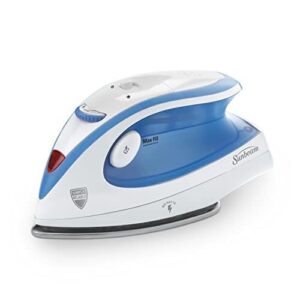
Once your templates are cut and ready, pressing seams flat is next — and that’s where the Sunbeam Dual Voltage Travel Steam Iron earns its spot in the classroom.
It weighs just 1.2 pounds, heats up in two minutes, and fits neatly into any storage bin. The Shot of Steam feature takes care of stubborn wrinkles quickly. It runs on 120V or 240V, so it works anywhere. Small, reliable, and easy for supervised student use.
| Best For | Quilters, crafters, and students who need a lightweight, reliable iron for pressing seams or touch-ups — especially handy for travel or classroom settings. |
|---|---|
| Primary Use | Sewing & Travel |
| Craft Compatible | Yes |
| Quilting Relevant | Seam pressing |
| Age Suitability | Adult |
| Product Weight | 1 pound |
| Made/Published In | Not listed |
| Additional Features |
|
- Super lightweight at just over a pound, so it’s easy to handle and store
- Dual voltage means you can take it anywhere in the world without an adapter
- The Shot of Steam feature handles stubborn wrinkles fast, even on hanging garments
- The water reservoir is small, so you’ll be refilling it pretty often during longer sessions
- No auto shut-off, which is worth keeping in mind if you tend to walk away mid-project
- The non-stick soleplate may raise concerns for anyone trying to avoid PFAS-coated surfaces
3. HeatnBond UltraHold Iron On Adhesive
With your seams pressed flat, it’s time to skip the needle and thread altogether. HeatnBond UltraHold Iron On Adhesive bonds fabric permanently — no sewing needed. It’s double-sided, heat-activated, and strong enough for appliqué shapes, patches, and quilt panels. The 17‑inch width accommodates larger pieces easily.
Students can draw designs directly on the paper backing, cut them out, and iron them on. It’s a practical, time‑saving tool that keeps classroom projects moving without the hassle.
| Best For | Crafters, quilters, and classroom students who want a fast, no-sew way to bond fabric, patches, or appliqué pieces permanently. |
|---|---|
| Primary Use | Fabric Bonding |
| Craft Compatible | Yes |
| Quilting Relevant | Appliqué adhesive |
| Age Suitability | Adult |
| Product Weight | 9.2 ounces |
| Made/Published In | Not listed |
| Additional Features |
|
- Super strong hold — bonds fabric, leather, felt, wood, and more without a single stitch
- Full sheet coverage means no puckering or bunching, even on larger pieces
- You can draw or print designs right on the paper backing, making cutting and placement a breeze
- Once it’s on, it’s on — there’s no undoing it if you make a mistake
- Single-use only, so you’ll need a fresh piece for every project
- Heat activation means it’s not ideal for materials that can’t handle an iron
4. Tulip Permanent Nontoxic Fabric Markers
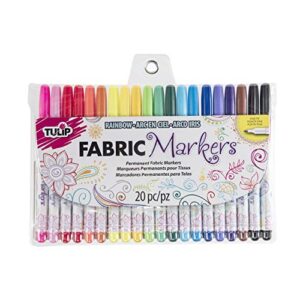
Once your fabric pieces are cut and bonded, let students make them their own. Tulip Permanent Nontoxic Fabric Markers come in a 20-pack rainbow assortment, so every student gets the colors they need.
The fine bullet tips write cleanly on cotton without snagging or bleeding — great for names, designs, and short messages.
The ink is machine washable and doesn’t need heat setting, which keeps your lesson simple. Nontoxic and safe for all ages, they’re a natural fit for group quilting days.
| Best For | Teachers, crafters, and families who want a safe, easy way to personalize fabric projects like quilts, t-shirts, and bags. |
|---|---|
| Primary Use | Food & Crafts |
| Craft Compatible | Yes |
| Quilting Relevant | Surface protection |
| Age Suitability | All ages |
| Product Weight | 10.93 ounces |
| Made/Published In | Not listed |
| Additional Features |
|
- 20 vibrant colors that stay bright after machine washing — no heat setting needed
- Fine bullet tips make it easy to write names, draw designs, or add details without bleeding
- Nontoxic and safe for all ages, so kids can jump right in
- Some markers may arrive dried out or with tips that don’t perform well
- Colors can bleed if you hold the marker in one spot too long
- You’ll need to wait 24 hours before tossing anything in the wash
5. Kindness Quilt Picture Book
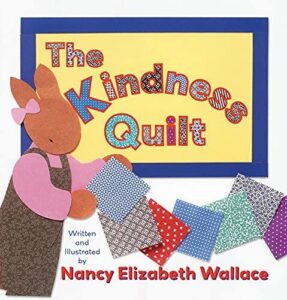
After the markers come out, here’s a book worth keeping on your shelf. The Kindness Quilt by Nancy Elizabeth Wallace is a 48-page picture book that pairs perfectly with any classroom quilting project.
It follows a young rabbit named Minna who builds a paper quilt to capture acts of kindness — square by square. At $10.89, it’s an affordable way to connect quilting with social‑emotional learning. Read it aloud, then watch students line up to make their own squares.
A young rabbit named Minna builds a paper quilt square by square, turning acts of kindness into a classroom lesson worth lining up for
| Best For | Teachers, homeschool parents, and caregivers looking for a simple, heart-led way to introduce kindness and empathy to preschool and early elementary kids. |
|---|---|
| Primary Use | Fabric Decorating |
| Craft Compatible | Yes |
| Quilting Relevant | Fabric marking |
| Age Suitability | All ages |
| Product Weight | 3.2 ounces |
| Made/Published In | Not listed |
| Additional Features |
|
- Ties kindness to a hands-on creative project kids can actually do themselves
- Works great as a read-aloud in classrooms or at home
- At under $11, it’s an easy, affordable addition to any SEL bookshelf
- The story leans heavily American, so it may feel less relatable to kids from other cultural backgrounds
- Illustrations are on the simpler side — not every kid (or adult) will love the style
- At 48 pages, it’s a light read that some older kids may outgrow quickly
Creative Classroom Quilt Project Ideas
Quilting in the classroom opens up more possibilities than you might expect.
From collaborative student projects to budget-friendly activities that sneak in social-emotional learning, there’s something here for every kind of classroom.
Here are some creative ways to put your fabrics to work.
Student-Made Quilts and Collaborative Projects
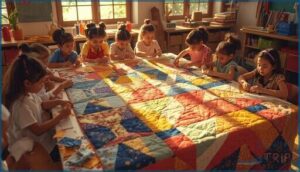
classroom quilt is more than a craft — it’s a community in the making. Student-made quilts bring Cross‑Curricular Integration to life, from math to storytelling. Try these collaborative project essentials:
- Color Palette Planning with 4–6 cotton shades for visual unity
- Role Rotation so every student contributes meaningfully
- Community Donation Process to connect quilting and sewing supplies to real purpose
Reflection Documentation seals the learning.
DIY Bulletin Board Backdrops
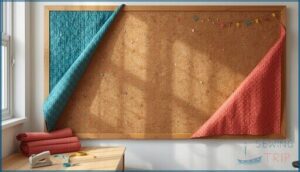
Transforming bulletin board backdrops starts with smart Measurement Planning — measure each board, then add 2–3 inches per side for wrapping. Quilting cotton‘s tight weave manages thumbtacks beautifully and costs around $10–12 per yard, making Budget Sourcing easy.
Follow Safety Codes limiting wall coverage, use staple guns or spray adhesive for solid Attachment Methods, and lean on Color Coordination to tie your whole room together.
Social-Emotional Learning With Quilting
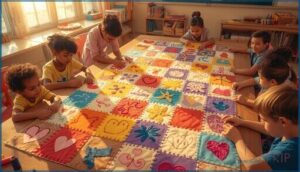
Quilting opens a surprising door into social-emotional learning.
Emotion Squares let students name and color their feelings daily, while Kindness Quilts celebrate real acts of caring.
Each class quilt builds Community Identity and bolsters Confidence Building as students see their square matter to the whole.
Collaborative Student Projects naturally weave in Coping Strategies and SocialEmotional Learning Integration through creative expression, making Building Classroom Community feel genuine.
Budget-Friendly Classroom Quilt Activities
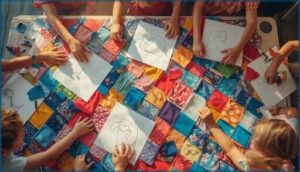
You don’t need a big budget to make a memorable classroom quilt. Paper Quilting with printable templates keeps costs near zero — just copy, color, and assemble.
Recycled Materials like old shirts or scrap fabric stretch supplies further.
Low-Cost Design techniques using fabric markers turn plain cotton into student projects with minimal prep.
Good Supply Management means one digital file, one copier, and a whole class creating together.
Tips for Selecting and Managing Classroom Fabrics
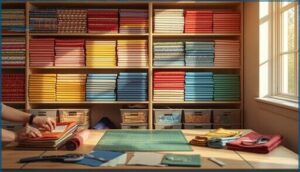
Picking the right fabrics for a classroom isn’t just about what looks good — it’s about what actually works.
A few smart habits can save you time, money, and a lot of headaches.
Here’s what to keep in mind when selecting and managing fabrics for your students.
Choosing Budget-Conscious Options
Budget doesn’t have to mean boring. Bulk purchasing strategies keep per-yard costs low, while remnant utilization turns scrap bundles into colorful classroom supplies.
Try thrifted fabric sourcing from local shops or community donation programs — families often give clean cotton happily. Seasonal sale timing on yardage and precuts.
Recycling initiatives like plarn or upcycled DIY projects stretch every dollar further.
Organizing Fabric for Student Use
Good classroom organization saves you time and keeps students focused. Sort your fabric storage bins by color coding and size sorting so students can find what they need quickly.
- Use clear label design on every bin
- Separate fabric rolls by project size
- Rotate stock with fabric rotation to keep supplies fresh
Student storage solutions make classroom supplies easy to manage.
Ensuring Safety and Washability
Once your storage is set, think about what goes inside those bins. Look for washable fabric with OEKO-Tex Certification — it’s been tested for harmful substances, so it’s safer for kids.
Run a quick colorfastness testing check before any project.
Choose durable polyester fabrics or tight-weave cottons that can machine wash and dry without falling apart.
Non-toxic markers, flame-retardant sprays, and durable adhesive bonds round out a safe, classroom-ready setup.
Sourcing Fabrics for Large Groups
Buying fabric for a whole class calls for a smarter approach. Look into wholesale suppliers like Simplifi Fabric, which offers bulk order discounts up to 30% on large quantities.
Use a supplier comparison to weigh price, lead times, and shipping consolidation options.
Always request samples for sample verification before committing.
Group purchasing agreements split costs across teachers, making school fabric for projects genuinely budget‑friendly.
Frequently Asked Questions (FAQs)
What fabrics are best for college apparel?
Cotton, polyester blends, and sustainable Tencel are top choices.
Breathable cotton keeps you comfortable, moisture-wicking polyester manages sweat fast, and eco-friendly blends offer durability — all machine wash and dry with ease.
How do you teach basic quilting stitches to beginners?
Start with a running stitch on practice squares using contrasting thread.
Show stitch length, then build to backstitch and whipstitch.
Check tension often and give clear, simple feedback as students progress.
Can quilting be adapted for different age groups?
Yes — quilting grows with your students. Toddlers glue paper squares, elementary kids draw on fabric, and teens machine‑sew full blocks.
Every age finds a skill‑progression entry point, making curriculum integration natural and rewarding.
What sewing machines are best suited for classroom use?
For classroom use, look for machines with easy threading, drop-in bobbins, and speed control.
The Janome Sewist 740DC and Brother Innov-is A16 offer great durability, beginner stitch options, and portability features teachers love.
Conclusion
You don’t need a big budget or a dedicated art room to make quilting work for your students.
The right quilting fabrics for classroom use do most of the heavy lifting—cottons that won’t fray, precuts sized for small hands, and washable materials that survive the chaos of a school day.
Start simple, stay organized, and let the fabric do its job.
When the materials are right, the only thing left is watching your students create something they’re genuinely proud of.
- https://fabric-fabric.com/blog/what-is-quilting-cotton
- https://billiegreen.com.au/blogs/news/oeko-tex%C2%AE-100-the-most-important-label-for-kids
- https://www.patchworkposse.com/how-to-wash-your-quilt-dont-be-afraid-of-this/
- https://mojavefarmsquiltingco.com/blogs/news/quilting-fabrics-the-pros-and-cons
- https://handiquilter.com/thread-durability/