This site is supported by our readers. We may earn a commission, at no cost to you, if you purchase through links.
The difference between a hand quilting project that feels smooth and one that fights you every step comes down to one thing: fabric choice. Not skill. Not tools. Fabric.
The wrong weave and your needle drags. The wrong weight and your stitches pucker or sink unevenly.
Cotton quilting fabrics for hand quilting exist in a league of their own—breathable, needle-friendly, and forgiving enough for long stitching sessions.
But not all cotton is equal, and batting, thread, and prep work each play their own role.
Get the full picture, and every stitch lands exactly where you want it.
Table Of Contents
- Key Takeaways
- Best Fabrics for Hand Quilting
- How to Choose Fabrics and Batting
- Top Tools and Notions for Hand Quilting
- 1. Coats Clark Dual Duty Hand Quilting Thread
- 2. Clover Natural Fit Leather Thimble
- 3. Clover Hera Fabric Marker
- 4. Dritz Mark B Gone Fabric Marking Pens
- 5. Fiskars Forged Embroidery Scissors 4 Inch
- 6. Thimtec Adjustable Finger Protector Tape
- 7. Wonderfil Eleganza Cotton Embroidery Thread Sampler
- 8. Clover Gold Eye Embroidery Needles
- 9. Gingher Stork Embroidery Scissors Leather Sheath
- Preparing Fabrics Before Hand Quilting
- Hand Quilting Tips for Fabric Success
- Frequently Asked Questions (FAQs)
- Conclusion
Key Takeaways
- Your fabric choice — not your skill level — is what makes hand quilting feel smooth or frustrating, with 100% cotton at 60–75 threads per inch being the gold standard for needle-friendly stitching.
- Matching your fabric weight to batting loft is a make-or-break decision: lightweight cotton pairs with low-loft batting for easy needle penetration, while heavy fabric and high loft together make every stitch a chore.
- Prewashing cotton before you cut accounts for 2–5% shrinkage upfront and prevents dye bleed, keeping your finished blocks true to pattern after washing.
- The right tools — a well-fitted thimble, sharp between needles in size 9 or 10, and quality thread like Coats & Clark Dual Duty — protect your hands and let you stitch longer with far less fatigue.
Best Fabrics for Hand Quilting
The fabric you choose can make or break your hand quilting experience. Some materials glide under the needle beautifully, while others fight you every step of the way.
The same goes for batting—your quilting batting selection guide can help you find the fill that works with your hands, not against them.
Here are the best fabrics to work with when you’re quilting by hand.
100% Cotton Quilting Fabrics
Premium cotton quilting fabrics are the benchmark for hand quilting — and for good reason. Their plain weave lets your needle glide through layers with ease. Look for a fabric weight around 40 to 44 inches wide with 60 to 75 threads per inch for smooth, even stitches.
Strong dye fastness keeps colors vibrant wash after wash. OEKO‑TEX certified options add peace of mind.
Color coordination across collections makes mixing prints easy.
medium-weight quilting cotton is the most widely used fabric for quilting.
Pre-washed Vs. Unwashed Fabrics
Cotton’s feel changes once it hits water — and that matters more than you’d think for hand quilting. Pre-washing affects shrinkage impact, color bleeding, hand feel, and fraying loss in ways that shape your finished look. Here’s what to know:
- Pre-washed fabrics shrink 2–5% upfront, keeping blocks truer to pattern after washing.
- Unwashed fabrics hold factory dye until that first quilt wash, risking bleeding onto lighter patches.
- Skipping the wash leaves sizing intact, making needles glide more smoothly during hand quilting.
Prewashing reduces fabric shrinkage(https://theblanketstatement.ca/blogs/the-blanket-statement/prewashing-your-quilt-fabrics) helps blocks stay true to pattern.
Specialty Fabrics for Hand Quilting
Beyond standard quilting cotton, specialty fabrics open up a whole new world of texture and feel.
Shot Cotton adds a soft two-tone shimmer. Cotton Lawn glides through your needle like butter. Yarn Dyed Woven brings warmth and depth. Linen Blends give that relaxed, lived-in look. Double Gauze feels cozy and light.
| Fabric | Best For |
|---|---|
| Shot Cotton | Big stitch, visible quilting lines |
| Cotton Lawn | Delicate, vintage-style quilts |
| Double Gauze | Baby quilts, soft drape |
Seasonal and Themed Fabric Collections
Seasonal and holiday fabric collections bring a whole new energy to hand quilting. Whether you’re reaching for Holiday Color Palettes in winter reds and greens or chasing Spring Floral Trends in soft pastels, there’s a collection for every mood.
- Autumn Leaf Motifs in rich copper and saffron
- Summer Beach Prints in crisp Prussian blue
- Patriotic Flag Designs in bold red, white, and blue
- Winter metallic snowflakes and hearts
- Easter florals and pastel garden prints
Watch for seasonal clearances to stock up smartly.
How to Choose Fabrics and Batting
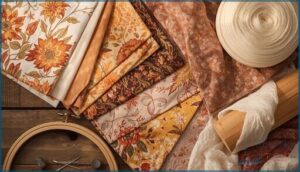
Picking the right fabric and batting combo can make or break your hand quilting experience. A few key factors will help you make choices that feel good to stitch through and hold up beautifully over time.
Here’s what to keep in mind as you build your project from the ground up.
Differences Between Batting Types
Not all batting is created equal — and the type you pick shapes everything from how your needle feels to how warm your finished quilt sits on the bed.
The following table summarizes the main characteristics of each batting material.
| Batting Material | Needle Drag | Warmth Weight |
|---|---|---|
| Cotton batting | More drag, great control | Heavier, breathable |
| Polyester batting | Smooth, low resistance | Light, warm |
| Wool batting | Minimal drag | Warm, lightweight |
Shrinkage rates and construction stability vary too. Cotton batting shrinks 3–5%, giving that classic antique pucker. Polyester stays flat. Your hand quilting experience changes with every choice.
Matching Fabric Weight to Batting Loft
Think of loft‑weight pairing like matching shoes to an outfit — the right combo just works.
Once you’ve nailed your loft-weight pairing, matching thread color to variegated fabric is the next move that ties the whole look together.
Lightweight cotton around 4 oz pairs beautifully with low loft batting, keeping fabric layers slim for needle penetration ease. Medium weight fabric suits low-to-medium loft for balanced drape balance strategies.
Heavy fabrics with high loft batting make hand quilting strenuous. Match weight to loft for stitch density guidance that feels easy.
Considerations for Beginners
Starting your first beginner hand quilting project doesn’t have to feel overwhelming. Smart fabric choice and batting selection make everything easier from the first stitch.
- Run the needle test — smooth pass means go
- Choose low-loft cotton batting for basic hand quilting stitches
- Pick essential hand quilting tools with tool comfort in mind
- Build a simple prep routine before cutting anything
Tips for Selecting Coordinating Fabrics
Picking coordinating fabrics comes down to a few solid principles.
Start with Color Palette Harmony — choose one hero print, then build around it using Print Scale Balance by mixing small, medium, and large prints. Use Value Contrast Planning to keep shapes crisp. Low Volume Blender fabrics give the eye a rest. Follow the 60-30-10 rule for Proportion Roles, and explore eQuilter’s Online Selection of Fabric Collections and Fabric Bundles to find your perfect pull.
Top Tools and Notions for Hand Quilting
hand quilting make hand quilting so much easier — and a lot more enjoyable.
From needles to marking pens, each one plays a small but important role in how your project comes together.
Here are the top tools and notions worth keeping in your quilting kit.
1. Coats Clark Dual Duty Hand Quilting Thread
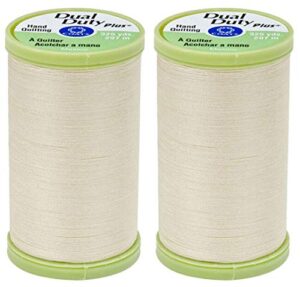
Thread matters more than most beginners expect. Coats & Clark Dual Duty is a go-to for good reason.
Its cotton-wrapped polyester core — about 68% polyester and 32% cotton — gives you real strength without sacrificing softness. The glace finish helps it glide through layers smoothly and resist tangling while you work.
At a heavier 10 weight, your stitches show up clean and confident on the quilt surface. Each spool holds 325 yards, so you won’t run short mid-project.
| Best For | Hand quilters of all skill levels who want reliable, smooth thread that holds up stitch after stitch. |
|---|---|
| Material | 100% Polyester |
| Primary Use | Hand Quilting |
| Brand | Coats & Clark |
| Weight (oz) | 1.44 |
| Skill Level | Beginner-Friendly |
| Durability | High |
| Additional Features |
|
- Comes in a 2-pack with 325 yards per spool, so you’ve got plenty to finish a project without running out
- Glides through fabric easily, which means less friction and less hand fatigue over long quilting sessions
- Polyester core gives it real durability — your seams stay strong wash after wash
- Only comes in cream, so your color options are pretty limited
- Not built for machine quilting, so it’s hand-sewing only
- No info on thread weight compatibility, which can make it tricky to match to delicate or specialty fabrics
2. Clover Natural Fit Leather Thimble
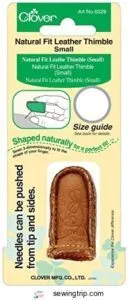
Your fingertip takes a beating during hand quilting — and that’s exactly what Clover Natural Fit Leather Thimble is built to handle. Its finger-shaped cowhide design hugs your finger from tip to middle, so it stays put while you push. No interior seams means no catching thread or chafing during long sessions.
The continuous contact area lets you push from any angle, which is perfect for working through thick batting. It comes in small, medium, and large — snug is the right starting fit.
| Best For | Hand quilters and sewists who spend long hours at a project and need reliable finger protection that actually stays comfortable. |
|---|---|
| Material | Natural Leather |
| Primary Use | Sewing/Knitting |
| Brand | Unbranded |
| Weight (oz) | 0.32 |
| Skill Level | All Levels |
| Durability | Moderate |
| Additional Features |
|
- No interior seams means your thread won’t snag and your finger won’t chafe, even after hours of stitching
- The finger-shaped fit keeps it from sliding around while you push the needle through thick layers
- Works from any angle, so you’re not stuck repositioning your hand to get a good push
- Leather can stretch out over time, so a snug fit today might feel sloppy a few months from now
- Heavy use can wear through or puncture the leather faster than you’d expect
- Sizing can be hit or miss — people with unusually small or large fingers may struggle to find the right fit
3. Clover Hera Fabric Marker
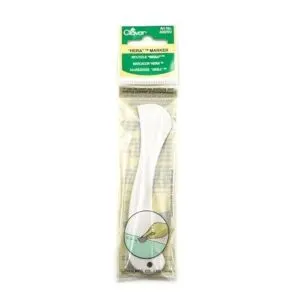
Once your finger is protected, your markings need to be just as reliable. That’s where the Clover Hera Fabric Marker earns its place in your toolkit.
Instead of ink or chalk, it presses a clean crease directly into the fabric — no residue, no smudging, no washing out later. The slim spatula shape fits comfortably in hand, and the thin curved tip runs right along a ruler edge. Your thread stays clean, and your lines stay crisp throughout the whole project.
| Best For | Quilters and sewists who want clean, mess-free markings without dealing with ink, chalk, or washout worries. |
|---|---|
| Material | Plastic |
| Primary Use | Quilting/Sewing |
| Brand | Clover |
| Weight (oz) | 0.64 |
| Skill Level | Beginner-Friendly |
| Durability | Moderate |
| Additional Features |
|
- Leaves a crisp crease with zero residue — no staining, no smudging, no cleanup headaches
- Slim and lightweight, so it’s comfortable to hold and easy to guide along a ruler
- Pressure marks disappear with a quick steam or iron, keeping your fabric looking fresh
- Doesn’t play nicely with every fabric type, especially thicker batting or very textured materials
- You’ll need a straight edge nearby if you want perfectly clean lines
- Marking curves or complex shapes is tricky — it’s really built for straight-line work
4. Dritz Mark B Gone Fabric Marking Pens
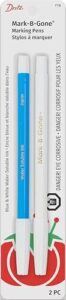
Not every line calls for a crease. Sometimes you need a visible mark — and that’s exactly what the Dritz Mark B Gone Pens deliver.
The set includes a blue pen for light fabrics and a white pen for darker ones. Just dampen a cloth and the ink wipes right off. One thing to remember: remove all marks before ironing or washing, since heat can set the ink permanently. Always test on a scrap first, especially with red or pink fabrics.
| Best For | Sewers, quilters, and crafters who need temporary, easy-to-remove markings on both light and dark fabrics. |
|---|---|
| Material | Ink/Dye |
| Primary Use | Quilting/Sewing |
| Brand | Dritz |
| Weight (oz) | 0.32 |
| Skill Level | All Levels |
| Durability | Low-Moderate |
| Additional Features |
|
- Comes with both a blue and white pen, so you’re covered no matter the fabric color
- Ink wipes off easily with just a damp cloth — no fuss, no residue
- Works on a wide range of fabrics, from felt to marine vinyl
- Pens can dry out quickly if you’re not careful about keeping the cap on
- May not work well on fabrics with tricky textures or tight weaves
- Heat can set the ink permanently, so you have to remove marks before ironing or washing
5. Fiskars Forged Embroidery Scissors 4 Inch
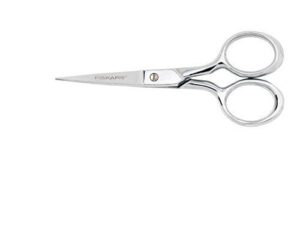
Good marking tools help you see your lines. Good scissors help you clean them up.
The Fiskars Forged Embroidery Scissors in 4 inches are built for exactly that kind of detail work. Forged steel blades stay sharp longer than standard stamped scissors and cut cleanly all the way to the tip. That matters when you’re snipping thread tails or trimming tiny appliqué pieces.
The double-loop handle works for both hands and won’t fatigue you during a long quilting session.
| Best For | Quilters, embroiderers, and crafters who need precise, clean cuts in tight spaces and do detail work regularly. |
|---|---|
| Material | Alloy Steel |
| Primary Use | Quilting/Embroidery |
| Brand | Unbranded |
| Weight (oz) | 0.8 |
| Skill Level | All Levels |
| Durability | High |
| Additional Features |
|
- Forged steel blades hold an edge longer and cut cleanly all the way to the tip — great for snipping thread tails with precision
- Double-loop handle works for both righties and lefties, and holds up well through long sessions
- All-metal build feels solid and durable, not like something that’ll fall apart after a few months
- The handle loops run small, so if you have larger fingers you might find them uncomfortable
- At 0.8 oz, they’re a little heavy for anyone dealing with wrist fatigue or hand weakness
- Sharp tips make these a no-go if kids are anywhere near your sewing space
6. Thimtec Adjustable Finger Protector Tape
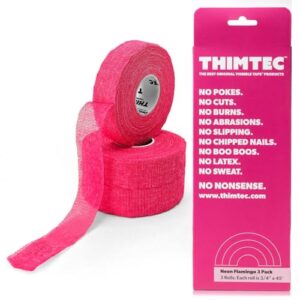
Scissors handle the outside. Your fingers take the hit from the inside.
Thimtec Adjustable Finger Protector Tape earns its place in your kit. It’s made from latex‑free, skin‑hugging material that molds right to your fingertip — no stiff metal, no sticky residue. Tear off 8 to 10 inches, wrap firmly, and you’re protected. It even resists punctures through multiple quilt layers. For anyone with sensitive joints or arthritis, this small roll makes long hand quilting sessions much more comfortable.
| Best For | Hand quilters, embroiderers, and crafters with sensitive fingers or arthritis who need flexible, comfortable finger protection during long sewing sessions. |
|---|---|
| Material | TPE/Latex-Free |
| Primary Use | Hand Sewing/Crafts |
| Brand | Unbranded |
| Weight (oz) | 2.39 |
| Skill Level | All Levels |
| Durability | Moderate |
| Additional Features |
|
- Molds to any finger shape and stays put without sticky residue
- Latex-free and gentle on sensitive skin and joints
- Flexible enough to keep full finger mobility while you work
- Sharp hand quilting needles can still pierce through it
- Needs a long enough strip to actually protect well, so you’ll go through it faster
- Won’t last as long as a metal thimble and may need replacing after a few uses
7. Wonderfil Eleganza Cotton Embroidery Thread Sampler
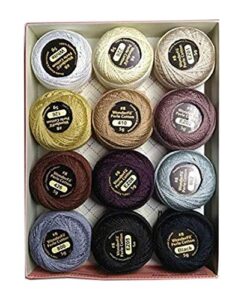
Thread quality shows up in every stitch.
Wonderfil Eleganza Cotton Embroidery Thread Sampler gives you 8wt perle cotton made from 100% long staple Egyptian cotton — double‑gassed and mercerized for a smooth, lustrous finish.
Each small ball holds 42 yards and glides cleanly through quilting cotton without fraying.
The tight 2‑ply twist forms firm, defined stitches that hold their shape.
Whether you’re doing big stitch quilting or sashiko patterns, this thread delivers both strength and a beautiful sheen that elevates your finished work.
| Best For | Embroiderers, sashiko artists, and hand quilters who want a premium thread with a beautiful finish and reliable stitch quality. |
|---|---|
| Material | 100% Cotton |
| Primary Use | Hand Embroidery |
| Brand | Wonderfil Eleganza |
| Weight (oz) | 0.176 |
| Skill Level | Intermediate |
| Durability | High |
| Additional Features |
|
- Long staple Egyptian cotton gives you a smooth, lustrous surface that’s genuinely a pleasure to stitch with
- The tight 2-ply twist means your stitches stay firm and defined — no loosening or distorting over time
- Works across a ton of techniques, from big stitch quilting to wool appliqué to crochet
- At only 5 grams per ball, you’re getting half the thread of a standard perle cotton — so it runs out faster than you’d expect
- The price feels steep when you factor in how little thread you’re actually getting per ball
- The neutral-only color range in this sampler limits you if you’re looking for bold or varied tones
8. Clover Gold Eye Embroidery Needles
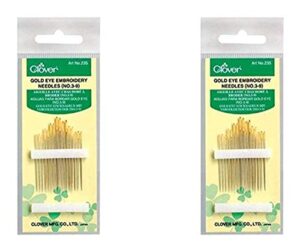
Your needle choice matters more than most people think. The Clover Gold Eye Embroidery Needles come in sizes 4 through 9, so you can match the right needle to your project — finer sizes like 8 and 9 are perfect for detailed hand quilting stitches on cotton.
The gold-plated elliptical eye threads easily and resists rust, while the high-temperature treated steel glides cleanly through layered fabrics. With 16 needles across multiple sizes, you’ve got plenty to work with for any quilting project.
| Best For | Embroiderers and hand stitchers who work with cotton or ribbon and want a needle that’s easy to thread and smooth through fabric. |
|---|---|
| Material | Alloy Steel |
| Primary Use | Embroidery/Crewel |
| Brand | Clover |
| Weight (oz) | Unspecified |
| Skill Level | All Levels |
| Durability | High |
| Additional Features |
|
- The large gold elliptical eye makes threading way easier — no squinting required
- Comes in four sizes (4, 6, 8, 9) so you can switch needles based on the project
- High-temp treated steel means it glides through fabric without snagging
- People with vision issues may still need a threader despite the larger eye
- These are embroidery-specific — not great if you need an all-purpose sewing needle
- No info on how they hold up over time or how often they break
9. Gingher Stork Embroidery Scissors Leather Sheath
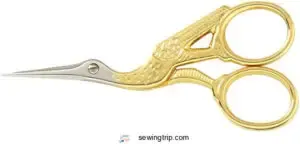
Every good pair of scissors deserves a safe home. The Gingher Stork Embroidery Scissors come with a genuine leather sheath that protects those precision-ground blades between uses.
At just 3.5 inches, these gold-handled scissors are built for detailed embroidery and hand quilting work — cutting thread, fabric, and needlework yarn with ease. The double-plated chrome-over-nickel finish holds up beautifully over time, and the full lifetime warranty backs that up.
Tuck them in your quilting bag without worry.
| Best For | Embroiderers, cross-stitchers, and quilters who need a precise, reliable small scissors for detail work. |
|---|---|
| Material | Steel/Leather |
| Primary Use | Sewing/Quilting |
| Brand | Gingher |
| Weight (oz) | 0.96 |
| Skill Level | All Levels |
| Durability | High |
| Additional Features |
|
- Precision-ground blades make clean, accurate cuts through thread, fabric, and needlework yarn
- Gorgeous gold handles with chrome-over-nickel finish that holds up over time
- Comes with a genuine leather sheath to protect the blades — and backed by a full lifetime warranty
- At 3.5 inches, they may feel too small and cramped for people with larger hands
- The finger holes can get slippery if your hands are very dry
- Not designed for heavy-duty cutting — strictly a lightweight, detail-work tool
Preparing Fabrics Before Hand Quilting
Good fabric prep is what separates a frustrating project from a smooth one.
few simple steps before you thread your needle can make a real difference in how your finished quilt looks and holds up.
what you need to do to get your fabrics ready.
Pre-washing and Ironing Fabrics
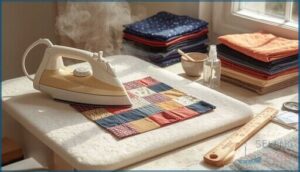
Skipping fabric preparation is one of the fastest ways to ruin a finished quilt. Cotton fabrics shrink 3 to 5 percent on their first wash — and Shrinkage Control starts before you ever cut a single piece. Smart fabric care means prewashing everything first.
Skipping the prewash is the fastest way to ruin a quilt — cotton shrinks 3 to 5 percent, and that damage starts long before the first stitch
- Dye Bleed Prevention: Wash reds and dark blues separately using Color Catcher usage sheets
- Fabric Moisture Management: Tumble dry until slightly damp for easier pressing
- Ironing Grain Alignment: Lift your iron straight up — never slide it
- Crispness Restored: A light spray starch brings fabric back to life for clean cuts
Cutting and Squaring Fabric Pieces
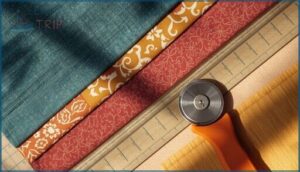
Accurate cuts start with a squared edge.
Align your fabric selvage to selvage on a self-healing cutting mat, then use a 6×24-inch acrylic ruler to trim a clean reference edge.
A sharp 45mm rotary cutter glides through fat quarter bundles, jelly rolls, and layer cakes without drag — so check your blade often.
Stack no more than six layers and always verify grain orientation before cutting.
Marking Designs on Fabric
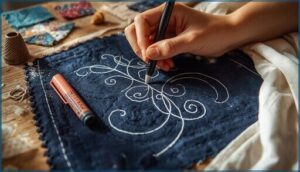
Your marks guide every stitch — so choose fabric marking tools wisely. Hera markers give you crease visibility without ink, making them ideal ink‑free markers for hand quilting.
For marking quilt lines on dark fabrics, a washable fabric marker or chalk‑based fabric marking marker adds color contrast. Use pressure sensitive tools lightly to prevent distortion, and apply stencil techniques to transfer marking quilting designs cleanly.
Assembling The Quilt Sandwich
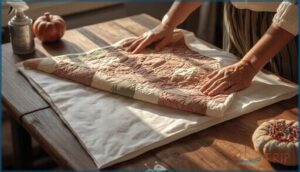
Once your design is marked, it’s time to build your quilt sandwich. Start with the backing facing down, leaving 4 to 6 inches of backing overhang on all sides.
Follow the layering sequence: backing, then batting, then your quilt top. Cotton batting lies flat and breathes beautifully. Use spray basting or pin basting every 4 to 6 inches for smooth, pucker-free quilt sandwich assembly.
Hand Quilting Tips for Fabric Success
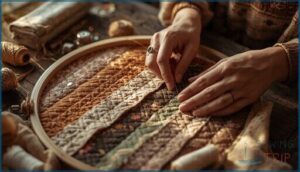
Good technique matters just as much as good fabric. A few smart habits can make a real difference in how your finished quilt looks and feels.
Here’s what to keep in mind as you work through your next project.
Keeping Stitches Even on Various Fabrics
Getting even stitches across different fabrics comes down to knowing your material. Cotton’s consistent weave makes stitch tension control almost easy, allowing 8–10 stitches per inch. Linen needs fiber-specific stitch length — around 1.5 mm — to keep things tidy.
Use hoop alignment techniques to reduce fabric drag by 40%, and let rocking needle motion load 5–6 stitches at once. Marking line precision with washable chalk keeps everything on track.
Maintaining Proper Tension With Different Materials
Even stitches mean nothing if your tension is off. Thread-fabric pairing matters more than most beginners realize.
Cotton thread on tight batiks needs slightly higher tension. Polyester runs smoother, so ease up a touch on flannel.
For batting loft adjustment, puffy wool hides knots more easily than low-loft cotton.
Always make tension testing samples first — your real quilt deserves that respect.
Avoiding Fabric Distortion While Quilting
Tension sorted — now let’s talk about keeping your fabric from creeping and warping mid‑project.
- Hoop Tension: Allow a fist-sized sag in the center before tightening.
- Pin Basting: Space curved safety pins every 4 inches across your quilt sandwich.
- Masking Tape Guides: Stitch along low‑tack tape edges for straight, distortion‑free lines.
- Grain Alignment: Align selvedges carefully — perpendicular grain keeps blocks square through hand quilting.
- Consistent Direction: Always quilt from the same edge to push fabric excess evenly.
Whether you’re working with high‑quality quilt fabrics, fabric bundles, or individual fabric swatches, these steps protect your work from start to finish.
Choosing Thread Colors for Fabric Types
Thread color is where quilting fabric design really comes alive.
For cotton thread matching, pair Aurifil 50wt with your dominant background tone.
Linen blend harmony calls for earthy creams like Aurifil 2000.
Dark fabric contrast works best one shade lighter — navy on black disappears beautifully.
Pastel thread blending favors off‑whites and cool grays.
Your patterned print strategy? Always match the background, never the accent.
Frequently Asked Questions (FAQs)
What is the best fabric for hand quilting?
100% cotton is the top pick for hand quilting. Its plain weave and 68×68 thread count let your needle glide smoothly, making every stitch clean and consistent.
What to use for hand quilting?
For hand quilting, you need a few key supplies: a between needle in size 9 or 10, quality thread, a hoop, and a thimble for comfort.
These basics set you up for success.
How do I store hand quilting fabrics long-term?
Keep your fabrics between 65 and 75°F with humidity near 50%. Use acid-free boxes or polypropylene tubs, block all light, and refold every few months to prevent permanent creases.
Can I mix fabric types in one quilt?
Yes, you can mix fabric types in one quilt. Just prewash everything first to match shrinkage rates, check weight compatibility, and stabilize any stretchy pieces before piecing.
What fabric widths work best for hand quilting?
Standard bolt widths of 44 inches work best for hand quilting. Usable width benefits start around 40 to 42 inches after trimming.
Wide backing options like 108-inch fabrics eliminate seams on queen-size quilts entirely.
How do fabric dyes affect hand quilting durability?
devil is in the details.
Dye fastness directly shapes stitch strength and needle drag. Colorfast reactive dyes preserve 95% seam hold, while bleed-prone fabrics cut durability by 15%.
smart fabric selection starts bleed prevention.
Are vintage fabrics suitable for hand quilting projects?
Vintage fabrics can work beautifully for hand quilting.
Pre-wash testing prevents dye bleeding risks, and checking vintage fiber strength ensures the cloth holds up.
Needle compatibility matters too — fine sharps protect fragile weaves.
Conclusion
A seasoned quilter once said her best work started the moment she stopped fighting her fabric and started listening to it.
That shift in thinking changes everything.
The right quilting fabrics for hand quilting don’t just make stitching easier—they shape the rhythm of your entire project.
When your cotton breathes, your batting holds, and your thread flows true, the quilt practically builds itself.
Trust your materials, and your hands will follow.
- https://homecrafttextiles.com.au/blogs/tips/the-best-fabric-choices-for-hand-quilting-and-machine-quilting
- https://northpennnow.com/news/2025/feb/03/understanding-fabric-weight-and-thread-count-in-quilting-materials/
- https://www.fabricsgalore.co.uk/blogs/fabric-news/quilting-cotton-vs-regular-cotton-what-every-quilter-should-know
- https://www.bethanylynnemakes.com/how-to-hand-quilt/
- https://www.quiltersquest.com/module/news/13618/fabric-101-weaves-weights--when-to-use-them