This site is supported by our readers. We may earn a commission, at no cost to you, if you purchase through links.
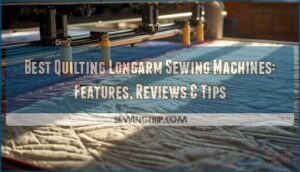
Most quilters hit the same wall: hand-quilting a king-size project takes weeks, and standard machines choke on anything thicker than a lap quilt. That’s where quilting longarm sewing machines transform your workflow entirely.
These specialized tools offer throat spaces up to 30 inches, stitch speeds exceeding 2,000 stitches per minute, and automated regulation that keeps your patterns consistent across yards of fabric. Whether you’re tackling customer orders or finally finishing that heirloom quilt, the right longarm machine manages bulky batting, reduces arm fatigue, and cuts project time by more than half.
Choosing one means weighing throat dimensions against your workspace, comparing computerized controls to manual systems, and understanding which features actually improve your stitching versus adding unnecessary cost.
Table Of Contents
Key Takeaways
- Longarm quilting machines cut project time by more than half through throat spaces up to 30 inches, stitch speeds exceeding 2,000 stitches per minute, and automated regulation that maintains consistent patterns across large quilts without constant repositioning.
- The choice between on-frame setups (18-26 inch throat space, handles 12-foot quilts) and sit-down configurations (compact, portable) depends on your dedicated workspace and whether you prioritize maximum quilt size over floor space efficiency.
- Stitch regulation systems with encoder tracking (400-800 pulses per inch) and automated speed adjustments on curves deliver professional-quality consistency, while ergonomic handlebars and LED lighting reduce physical strain during marathon quilting sessions.
- Budget planning should weigh throat space against speed and automation features—computerized systems add 15-40% to the price but unlock pattern libraries and precise control, while manual models offer reliability at lower cost for quilters comfortable with hands-on pacing.
Key Features of Longarm Quilting Machines
Longarm quilting machines stand apart from standard sewing machines through specific features designed for handling large-scale projects. These capabilities give you the speed, control, and workspace needed to tackle everything from bed-sized quilts to intricate custom designs.
For projects that demand consistent precision at scale, you’ll want to explore industrial sewing machine quilting projects that push beyond what home equipment can handle.
Let’s look at the key features that make longarm machines essential tools for serious quilters.
Large Throat Space and Extended Workspace
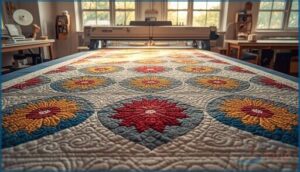
A generous throat space—the distance from needle to machine body—is your first line of defense against fabric drag and crowding. Most long arm quilting machines offer 16 to 30 inches of workspace, letting you handle king-size quilts without constant repositioning at the frame or table. Extended workspace improves fabric management, boosts quilt visibility, and maintains workspace ergonomics during long sessions:
- Throat space benefits include smoother movement of batting and multiple layers across the harp area.
- Extended workspace reduces arm strain by allowing natural wrist motions over wide quilt segments.
- Larger throat space accommodates quilts up to 120 inches wide without excessive bunching or sagging.
- Enhanced visibility from the extra room helps you align complex patterns more precisely and trim threads cleanly.
For a detailed overview of how impacts project size and workflow, see this guide.
High-Speed Stitching and Precision Control
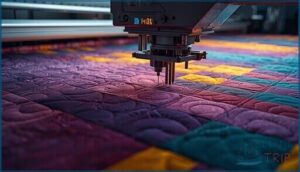
Speed control on long arm quilting machines lets you push up to 2,000 stitches per minute without sacrificing stitch accuracy. Servo-driven feed systems keep fabric moving smoothly at any pace, while precision modes lock in consistent spacing through microstep motors that adjust on the fly.
You’ll breeze through bed-size projects faster, yet still land every stitch exactly where you want it. For even greater results, understanding the importance of can help guarantee ideal speed and precision during quilting.
Stitch Regulation and Automation Options
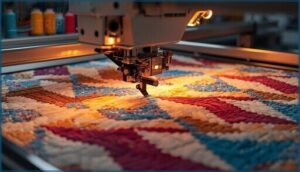
Stitch regulation gives you control through encoder systems that track every movement and deliver 400 to 800 pulses per inch for precision. You can switch between manual modes for hands-on pacing or let auto algorithms adjust stitch length on curves and corners.
Feed profiles—soft, medium, or aggressive—match your quilting style, while system diagnostics alert you to encoder slips or thread breaks before they derail your project.
Ergonomic Design and Lighting Enhancements
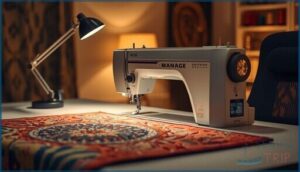
Your machine’s ergonomic grips and adjustable arms keep controls within a 12-inch reach zone, so you won’t strain during marathon sessions. Pair your long arm quilting machine with comfort seating and proper table height—28 to 35 inches—to reduce fatigue and maintain neutral posture throughout your project.
Task lighting with anti-glare finishes illuminates throat space from 200 to 1,000 lux, while adjustable headlights angle 15 to 30 degrees to cut shadows.
On-Frame Vs. Sit-Down Configurations
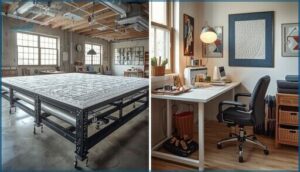
You’ll choose between two worlds when you pick your longarm quilting machines: on-frame setups anchor to sturdy stands with 18 to 26 inches of throat space, while sit-down configurations save floor real estate with compact quilting machine portability.
Frame stability lets you tackle 12-foot quilts without fabric repositioning, but setup complexity demands dedicated installation. Sit-down models offer space efficiency and simpler assembly, perfect for smaller studios.
Essential Benefits for Quilters
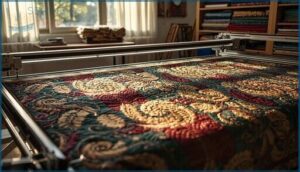
You’ve seen what longarm machines can do, now let’s talk about what they’ll do for you. These aren’t just bigger machines with more bells and whistles—they solve real problems you face at your quilting frame every single day.
Whether you’re exploring free-motion quilting techniques or tackling large projects, the right longarm turns creative vision into finished quilts faster and with less frustration.
From tackling king-size quilts without breaking a sweat to unlocking design possibilities you’ve only dreamed about, the benefits go way beyond speed and workspace.
Efficient Handling of Large Quilts
Your long arm quilting machines transform how you tackle king-size projects that would overwhelm standard equipment. Efficient quilt rolling and fabric management keep bulk away from the needle, while generous throat space—often 26 to 30 inches—lets you maneuver queen-size quilts without constant repositioning. On-frame setups support the entire weight, so you can focus on your design instead of wrestling with layers:
- Roll batting to reduce drag at the throat.
- Place a stable table behind the frame for support.
- Use low-profile rulers for accurate throat optimization.
Improved Stitch Quality and Consistency
Precision servo motors and coded stitch regulation systems keep your quilting accuracy sharp, delivering uniform density even across king-size projects. Thread tension stabilizes automatically as fabric thickness changes, while laser guides and feedback sensors guarantee needle calibration stays within one percent variance.
Long arm quilting machines with wide throat space and real‑time stitch regulation turn inconsistent stitches per minute into perfectly even rows, mile after mile.
Reduced User Fatigue and Strain
Your shoulders and wrists stay relaxed thanks to ergonomic design features like adjustable handlebars, shadowless LED lighting, and extension tables that keep fabric level with the machine bed. Long arm quilting machines with generous throat space reduce reaching, while automatic needle threader and stitch regulation modes cut repetitive motion.
Fatigue reduction and injury prevention become real when user comfort meets smart engineering—so you can quilt longer without strain or stress management concerns.
Expanded Creative Design Capabilities
You access artistic stitching possibilities with computerized quilting systems that store up to 100 custom quilt patterns and automate pantograph designs across fabric.
Digital design tools and quilting software give you creative freedom to explore new quilting techniques—from edge-to-edge motifs to intricate free-motion work.
Long arm quilting machines with stitch regulation transform ambitious quilting patterns and designs into reality without constant speed adjustments.
Top Longarm Quilting Machines Reviewed
You’ve got options regarding longarm quilting machines, and each one brings something different to your workspace. We’ve tested and reviewed five standout models that quilters actually use, from computerized powerhouses to budget-friendly workhorses.
Here’s what you need to know about each machine’s throat space, stitching speed, and unique features that’ll help you tackle those large quilts with confidence.
1. Singer Computerized Sewing Machine
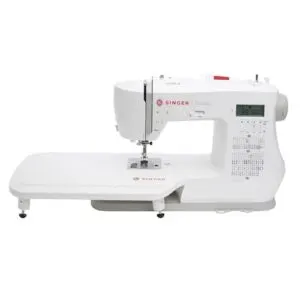
You’ll find the Singer C7290Q delivers serious versatility with 417 stitch applications, perfect for tackling everything from intricate quilting to home décor projects. This computerized machine features a one-touch start/stop button, adjustable speed control, and a built-in thread cutter that streamlines your workflow.
The LCD screen makes stitch selection straightforward, while 12 included presser feet expand your creative options. Weighing just 14 pounds with dimensions of 21 x 14 x 11 inches, it manages thick fabric layers effortlessly.
The extension table provides extra workspace for larger quilts without overwhelming your sewing room.
| Best For | Sewers and quilters of all skill levels who want a versatile machine that handles everything from basic stitching to complex quilting projects without breaking the bank. |
|---|---|
| Brand | SINGER |
| Color | White |
| Material | Metal, Plastic |
| Power Source | Electric |
| Weight | 14 pounds |
| Primary Use | Sewing and quilting |
| Additional Features |
|
- 417 stitch options and 12 presser feet give you tons of creative flexibility for different fabrics and projects
- One-touch start/stop and adjustable speed control make it beginner-friendly while still offering precision for experienced users
- Built-in thread cutter and needle threader save time on repetitive tasks during long sewing sessions
- Throat plate may feel cramped when working on larger quilting projects
- Learning curve for some features means you’ll need to spend time with the manual
- Not built for heavy commercial use, so it’s best kept as a home machine
2. Janome Quilt Maker Machine
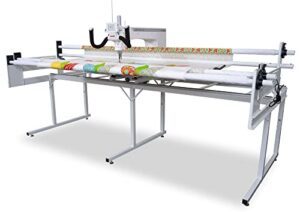
Step up to the Janome Quilt Maker Pro 18, which offers an 18-inch throat space ideal for managing full-sized quilts on a dedicated frame. You’ll hit speeds around 2,200 stitches per minute, with built-in stitch regulation ensuring consistent spacing at any pace.
The LED headlight ring illuminates your work area, while adjustable handlebars reduce shoulder strain during marathon sessions.
Frame options include 12-foot, 8-foot, and 4-foot configurations, letting you scale the setup to your workspace and project demands.
| Best For | Serious quilters and professionals who need a dedicated longarm setup with plenty of throat space for handling king-sized quilts and complex patterns. |
|---|---|
| Brand | Janome |
| Color | White |
| Material | Alloy steel |
| Power Source | Corded electric |
| Weight | 160 pounds |
| Primary Use | Quilting |
| Additional Features |
|
- 18-inch throat space gives you room to maneuver large quilts without constant repositioning
- Fast 2,200 stitches per minute with stitch regulation keeps your work consistent even when you speed up or slow down
- Multiple frame sizes (4, 8, or 12 feet) let you match the machine to your available space
- At 160 pounds, you’ll need a permanent spot and possibly help moving it into place
- $8,495 price tag puts it out of reach for casual hobbyists
- Requires dedicated floor space and a reliable power outlet, so apartment quilters might struggle
3. Juki Long Arm Sewing Machine
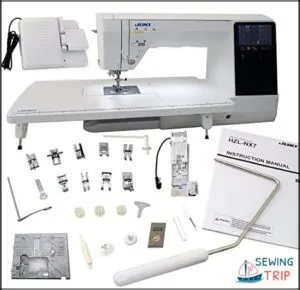
The Juki HZL-NX7 delivers a 12-inch throat space, automated threading, and over 1,000 stitches per minute for faster project completion. You get programmable stitch regulation, adjustable presser foot pressure for multiple fabric layers, and a built-in walking foot that keeps cotton, minky, and knit moving smoothly.
The touchscreen interface simplifies stitch selection, while bright LED lighting reduces eye strain. At 34 pounds, you can reposition this machine easily.
Regular oiling of the hook assembly keeps your stitches consistent across heavy quilting threads and dense batting.
| Best For | Experienced quilters and sewers who tackle large projects like quilts and home decor, especially those working with multiple fabric layers or thick materials. |
|---|---|
| Brand | JUKI |
| Color | Black and white |
| Material | Metal |
| Power Source | Electric |
| Weight | 34 pounds |
| Primary Use | Quilting and sewing |
| Additional Features |
|
- 12-inch throat space and 1,000 stitches per minute speed up large quilting projects significantly
- Automatic needle threader and built-in walking foot handle tricky fabrics like minky and knit without hassle
- Touchscreen interface and bright LED lighting make stitch selection and detailed work much easier
- Can struggle with very thick fabrics or multiple layers of dense materials
- Some users report reliability issues with the thread cutter, needle threader, and feed dogs
- Technical support may require shipping the machine back to Juki America at your own expense, with limited local dealer support available
4. Qnique Long Arm Quilting Machine
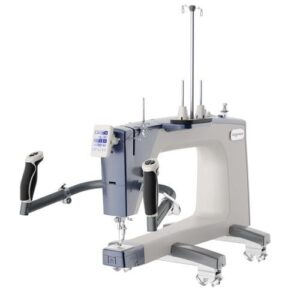
Qnique longarm machines offer 15 to 21 inches of throat space, depending on your model, letting you quilt larger blocks without constant rehooping. You’ll appreciate built-in stitch regulation across cruise and precise modes, plus adjustable handlebars that fit your height and quilting style.
The touchscreen display provides edge warnings, bobbin estimates, and on-screen tutorials to simplify your workflow.
High-torque motors reach up to 2,100 stitches per minute on select models, handling dense designs and heavy batting with consistent power across standard domestic outlets.
| Best For | Quilters who need serious throat space for large projects and want the speed and precision of built-in stitch regulation without stepping up to a full industrial setup. |
|---|---|
| Brand | The Grace Company |
| Color | White and Gray |
| Material | Metal |
| Power Source | Electric (AC/DC) |
| Weight | 187 pounds |
| Primary Use | Quilting |
| Additional Features |
|
- 19 inches of throat space means you can handle bigger quilt blocks without stopping to reposition constantly
- Adjustable handles let you find a comfortable working position that won’t leave you aching after long sessions
- Rotating hopping foot gives you a clearer view of your stitching line, making it easier to follow patterns accurately
- At 187 pounds, this machine isn’t something you’ll be moving around easily—you’ll need dedicated space for it
- Assembly and frame adjustments can be fiddly, especially if you’re new to longarm machines
- There’s definitely a learning curve to get the most out of all the features and controls
5. Brother Sewing And Quilting Machine
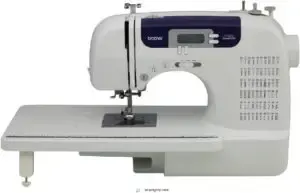
Brother’s SQ9130 delivers 130 built-in stitches and eight buttonhole styles, giving you varied design options for quilt tops and labels. The wide throat space manages larger fabric pieces with ease, while the seven-point feed dog system keeps fabric moving smoothly under the needle.
You’ll reach speeds up to 850 stitches per minute, and the backlit LCD display makes stitch selection simple in any lighting. Drop feed support unlocks free-motion quilting for stippling and decorative work, and the included wide table provides stable workspace for oversized projects.
| Best For | Beginners and intermediate sewists who want a versatile machine for quilting, garment construction, and crafting without breaking the bank. |
|---|---|
| Brand | Brother |
| Color | Not specified |
| Material | Aluminum and plastic |
| Power Source | Electric |
| Weight | 13 pounds |
| Primary Use | Sewing and quilting |
| Additional Features |
|
- 60 built-in stitches with 7 one-step buttonholes give you plenty of creative options for different projects
- Automatic needle threader and drop-in bobbin save time and reduce frustration during setup
- Wide table and free arm provide flexibility for both large quilts and smaller cylindrical items like sleeves
- Plastic construction raises durability concerns for long-term or heavy-duty use
- Included carrying case feels flimsy and may not provide adequate protection during transport
- Some users report electronics issues over time, which could mean repairs or replacement down the road
Buying and Maintenance Tips
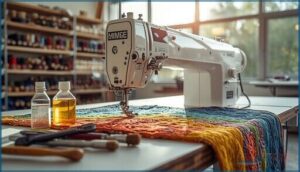
Picking the right longarm machine means looking beyond flashy features to what actually matters for your quilting work. You’ll want to evaluate throat space, speed, controls, and how much upkeep you’re willing to handle.
Let’s break down the key factors that’ll help you invest wisely and keep your machine running strong for years.
Choosing The Right Throat Space and Speed
Your throat size determines quilt mobility—machines with 18 to 24 inches of throat space let you tackle king-sized projects without constant repositioning.
Match stitch speed to your comfort level: long arm quilting machines offer 1,800 to 2,500 stitches per minute, but higher rates demand stronger motor power and precise fabric handling to prevent skipped stitches during those marathon quilting sessions.
Evaluating Control Systems and User Interface
Touchscreen navigation puts pattern libraries at your fingertips—machines with LCD screens and color-coded alerts give you real-time feedback on tension, speed, and thread breaks.
Look for control panels with tactile jog dials alongside touch interfaces, preset memory that stores 20+ configurations, and ergonomic grips that swivel for comfort.
Computerized quilting demands a user-friendly experience, so test the interface design before you commit.
Importance of Regular Maintenance and Accessories
Consistent maintenance schedules—every 40 to 80 hours of use—keep your quilting machine running at peak performance, preventing costly repairs down the line. Lubrication tips from your manual protect gears and drive belts, while needle care after 8 to 12 hours prevents snags.
Clean tension discs regularly, upgrade accessories like pantograph guides when worn, and your sewing equipment will reward you with perfect stitches.
Budgeting and Comparing Features
When comparing the best long arm quilt machine options, your budget planning should weigh throat space—18 inches accommodates queen quilts—against speed, which ranges from 1,000 to 2,000 stitches per minute.
High-end automation bumps prices 15 to 40 percent, so a thorough quilting machines review and feature comparison help you track expenses and find the sweet spot for your sewing machine comparison.
Frequently Asked Questions (FAQs)
Why is longarm quilting so expensive?
Long arm quilting machines demand serious cash—think industrial-grade motors, precision robotics, and frames spanning ten feet.
Add material expenses, maintenance budgets, and specialized training, and you’re investing in professional equipment that transforms quilting into serious craftsmanship.
How much does a Nolting longarm cost?
You’ll find used Nolting longarm quilting machines ranging from about $1,300 to $11,000, while new Pro models usually start around $18,000 to $22,000 before add-on fees and longarm financing options.
What is the going rate for long arm quilting?
Pricing factors for longarm quilting services weave together like a complex pattern—you’ll usually pay 5 to 3 cents per square inch, with quilt size, thread costs, and design complexity influencing the final rate comparison.
What brand of sewing machine is best for quilting?
For general quilting needs, the Brother CS6000i and Juki are leading choices. Meanwhile, Handi Quilter dominates the market for long-arm quilting machines.
To make an informed decision, check user reviews for machine durability. Then, match brand comparison results to your specific sewing machine requirements.
What are the different types of long arm quilting machines?
You’ll encounter sit-down and frame-mounted long arm quilting machines, each offering different throat spaces from 18 to 30 inches.
Options range from hand-guided models to computerized systems with Pro Stitcher automation for precise quilting control.
How do you finance a longarm quilting machine?
Most dealers partner with lenders offering specialized quilting machine loans spanning three to seven years. You’ll usually need a 10 to 30 percent down payment, with rates tied to your credit score.
What maintenance does a longarm machine require?
Your Long Arm Quilting Machine needs a regular cleaning routine, consistent lubrication schedule, belt inspection, and needle care.
Factory-authorized maintenance from qualified longarm technicians ensures your quilting equipment runs smoothly for years.
Can longarm machines handle delicate fabrics well?
Yes, your machine can whisper through silk when you choose microtex needles, fine threads, lower tension, and slow stitching speeds. Stitch regulation and throat space help delicate fabrics stay flat, preventing puckering across sheer layers.
Are there portable options for longarm quilting?
Portable frames, compact motors, and travel cases make long arm quilting machines mobile. Models like the Qnique 19X and Handi Quilter fit smaller studios, offering quilting grips and space savings without sacrificing performance.
How does a longarm machine improve quilting speed?
High-speed stitching rates, reaching thousands of stitches per minute, slash quilting time dramatically.
Automated stitch regulation, expansive throat space, and efficient fabric handling let you power through large quilts without constant repositioning or slowdowns.
Conclusion
Hand-stitching demands patience; quilting longarm sewing machines demand precision. You’ve seen the throat space, speed ratings, and regulation systems that separate hobbyist tools from production workhorses.
Now you control which features match your workspace, budget, and project scale. Test stitch tension on sample batting, verify frame compatibility, and don’t overlook lighting upgrades.
Your next king-size quilt won’t finish itself, but the right longarm cuts weeks into days—and transforms backlog into completed masterpieces.