This site is supported by our readers. We may earn a commission, at no cost to you, if you purchase through links.
A misaligned triangle ruler can turn a stunning quilt pattern into a frustrating pile of wonky points and wasted fabric. You’ve probably experienced that sinking feeling when your carefully cut triangles don’t nestle together the way they should, leaving gaps or puckered seams where crisp angles belong.
The right quilting rulers for triangle patterns transform this common struggle into precise, satisfying work. These specialized tools feature angle-specific markings and stable grips that guide your rotary cutter exactly where it needs to go.
Whether you’re piecing together classic half-square triangles or exploring intricate 60-degree designs, understanding which ruler matches your project makes the difference between mediocre blocks and professional results.
Table Of Contents
- Best Quilting Rulers for Triangle Patterns
- 1. Wright Tri Recs Quilting Tool
- 2. Madam Sew Needle Sorting Pin Cushion
- 3. Odif Non Slip Coating
- 4. Tall Triangle Quilting Ruler
- 5. Kigley Triangle Quilting Rulers Set
- 6. Kigley Acrylic Triangle Ruler Set
- 7. Creative Grids 60 Degree Quilt Ruler
- 8. Quilted Bear Acrylic Quilting Templates
- 9. Watersay Quilting Triangle Ruler Tool
- 10. Smgda Quilting Ruler Templates
- Essential Types of Triangle Quilting Rulers
- Key Features to Look for in Triangle Rulers
- How to Use Quilting Rulers for Triangle Patterns
- Tips for Perfect Triangle Quilt Blocks
- Frequently Asked Questions (FAQs)
- Conclusion
Best Quilting Rulers for Triangle Patterns
You can’t build precise triangle patterns without the right ruler in your hand. The difference between a frustrating cutting session and smooth, accurate piecing often comes down to having a tool designed for the specific triangles you’re making.
A well-chosen quilting ruler for small projects gives you the control you need to trim tiny triangles with confidence and precision.
Precision triangle piecing starts with choosing a ruler designed for the exact shape you’re cutting
Here are ten triangle rulers that quilters trust for clean cuts and professional results.
1. Wright Tri Recs Quilting Tool
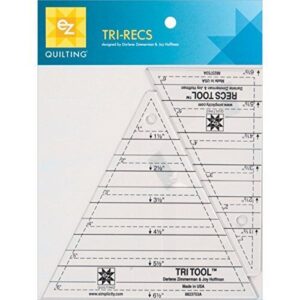
The Wright Tri Recs tool gives you a two-piece acrylic set that cuts both center triangles and side rectangles from the same fabric strip. You’ll find marked guides on each ruler showing strip width and finished unit sizes, so there’s no guesswork.
The center triangle features a blunt top edge that aligns perfectly with your strip edge to create sharp, accurate corners. This tool works with standard rotary cutters and includes step-by-step instructions to help you master triangle-in-a-square blocks efficiently.
| Best For | Quilters who want to make triangle-in-a-square blocks quickly without doing a bunch of math or wasting fabric. |
|---|---|
| Material | Acrylic |
| Color | Clear |
| Primary Use | Triangle cutting |
| Seam Allowance | 1/4 inch |
| Skill Level | All levels |
| Durability | Thick/sturdy |
| Additional Features |
|
- Cuts both triangle and rectangle pieces from the same strip, which saves fabric and time
- Built-in seam allowances mean you don’t have to measure or add them yourself
- Clear acrylic lets you see your fabric placement while you’re cutting
- Templates can slide around on fabric unless you use grip tape or anti-slip products
- Instructions might confuse beginners who haven’t done this type of piecing before
- Only works for specific triangle-in-square designs, so it’s pretty limited if you like variety
2. Madam Sew Needle Sorting Pin Cushion
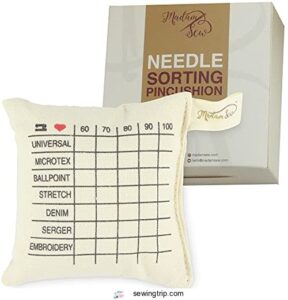
While triangle rulers organize your cutting, the Madam Sew Needle Sorting Pin Cushion keeps your machine needles straight. This compact cotton cushion measures roughly 2.6 by 3.6 by 1.4 inches and fits neatly in your notions drawer.
You’ll see a printed grid listing seven needle types—Universal, Microtex, Ballpoint, Stretch, Denim, Serger, and Embroidery—paired with six size categories from 60 to 100. The fiberfill interior holds needles securely without rattling, and a loop lets you hang it within reach.
At $8.99, it’s a simple sorting station for quick needle identification.
| Best For | Sewers who use multiple needle types and sizes and want a compact way to identify and store them between projects. |
|---|---|
| Material | Fabric |
| Color | Multi-color |
| Primary Use | Needle organization |
| Seam Allowance | N/A |
| Skill Level | All levels |
| Durability | Soft fabric |
| Additional Features |
|
- Clear grid layout makes it easy to grab the right needle without guessing or squinting at tiny markings
- Compact size with a hanging loop fits in most sewing spaces without taking up drawer real estate
- Soft fiberfill holds needles securely so they stay sharp and don’t scatter
- Grid can get crowded if you store a large collection of partially-used needles
- Some users feel the $8.99 price is high for what amounts to a printed fabric cushion
- Limited size options mean serious sewers with extensive needle collections may outgrow it quickly
3. Odif Non Slip Coating
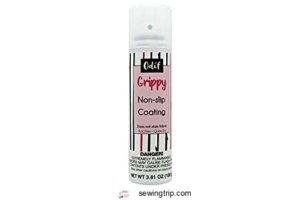
Even the best rulers slide when you’re cutting fabric at speed. Non Slip Coating sprays a tacky, translucent layer onto acrylic rulers, templates, and stencils to hold them firmly in place.
The 3.81-ounce aerosol dries fast and works on fabric, paper, plastic, glass, and wood. You can wash the coating off and reapply as grip fades, or strip it with Odif DK5 Glue Remover. Use it in a well-ventilated space—the formula is flammable and carries a strong odor during application.
| Best For | Quilters, sewers, and paper crafters who need rulers and templates to stay put during precise cutting and measuring. |
|---|---|
| Material | Plastic |
| Color | Clear |
| Primary Use | Non-slip coating |
| Seam Allowance | N/A |
| Skill Level | All levels |
| Durability | Temporary coating |
| Additional Features |
|
- Fast-drying spray creates a grippy surface that prevents rulers and stencils from sliding on fabric, paper, and other materials
- Reusable coating can be washed off and reapplied when grip wears down, making it cost-effective over time
- Works on multiple surfaces including acrylic, plastic, glass, and wood for versatile craft room use
- Strong chemical odor requires working in a well-ventilated area, which may not be practical for all workspaces
- Flammable aerosol formula poses storage and safety concerns
- Coating can feel gritty and may leave a cloudy finish on some surfaces, and effectiveness diminishes without multiple layers
4. Tall Triangle Quilting Ruler
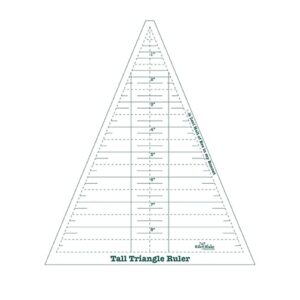
When your blocks need height instead, Riley Blake’s 45-degree triangle ruler shifts the proportions. The 8 1/2″ x 9 3/4″ clear plastic template lets you cut tall isosceles triangles for vertical star points, pennant banners, and 3D quilt designs.
It’s friendly for 5- and 10-inch stacker packs, so you can fussy cut kaleidoscope patterns or work through precut bundles. The clear background keeps fabric visible while you line up prints. Just note there’s no hanging hole or printed cutting guides for different finished sizes.
| Best For | Quilters working with precut fabric bundles who need tall triangle shapes for star blocks, pennants, or 3D quilt designs. |
|---|---|
| Material | Plastic |
| Color | Clear |
| Primary Use | Triangle cutting |
| Seam Allowance | Not specified |
| Skill Level | All levels |
| Durability | Sturdy plastic |
| Additional Features |
|
- Clear plastic lets you see fabric patterns underneath for precise fussy cutting
- Works perfectly with 5- and 10-inch stacker packs right out of the package
- Cuts tall 45-degree triangles that add vertical drama to star points and kaleidoscope quilts
- No pegboard hanging hole makes storage a bit awkward
- Doesn’t include printed cutting guides for different finished sizes
- Limited to one angle, so it won’t work for every triangle-based project
5. Kigley Triangle Quilting Rulers Set
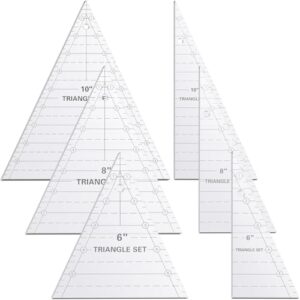
The Kigley set brings you three tall triangle templates in 10-, 8-, and 6-inch sizes, all cut from 3mm clear acrylic. You get gradient grid lines from 1 to 9 inches, plus a built-in quarter-inch seam allowance that lines up your fabric after stitching.
These rulers work great for anyone new to quilting rulers for beginners, offering clear visual guides that make angle cuts feel less intimidating.
The clear material shows your prints underneath, so you can fussy cut directional fabrics or center motifs. Just peel off the protective film before your first cut. No instructions come in the box, but the marked edges guide most common patchwork angles.
| Best For | Quilters who want precise triangle cuts across multiple projects and don’t mind learning the tools through hands-on practice. |
|---|---|
| Material | Acrylic |
| Color | Clear |
| Primary Use | Triangle cutting |
| Seam Allowance | 1/4 inch |
| Skill Level | Beginner-friendly |
| Durability | 3mm thick |
| Additional Features |
|
- Three size options (10″, 8″, 6″) let you mix scales in the same quilt without buying separate rulers
- Clear acrylic with grid lines makes it easy to align fabric patterns and see what you’re cutting
- Built-in quarter-inch seam allowance saves you from measuring and marking every piece
- No instructions included, so you’ll need to experiment or look up tutorials online
- Limited to three specific sizes, which might not cover every triangle pattern you want to try
- Protective film must be peeled off carefully before use or it can interfere with cutting accuracy
6. Kigley Acrylic Triangle Ruler Set
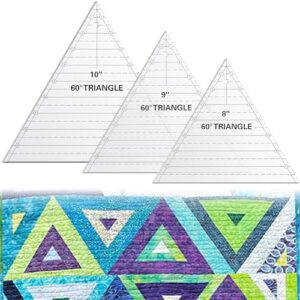
A single set delivers three 60-degree rulers in 8-, 9-, and 10-inch sizes, all stamped from 3mm acrylic that won’t warp mid-cut. Graduated grid lines run from 1 to 9 inches, giving you flexibility for equilateral triangle blocks without juggling multiple templates.
The clear surface lets you see fabric underneath for fussy cutting, and the smooth beveled edges glide along your rotary blade without snagging thread. You’ll notice fewer measurement markings than premium brands, so double-check alignment on complex patterns.
| Best For | Quilters and sewers who want an affordable three-size triangle ruler set for standard equilateral blocks and don’t need ultra-dense measurement markings. |
|---|---|
| Material | Acrylic |
| Color | Clear |
| Primary Use | Triangle cutting |
| Seam Allowance | Not specified |
| Skill Level | Beginner-friendly |
| Durability | Durable acrylic |
| Additional Features |
|
- Three sizes (8″, 9″, 10″) in one set give you flexibility without buying separate rulers
- Clear acrylic lets you see your fabric for precise fussy cutting and pattern alignment
- Durable 3mm thickness resists warping and the beveled edges glide smoothly with rotary cutters
- Fewer measurement markings than premium brands mean you need to double-check alignment on detailed work
- Not ideal if your project demands extremely precise measurements or intricate pattern matching
- The simplified grid requires more careful attention to avoid measurement errors
7. Creative Grids 60 Degree Quilt Ruler
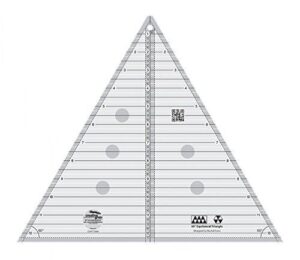
This American-made ruler cuts 60-degree triangles up to 12½ inches tall, large enough for bed quilts and modern statement blocks.
The exclusive non-slip grip grips fabric lightly when you press down, then slides freely while you reposition—no annoying stickers that peel off after a few washes. Black and white markings stay visible on both light and dark prints, and a central ¼-inch seam line helps you line up points when piecing hexagons or sawtooth borders.
Creative Grids includes a QR code that links to video tutorials.
| Best For | Quilters who regularly work with triangle-based patterns like hexagons, sawtooth borders, or kaleidoscope designs and want a ruler that won’t slip during cutting. |
|---|---|
| Material | Acrylic |
| Color | Black/White |
| Primary Use | Triangle cutting |
| Seam Allowance | 1/4 inch |
| Skill Level | Intermediate |
| Durability | High-quality |
| Additional Features |
|
- Non-slip grip keeps the ruler stable without adhesive strips that wear out
- Clear markings work on both light and dark fabrics, plus a center seam guide for accurate piecing
- Includes video tutorials via QR code to help you get started quickly
- Only cuts 60-degree angles, so you’ll need other rulers for different shapes
- Higher price point compared to basic quilting rulers
- No storage case included for protection between projects
8. Quilted Bear Acrylic Quilting Templates
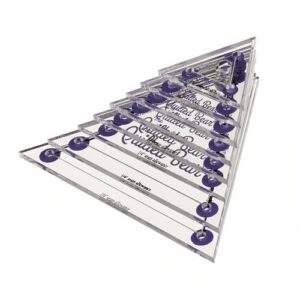
This eight-piece set gives you triangle templates from ¾ inch to 3 inches, all cut from 3mm clear acrylic that holds up under repeated rotary blade passes. Each template includes a built-in ¼-inch seam allowance, so you don’t need to eyeball spacing when you’re piecing half-square or quarter-square blocks.
The templates attach to a rotating clasp—handy for keeping them together, though if one goes missing, you’ll lose the whole bundle. Laser-etched markings stay legible through dozens of washes and pressing sessions.
| Best For | Quilters who want a reliable range of triangle sizes without buying individual templates—especially if you work through lots of half-square triangles or need consistent seam allowances across projects. |
|---|---|
| Material | Acrylic |
| Color | Clear |
| Primary Use | Template cutting |
| Seam Allowance | 1/4 inch |
| Skill Level | All levels |
| Durability | Durable acrylic |
| Additional Features |
|
- Built-in ¼-inch seam allowance saves you from measuring twice on every cut
- Clear acrylic lets you see fabric patterns underneath so you can line up prints exactly where you want them
- Rotating clasp keeps all eight sizes together so you’re not digging through a drawer when you need the next template
- Non-slip coating could use more grip—some users report the templates slide around more than they’d like
- Losing one template means you lose the whole set because they’re cabled together
- If you prefer templates with a tactile, textured surface, the smooth acrylic might feel too slick
9. Watersay Quilting Triangle Ruler Tool
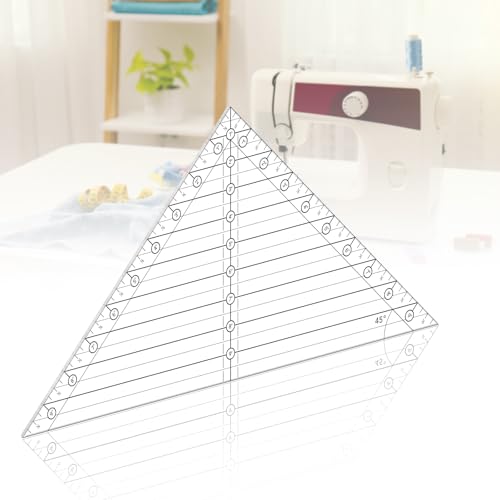
If you want both 30- and 60-degree triangles from one tool, the Watersay ruler delivers. This transparent acrylic piece spans roughly 10 inches and carries dual-color markings that separate seam allowances from cutting lines.
The non-slip surface grips your fabric during rotary cuts, and laser-polished edges slide smoothly without snagging threads. You’ll find center-point marks for symmetry checks and bidirectional scales that work whether you’re right- or left-handed.
It pairs cleanly with standard 28mm or 45mm blades and fits onto most cutting mats without wandering.
| Best For | Quilters who need a reliable 45-degree triangle ruler for cutting diamonds, strips, and coordinating patchwork shapes with precision. |
|---|---|
| Material | Acrylic |
| Color | Clear |
| Primary Use | Triangle cutting |
| Seam Allowance | Not specified |
| Skill Level | All levels |
| Durability | Warp-resistant |
| Additional Features |
|
- High-transparency acrylic lets you see your fabric clearly for accurate alignment and cutting
- Finely printed markings help you measure and cut precisely without guessing
- Durable construction resists warping and cracking, so it lasts through many projects
- Limited to 45-degree angles only, so you’ll need other tools for different triangle cuts
- Manual measurement can lead to slight size variations in the ruler itself
- May not handle large-scale or complex quilting projects as well as specialized tools
10. Smgda Quilting Ruler Templates
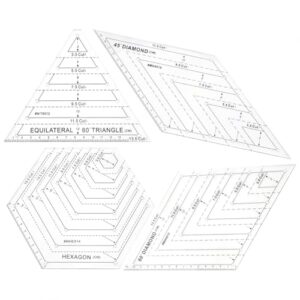
A set of four acrylic templates covering triangles, diamonds, and hexagons sounds adaptable, but the Smgda package brings mixed results. You’ll appreciate the metric scales up to 15.5 cm and the clear material that lets you see your fabric beneath, yet the plastic construction feels thin under a rotary blade.
Some users report scratches straight from the box, and the edges nick more easily than thicker rulers. If you’re working on smaller craft projects rather than precision piecing, these templates can handle basic cuts without demanding a premium price.
| Best For | Hobbyists and casual crafters who want affordable geometric templates for smaller quilting or scrapbooking projects and don’t need industrial-grade durability. |
|---|---|
| Material | Plastic |
| Color | Clear |
| Primary Use | Multi-shape cutting |
| Seam Allowance | Not specified |
| Skill Level | All levels |
| Durability | Less sturdy |
| Additional Features |
|
- Clear acrylic with metric markings lets you see fabric placement and measure accurately up to 15.5 cm
- Four different geometric shapes (triangle, diamond, hexagon) give you versatility for piecing and design work
- Budget-friendly option that works across multiple materials like cloth, leather, and paper
- Thin plastic construction can get nicked or sliced by rotary blades during regular use
- Quality control issues mean some units arrive scratched or damaged right out of the package
- Less sturdy than premium brands, so they may not hold up well for frequent or precision quilting
Essential Types of Triangle Quilting Rulers
You’ll find several specialized triangle rulers designed for different quilting techniques and patterns. Each type fulfills a specific purpose, from creating precise equilateral triangles to complex star designs.
Let’s look at the essential rulers you’ll want in your toolkit for triangle piecing.
Equilateral Triangle Rulers
When you need perfect triangles with three equal sides, an equilateral triangle ruler becomes your trusted quilting tool. These clear acrylic rulers feature three 60-degree internal angles and marked grid alignment lines that make fabric visibility easy while ensuring triangle accuracy in every cut.
- Precision angles: Each corner measures exactly 60 degrees for consistent cutting techniques
- Clear ruler materials: See-through acrylic lets you position fabric precisely before cutting
- Variety of sizes: Standard triangle quilting rulers range from 6 to 12 inches
60 Degree Triangle Rulers
You’ll find 60 degree triangle rulers in almost every quilter’s toolkit because they pair perfectly with equilateral rulers to create hexagons, diamonds, and star designs.
These quilting tools feature laser-etched markings that stay readable through countless cuts, while non-slip grips keep your fabric from shifting during precise cutting techniques.
Most acrylic ruler materials range from 8 to 8.5 inches tall for practical triangle accuracy. For those seeking enhanced durability and functionality, consider the benefits of a ruler with an exclusive gripper for secure cutting.
30/60/90 Triangle Rulers
When patterns call for right triangles with precise proportions, 30/60/90 triangle rulers deliver the triangle accuracy you need for diamonds and star designs. These quilting rulers come in plastic or aluminum ruler materials, with laser-etched precision markings that won’t fade. You’ll appreciate how the hypotenuse edge guides your cutting techniques while grid patterns help you align multiple blocks. The fundamental guarantee consistent results in quilt design and cutting.
- Plastic versions offer lightweight durability for repeated cutting sessions
- Aluminum builds resist warping when pressure is applied during cuts
- Clear bodies let you see underlying fabric for better triangle piecing
- Non-slip grips prevent shifting on your mat during angled cuts
- Compatible with rotary cutters and standard quilters rulers and guides
Half Square and Quarter Square Triangle Rulers
Half-square triangle rulers and quarter-square triangle rulers simplify your quilting techniques by guiding accurate cuts on fabric selection from 1 to 6 inches finished. You’ll spot the 45 degree line and color coded markings that boost triangle accuracy while dual-purpose designs handle both styles with a single 90 degree quarter-square triangle ruler for sewing efficiency.
| Feature | Half-Square Triangle | Quarter-Square Triangles |
|---|---|---|
| Formation | Diagonal cut creates two right triangles | Two triangles joined along hypotenuse |
| Key Alignment | 45 degree line on square diagonal | Center reference with 45 degree guide |
| Common Sizes | 1 to 6+ inches finished | 1 to 6+ inches finished |
| Markings | Seam allowance guidance | Dual color for quick reading |
| Material | Clear acrylic for visibility | Laser precision edges |
Regular ruler maintenance keeps those laser-etched edges sharp for consistent quilt ruler performance.
Triangular Lattice Rulers
Lattice patterns require a hexagonal grid system that triangular lattice rulers deliver through precisely marked 60 degree angles. These quilting tools guide your cutting techniques across consistent triangle blocks while dual-purpose markings keep triangle accuracy sharp for mosaic designs.
You’ll manage fabric with vertex-to-vertex references that lock in equal bases, and the durable acrylic construction slides smoothly under your rotary cutter without the bulk of traditional quilt rulers and tools.
Key Features to Look for in Triangle Rulers
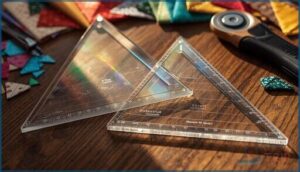
Not all triangle rulers are created equal, and the right features can make the difference between frustration and precision.
When you’re shopping for a new ruler, you’ll want to focus on qualities that support accurate cuts and comfortable use.
Here are the key features that separate excellent triangle rulers from mediocre ones.
Non-slip Grip and Stability
A triangle ruler that slides across your fabric mid-cut wastes time and ruins precision cutting. You need solid grip enhancement to keep your ruler exactly where you place it, especially when working with slippery bias edges. Edge stability makes the difference between clean points and wonky blocks.
- Textured rims boost ruler friction against fabric without leaving residue or staining your pieces
- Rubber compounds designed for fabric adhesion maintain slip resistance even after repeated use
- Micro-textured surfaces act as natural quilters aids, gripping fabric securely under rotary cutter pressure
- Non-slip coatings on triangle rulers prevent shifting when you apply downward cutting force
- Proper gripper features work across different mat surfaces, from self-healing grids to glossy boards
Accurate Measurement Markings
Ruler calibration starts with clear numerals you can read at a glance. Black markings at one-inch intervals prevent measurement errors, while finer lines every sixteenth inch guarantee grid precision for triangle rulers.
Look for emphasized ticks that guide your marking techniques. Scale accuracy improves when diagonal angle lines and center crosshairs are etched directly onto your quilt ruler, giving you a reliable ruler combo for precision cutting.
Durability and Material Quality
Acrylic rulers you’ll use week after week need to handle more than just one quilt.
High-grade acrylic resists cracking when you lean into cuts, while edges stay sharp after a thousand passes with your rotary blade.
Look for surface finishes that won’t snag fabric and markings that remain readable after three years under studio light—durability that matches your dedication.
Compatibility With Rotary Cutters and Mats
Your best triangle ruler means nothing if it can’t partner with the tools on your cutting table. A flat ruler edge prevents blade catching and drift against your mat surface quality, while proper thickness—just 1 to 3 millimeters—lets your rotary cutter glide cleanly through fabric cutting without scoring.
Here’s what keeps your setup working smoothly:
- Cutter alignment improves when the ruler sits 1 to 2 millimeters above your rotary cutting mat
- Blade replacement every 6 to 12 months maintains precision on triangle ruler cuts
- Safety precautions like retractable blades protect you between quilt ruler passes
Size and Versatility for Various Patterns
You’ll find multi-inch marks on a ruler set let you cut precise triangles from 1/8 inch up to 6 inches, while some triangle ruler options scale to 12 inches for large blocks.
A QuarterSquare Triangle Ruler combined with Creative Grids tools covers everything from mini motifs to full-sized quilt design layouts, giving you pattern scaling flexibility without recalculating each time you switch block size for better fabric efficiency.
How to Use Quilting Rulers for Triangle Patterns
You’ve got your triangle ruler in hand—now it’s time to put it to work.
The key to clean, accurate triangle blocks starts with understanding how to cut and position your fabric using the ruler’s markings. Let’s walk through the essential techniques that’ll turn those fabric strips into perfectly pieced triangles.
Cutting Center and Side Triangles
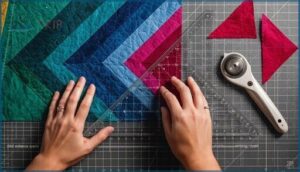
Start by identifying whether you’re creating center points or side triangles, since each demands a different approach. Center triangles share a common vertex with your block’s heart, so you’ll cut from a larger square to guarantee Triangle Alignment stays symmetrical.
Side triangles fill outer edges and usually use half-square triangle methods. Position your Triangle Ruler to keep straight grain along borders, minimizing Bias Management headaches while maintaining Precision Cutting throughout your Triangle in a Square blocks.
Aligning Rulers for Precision Cuts
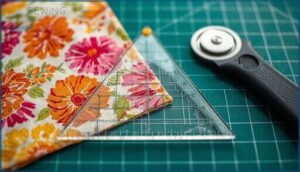
Once you’ve picked your triangles, lock your Triangle Ruler in place by checking Edge Alignment against the Fabric Grain.
Your Cutting Mat grid becomes your guide for Ruler Calibration—verify zero alignment before you touch the Rotary Cutter.
A stable Ruler Combo with non-slip grip prevents shifting during cuts, turning Precision Crafting Supplies into clean triangle edges every time.
Creating Triangle-in-a-square Blocks
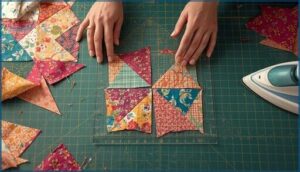
With your cuts complete, you’re ready to build Triangle in a Square blocks using proven Quilting Techniques.
Block Construction follows three core steps:
- Sew the center triangle to form your Square Blocks foundation, checking Triangle Alignment at each seam.
- Attach side triangles using your Triangle Ruler markings for Half-Square Triangle precision.
- Press seams outward to maintain block shape with quality Quilting Tools and Supplies supporting smart Fabric Selection.
Minimizing Fabric Waste With Correct Ruler Use
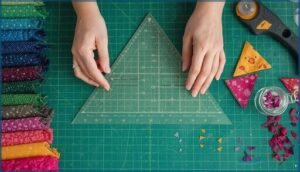
Block assembly done right sets you up for Fabric Efficiency, but smart Ruler Placement cuts waste before you even sew. Use single-layer cutting with your Triangle Ruler aligned on grain lines to enhance Fabric Cutting and Crafting yields.
Here’s how Precision Alignment and Cutting Optimization reduce scraps:
| Strategy | Waste Reduction Benefit |
|---|---|
| Align rulers along full fabric widths | Minimizes offcuts and preserves yardage |
| Use whole strips for multiple triangles | Reduces duplicate scrap pieces |
| Plan cuts to respect grain and selvage | Prevents re-cutting from misalignment |
| Verify Seam Allowance before marking | Avoids inaccurate cuts that waste fabric |
| Save small offcuts for binding or accents | Repurposes remnants into future blocks |
Your Quilting Tools and Supplies work best when you double-check measurements with a second ruler and keep a clean cutting mat under your work. That way, every Quilt Making Techniques step builds on the last without costly do-overs.
Tips for Working With Bias Edges
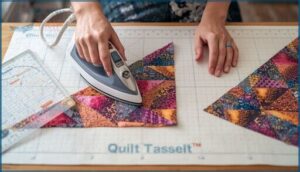
Bias Edge Control calls for a light touch—triangle edges cut on the diagonal stretch easily, so you’ll need smart Fabric Stabilization moves. Here are five ways to tame distortion:
- Lightly starch fabric before cutting triangles to add body and reduce stretch during Triangle Piecing.
- Handle pieces by the corners instead of pulling on long bias edges.
- Press seams with a lifting motion rather than sliding the iron.
- Shorten your stitch length to around 1.8 millimeters for secure Triangle Alignment.
- Pair bias edges with straight grain whenever possible to keep Seam Allowances stable.
Keep freshly pressed units flat until cool, and your Seam Pressing will prevent Edge Distortion while quilting rulers guide every cut.
Tips for Perfect Triangle Quilt Blocks
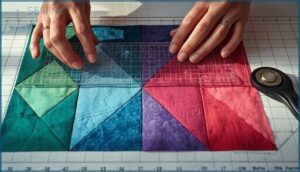
Getting clean, sharp triangle points isn’t about luck—it’s about technique.
You’ll need to master a few key practices, from how you press your seams to the tools you choose for controlling bias edges.
Here’s what makes the difference between triangles that look homemade and blocks that look professional.
Maintaining Sharp Triangle Points
A crisp triangle point starts with ruler edge care and ends with your blade angle. Use a fresh rotary cutter and align the ruler’s fine navigation line exactly with your fabric grain to prevent skewing the tip. Light pressure keeps the ruler steady while precision trimming preserves those sharp tips.
| Sharp Cutting Techniques | Tip Maintenance Habits |
|---|---|
| Align ruler edge with fabric grain | Clean ruler edges after each project |
| Use fresh rotary blade | Store with protective covers |
| Apply light downward pressure | Check for burrs or nicks regularly |
| Keep blade flat during cuts | Replace worn non-slip pads |
Triangle piecing rewards you when you match your seam allowance perfectly with quilt patterns that feature clean, pointed intersections.
Pinning and Sewing for Accurate Alignment
Pin placement every four to six inches along your seam keeps triangle edges from shifting under the presser foot.
Double pin at each corner where triangle points meet to lock that alignment through the intersection. Remove pins just ahead of your sewing foot while maintaining a consistent seam allowance, and you’ll achieve stitch consistency that transforms fabric control into precise triangle quilting blocks.
Using Starch to Control Fabric Stretch
Starch transforms triangle quilting by locking fabric weave before you cut, so bias edges behave instead of stretch. Spray your yardage flat, let it dry fully, then press with an up-down motion to prevent distortion along diagonal grain lines.
That extra body keeps triangle points sharp and seam allowances stable under your ruler and presser foot, giving you flatter blocks that meet their target size.
Choosing The Right Triangle Ruler for Your Project
Your pattern type drives every ruler decision you make. A Tri Recs Triangle Ruler excels when you’re building triangle-in-a-square blocks, while a 90 Degree QuarterSquare Triangle Ruler manages QST units with built-in seam allowances.
Match your ruler to the work ahead:
- Check ruler material for durability and fabric compatibility with your rotary cutter
- Verify triangle accuracy through clear markings and calibrated angles
- Choose size based on your block dimensions and cutting efficiency needs
- Confirm quilting precision features like non-slip grip for consistent triangles
Common Mistakes and Troubleshooting
You’ll notice most cutting mistakes start with rushing through error analysis. Misaligned triangle rulers create wonky points, while skipping the 60-degree line check leads to fabric waste.
When alignment issues appear, stop and verify your strip width matches the ruler’s printed size. These troubleshooting tips save hours of seam ripping.
The Tri Recs Triangle Ruler simplifies sewing techniques once you master proper positioning for quilting patterns and designs.
Frequently Asked Questions (FAQs)
What is the quilters rule triangle?
The Quilters Rule Triangle is a specialized tool that helps you cut precise triangular shapes for quilt blocks.
Its clear markings for common angles and sizes guarantee consistent half-square triangle and equilateral triangle units every time.
How to keep points on triangles when quilting?
Precision is everything when chasing perfect triangle tips. Use a sharp rotary blade with your ruler for exact cutting techniques, then pin points carefully before sewing.
Light fabric stabilization with starch tames bias stretch beautifully.
What fabrics work best with triangle rulers?
Quilting cottons work beautifully with triangle rulers thanks to stable weave and minimal stretch. You’ll get clean cuts and sharp points. Avoid knits unless you stabilize them with starch first.
How do you clean acrylic quilting rulers?
Wipe your acrylic ruler with a soft microfiber cloth and mild dish soap in warm water.
Rinse thoroughly, dry with a lint-free towel, and avoid harsh solvents that can crack the plastic.
Can triangle rulers be used for paper piecing?
Angles that seem fixed actually shift on paper—that’s the beauty of foundation piecing.
Triangle rulers absolutely work for paper piecing, helping you align fabric edges along templates while maintaining ruler markings for precise seam allowances and crisp points.
Whats the difference between finished and unfinished sizes?
Finished size is your block’s final dimension after seams are sewn, while unfinished size includes seam allowances.
A 6-inch unfinished triangle becomes 5 inches finished when you use standard quarter-inch seam allowances.
How do you store triangle rulers safely?
Like protecting your favorite kitchen knives, store triangle rulers flat in padded drawers or protective cases with dividers.
Keep them upright on secure shelves, and always handle by edges to prevent scratches on measurement markings.
Conclusion
What’s the real secret to perfect triangle blocks? It starts with the ruler in your hand. The right quilting rulers for triangle patterns give you control over every angle, every seam, every point.
You’ve learned which tools match your projects and how to use them with confidence. Now your fabric strips will transform into precise triangles that lock together beautifully. Pick your ruler, trust your measurements, and watch those perfect points emerge exactly where you planned them.
- https://www.creativegridsusa.com/products/CGRT60
- https://gequiltdesigns.com/products/creative-grids-60-degree-ruler-8-1-2
- https://www.missouriquiltco.com/products/creative-grids-60-degree-diamond-ruler
- https://www.guiltyquiltystudio.com/post/12-tips-for-sewing-with-bias-edges
- https://thenotsodramaticlife.com/confusing-corners-and-classy-curves-how-to-bind-unexpected-quilt-edges/