This site is supported by our readers. We may earn a commission, at no cost to you, if you purchase through links.
The binding is the last thing you sew, but it’s the first thing people touch. Run your fingers along the edge of a well-finished quilt and you’ll understand why quilters spend so much time getting it right—that folded strip of fabric holds everything together, literally and visually.
Skip it or rush it, and months of careful piecing can unravel at the corner of a bed.
But when the binding lies flat, turns crisp mitered corners, and sits flush against the backing, the whole quilt feels finished in a way nothing else achieves.
Learning to sew binding on a quilt is the skill that transforms a project into an heirloom.
Table Of Contents
- Key Takeaways
- What is Quilt Binding and What You’ll Need
- Top 5 Tools for Sewing Quilt Binding
- How to Calculate, Cut, and Prepare Binding Strips
- How to Sew Binding on a Quilt Step by Step
- Squaring and Trimming Quilt Edges Before Binding
- Aligning and Pinning Binding to The Quilt Front
- Sewing Binding With a Quarter-Inch Seam Allowance
- Creating Neat Mitered Corners at Each Turn
- Joining and Securing The Binding Tail Ends
- Folding Binding Over to The Quilt Back
- Machine Stitching Vs. Hand Stitching The Back Finish
- Tips for Uniform Stitching and Professional Results
- Frequently Asked Questions (FAQs)
- Conclusion
Key Takeaways
- Double fold binding outlasts single fold on most quilts, but single fold keeps wall hangings neat and flat—so pick your style based on how the quilt will actually be used.
- Getting your math right before you cut saves real headaches: measure the perimeter, add 10 inches for corners, then calculate strips and yardage with a small waste buffer built in.
- Mitered corners come down to one key move—stop stitching exactly ¼ inch from the edge, fold at 45°, then fold back down before you continue—and a walking foot makes the whole thing far less stressful.
- Pre-washing your binding fabric isn’t optional if you care about the finished quilt: it handles shrinkage, checks colorfastness, and removes stiffening agents before they cause problems later.
What is Quilt Binding and What You’ll Need
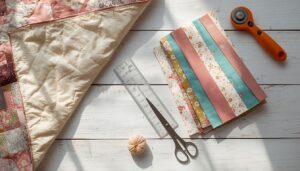
Quilt binding is the folded fabric strip that wraps around your quilt’s raw edges to keep everything neat, secure, and fray-free. Before you pick up your rotary cutter, it helps to understand the basics so you can make smart choices from the start.
If you want a deeper look at the whole process, this guide on sewing binding on a quilt walks you through every step clearly.
Here’s what you need to know about binding styles, fabric, and width before you begin.
Purpose of Binding and Edge Protection
Binding is the finishing touch that holds everything together — literally. Without it, your quilt’s raw edges fray, weaken, and unravel with every wash. Think of it as the frame around a painting: it protects and presents.
Quilt binding is the frame around your painting — without it, every edge frays, weakens, and unravels with every wash
Good binding delivers:
- Fray prevention that keeps edges intact through years of use
- Structural reinforcement along stress points at every corner
- Wear resistance against folding, stacking, and handling
- Aesthetic framing that completes your quilt’s overall look
Single Fold Vs. Double Fold Binding
There are two main binding methods to know: Single Fold and Double Fold Binding. Single fold uses one layer wrapped around the edge — less bulk profile, lighter weight difference, and a softer drape appearance. Double fold adds a second layer, boosting edge durability and repair ease. For most quilts, double fold wins.
But wall hangings? Single fold’s slimmer binding width keeps things neat. Choosing a bias cut binding can simplify corner turns.
Straight Grain Vs. Bias Binding
Now that you’ve picked your fold style, it’s time to think about fabric grain.
Straight Grain Binding cuts parallel to the selvage — great for straight edges, easy to cut, and kind to your wallet for cost efficiency.
Bias Binding goes at 45 degrees, giving you stretch behavior that manages curves smoothly.
For most beginner quilts with straight edges, straight grain wins every time.
Best Fabric Choices for Quilt Binding
Fabric grain matters, and so does what that fabric is made of. For most beginners, quilting cotton is your best friend — it folds crisply, holds mitered corners beautifully, and the colorfastness tips practically write themselves (prewash it).
Here’s a quick breakdown:
- Quilting cotton — classic choice for the binding fabric
- Cotton Polyester blend — adds blend strength and resists wrinkling
- Silk sheen or leather accents — stunning on heirloom or art quilts
Choosing The Right Binding Width
Most beginners reach for 2½-inch strips, and honestly, that’s a solid starting point. Your binding width choice shapes edge thickness, corner mitering ease, and visual proportion all at once.
Heavier fabric weight calls for wider binding so corners don’t bulk up. There’s always a durability tradeoff — narrow binding sits flatter but wears faster.
Factor that into your fabric binding width calculation before you cut.
Top 5 Tools for Sewing Quilt Binding
Having right tools on hand makes the whole binding process smoother and less frustrating. You don’t need a lot, but few key pieces really do make a difference.
Here are the five tools worth keeping close when you’re ready to start.
If you’re new to this technique, mastering bias tape corners and overlaps will make the whole process click into place.
1. Omnigrid 6 by 24 Acrylic Quilting Ruler
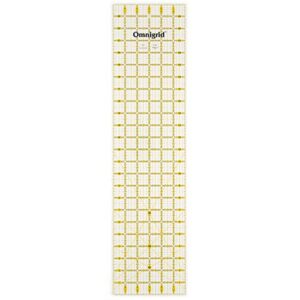
The Omnigrid 6 by 24 inch acrylic ruler is a workhorse you’ll reach for on every single project. Its dual-color black and yellow grid stays visible on both light and dark fabrics, so you’re not squinting or second-guessing your measurements.
The laser-cut edges give you clean, accurate cuts every time, and the 30°, 45°, and 60° angle guides make bias strips a breeze.
It works for both left- and right-handed quilters, which is a thoughtful touch.
| Best For | Quilters and sewers of all skill levels who work with a variety of fabric colors and need reliable, accurate cuts for strips, bias pieces, and blocks. |
|---|---|
| Primary Material | Premium acrylic plastic |
| Handedness Support | Ambidextrous design |
| Intended Use | Quilting and fabric cutting |
| Unit Count | 1 ruler |
| Durability Feature | Thick acrylic construction |
| Ergonomic Design | Raised hash marks for tracing |
| Additional Features |
|
- The dual-color black and yellow grid shows up clearly on both light and dark fabrics — no more guessing or re-measuring.
- Angle guides at 30°, 45°, and 60° make cutting bias strips fast and accurate.
- Works for both left- and right-handed users, so it’s a great fit for any sewing space.
- The non-slip feet are often missing from the package, so the ruler can slide around while you’re cutting.
- At 11.56 oz, the thick acrylic might feel a bit heavy or bulky compared to thinner rulers.
- The 6 × 24 inch size is easy to misplace if you don’t have a dedicated spot to store it.
2. Fiskars 45mm Fabric Rotary Cutter
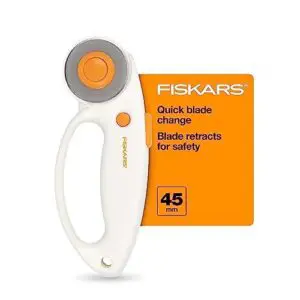
Pair your ruler with the Fiskars 45mm Rotary Cutter and you’ve got a winning combination.
The precision-ground titanium carbide blade slices through multiple fabric layers cleanly — no fraying, no jagged edges.
The loop-style handle fits naturally in your hand, so long cutting sessions won’t leave you sore.
It works for both left- and right-handed quilters, and the sliding safety lock keeps the blade tucked away when you’re not cutting.
At under $15, it’s one of the smartest investments in your sewing kit.
| Best For | Quilters and sewers — both lefties and righties — who need clean, fast cuts through multiple fabric layers without hand fatigue. |
|---|---|
| Primary Material | Stainless steel / titanium carbide |
| Handedness Support | Left and right-handed |
| Intended Use | Fabric cutting |
| Unit Count | 1 cutter |
| Durability Feature | Lifetime warranty on body |
| Ergonomic Design | Loop grip reduces fatigue |
| Additional Features |
|
- Titanium carbide blade cuts through multiple fabric layers cleanly, leaving smooth edges with no fraying
- Loop-style ergonomic handle keeps your hand comfortable during long quilting or sewing sessions
- Works for both left- and right-handed users, and the safety lock makes storage worry-free
- The 45mm blade struggles with tight curves or detailed work, so small or intricate cuts may need a different tool
- Blades wear out over time and aren’t covered by the lifetime warranty, so replacement costs add up
- Really needs a cutting mat to perform well — without one, you lose accuracy and risk damaging your work surface
3. Fiskars Eco Cutting Mat
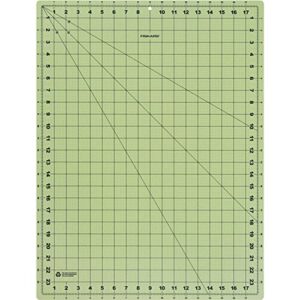
Every great cut starts with a stable surface — and the Fiskars Eco Cutting Mat delivers exactly that.
At 25.25 by 19.25 inches, it gives you plenty of room to lay out your binding strips without fighting for space.
The double-sided grid includes bias lines at 30°, 45°, and 60°, so angle cuts are simple and accurate.
It’s made from recyclable polypropylene, cleans up with warm soapy water, and resists moisture well.
A solid, eco-friendly foundation for your quilting workspace.
| Best For | Quilters and crafters who work in small spaces and want an eco-friendly mat that handles straight and angle cuts with ease. |
|---|---|
| Primary Material | Polypropylene |
| Handedness Support | Dual-sided layout |
| Intended Use | Fabric cutting surface |
| Unit Count | 1 mat |
| Durability Feature | Impact-resistant surface |
| Ergonomic Design | Flat-lay storage design |
| Additional Features |
|
- Double-sided grid with bias lines at 30°, 45°, and 60° makes angle cuts quick and accurate
- Made from recyclable polypropylene — easy to clean with just warm water and soap
- Generous 25 x 19-inch surface gives you plenty of room without hogging your workspace
- Doesn’t self-heal like PVC mats, so heavy use will leave permanent grooves over time
- The grid print can wear off with prolonged blade contact
- The color may show up as neon green in person, not the off-white shown in product photos
4. Coats Clark Dual Duty Hand Quilting Thread
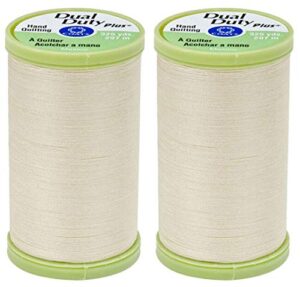
Thread matters more than most beginners realize — and Coats Clark Dual Duty Hand Quilting Thread earns its spot in your sewing basket.
Its cotton-covered polyester construction gives you real strength without the stiffness, so it glides through binding layers without constantly snapping.
The polished glacé finish keeps tangles minimal and stitch tension consistent.
Each spool holds 325 yards, which means you’ll finish several bindings before needing a refill.
That neutral cream color blends beautifully with most fabric palettes, too.
| Best For | Hand quilters who work on large or ongoing projects and want a strong, smooth thread that cuts down on hand fatigue and keeps costs low. |
|---|---|
| Primary Material | 100% polyester |
| Handedness Support | Universal use |
| Intended Use | Hand quilting |
| Unit Count | 2 spools |
| Durability Feature | High tensile strength |
| Ergonomic Design | Low-friction smooth finish |
| Additional Features |
|
- Smooth, low-friction finish means less needle drag and hand strain — great for high stitch counts
- 650 total yards across two spools gives you serious mileage at just $9.99
- Neutral cream color works with a wide range of fabric colors without clashing
- Only comes in cream, so it’s a no-go if you need contrast stitching in other colors
- Pure polyester won’t suit quilters who prefer natural-fiber threads for cotton-based projects
- Built for hand quilting — don’t expect great results if you run it through a machine at speed
5. Clover Natural Fit Leather Thimble
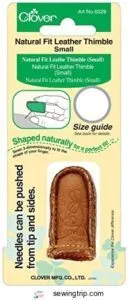
If you’ve ever finished a long hand-stitching session with a sore, pricked fingertip, the Clover Natural Fit Leather Thimble is about to become your best friend. It’s sewn three-dimensionally to follow your finger’s natural curve, so it feels snug without cutting off circulation.
The seam-free needle zone lets you push from any angle without snagging.
Two leather layers protect where it counts most.
Small size fits a 14.5 mm diameter — and it softens beautifully with wear.
| Best For | Hand sewers, quilters, and crafters with small or thin fingers who want a comfortable, natural-feeling thimble that protects without the bulk of metal. |
|---|---|
| Primary Material | Genuine leather |
| Handedness Support | Universal use |
| Intended Use | Hand quilting and sewing |
| Unit Count | 1 thimble |
| Durability Feature | Leather stretches to fit |
| Ergonomic Design | Seam-free needle entry zone |
| Additional Features |
|
- The seam-free needle zone means no snagging mid-stitch — you can push from any angle without fumbling.
- Leather molds to your finger over time, so it gets more comfortable the more you use it.
- Lightweight and low-profile, it almost disappears on your finger once broken in.
- The leather will stretch out eventually, so you may need to replace it sooner than a metal thimble.
- The thin fingertip area can feel a little lacking if you’re pushing through tough fabric with real force.
- It’s sold as a single small size, so if your finger runs a bit larger or smaller than average, getting the right fit might take some trial and error.
How to Calculate, Cut, and Prepare Binding Strips
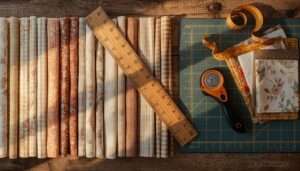
Before you cut a single strip, you need to know exactly how much binding your quilt actually needs. Getting the math right upfront saves you from running short mid-project — and that’s a frustration nobody needs.
Here’s how to measure, calculate, cut, and prep your binding strips the right way.
Measuring Your Quilt Perimeter for Binding Length
Before you cut a single strip, you need to measure the perimeter of your quilt accurately. Lay it flat, then use a flexible tape measure along each edge — that’s your Accurate Tape Use.
Skipping Edge Square Verification here causes real problems later.
Add the four sides together using the simple Perimeter Formula Reminder: (2 × length) + (2 × width), then add 10 inches for Corner Allowance Calculation.
Calculating Yardage and Number of Strips
Once you’ve got your binding length — perimeter plus that Extra Corner Allowance — the math gets simple.
Divide your total by 42 inches (standard Fabric Width Utilization), then round up for Strip Count Rounding. That’s your strip count.
Multiply by 2.5 inches, divide by 36, and you have your fabric yardage estimation. Always add a small Yardage Waste Factor — a few extra inches save a last-minute headache.
Cutting Strips With a Rotary Cutter and Ruler
Now that your strip count is sorted, it’s time to cut.
Lay your fabric on the cutting mat — Mat Placement matters here, so keep it flat and steady.
Grip your quilting ruler firmly (that’s your Ruler Grip), align it at exactly 2½ inches, and stack up to four layers for efficiency — Layer Stacking saves real time.
Keep your Blade Angle consistent, press firmly with your rotary cutter, and glide in one smooth pass.
Don’t forget basic Safety Precautions: always cut away from your body and swap dull blades immediately for clean binding strips.
Joining Strips With Diagonal Seams
Now that your strips are cut, you need to join them into one continuous length. Lay two strips right-sides together at a right angle, then draw a diagonal line across the corner.
Sew along that line with a ¼-inch seam allowance, trim excess fabric, and press the joint open.
Diagonal seam alignment distributes bulk reduction evenly — no lumpy spots, just smooth edges ready to machine stitch around your quilt.
Pressing and Folding The Continuous Strip
Press the binding strip in half lengthwise before anything else — it sets the stage for clean edges all the way around.
- Lay your continuous strip flat on the iron and ironing board
- Use medium heat settings to avoid scorching
- Apply steady crease pressure from center outward
- Follow a pressing sequence: seams open first, then fold in half
- Check fold alignment with a ruler before sewing
How to Sew Binding on a Quilt Step by Step
Now that binding strips are ready, it’s time to put them to work. This part moves pretty quickly once you know the order of steps.
Here’s exactly how to sew your binding from start to finish.
Squaring and Trimming Quilt Edges Before Binding
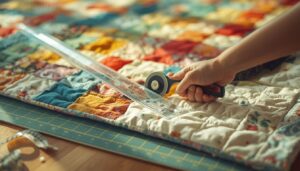
Before a single stitch of binding touches your quilt, edge squaring makes or breaks the final look. Trim batting and backing flush using ruler alignment tips—your cutting mat keeps everything steady.
Correct wavy edge correction issues by trimming perpendicular to each side. Follow batting trim guidelines of ¼ to ½ inch, true each corner with a diagonal trim, and you’re set.
Aligning and Pinning Binding to The Quilt Front
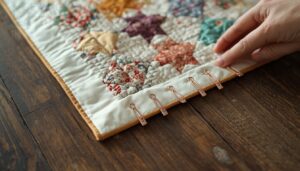
Once edges are trimmed and true, it’s time to get your binding strips positioned and pinned. Start with binding fold positioning at one side — not a corner — so joining the ends later is easier. Front edge alignment matters here, so keep that folded edge sitting just slightly toward the quilt front.
- Use pins or clips every 1–2 inches for steady pin spacing
- Place pins perpendicular to the edge so they grip without slipping
- Apply gentle presser foot pressure when approaching the corner pivot technique area to avoid distortion
Sewing Binding With a Quarter-Inch Seam Allowance
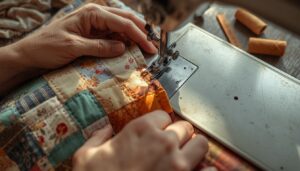
Now you’re ready to sew. Set your machine to a precise quarter-inch seam allowance measurement — this keeps the binding strips secure without pulling.
A walking foot setup is non-negotiable here; it feeds all those quilt layers evenly and prevents edge puckering beautifully.
Keep your stitch spacing consistently tight (around 2.0mm), and dial in thread tension tuning so nothing bunches along the quilt edge seam allowance.
Creating Neat Mitered Corners at Each Turn
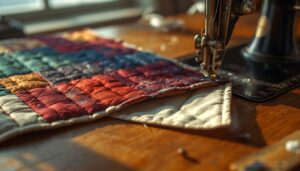
Mitered corners are where beginners either shine or stumble — and with the right steps, you’ll shine every time. Stop stitching exactly ¼ inch before the corner, then fold the binding up at 45° for Sharp Crease Formation. Fold it back down, aligning edges perfectly.
- Use Secure Corner Pinning to hold the fold before stitching
- Apply Walking Foot Guidance slowly through the turn
- Lock the fold with a Reinforced Backstitch
That diagonal fold is your Diagonal Seam Placement working beautifully.
Joining and Securing The Binding Tail Ends
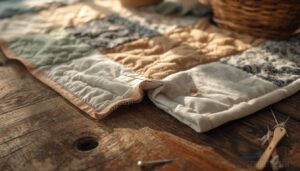
Now comes the part that ties everything together — literally.
To join the binding ends, you have two solid options: the Pocket Method, which tucks the tail inside a small folded flap, or the Overlap Method, which lays one end over the other for a flatter finish.
Either way, keep your Seam Alignment true, use a backstitch for Tail Tension Control, and trim close.
Folding Binding Over to The Quilt Back
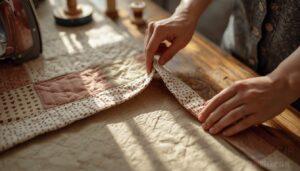
With your binding tail secured, gently fold the binding over to the quilt back. Keep your Consistent Fold Width between ½ and ¾ inch all the way around — this keeps things balanced and clean.
Use Back Edge Pinning to hold the folded edge in place, then press the binding flat. A steady Pressing Rhythm as you work each section prevents puckers before you stitch.
Machine Stitching Vs. Hand Stitching The Back Finish
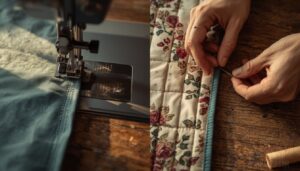
Now that your binding is folded and pinned, you have a real choice: machine sew the binding down or hand sew the binding closed.
Machine stitching wins on Speed Efficiency and Durability Comparison, but Stitch Visibility is higher on the Quilt back.
Hand sewing with a Backstitch or slip stitch nearly disappears — worth the extra time for Corner Reinforcement and a polished finish.
Thread Choice matters either way.
Tips for Uniform Stitching and Professional Results
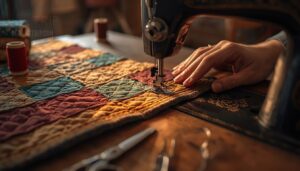
Whether you machine stitch or hand sew, a few small habits make a big difference.
Attach your walking foot — it feeds all three quilt layers evenly, so nothing shifts. Set your stitch length to 2.0mm and double-check your tension adjustment before starting.
Your thread choice, seam allowance, and pressing method all affect how crisp that binding width looks when it’s done.
Frequently Asked Questions (FAQs)
What are common quilt binding mistakes?
The most common quilt binding mistakes include insufficient length, miter bulges, corner gaps, uneven grain, and poor stitch tension.
Getting your seam allowance, binding width, and mitered corners right — plus calculating binding fabric requirements carefully — saves real headaches.
What is the best way to miter corners when binding a quilt?
Like origami, precision folds make all the difference.
Stop stitching ¼ inch before each corner, fold at 45 degrees using the Diagonal Fold Technique, pivot, and continue.
Corner Pin Placement keeps everything crisp and clean.
How do I handle binding on odd corner angles?
Odd angles don’t have to intimidate you. Use bias binding for flexibility, clip a small notch near the corner, then let your stiletto guide the fold.
walking foot and invisible slip stitches finish it cleanly.
What is the difference between bias binding and straight-cut binding?
Think of it like rope vs. ribbon. Bias binding is cut at 45° to the grain, giving it natural Binding Stretchability and Corner Flexibility for curves.
Straight grain binding skips the stretch — clean, quick, less Fabric Waste.
Can I use self-binding on my quilt?
Yes, you can! Self-binding works great for small projects like baby quilts or wall hangings. Just keep edge stability concerns in mind — thick batting can make this binding method tricky.
How do I handle scalloped or rounded borders when binding a quilt?
Scalloped edges and bias binding were practically made for each other.
Cut your strips at 45 degrees, clip notches into inner curves, stagger your joins inside valleys, and press gently after each turn.
Can I use knit fabric for quilt binding?
You can, but knit fabric for quilt binding comes with challenges.
Stretch causes stretch causes wavy edges, so use stability interfacing techniques or a straight-grain cut to keep things smooth and avoid edge puckering.
How do I bind a scalloped edge quilt?
Binding a scalloped edge quilt calls for bias binding strips and careful notching at each valley.
Clip those inner curves, ease the fabric gently, and your walking foot manages the rest without puckering.
What is a flange and how to add one?
A flange is a flat rim that joins two components together, creating a sealed connection.
In quilting terms, it’s a narrow folded strip tucked between binding strips and your quilt top for a decorative edge finishing accent.
Should I pre-wash my binding fabric before using?
Yes — think of pre-washing as your fabric’s audition. It manages shrinkage testing, colorfastness checks, sizing removal, and edge fraying control before your binding ever touches the quilt.
Conclusion
Every great quilt tells a story, and the binding is its final sentence—the one that makes everything before it make sense.
Now that you know how to sew binding on a quilt, that last step no longer feels like a chore. It feels like a signature. Your corners will lie flat, your edges will hold strong, and the person who wraps themselves in your quilt will never know how much thought went into that single folded strip.
- https://craftindustryalliance.org/the-size-of-the-quilting-market-quilting-trends-survey-results-2024/
- https://zipdo.co/sewing-industry-statistics/
- https://www.verifiedmarketresearch.com/product/quilt-market/
- https://www.precisionbusinessinsights.com/market-reports/quilt-market
- https://www.businessresearchinsights.com/market-reports/quilt-market-104729