This site is supported by our readers. We may earn a commission, at no cost to you, if you purchase through links.
Your sewing machine hums through another project, but invisible threats float with every stitch. Fabric emissions, synthetic fiber dust, and aerosol finishes spike indoor pollution to levels two to five times worse than city air—right in your creative space.
Many sewers blame allergies or fatigue on coincidence, never connecting the dots to what they’re breathing eight hours a week.
The good news? Strategic sewing room ventilation tips can slash airborne toxins by 30% in days, not months. Simple changes—from window placement to purifier selection—transform stuffy workshops into spaces where your lungs work as smoothly as your rotary cutter.
Table Of Contents
Key Takeaways
- Indoor air pollution in sewing rooms can reach 2–5 times outdoor levels due to fabric emissions, VOCs from solvents and sprays, and fiber dust, increasing respiratory symptom risk by 9–12% with prolonged exposure.
- Strategic ventilation—targeting 6–8 air changes per hour for general sewing and 10–12 ACH when using aerosols or cutting synthetics—can reduce airborne toxins by 30% and boost productivity by 5–12% on complex tasks.
- HEPA air purifiers with true certification (99.97% capture of 0.3-micron particles) should be centrally placed at breathing height with proper clearance, paired with real-time CO2, PM2.5, and VOC monitoring to maintain safe thresholds.
- Daily habits like sealed fabric storage, HEPA-filtered vacuuming, and maintaining 40–50% relative humidity cut dust exposure by 25–40% while preventing static buildup and mold growth in your workspace.
Why Sewing Room Ventilation Matters
Your sewing room might seem harmless, but the air you breathe while crafting can carry hidden risks that affect both your health and your work. From chemical vapors in fabrics to clouds of lint and dust, poor ventilation turns a creative space into a potential hazard zone.
Understanding these risks is the first step toward protecting yourself and keeping your sewing sessions comfortable and productive.
Common Air Quality Risks in Sewing Spaces
Your sewing space harbors hidden air quality risks you can’t ignore. Fabric emissions and sewing fumes release airborne toxins—formaldehyde from textiles and VOCs from solvents—that can spike indoor pollution by 2–5 times outdoor levels in poorly ventilated sewing rooms.
Textile fibers and dust accumulate rapidly during cutting and trimming, while finishing sprays add sub-micron particulates that linger without proper ventilation systems supporting air quality improvement.
To mitigate these risks, it’s imperative to follow a systematic review process for evaluating the effectiveness of ventilation systems.
Health Effects of Poor Ventilation
Poor ventilation systems in your sewing room expose you to respiratory issues and indoor air pollution that go beyond discomfort. You’re facing a 9–12% risk of upper respiratory symptoms from prolonged exposure to airborne toxins, while inadequate air quality improvement allows CO2 above 1,000 ppm—dulling your focus after just two hours.
Poor ventilation in your sewing room raises respiratory symptom risk by 9–12% and dulls focus within two hours
If you have asthma, these sewing room hazards multiply your wheeze risk by 1.3–1.7 times, making proper ventilation non-negotiable for health effects prevention.
How Ventilation Impacts Sewing Productivity
Beyond the health risks, ventilation systems directly control your cognitive function and output. When you boost air quality metrics in your sewing room layout, you’ll see productivity gains of 5–12% on complex tasks. That cleaner air means fewer threading errors and sharper focus.
- Workspace optimization with fresh air cuts mistake rates by 4–8%
- CO2 below 1,000 ppm sharpens vigilance by 1–2 standard deviations
- Better ventilation speeds cognitive processing by 3–6%
- Poor air quality drags productivity down 3–7% annually
Effective communication relies on clear theme identification to convey the importance of ventilation in sewing rooms.
Key Sources of Indoor Pollutants

Your sewing room might look clean, but the air you’re breathing tells a different story. Every fabric you cut, every spray adhesive you use, and even the humidity level in your space contributes to indoor air pollution that can affect your health and comfort.
Let’s break down the three main culprits so you know exactly what you’re dealing with.
VOCs From Fabrics, Solvents, and Aerosols
You mightn’t realize it, but every time you spray starch or press treated fabric, you’re releasing volatile organic compounds that can build up fast in your crafting space. VOC concentrations often climb above safe thresholds during projects involving fabric finishes, solvents, or aerosols.
Focus on VOC reduction through solvent alternatives, improved air purification, and smart storage solutions to maintain healthier air quality in your sewing room organization.
Dust and Fiber Particulate Accumulation
Every snip and cut sends invisible particulates airborne—PM2.5 levels can spike to 60–120 µg/m³ in your crafting space without proper ventilation systems. These sewing room hazards aren’t just nuisances—they’re airborne toxins affecting your comfort and focus.
Fiber dust control starts with simple fixes: seal fabric storage, vacuum with HEPA filters during breaks, and monitor particulate measurement regularly. Smart sewing room organization protects your respiratory health while you create.
Humidity and Static Electricity Concerns
Low humidity turns your crafting space into a static generator—shocking fingers, clinging fabrics, and disrupting workflow. Maintaining 40–60% relative humidity cuts static buildup by 15–35% while protecting stored textiles from brittleness and mold.
- Install a hygrometer near your cutting table for real-time humidity control
- Run a humidifier during dry months to enable static prevention
- Pair air purification with moisture management for complete fabric storage protection
- Ground yourself with anti-static mats to achieve electrostatic reduction in your sewing room
Effective Ventilation Strategies
You can’t improve your sewing room’s air quality without the right ventilation strategy in place. The good news is that you don’t need a complicated setup to move stale air out and fresh air in.
Let’s look at three proven approaches that will keep your workspace healthier and more comfortable.
Natural Ventilation—Windows and Doors

Opening windows on opposite walls is your best natural ventilation tool—cross ventilation can slash indoor CO2 by 20–40% within ten minutes. Window placement matters: casement styles boost air exchange up to 40% more than standard sash designs.
Seal door gaps to control leakage, and open windows during fabric cutting to reduce dust by 25–50%, keeping your sewing room layout healthier.
Mechanical Ventilation—Exhaust Fans and Air Exchangers
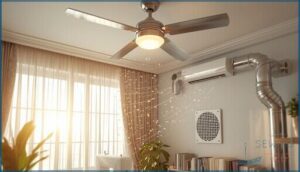
When windows aren’t enough, exhaust fans and air exchangers become your mechanical allies. Install high-capacity units—at least 50 CFM per 100 square feet—to tackle VOCs and fiber dust in your sewing room.
- Inline exhaust fans with variable speed controls slash aerosol dispersion by up to 60%
- Heat recovery ventilators (HRV/ERV) retain 60–90% of thermal energy while renewing air
- Smooth duct design with minimal bends boosts exhaust effectiveness by 15–25%
Pair these systems with proper filtration integration and ventilation controls for maximum storage and organization of clean air.
Recommended Air Changes Per Hour for Sewing Rooms

Think of air changes per hour (ACH) as your ventilation system’s rhythm—targeting 6–8 ACH for general sewing space activity keeps air quality standards met without overengineering.
When you’re working with spray adhesives or cutting synthetic fabrics, bump that to 10–12 ACH to dilute VOCs fast.
Your crafting space needs this airflow management to protect your lungs and maintain focus.
Air Filtration and Quality Monitoring

Even with solid ventilation in place, you’ll want backup filtration to catch what slips through—especially fine fibers and chemical vapors that linger in your workspace.
A quality HEPA purifier can make a noticeable difference, but only if you choose the right unit and place it strategically.
Pairing filtration with real-time air quality monitoring gives you control over what you’re breathing while you create.
Choosing The Right HEPA Air Purifier
Not every air purifier delivers the filtration efficiency your sewing space organization demands. True HEPA technology captures 99.97% of 0.3-micron particles—essential for managing dust from fabrics and fibers in your crafting space ideas. Look for units with CADR ratings supporting at least 2–3 air changes per hour for your room size.
- Filter replacement every 6–12 months maintains peak performance
- Energy Star-rated air purifier types balance power use with continual operation
- Avoid HEPA-type filters—only certified true HEPA meets rigorous standards
Regular purifier maintenance protects your health during crafting and hobbying sessions.
Placement for Maximum Filtration Efficiency
Your new purifier won’t work miracles if it’s trapped in a corner. Central placement improves particle removal by roughly 20 percentage points compared to edge positioning—modeling shows effectiveness jumps from 60–70% to 85–90%.
Keep at least one foot of distance clearance from walls to preserve airflow optimization and full CADR output. Raise the unit 3–5 feet for breathing zone alignment, targeting seated work height where fibers linger longest in your sewing space organization.
Using Monitors for CO2, PM2.5, and VOCs
Once your filtration systems are running, air quality sensors show you what’s really happening. CO2 monitors reveal when ventilation control falls short—readings above 1,000 ppm signal inadequate air exchange in your sewing room.
PM2.5 and VOC sensors catch dust spikes and solvent fumes before they build up. Smart monitor placement at breathing height, combined with regular data analysis, transforms guesswork into actionable ergonomic workspace improvements.
Daily Habits for Cleaner Sewing Air
Even with the best ventilation system in place, your daily habits make or break your sewing room’s air quality. Small, consistent actions prevent dust buildup, control humidity, and keep pollutants from lingering in your workspace.
Let’s look at three practical routines that’ll keep your air clean without disrupting your creative flow.
Managing Fabric and Supply Storage to Reduce Dust
Your fabric storage choices directly shape dust control in your sewing room. Sealed, labeled bins cut fabric dust intrusion by 25–35%, while rolling storage containers keep fabrics off floors and reduce dust exposure by up to 40%.
Separate highly shedding materials like wool from low-shedding fabrics to minimize cross-contamination—this simple shelf management step lowers overall dust levels by 10–25% in mixed collections.
Cleaning Routines That Improve Air Quality
Your cleaning schedule directly impacts air quality. Daily vacuuming with a HEPA-filter vacuum reduces airborne dust by 30% over a week, while routine surface cleaning cuts VOCs by 15–25% within 24 hours.
Wet-cleaning methods in your sewing space prevent fiber resuspension better than dry sweeping—reducing dust clouds by roughly 50%. Filter maintenance and disposal of fabric scraps keep your crafting environment cleaner and safer.
Maintaining Optimal Humidity for Comfort and Safety
Balance is everything when managing your sewing room’s moisture levels. You’ll want to keep relative humidity between 40% and 50%—this range prevents mold growth while reducing static electricity that disrupts fabric handling.
Install a hygrometer to track conditions, then use dehumidifiers in humid climates or humidifiers when air gets too dry.
Proper humidity control maintains both air quality and comfort during long sessions at your workstation.
Frequently Asked Questions (FAQs)
What plants naturally purify sewing room air?
Spider plants, English ivy, and peace lilies offer modest VOC removal—think of them as your crafting workspace’s quiet helpers, not miracle workers.
Pair these green companions with mechanical filtration for real indoor air improvement.
Do air purifiers increase electricity costs significantly?
Most air purifiers add only $6–$30 annually to your electricity bill when run during sewing sessions. Pairing them with smart ventilation strategies and filter replacement schedules keeps energy consumption minimal while protecting your health.
Can poor ventilation damage sewing machine motors?
Absolutely—motors run hot without proper airflow. Heat buildup, dust intrusion, and humidity accelerate bearing wear, reduce efficiency by 5–10%, and can shorten motor life by 1–3 years in stagnant spaces.
Should I ventilate differently for leather projects?
Yes—leather work releases more VOCs and dust than fabric sewing. You’ll need stronger ventilation, ideally 6–8 air changes per hour during finishing tasks, plus localized exhaust to capture solvent vapors at the source.
How often should I replace HEPA filters?
Here’s the rule of thumb: replace HEPA filters every 6–12 months for typical sewing room use, or every 3–6 months in dust-heavy environments—whichever maintains your purifier efficiency and air quality.
Conclusion
Think of your lungs as fabric—what you expose them to daily weaves into their long-term condition. By implementing these sewing room ventilation tips, you’re not just clearing the air; you’re preventing respiratory deposits that accumulate like lint in a bobbin case.
Open windows strategically, run HEPA purifiers near cutting stations, and monitor particulate levels weekly.
Your creative output deserves clean air as much as your body does. Breathe easier, stitch longer.