This site is supported by our readers. We may earn a commission, at no cost to you, if you purchase through links.
Most sewing frustrations trace back to one small dial that barely gets a second glance. Loops on the underside of your fabric, puckered seams, stitches that pull and distort—these aren’t random machine gremlins. They’re tension talking to you.
The tension dial controls how tightly the upper thread feeds through your machine, and even a half-step in the wrong direction changes everything about how a stitch forms. Medium-weight cotton behaves completely differently than denim or chiffon, so no single setting works for every project.
Once you understand what those numbers actually mean—and how to read your stitches like a technician—dialing in perfect tension becomes second nature.
Table Of Contents
Key Takeaways
- Your tension dial is the real culprit behind loopy undersides, puckered seams, and pulled stitches—dial it to 4–4.5 for medium fabrics, then adjust in quarter‑turn steps for everything else.
- Every fabric has its own sweet spot: chiffon sits around 2–3, denim pushes to 5–6, and specialty threads like metallic or monofilament need you to drop tension even lower with a matched needle.
- Threading with contrasting colors—bright red on top, navy in the bobbin—turns tension diagnosis from guesswork into an instant visual read.
- Small habits prevent the biggest headaches: raise your presser foot before threading, clean lint from the tension discs regularly, and hold thread tails back 7–10 cm at the start of every seam.
Thread Tension Dial Settings Explained
tension dial is the heart of your sewing machine — small, but in complete control of how every stitch forms.
Getting that dial right makes all the difference, and these thread-breaking fixes and tension troubleshooting tips can help you dial in perfect stitches every time.
Once you understand what it’s actually doing, adjusting it stops feeling like guesswork.
Here’s what you need to know before you touch that dial.
How The Tension Dial Works
The tension dial is the control center of your stitch quality. Turn it clockwise, and the tension discs press closer together — that’s disc pressure mechanics doing its job.
A spring tension ratio keeps everything balanced, while cam linkage interaction connects your dial movement to those discs in real time.
Thread path friction through the assembly determines how smoothly your thread flows.
For medium-weight fabrics, the default straight stitch setting is generally around 4‑4.5.
Tension Dial Number Scale and Meanings
Most dials run from 0 to 9 — that’s your full tension dial scale. Think of it as a spectrum: 0 is nearly zero resistance, 9 grips the thread tightly.
Dial calibration starts at 4–4.5 for medium-weight fabrics, which is your numeric reference point for balance. Fabric weight mapping makes this simple — chiffon sits around 2–3, denim pushes to 5–6.
Proper sewing requires correct thread tension to guarantee balanced stitches.
Role of Tension in Stitch Formation
Every stitch is really a tiny tug-of-war. Your upper thread and bobbin thread pull against each other to interlock right in the middle of the fabric — that’s the interlock balance doing its job.
Every stitch is a tiny tug-of-war where upper and bobbin threads interlock perfectly inside the fabric
When stitch loop geometry lines up perfectly, you get balanced tension with no fabric puckering, mechanics pulling the seam sideways.
Tension peak timing happens quickly, so even a half-step on the tension dial changes stitch formation noticeably.
Step-by-Step Guide to Adjusting Tension
Getting your tension right doesn’t have to be a guessing game. A few simple steps can take you from frustrating bunched threads to clean, even stitches you’re proud of. Here’s exactly how to work through it.
Preparing Your Sewing Machine
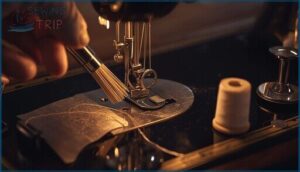
Before you touch the tension dial, get your machine ready.
Start with a basic sewing machine maintenance check: clean the tension discs with a soft brush, follow your needle insertion guide to seat a fresh needle flat‑side back, and review your thread path inspection from spool to eye. Good bobbin winding tips and presser foot adjustment lay the groundwork for any tension adjustment to actually work.
Incremental Adjustments for Perfect Stitches

Small moves win here. Adjust your tension dial in quarter-turn precision increments — never more than 0.25 at a time — and sew 10 test stitches on scrap fabric after each change.
- Start at 4, shift to 4.25
- Inspect both sides using the stitch inspection technique
- Log fabric weight scaling and humidity impact in your tension log
That’s real tension calibration.
Using Contrasting Thread for Diagnosis
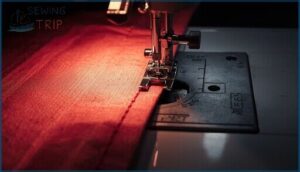
Seeing tension problems clearly starts with the right thread pairing strategy. Load bright red on top, navy blue in your bobbin, then sew on white muslin.
Color loop detection becomes instant — bobbin visibility test shows exactly where your tension dial needs adjustment. This stitch color contrast approach turns guesswork into a reliable diagnostic checklist for tension problems, balancing top and bobbin threads without frustration.
Troubleshooting Common Tension Problems
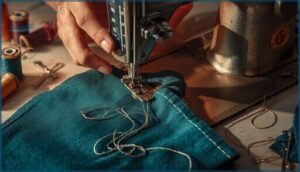
Even the most careful sewers run into tension trouble — it’s part of the process, not a sign you’re doing something wrong.
The good news is that most problems follow predictable patterns, and once you know what to look for, fixing them gets much easier.
Here’s what to check when your stitches aren’t behaving.
Identifying Unbalanced Vs. Balanced Tension
Balanced tension is the difference between a seam you’re proud of and one you hide. Here’s what to look for:
- Stitch Appearance Analysis – Perfect stitches look identical on both sides; unbalanced tension shows loops or dots on one surface.
- Interlock Point Location – Balanced tension hides the thread interlock midway through the fabric.
- Test Stitch Patterns – Use contrasting thread colors; any color bleeding to the wrong side reveals tension problems instantly.
- Fabric Feel Indicators – Run your fingers along the seam; balanced tension feels smooth and lies completely flat.
- Machine Sound Cues – A steady, even hum means your tension dial is dialed in correctly.
Fixing Loose or Tight Stitches
Loose stitches? Turn your tension dial clockwise to 6 or 7. Tight ones pulling the fabric? Drop it to 2 or 3.
Always do a needle condition check first — a dull needle mimics tension problems. Try cleaning lint buildup from your tension discs, then run a test stitch fabric sample.
Bobbin screw adjustment and thread quality selection matter too.
Small fixes, big difference.
Preventing Bird’s Nest Loops and Puckering
Bird’s nest loops and puckering fabric are your machine’s way of saying something’s off in the tension path. Most of the time, it comes down to these five fixes:
- Raise the presser foot before threading — this opens the tension discs properly
- Practice proper threading through every guide, especially the last one above the needle
- Floss your tension disc cleaning routine regularly to remove hidden lint
- Hold thread tails back 7–10 cm at the start to prevent birds nest tangles
- Use stitch length adjustment and matching thread weights for your fabric
Your tension dial and sewing machine tension troubleshooting skills sharpen fast once you build these habits.
Resetting Tension to Default Settings
Think of resetting your tension dial as returning to factory calibration — your machine’s clean slate. Most machines default to position 4 or 4.5.
Follow this quick reference for your model:
| Machine | Digital Reset Procedure | Dial Alignment Tips |
|---|---|---|
| Brother | Hold return key 2 seconds | Middle number screen |
| Janome M7 | Press default key | Auto-tension resets |
| Singer HD 4423 | Rethread completely | Align 4–5 marking |
| Vintage Mechanical | Machine power cycle off/on | Visual 4 mark only |
| Generic Analog | Manual bobbin thread check | Midpoint 0–9 scale |
Start fresh, stitch confidently.
Fabric and Thread-Specific Tension Settings

Not every fabric plays by the same rules, and your tension dial needs to keep up.
What works beautifully on denim will wreck a silk blouse, and the thread you choose only adds another variable to the mix.
Here’s what you need to know for the materials and threads you’re most likely to work with.
Adjusting Tension for Heavy-Duty Fabrics
Heavy fabrics like denim and canvas push back hard — your machine needs to match that force. Start with tension dial adjustment steps: set between 4 and 6, test on scrap, then adjust in quarter turns.
- Needle Size Matching: Use 100/16 for denim, 90/14 for twill.
- Stitch Length Optimization: 3–4 mm keeps seams secure.
- Presser Foot Pressure: Increase it to prevent skipped stitches.
- Test Swatch Evaluation: Always confirm stitch balance before cutting into your project.
Tension Tips for Delicate and Lightweight Materials
Delicate fabrics need a lighter touch — lower your tension dial to 2 or 3, then run a Fabric Tension Test on a scrap first. Use a Short Stitch Length around 1.5–2.0 mm, and swap in a Roller Foot to stop chiffon from bunching.
Starch Application stiffens sheer voiles temporarily, making them far easier to control.
Get these right, and balanced tension follows naturally.
Specialty Thread and Needle Considerations
Specialty threads each demand a specific needle and tension dial adjustments to avoid breakage or skipped stitches.
- Metallic Needle Choice — Loosen tension to 1.0–2.0 and use a 90/14 metallic needle.
- Stretch Needle Tips — Drop tension 1–2 points and use an 80/12 stretch needle.
- Monofilament Needle Size — Use 60–70 Microtex needles with tension set around 1.5–2.5.
- Heavy‑Duty Needle Types — Pair thick thread with 100/16 needles at dial 3–4.
Match needle size compatibility to thread thickness, and thread tension balance follows.
Managing Tension for Decorative and Embroidery Stitches
Decorative stitches and embroidery play by different rules than regular sewing.
Drop your tension dial to 1 for heavy 12wt decorative threads — this pulls the thread smoothly to the fabric’s backside, giving you that hand-embroidered look.
Stabilizer Selection, Thread Weight Matching, and Presser Foot Adjustments all work together here.
Balanced tension means testing after every change, then trusting what you see.
Top Sewing Products for Mastering Tension
Getting your tension right is only half the battle — having the right tools and resources makes the other half a lot easier.
A few well-chosen products can help you practice, polish, and build real confidence at the machine.
Here are three worth keeping in your sewing room.
1. Vogue Women’s Shirt and Pants Pattern

If you want a real-world project to test your tension settings, the Vogue V1642Y pattern is worth keeping on your workbench. It includes two shirts and a pair of pants — all beginner‑friendly, with loose‑fitting tops featuring zippered collars and pants with elasticized back waists.
The varied fabrics you’ll likely use across these pieces give you natural practice adjusting tension. Sizes run 4–14, and the clear instructions make it easy to focus on your stitching technique rather than decoding the pattern.
| Best For | Beginners who want a fun, low-stress sewing project to build their skills and end up with a few wearable pieces. |
|---|---|
| Skill Level | Beginner |
| Project Type | Shirts and Pants |
| Instructions Included | Yes |
| Size Range | 4-14 |
| Origin | USA |
| Fabric Guidance | Yes |
| Additional Features |
|
- Comes with two shirt patterns and a pair of pants, so you get solid variety for one purchase
- Beginner-friendly instructions mean you spend more time sewing and less time scratching your head
- Forgiving design details — like elasticized waistbands and loose-fitting tops — make it easier to get a good result
- Sizes only go up to 14, so it won’t work for everyone
- You’ll still need to buy fabric and supplies separately, which adds to the cost
- Not much of a challenge if you’re past the beginner stage and looking for something more complex
2. Style Arc Hendrix Coat Sewing Pattern
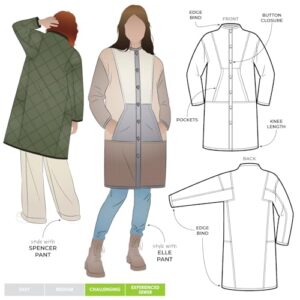
Style Arc Hendrix Coat is the kind of pattern that genuinely tests your tension skills. You’re working with panelled construction — multiple front pieces, angled seams, set-in sleeves — all places where uneven tension shows up fast.
Fabric choices like wool, faux fur, or velvet each behave differently under the presser foot, so you’ll need to dial in your settings carefully for each one. Sizes run 10–22, and optional topstitching throughout gives you built-in checkpoints to verify your tension is balanced and consistent.
| Best For | Intermediate to advanced sewers who want a stylish, structured coat they can customize with different fabrics and wear across seasons. |
|---|---|
| Skill Level | Intermediate to Advanced |
| Project Type | Coat |
| Instructions Included | Yes |
| Size Range | 10-22 |
| Origin | Australia |
| Fabric Guidance | Yes |
| Additional Features |
|
- Sizes 10–22 are all included and printed in different colors, so cutting out the right size is actually easy
- Lots of fabric options — wool, linen, faux fur, velvet — meaning you can make this coat work for almost any season or occasion
- Features like optional topstitching and angled patch pockets give you room to make it your own
- This isn’t a beginner-friendly pattern — panelled construction and set-in sleeves can trip you up if you’re still building skills
- Fabrics like faux fur and velvet need careful handling, so expect some trial and error dialing in your settings
- You’ll need to source buttons or snaps and fusing separately, which adds a bit to your overall cost and prep time
3. Tailoring Book Measuring Cutting Fitting Altering Finishing
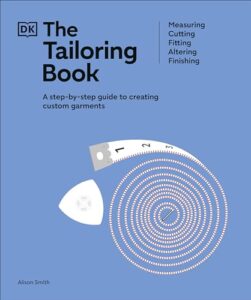
If you’re serious about getting tension right, this book belongs on your workbench. DK’s tailoring guide walks you through 80+ techniques covering measuring, cutting, fitting, altering, and finishing — the full picture, not just the basics. Understanding your fabric matters just as much as technique — knowing how to identify twill weave and its diagonal structure helps you make smarter tension decisions before you cut a single piece.
With 10 downloadable garment projects and couture-level detail, you’ll understand why tension behaves differently across fabrics and constructions. It’s 304 pages of hands‑on knowledge that connects every stitch decision to a real outcome. Think of it as your patient, experienced mentor sitting right beside you.
| Best For | Anyone who wants to seriously level up their tailoring — whether you’re just starting out or ready to tackle couture techniques. |
|---|---|
| Skill Level | All Levels |
| Project Type | Shirts, Jackets, Coats, Trousers |
| Instructions Included | Yes |
| Size Range | Downloadable Patterns |
| Origin | UK |
| Fabric Guidance | Yes |
| Additional Features |
|
- 80 techniques covering everything from measuring to finishing, so you’re not left guessing at any stage
- Downloadable patterns and 10 full garment projects make it practical, not just theoretical
- Works for both womenswear and menswear, which is rare in one book
- It’s a book, so if you learn better from video or hands-on instruction, it might feel limiting
- At 3.4 pounds and 304 pages, it’s a serious commitment — not a quick-reference flip
- Some techniques may feel advanced for total beginners before they’ve built confidence with the basics
Frequently Asked Questions (FAQs)
What do the numbers on a tension dial mean?
Small numbers loosen the thread; high numbers tighten it. Most dials run from 0 to 9, with 4 or 5 as your sweet spot for everyday sewing on medium-weight fabric.
Can humidity affect my sewing machines thread tension?
humidity absolutely can mess with your thread tension.
cotton threads swell, gripping tension discs tighter.
puckering or uneven stitches — even without touching your dial.
How does machine age impact tension consistency?
Like a car with high mileage, older machines lose precision over time.
Tension discs wear grooves, bobbin springs fatigue, and dial mechanisms develop slack — all quietly sabotaging your stitch consistency before you even notice something’s off.
Should tension differ for hand versus machine quilting?
Tension should absolutely differ.
Machine quilting relies on dial settings and consistent mechanics, while hand quilting depends on your personal pull and thread weight.
two different crafts, so treat them that way.
Does thread color influence how tension appears visually?
Thread color acts like a spotlight.
Contrasting top and bobbin threads reveal exactly where tension pulls — dark loops surfacing on light fabric expose imbalances instantly, while matching colors quietly hide the same flaws.
How often should tension discs be professionally serviced?
For most home sewers, a professional tension disc service every 12 to 18 months keeps things running smoothly. Heavy daily use? Bump that up to every 6 to 9 months.
Conclusion
Tension transforms timid stitching into truly custom results—and now you have the know-how to make it happen.
Your thread tension dial settings are no longer a mystery but a tool you can read, adjust, and trust.
Every fabric speaks through its stitches, and you’ve learned the language.
Keep a test swatch nearby, trust your incremental adjustments, and remember: good tension isn’t luck.
It’s a skill you’ve already started building.
- https://www.threadsmagazine.com/2008/11/02/understanding-thread-tension
- https://paigehandmade.com/sewing-machine-basics/tension
- https://www.sewschool.co.uk/sewing-machine-thread-tension/
- https://mellysews.com/sewing-machine-tension/
- https://lindas.com/blogs/tips-and-tricks/sewing-machine-tension-settings