This site is supported by our readers. We may earn a commission, at no cost to you, if you purchase through links.
A seam that puckers isn’t just an eyesore—it signals a mechanical disagreement happening between your thread, needle, fabric, and machine tension that won’t resolve itself by sewing slower or pulling the fabric taut.
Textile engineers identify thread tension imbalance as the root cause in roughly 70% of puckering cases, yet most sewists spend their troubleshooting time adjusting the wrong variable entirely.
The relationship between needle tension, bobbin resistance, and fabric structure follows precise cause-and-effect logic once you understand what each component controls.
Knowing how to troubleshoot puckering seams and tension systematically—rather than by trial and error—puts you permanently in command of your results.
Table Of Contents
Key Takeaways
- Thread tension imbalance causes roughly 70% of puckering cases, yet most sewists waste time adjusting the wrong variables—systematic diagnosis always beats trial and error.
- Your needle, thread, and fabric must work as a matched system; a single mismatch in weight, fiber type, or point style quietly unravels even perfect tension settings.
- Fabric feeding problems—wrong presser foot pressure, off-grain cuts, or manually pulling material—compound tension issues and create puckering that no dial adjustment alone can fix.
- Routine machine maintenance (weekly lint removal, oil every 3–4 hours, needle swaps every 8–10 hours) directly prevents mechanical drift that lets puckering creep back into otherwise well-tuned seams.
Common Causes of Puckering Seams
Puckering rarely comes from just one thing going wrong — it’s usually a combination of small factors that add up fast.
Fixing it usually means checking a few things at once — and these tips for smooth sewing machine seams walk you through exactly where to look.
Understanding what’s actually causing the problem is the first step toward fixing it for good.
Here are the most common culprits to check.
Thread Tension Imbalance
Thread tension imbalance is the most common culprit behind seam puckering. When your needle thread tension and bobbin tension aren’t synchronized — what professionals call Needle Thread Sync and Bobbin Spring Calibration — the Stitch Knot Positioning shifts away from the fabric’s center.
Run Tension Test Swatches first: if fabric bunches immediately, your thread tension is too tight and needs a tension adjustment to restore Fabric Pull Compensation. For precise control, you can adjust upper thread tension.
Incorrect Needle or Thread Selection
Even with tension dialed in, the wrong needle or thread can sabotage your seams. Needle size matching matters more than most sewists realize — a 100/16 on silk creates rippled holes, while a fine 70/10 pierces cleanly. Microtex needle benefits shine on dense synthetics.
Understanding various sewing machine settings is essential for achieving perfect seams across different fabric types. Thread weight choice and specialty thread coatings affect how smoothly stitches form, directly influencing thread tension and thread compatibility across fabric types.
Fabric and Thread Incompatibility
Beyond needle choice, thread and fabric compatibility shape whether your seam lies flat or fights the cloth.
Thread weight mismatch is a primary culprit — heavy 30 wt polyester on chiffon creates visible pull lines because the thread resists the fabric’s natural drape.
Fiber shrinkage variance, elasticity mismatch, needle hole sizing relative to thread diameter, and drape hand conflict all quietly compound seam puckering when your sewing machine settings don’t compensate.
Improper Fabric Feeding
Fabric feeding issues are just as disruptive as thread mismatches.
When your feed dog height is off, or Presser Foot Pressure is too heavy, layers shift unevenly and feed pucker becomes inevitable.
Common operator guidance mistakes include:
- Pulling fabric instead of letting the feed dog work
- Walking Foot Use on slippery materials
- Differential Feed settings on knits
Seam distortion follows.
Fabric Structure and Grain Issues
Your fabric’s grain direction quietly governs whether seams lie flat or ripple.
Cutting off-grain is one of the sneakiest causes of uneven stitches, so if seams keep puckering, it’s worth checking out this guide to fixing thread tension problems before assuming your machine is the culprit.
Lengthwise Grain Alignment offers the most stability, while Crosswise Grain Behavior introduces slight give that can cause horizontal ripples when tension settings aren’t balanced.
Bias Grain Stretch is the trickiest — even minor pulling creates wavy seams.
Mixed Grain Interactions and differences in Fabric Density Shrinkage compound these problems, making stabilization methods and precise fabric grain alignment essential before you stitch a single seam.
Diagnosing Thread Tension Problems
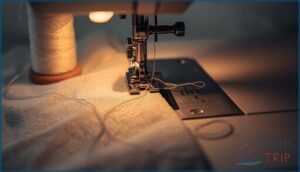
Thread tension is one of those things that’s easy to overlook until your seams start telling you something’s wrong.
Before you start adjusting dials, you need to know exactly what you’re looking at.
Here are the key signs to help you pinpoint the problem.
Signs of Excessive Thread Tension
Excessive thread tension leaves a trail of clues you can’t ignore. A gathered seam line that won’t press flat, regular puckering ridges spaced at each stitch interval, and a stiff fabric feel where the seam should flex — these are your clearest warnings.
- Visible bobbin dots appearing on the fabric’s right side
- Thread breakage frequency spiking at thick seams or direction changes
- Seam puckering that worsens after washing as stretched thread contracts
Trust what you’re seeing and feeling.
Identifying Bobbin Vs. Needle Tension Issues
Pinpointing whether your needle or bobbin tension is the culprit doesn’t have to be guesswork. Run a Contrast Thread Test using two different thread colors — whichever color dominates the wrong side reveals the offending tension. Combine this with a Bobbin Drop Test and Pucker Pattern Analysis using this quick reference:
| Indicator | Likely Cause | Fix First |
|---|---|---|
| Seam Side Indicators show top puckering | Needle tension too tight | Lower needle dial |
| Underside rippling only | Bobbin tension too tight | Screw Position Marking, then adjust |
| Both sides rippling equally | Both tensions too high | Reset sewing machine settings |
Adjusting Sewing Machine Settings
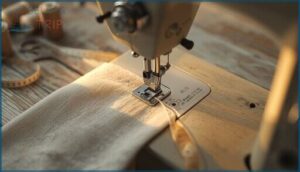
Once you’ve diagnosed where your tension is off, it’s time to make actual adjustments.
Your machine gives you more control than you might think — from bobbin tension to stitch length, each setting plays a specific role in how your seam behaves. Here’s what to work through.
How to Set Correct Thread Tension
Thread tension calibration starts with matching your upper tension to fabric weight — lightweight silks and voiles usually need settings around 3 to 4, while denim or canvas calls for 5 to 6.
Use dial increment strategies: adjust one number at a time, then test on scrap material. Thread lubrication effects and stitch length coordination both influence your final sewing machine settings, so treat each tension adjustment procedure as a conversation with your fabric.
Balancing Needle and Bobbin Tension
Think of needle and bobbin tension as a two-way handshake — both sides need equal commitment. Start with the Tension Drop Test: a properly calibrated bobbin case drops 1–2.5 cm when bounced gently.
Then run an H-Test Interpretation on scrap fabric. Bobbin Spring Calibration, thread lubrication effects, and Stitch Length Interaction all shape your final balance, so adjust one variable at a time.
Adjusting Presser Foot Pressure
Presser foot pressure is one of the most overlooked sewing machine settings when diagnosing seam puckering causes. Too much downward force compresses delicate fabric pressure points, stretching layers that snap back into gathers after stitching.
Apply these pressure adjustment tips based on your fabric:
- Lightweight sheers: reduce foot pressure to prevent tunneling
- Knits: lower settings prevent wavy, rippled seams
- Heavy denim: increase pressure so all layers feed evenly
Modern machines with digital pressure controls simplify calibration techniques considerably—adjust incrementally and test each change on a scrap before committing.
Selecting Optimal Stitch Length and Type
Once your presser foot pressure is dialed in, stitch length and type become the next levers worth adjusting. Fabric weight matching matters here — lightweight voile needs 2.0–2.5 mm while denim accommodates 3.0–4.0 mm.
Stitch density balance prevents puckering along long seams. For knit stretch options, a narrow zigzag works better than a straight stitch. Topstitch length guidance suggests 3.0–4.0 mm for smooth, flat results.
Preventing and Fixing Seam Puckering
Puckering doesn’t have to be a permanent frustration—most of it comes down to a handful of fixable habits and choices.
Once you understand what’s actually causing the problem, the solutions become surprisingly straightforward. Here’s what to focus on when preventing and fixing seam puckering for good.
Choosing Compatible Thread and Needle
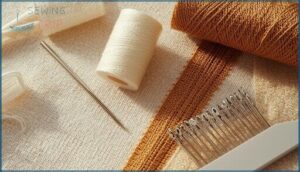
Matching your needle and thread isn’t guesswork — it’s engineering. Needle‑Thread Matching directly controls thread tension and seam construction quality.
Thread Weight Selection, pair 50‑weight cotton with an 80/12 needle; move to 90/14 for 40‑weight.
Needle Point Type matters too — ballpoints protect knit fabric structure, while universals suit wovens.
Fabric‑Thread Compatibility and Thread Lubrication Choice keep stitches balanced and puckering‑free.
Preparing and Stabilizing Fabric
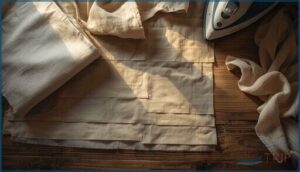
Once needle and thread are dialed in, the fabric itself needs attention.
Prewash Shrinkage is your first line of defense — prewashing cottons and linens removes factory sizing and eliminates post‑seam distortion. Spray Starch firms up slippery fabrics like rayon for cleaner feeding.
Apply Fusible Interfacing along bias cut edges, use Tissue Stabilizers under knits, and always finish by Pressing Seams with proper fabric grain alignment.
Hand Basting and Pre-sewing Techniques
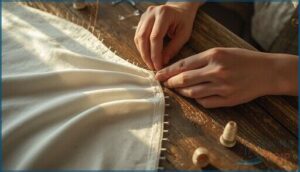
With your fabric stabilized, hand basting becomes your next line of defense. Space basting stitches are about 6 millimeters apart on straight seams—tighter on curves. Shorter Curved Seam Basting stitches give you control around armholes without stretching.
Combine this with Staystitch Placement just inside the seam allowance, Tailor Tacks Usage at key intersections, and Ease Stitching Prep on sleeve caps for consistently flat, pucker‑free results.
Techniques for Sewing Tricky Fabrics
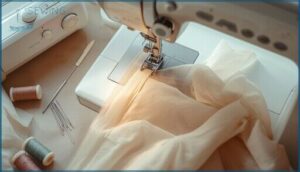
Taming tricky fabrics comes down to matching your tools to the material. For chiffon or crepe, Tissue Stabilization gives the feed dogs something to grip, preventing drag into the throat plate.
A Walking Foot keeps slippery layers moving in sync, while Differential Feed on a serger handles stretch fabrics and knit fabrics without rippling. Pair these with careful Needle Selection, thread tension adjustment, and Temporary Interfacing on stress points for consistently flat seams.
Maintenance and Professional Solutions
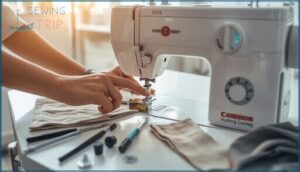
Even after you’ve dialed in your tension and technique, puckering can creep back if your machine isn’t running at its best.
Keeping your equipment maintained — and knowing when to hand it off to a pro — makes a real difference in long-term seam quality.
Here’s what to focus on.
Routine Sewing Machine Maintenance
Think of your machine as a precision instrument — consistent care is what separates reliable results from frustrating rework. A solid sewing machine maintenance routine covers the three most common mechanical contributors to puckering:
- Lint Removal Routine: Clear the bobbin case and feed dog weekly
- Lubrication Schedule: Apply one drop of oil to the hook race every 3–4 sewing hours
- Needle Replacement Timing: Swap needles every 8–10 hours to prevent burr tips that distort thread tension settings and presser foot pressure response
When to Seek Expert Repair
Some problems run deeper than routine sewing machine maintenance and repair can reach.
When persistent noise issues — grinding, crunching, or clicking from the bobbin area — accompany puckering that survives every tension adjustment, that’s your machine signaling internal wear.
Electrical fault signs and mechanical damage indicators demand professional sewing expertise.
| Symptom | Action Required |
|---|---|
| Timing misalignment symptoms | Professional recalibration |
| Electrical fault signs | Certified technician inspection |
| Bent hook or broken feed dogs | Component replacement |
| Warranty and service considerations | Contact authorized repair center |
Industry Standards for Seam Quality
Understanding where your seams stand against measurable benchmarks matters more than guesswork.
Industry standards for seam quality — including AATCC 88B grading for post‑laundry smoothness, ISO 7770 rating for visual appearance, ASTM D1683 strength testing, EN ISO 13935 rupture force, and TS EN ISO 13936 slippage resistance — give you an objective framework for seam defect analysis and solutions, turning quality control in sewing from guesswork into precision.
Industry seam standards turn quality control from guesswork into measurable, objective precision
Educational Resources for Tension Troubleshooting
Plenty of sharp resources exist to sharpen your understanding of tension adjustment procedures without wasting hours guessing.
Video Tutorials from channels like Professor Pincushion and Juki Junkies walk you through real fabric samples and 8‑step checklists.
Interactive Courses like Advanced Threads’ tension simulator make sewing machine troubleshooting hands‑on. Free PDF Guides, Community Forums, and Tension Charts round out your sewing education toolkit for resolving thread tension problems efficiently.
Frequently Asked Questions (FAQs)
Can puckering occur even with correct tension settings?
Yes — absolutely.
Even with perfect tension, fabric feed dynamics, needle size impact, stitch density effects, and thread material shrinkage can all independently trigger fabric puckering.
Tension is just one piece of a much bigger puzzle.
Does thread color affect seam puckering outcomes?
Thread color does affect seam puckering.
Dye friction and pigment thickness alter tension settings, so darker threads often need slight loosening to maintain fabric-thread matching and prevent visible bobbin dots or seam gathers.
How does humidity impact thread tension and puckering?
Humidity quietly hijacks your thread tension. Humidity‑Induced Swelling causes cotton threads to swell up to 15%, triggering Fabric‑Thread Dimensional Mismatch and fabric puckering.
Polyester Thread Stability makes it the smarter pick for variable conditions.
Are vintage machines more prone to seam puckering?
Vintage machines carry their age in silence.
Tension disc wear, feed dog wear, bobbin case burrs, and lack of differential feed combine to make seam puckering far more likely than on modern equipment.
Can puckered seams be fixed without removing stitches?
In many cases, puckered seams don’t require removing stitches.
Steam Relaxation, Fingernail Smoothing, Gentle Stretching, Stabilizer Tape, and a Fabric Mist Test can resolve thread tension and fabric distortion issues without compromising seam quality.
Conclusion
Puckering is simply machine’s way of asking for better alignment between its moving parts—and now you speak its language. When you troubleshoot puckering seams tension methodically, you’re not guessing anymore; you’re diagnosing with the same precision a textile engineer brings to a production floor.
Every balanced stitch you produce from here reflects that understanding. The fabric doesn’t lie, and neither does a perfectly flat seam—both reward the sewist who knows exactly what to adjust.
- https://sewguide.com/puckered-seam-and-fabric-solutions/
- https://www.thecreativecurator.com/seam-puckering-causes-and-remedies/
- https://www.threadsmagazine.com/2015/10/15/cures-for-puckered-stitches
- https://debsquiltstudio.blog/understanding-and-solving-fabric-puckering-issues-a-complete-troubleshooting-guide/
- https://www.tampabay.com/archive/1997/04/13/correct-needle-size-eliminates-puckering/