This site is supported by our readers. We may earn a commission, at no cost to you, if you purchase through links.
Most sewing problems trace back to one small dial. Skipped stitches, puckered seams, thread loops bunching on the underside — nine times out of ten, the upper tension dial is the culprit.
Sewers obsess over fabric choice and needle size, yet overlook the one control that ties everything together.
The tension dial governs how tightly the machine grips your upper thread, and even a half-step in the wrong direction changes everything.
Get it right, and your stitches lock cleanly through any fabric.
This upper tension dial settings guide breaks down exactly how to read, adjust, and troubleshoot that dial with precision.
Table Of Contents
Key Takeaways
- The upper tension dial — not fabric or needle choice — is the root cause of most stitch problems, so start your troubleshooting there every time.
- No single tension number works for all fabrics: start at 4–5 for medium-weight materials, drop to 2–3 for silk or chiffon, and push toward 5 for heavy denim.
- Always adjust in quarter-turn increments and test on scrap fabric first — small, deliberate moves beat dramatic swings every time.
- If tweaking the dial changes nothing, rethread completely and floss lint from the tension disks, because buildup and missed threading silently break any setting you try.
What The Upper Tension Dial Controls
The tension dial is one of the most powerful controls on your machine — and one of the most misunderstood.
Once you know where to find it, you can start balancing upper and lower thread tension to fix uneven stitches and skipped loops for good.
Get it right, and every stitch locks cleanly into place.
Here’s what it actually does and where to find it.
How The Tension Dial Affects Stitch Formation
When you turn the tension dial, you’re controlling how hard two metal discs grip your upper thread — that’s thread grip mechanics in action. Higher numbers increase disc friction dynamics, pulling the thread tighter as the needle descends. This directly shapes stitch loop formation and fabric pull balance.
Start at 4 or 5. Adjust from there.
A balanced stitch looks the same on both sides of the fabric, as explained in the guide on balanced stitch formation.
Differences Between Upper and Bobbin Tension
Upper thread tension and bobbin tension aren’t the same animal. Here’s the key difference:
- Upper Thread Tension — adjusted via the tension dial, changed often per project.
- Bobbin Tension — set by a tiny spring and screw; rarely touched.
- Tension Balance — both must pull equally so the stitch knot hides inside the fabric layers.
Start troubleshooting with the upper tension dial first. Understanding balanced stitch formation helps prevent uneven seams.
Identifying The Location of The Tension Dial
Now that you know upper and bobbin tension work as a team, find your tension dial fast.
On most machines, it sits right on the front panel — numbered 0 to 9, default around 4 or 5. Brother models place it near the top front. Bernina sets it close to the presser-foot area.
Look for a numbered dial with a highlighted mid-range band — that’s your visual identification cue.
Ideal Upper Tension Settings for Different Fabrics

No single tension number works for every fabric — that’s just not how sewing works.
dial needs to shift depending on what’s under your presser foot and what’s on your spool.
matching your tension to your materials.
Recommended Settings for Cotton, Linen, and Synthetics
Each fabric has a sweet spot. Nail it, and your stitches lock perfectly every time.
Matching needle size to fabric weight is where it all comes together — this guide to sewing machine needle and thread combinations makes finding that sweet spot much easier.
- Cotton tension range: Set your dial to 4–5. Pair with an 80/12 needle for clean results.
- Linen needle match: Tension 4–5 with a 90/14 universal keeps seams balanced.
- Synthetic thread pairing: Polyester fabrics sit comfortably at 4–4.5 — any higher risks breakage.
Dial calibration tips start with knowing your fabric type first.
Adjusting Tension for Heavy Vs. Lightweight Fabrics
Fabric weight impact changes everything about how you set that tension dial. Heavy denim or canvas? Start at 5 — that upper thread tension needs muscle to lock through thick layers.
Lightweight chiffon or silk? Drop to 2 or 3, or you’ll pucker the seam instantly.
Always run a tension test scrap first, checking both sides for balanced stitch quality before committing.
How Thread Type Influences Tension Needs
Thread type rewrites the rules entirely. Your Upper Thread Tension dial can’t behave the same for metallic as it does for cotton — the physics won’t allow it.
- Cotton weight balance — dial 3 to 4 for medium fabrics.
- Polyester strength effect — supports up to 5 without breaking.
- Metallic thread tension — drop to 1.0–2.0 or it’ll snap.
- Nylon slip control — set around 3; it slides more than cotton.
- Thread‑needle compatibility — wrong pairing kills any tension dial adjustment.
Step-by-Step Guide to Adjusting Upper Tension
Adjusting upper tension doesn’t have to be a guessing game.
A few deliberate steps make the difference between a frustrating afternoon and a perfectly balanced stitch.
Here’s exactly how to work through it.
Making Incremental Adjustments
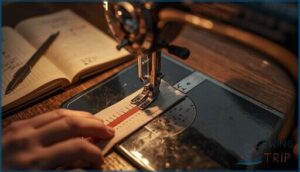
Small moves win here. Dial Turn Precision means turning the Tension Dial just a quarter turn at a time — no dramatic swings. Start around 4–5, your machine’s sweet spot for Upper Thread Tension. After each Thread Tension Adjustment, run 10–15 cm of stitches on a Fabric Sample Consistency strip. Use Color‑Coded Thread to read top and bottom clearly. Log every setting in an Adjustment Logbook.
| Symptom | Adjustment Direction | Test Stitch Length |
|---|---|---|
| Bobbin thread on top | Lower dial (loosen) | 10–15 cm |
| Needle thread on bottom | Raise dial (tighten) | 10–15 cm |
| Small underside loops | Increase ¼ turn | 10–15 cm |
| Seam puckering | Back off ¼ turn | 10–15 cm |
| Balanced stitch | Stop — hold position | 10–15 cm |
Tension Control isn’t about chasing ideal — it’s about disciplined, incremental steps. One change. One test. That’s it.
Tension control is not about perfection — it is about one deliberate change, one honest test
Recognizing Balanced Versus Unbalanced Stitches
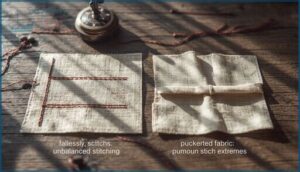
Your stitches tell the truth.
Run a Thread Visibility Test using contrasting thread colors — balanced Upper Thread Tension shows tiny dots on each side, nothing more.
Stitch Loop Indicators underneath mean loosen the Tension Dial. Puckering Detection on top means tighten it.
Check Zigzag Arm Flatness and do a Seam Flexibility Check.
Mastering Thread Tension Management means reading what’s already there.
Troubleshooting Common Upper Tension Issues

Even seasoned sewists hit a wall when their stitches start misbehaving.
The good news — most tension problems have a clear cause and a straightforward fix.
Here are the most common issues you’ll run into and exactly how to solve them.
Fixing Loose or Tight Stitches
Loose stitches pulling free? Tight ones puckering the fabric? Both problems trace back to one dial. Start your Sewing Machine Troubleshooting with a Thread Path Inspection — raise the presser foot first to open the tension discs, then rethread completely.
- Loose stitches: Raise Upper Thread Tension from 4 toward 5, testing every quarter-turn
- Tight stitches: Drop the Tension Dial half a number; check Bobbin Tension Sync after
- Needle Condition Check: A dull needle throws off Stitch Quality regardless of perfect Thread Tension Management
Addressing Thread Loops and Puckering
Loops on top? That’s your Upper Thread Tension sitting too loose — dial it up from 4 toward 5 in half‑step increments for solid Loop Diagnosis.
Puckering means the opposite: the Tension Dial is too tight, compressing lightweight fabrics badly. Drop to 3.5 for synthetics, 2.5 for silk.
Puckering Prevention also depends on Stitch Density Control and Fabric Feed Adjustment — slower speeds reduce distortion.
Keep Bobbin Tension balanced throughout.
When to Rethread or Clean Tension Disks
Beyond puckering fixes, watch for Thread Slip Signs — if adjusting the Tension Dial changes nothing, your upper thread likely slipped out of the Tension Disks entirely.
Rethread completely.
For Disk Debris Indicators, lint buildup creates inconsistent Thread Tension quickly.
Floss between disks using a business card edge — never compressed air.
Rethreading Frequency should match every thread or fabric change.
Top Sewing Patterns for Practicing Tension Settings
The best way to lock in your tension skills is to sew something real.
These three patterns give you varied fabrics, seams, and construction details — exactly the kind of challenges that expose tension problems fast.
Start with any one of them and put everything you’ve learned to work.
1. Style Arc Hendrix Coat Sewing Pattern
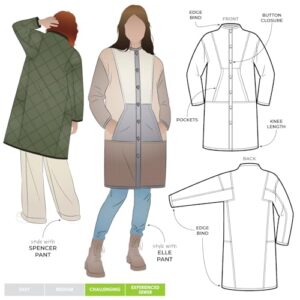
The Style Arc Hendrix Coat is a serious tension workout. It’s unlined and highly panelled, which means every seam shows — there’s nowhere for bad stitches to hide.
You’ll work through wool, linen, faux fur, or velvet, each demanding different tension settings.
The binding at the neck, hem, and sleeves requires especially clean, consistent stitching.
Optional topstitching along the panel lines puts your tension mastery on full display.
Sizes run 4–30, with 2.5–3m of fabric depending on your size.
| Best For | Intermediate to advanced sewers who want a stylish, structured coat they can make their own with fabric choices like wool, faux fur, or velvet. |
|---|---|
| Pattern Type | Coat Pattern |
| Material | Paper |
| Language | English |
| Size Range | Sizes 10-22 |
| Style Options | Optional top-stitching |
| Skill Level | Intermediate to Advanced |
| Additional Features |
|
- Sizes 10–22 are each printed in a different color, making it easy to cut the right pieces without second-guessing yourself.
- The design is genuinely versatile — swap the fabric and you’ve got a coat that works across seasons and occasions.
- Patch pockets, dropped shoulders, and optional topstitching give you room to add personal flair.
- It’s unlined and heavily panelled, so every seam is on show — not the pattern to learn tension control on.
- Faux fur and velvet are notoriously tricky fabrics, so your material choice can seriously raise the difficulty level.
- You’ll need to source buttons or snaps, fusing, and enough fabric (up to 3m for larger sizes), so costs and prep time add up.
2. Butterick Misses Collared Shirt and Shorts Pattern
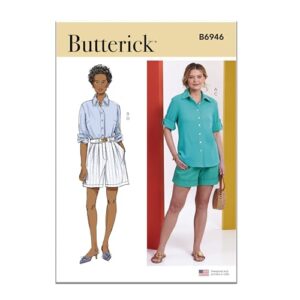
If the Hendrix Coat pushes your tension limits, the Butterick B6947 sharpens your control on lighter ground. This fitted shirt and shorts pattern — sized 4 through 12 — works through cotton shirting and lightweight twill, fabrics that expose tension imbalances quickly.
The collar stand, bust darts, and pleated cuffs all demand consistent upper tension. Too tight, and the placket puckers. Too loose, and button bands shift. It’s a clean, practical pattern for building real tension intuition.
| Best For | Home sewers with some experience who want to build sewing confidence while creating versatile, form-fitting shirts and shorts in sizes 4–12. |
|---|---|
| Pattern Type | Shirt & Shorts Pattern |
| Material | Paper |
| Language | English |
| Size Range | Sizes 4-12 |
| Style Options | Multiple sleeve views |
| Skill Level | Intermediate |
| Additional Features |
|
- Includes multiple style variations — rolled sleeves, button tabs, turn back cuffs — so you get several looks from one pattern
- Great for everyday wear or special occasions, making it a practical addition to any sewing toolkit
- Working through details like collar stands and bust darts builds real, transferable sewing skills
- Only covers misses’ sizes 4–12, so it won’t work for those outside that range
- Requires solid sewing knowledge — beginners may find the collar band and pleated cuffs a bit tricky
- Pattern instructions can be dense, so expect a learning curve if you’re still getting comfortable with sewing terminology
3. McCall’s Misses Tops Sewing Pattern
Now scale back and slow down.
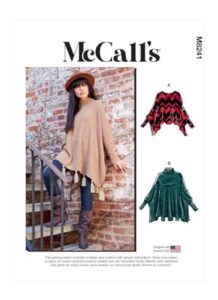
McCall’s M8241 is rated easy — and that’s exactly why it’s useful here.
Knit ponchos, turtlenecks, wide sleeve bands — these pull-on styles in cotton jersey demand a looser upper tension than woven shirts.
Bump it too tight, and the seams stretch, then snap.
Drop it too low, and the stitches sag.
This pattern gives you clean, repeatable seams to test against.
Use it to dial in your tension for knits before tackling anything harder.
| Best For | Beginners and hobbyists who want a simple, versatile knit top pattern to practice with or build a casual wardrobe. |
|---|---|
| Pattern Type | Poncho Top Pattern |
| Material | Paper |
| Language | English |
| Size Range | XS-XXL |
| Style Options | Cropped or shaped hem |
| Skill Level | Beginner |
| Additional Features |
|
- Easy rating makes it approachable if you’re still getting comfortable with your machine
- Lots of style variety — cropped, turtleneck, crewneck, tassel hem — from one pattern
- Great for dialing in tension settings before moving on to trickier knit projects
- It’s just the pattern — you’ll need fabric, tools, and some basic sewing know-how to actually make anything
- Knit fabrics can be finicky, so total beginners may hit a learning curve with stretch seams
- Envelope printing may vary, which can be a little confusing when you first open it up.
Frequently Asked Questions (FAQs)
What does an upper thread tension dial do?
Think of it as a gatekeeper. The upper tension dial controls how tightly two small metal discs squeeze your top thread, directly shaping how each stitch locks into the fabric.
What is the best tension setting?
There’s no single perfect number — it depends on your fabric and thread. For most medium-weight fabrics, start at 4 to 5. That’s your baseline. Adjust from there.
Is a higher number tighter tension?
Yes — on most machines, a higher number means tighter upper tension. The discs squeeze the thread harder, pulling it more firmly into each stitch. Lower numbers loosen that grip.
Can humidity affect my tension dial accuracy?
Humidity absolutely messes with dial accuracy. High moisture swells cotton thread and fabric, tightening your usual setting.
Dry air makes thread brittle and snappy. Always run a test strip when weather shifts noticeably.
How often should tension disks be professionally serviced?
If your sewing machine were a vintage car, you’d schedule a tune-up yearly.
For home use, tension disks need professional service every 12–18 months—or sooner if you notice persistent tension problems, odd noises, or visible wear.
Does needle size impact upper tension performance?
Needle size absolutely affects upper tension. A smaller eye increases thread friction, effectively tightening tension without touching the dial. Mismatched needle and thread size throws off stitch balance fast.
Can worn tension dials be repaired or replaced?
Both are possible.
If the dial slips or feels rough, cleaning the tension discs often fixes it.
A cracked or unresponsive dial usually needs full replacement — sold as a complete assembly.
Do vintage machines require different tension approaches?
Yes — vintage machines need more hands-on tension work. No automatic compensation means every fabric-thread switch requires a manual dial adjustment.
Older Singer 66 and 99 models use thumbscrews instead of numbered dials, so expect more trial and error.
Conclusion
Picture a seam lying flat and smooth, thread locked cleanly through every layer — that’s what a dialed-in tension looks like in practice. This upper tension dial settings guide gives you the control to make it happen consistently.
Adjust in small steps, test on scrap fabric first, and trust what your stitches tell you. When the tension is right, everything else falls into place. That dial isn’t a mystery anymore — it’s yours to command.
- https://www.magnetichoop.com/blogs/news/mastering-your-thread-tension-dial-the-ultimate-guide-to-perfect-stitches
- https://www.muellerundsohn.com/en/allgemein/the-correct-thread-tension/
- https://singerco.com.au/learn-create/how-to-fix-sewing-machine-tension-issues/
- https://mellysews.com/sewing-machine-tension/
- https://www.sewschool.co.uk/sewing-machine-thread-tension/