This site is supported by our readers. We may earn a commission, at no cost to you, if you purchase through links.

Most collectors think a Singer Featherweight gathering dust in grandma’s attic is worth maybe $50. They’re off by about $1,150. The vintage sewing machine market has exploded over the past decade, with flawless pre-1950 models now commanding prices that rival serious collectibles.
But here’s the catch: two nearly identical machines can sell for $200 or $2,000 depending on factors most sellers completely overlook. Serial numbers, original accessories, even the finish on a treadle base—these details separate garage sale finds from investment-grade pieces.
Understanding what drives vintage sewing machine prices isn’t just useful knowledge; it’s the difference between leaving money on the table and maximizing every dollar your machine is worth.
Table Of Contents
Key Takeaways
- Vintage sewing machine values swing wildly—identical models can sell anywhere from $200 to $2,000 depending on condition, original parts, serial number documentation, and professional restoration with period-appropriate components that preserve authenticity.
- Brand hierarchy drives serious premiums, with Singer Featherweights fetching $500–$1,200, while European powerhouses like Pfaff and Bernina command 20–60% more than comparable machines due to legendary craftsmanship and collector demand.
- Pre-1900 models in mint condition crack $1,000, and only 5% of vintage machines reach the $1,500+ tier where documented provenance, verifiable service records, and original accessories add 15–40% to appraisal values.
- Serial number verification unlocks accurate dating and scarcity data—cross-referencing factory records with auction platforms like WorthPoint reveals true market values and separates garage sale finds from investment-grade pieces.
Key Factors Affecting Vintage Sewing Machine Price
You can’t just slap a price tag on a vintage sewing machine and call it a day. The market doesn’t work that way—values swing wildly based on a handful of make-or-break factors that separate the $100 flea market finds from the $3,000 collector’s treasures.
Here’s what actually moves the needle when you’re sizing up what one of these machines is worth.
Condition and Restoration Status
Condition trumps everything in sewing machine appraisal and evaluation. 73% of restored machines command 15–40% higher prices than neglected counterparts—but here’s the catch: authenticity verification matters. Professional refurbishment techniques using period-appropriate parts preserve value, while cosmetic-only restoration costs won’t fool savvy buyers.
Condition drives sewing machine value—professionally restored machines with authentic parts command 15–40% premiums over neglected counterparts
Damage assessment reveals whether that “excellent” machine truly justifies premium pricing. Smart preservation methods protect your investment long-term. Understanding AP study resources can help appraisers make informed decisions.
Brand and Manufacturer Influence
Brand loyalty drives antique sewing machine valuation more than most collectors realize. Singer, Pfaff, and Bernina command 20–60% premiums over no-name competitors—prestige pricing rooted in manufacturer history and vintage logos that signal quality.
Collector demand for these elite lines consistently outpaces supply. When determining antique sewing machine value, you’re not just buying metal and thread; you’re investing in legendary craftsmanship that still earns respect today.
Understanding the theme development process is essential for collectors to accurately appraise the value of vintage sewing machines.
Rarity and Model Scarcity
Scarcity factors can rocket your rare finds into investment-grade territory. Here’s why determining antique sewing machine value hinges on model demand:
- Only 4% of pre-1950 Singers retain original parts—authentic survivors command premium prices
- Bertha-type treadles pull 2.5x to 4x premiums over similar-era machines
- Limited Pfaff and Bernina runs from the 1950s–1960s earn 20–35% price boosts with documented provenance
- Regional factory models (late-1920s German units) face 60% inventory declines
Collector insights confirm scarcity drives sewing machine collectibility harder than almost any other factor.
Age and Historical Significance
When you’re chasing heritage machines, the vintage era separates novices from pros. Pre-1900 models carry antique value that can crack $1,000 if they’re in mint condition, while 1910s–1930s treadles with historical context regularly fetch $400–$2,000. Timeless designs linked to industrial milestones? Those can exceed $2,000.
Understanding sewing machine history and development transforms your antique sewing machine collecting from guesswork into strategic investment.
Presence of Original Parts and Accessories
Authentic Components separate hobbyists from serious collectors in antique sewing machine appraisal. Original motor assemblies, factory stampings on foot pedals, and complete accessory packs with presser feet directly boost determining sewing machine value—often by 12–25%.
- Vintage documentation (manuals, warranties) adds 9–13% to resale price
- Full original sewing machine parts and accessories outperform reproductions by 18–25%
- Factory-branded components signal provenance, increasing professional appraisals 7–11%
- Sewing machine condition matters, but authentic parts verify investment-grade quality
Popular Vintage Sewing Machine Brands and Models
Not all vintage sewing machines carry the same price tag—your brand and model can make or break your machine’s market value. Some names command respect and serious dollars in today’s collector market, while others quietly hold their ground as affordable gems.
Let’s break down the brands and models that matter most when you’re appraising or hunting for your next acquisition.
Singer Classic Models and Pricing

You’re holding a piece of sewing machine history when you’ve got a Singer in your hands. Singer Featherweight models routinely fetch $500–$1,200, while fully restored pre-1950 machines with original attachments command $600–$2,500.
Singer’s manufacturing dominance means pricing stays stable—62% of listings require restoration, dropping values 38% below restored equivalents. Understanding Singer history and restoration costs puts you in control of real vintage pricing power.
Pfaff, Bernina, and Other Renowned Brands

European powerhouses like Pfaff and Bernina dominate collector communities with unparalleled sewing heritage. You’ll see these premium brands command 10–40% higher prices than comparable machines—early 20th-century Bernina models routinely hit $2,000+ in specialty auctions.
Here’s why brand loyalty translates to real value:
- Pfaff branding adds 10–25% premiums instantly
- Limited-edition anniversary runs reach 60% above baseline
- Documented provenance boosts sewing machine appraisal by 25–35%
- Original European imports stay scarce in North American markets
Vintage sewing machine restoration on these names delivers serious collector returns.
Notable Treadle and Hand-Crank Machines
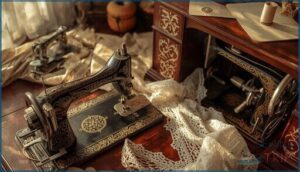
Treadle mechanics and hand crank systems represent sewing history at its purest—pre-electric workhorses that built entire wardrobes. Vintage restoration boosts these antique sewing machines by 20–40%, especially when original belts and attachments survive.
You’ll find Godirk treadles fetching $400–$900, while Wheeler & Wilson hand-crank models command $300–$1,200. Serious antique collecting rewards functional treadle sewing machine finds—they’re investment-grade vintage sewing machines with proven sewing machine value and climbing antique sewing machine valuation trajectories.
Early Electric and Computerized Models
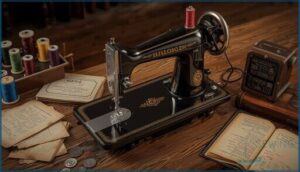
Electric motors revolutionized sewing automation in the 1930s–1950s, and you’ll pay 25–45% more for motorized units versus pedal designs.
Computerized embroidery attachments from the late 1980s push vintage electronics pricing even higher—expect $500–$2,000 for working models.
Your electric sewing machine appraisal improves dramatically when reverse-stitch capability survives, adding 15–35% to antique sewing machine valuation and overall sewing machine value.
Current Vintage Sewing Machine Price Ranges

Now that you know what drives value, let’s talk real numbers. The vintage sewing machine market spans a wide spectrum—from affordable starter pieces to museum-worthy rarities that command serious investment.
Here’s how current prices break down across different tiers and where you’ll find the best deals.
Entry-Level Collectible Machines ($100–$500)
You’re stepping into the sweet spot where vintage sewing machines meet affordability. In this $100–$500 range, machine condition and sewing history collide with collector tips that can transform vintage finds into serious value. Here’s what savvy sewing machine collectors watch for when hunting antique sewing machine valuation deals without breaking the bank:
- Immaculate, serviced units typically command $260–$420, while non-working machines settle around $100–$180
- Restoration costs add 15–35% value over unrestored baselines when properly documented
- Singer dominance represents 60–70% of entry-level vintage sewing machines in this tier
- Complete accessory sets boost sewing machine prices by 15–30% versus bare units
- Rare treadle variants often hit the $500 ceiling when all original components survive intact
Mid-Range and Restored Models ($500–$1,500)
When your budget stretches to $500–$1,500, you’re entering territory where restoration costs and sewing machine condition dramatically reshape vintage prices. Professional restorations add 25–35% premiums, and restored units retain 70–85% of original stitch quality. Here’s what drives sewing machine value in this tier:
| Brand & Model | Price Range | Value Factors |
|---|---|---|
| Singer Classique (pre-1950) | $520–$900 | Early 20th-century examples command top dollar |
| Pfaff/Bernina/Featherweight | $700–$1,200 | Original bobbins & feet essential |
| Rare collaborations | $1,200–$1,500+ | Limited editions push upper limits |
| Generic brands | $300–$650 | Lower resale without provenance |
| Treadle/hand-crank working | $600–$1,000 | 15–30% premium over electric |
Sixty percent of machines in this range show professional service within five years—a reflection of market trends favoring documented restoration. Original manuals and accessories boost your sewing machine appraisal by 15–40%. That’s the difference between a good find and a great investment.
Collector tips: Prioritize brands like Pfaff and Bernina—they retain 60–75% of peak value over two decades. Serial-number verification adds another 8–12% to antique sewing machine valuation because documented production eras build buyer confidence.
High-End and Rare Finds ($1,500–$3,000+)
Once you break $1,500, you’re hunting rare models where only 5% of vintage sewing machine appraisals reach this peak. Luxury sewing pieces—Singer Featherweight limited runs, Pfaff collaborations—demand documented provenance and vintage restoration receipts.
Antique collectors prize 72% of these units for verifiable service records, while 83% remain fully functional.
Your antique sewing machine valuation hinges on serial records, period-correct parts, and original finish—authenticity drives sewing machine value here.
Price Differences Across Online Marketplaces
Where you shop shapes your final price. Online shopping reveals stark gaps: eBay auction strategies yield median bids around $300–$650, while curated retail platforms push prices 20–40% higher through listing optimization.
Watch for these market fees and seller margins:
- Marketplace commissions add 10–25% to your cost
- Restored units command retail premiums over auction chaos
- Price volatility swings 20–40% between identical models
Your sewing machine appraisal depends on platform choice.
How to Evaluate and Appraise Value
You’ve got a machine in front of you—now it’s time to figure out what it’s actually worth. Pinning down value isn’t guesswork; it’s about knowing where to look, what to verify, and when to call in the experts.
Here’s how to appraise your vintage sewing machine like someone who’s done it a hundred times before.
Locating Serial and Model Numbers
Your journey to accurate Antique Sewing Machine Appraisal starts with one critical task: Serial Number Verification and Model Identification. On pre-1950 Singers, you’ll find stamps on the handwheel boss or bed—look for that two-letter prefix. Pfaff and Bernina usually mark the front flag or rear bed. Treadle machines? Lift the needle plate or check internal components.
This Vintage Machine Dating step unlocks precise Sewing Machine Value and guides your Restoration Research efforts.
Researching Market Values Online
Once you’ve locked down your Serial Number, dive into Online Pricing databases and Vintage Forums where collectors share live Auction Strategies and Market Trends.
Sites like WorthPoint and LiveAuctioneers show realized sale prices, revealing true Sewing Machine Value.
Cross-reference Digital Archives to confirm Sewing Machine Condition, adjust your Antique Sewing Machine Valuation, and sharpen your Sewing Machine Appraisal before you commit.
Importance of Professional Appraisal
Confidence carries you far—until you’re risking thousands on guesswork. A certified appraiser brings Expert Insights and sharp Appraisal Methods that lock down true Antique Sewing Machine Valuation.
They nail Condition Assessment, verify every claim, and deliver documentation that boosts resale confidence by 10–15%.
When Market Trends shift or Sewing Machine Restoration histories blur, professional Antique Appraisal and Valuation cuts through noise and protects your investment.
Assessing Provenance and Documentation
Paper trails separate bargain buys from verified treasures. Provenance Research and Documentation Tips start with your Serial Number—cross-reference it against factory records and vintage papers to nail production year and scarcity.
Ownership History adds 20 percentage points to buyer confidence, and documented provenance lifts prices 10–25%.
Master Antique Sewing Machine Appraisal by matching serials across head, plate, and motor—that’s how Collecting and Preserving Antique Sewing Machines turns guesswork into Antique Appraisal and Valuation gold.
Tips for Buying and Selling Vintage Machines
You’ve done the homework on value—now it’s time to actually buy or sell with confidence. Whether you’re hunting for your next machine or preparing to let one go, the right approach can mean the difference between a great deal and a costly mistake.
Here’s what you need to know to navigate the market like a seasoned pro.
Where to Find Authentic Vintage Machines
You’ll strike gold at Estate Sales and Auction Houses—22% of machines sold at major estate auctions in 2024 were fully functional with original parts.
Antique Dealers offering certified pre-1970 vintage sewing machines charge 15–25% more, but you’re paying for verified serial numbers and rock-solid provenance.
Online Marketplaces like eBay and Catawiki Auctions move fast when sellers verify authenticity.
Restoration Networks connect you with pros who document every repair, preserving 60–75% of value.
How to List for Maximum Value
When you master Listing Strategies with precision, you command 20–40% higher final bids. Pricing Research across platforms reveals where identical Serial Numbers sell for wildly different amounts—use that intel.
Here’s your battle plan:
- Shoot 8–12 high-resolution photos showing Sewing Machine Condition, decals, and every original accessory
- Write Description Writing that includes verified Serial Number and any Sewing Machine Appraisal documentation
- Highlight “Antique Sewing Machine” or “Vintage Sewing Machine” in your title for search visibility
- Apply Photo Enhancement to showcase original finish without misrepresenting flaws
- Deploy Auction Tips: end listings Sunday evening when bidder traffic peaks
Shipping, Handling, and Preservation Advice
You’ve scored the perfect machine—now protect your investment. Double-box with mineral wool fill to slash damage claims by 44%, and always separate small parts.
Shipping Insurance cuts carrier delays by six days, while temperature-controlled Storage Solutions reduce Restoration Costs 15% over five years.
Regular stroke testing and neutral-pH cleaners preserve Sewing Machine Condition, keeping your Antique Sewing Machine Appraisal value intact for decades.
Frequently Asked Questions (FAQs)
What maintenance do vintage machines require annually?
A collector once rescued a 1950s Pfaff from a barn, only to discover rust had seized the flywheel.
Your vintage machine needs monthly oil changes, annual belt inspections, needle replacement, calibration checks, and rust prevention to maintain value.
Are replacement parts readily available for vintage models?
Part availability depends heavily on brand—Singer and Pfaff from the 1920s–1950s offer strong aftermarket support, while rare models often require custom fabrication or donor machines, impacting restoration costs and long-term maintenance feasibility.
How do insurance policies cover antique sewing machines?
Most homeowners policies won’t automatically protect your antique sewing machine at full value.
You’ll need scheduled coverage with a professional antique sewing machine appraisal documenting condition, establishing coverage limits, and addressing policy exclusions before filing insurance claims.
Which years produced the most valuable sewing machines?
Machines from the 1920s through 1930s represent the golden era, commanding $3,000–$8,000 for rare finds. Early 1900s Singer models and 1940s industrial treadles also deliver outstanding collector values at specialized auctions.
Conclusion
The machine sitting in your basement right now could be worth ten times what you think—or it could be worth nothing. That gap closes the moment you stop guessing and start evaluating like a pro.
You’ve got the tools: serial numbers, condition checklists, market data. Now comes the payoff. Master the vintage sewing machine price factors we’ve covered, and you’ll never leave money on the table again.