This site is supported by our readers. We may earn a commission, at no cost to you, if you purchase through links.
A dull rotary blade drags across fabric instead of slicing through it—and that single problem ruins more cuts than most sewers realize. The culprit isn’t always the blade itself. It’s often the surface underneath. Hard tables and generic cutting boards accelerate blade wear, let fabric shift, and leave no margin for error when you’re cutting silk or a perfectly aligned quilt strip.
A self-healing mat for fabric solves several of these problems at once. Its polymer surface absorbs blade impact, rebounds after each pass, and grips fabric just enough to keep it still. The difference shows immediately in cut quality, blade longevity, and how confidently you can work through a long project.
Table Of Contents
- Key Takeaways
- Why Self-Healing Mats Help Fabric
- How Self-Healing Mats Work
- Better Accuracy for Fabric Cutting
- Protecting Blades and Work Surfaces
- Grids That Improve Fabric Measuring
- Fabric Stability During Cutting
- Choosing The Right Mat Size
- Caring for Your Cutting Mat
- How Long Cutting Mats Last
- Top 5 Self-Healing Mats
- Frequently Asked Questions (FAQs)
- Conclusion
Key Takeaways
- A self-healing mat’s polymer surface closes after every blade pass, which keeps your cuts consistent and extends the life of your rotary blades significantly.
- The mat’s built-in grid—with inch, metric, and angle markings—acts as a measuring tool, so you spend less time reaching for a ruler and more time cutting accurately.
- Fabric stays flat and still on a self-healing surface, which matters most when you’re working with slippery materials like silk or stacking multiple layers for quilting.
- Storing your mat flat, away from heat and sunlight, and rotating it regularly are the habits that separate a mat that lasts years from one that warps and grooves within months.
Why Self-Healing Mats Help Fabric
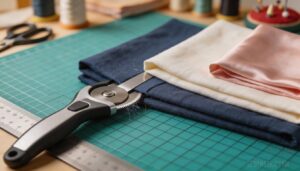
Cutting fabric cleanly isn’t just about having a sharp blade — the surface underneath matters just as much. A self-healing mat gives you a stable, consistent base that works with your tools instead of against them.
Knowing which cutting mat surface works best for precision sewing can make the difference between clean edges and frayed frustration.
Here’s why it makes a real difference for fabric work.
Smoother Cuts With Less Drag
selfhealing cutting mat reduces friction along the entire cutting surface — blade glide improves by up to 25 percent compared to hard tables. The mat’s material elasticity and mat flexibility let the blade sink slightly, which facilitates heat dissipation and blade preservation during long sessions.
Uniform resistance across the surface keeps your rotary cutter moving straight without fighting the surface texture.
Fewer Fabric Snags and Distortions
That smoother blade glide also means less fabric disruption. A snag-free surface keeps delicate fibers from catching mid‑cut — a real problem on silk blends or fine knits. Micro‑particle healing closes the surface after each pass, so raised edges don’t form. Tension uniformity and fiber glide reduction work together to prevent distortion across the cut path.
- Edge seamlessness keeps fabric edges clean and unfrayed
- Uniform resistance prevents fabric shifting during long straight cuts
- Consistent surface density lowers snag risk on slippery or delicate materials
Better Results for Sewing and Quilting
Clean cuts make everything downstream easier. When the surface holds consistent tension beneath your fabric, you get precise seam alignment without stretching or pulling the grain.
That’s why quilters often notice improved piecing accuracy almost immediately — reduced fabric stretch keeps pattern pieces true.
Self-healing sewing mats maintain cutting accuracy pass after pass, and blade dulling prevention means your rotary blade stays reliable across an entire project.
Less Waste From Cutting Mistakes
Precise cuts don’t just improve quality — they protect your material. When a mis-cut happens, the mat’s resilient surface lets you re-seat the blade cleanly for error recovery strategies without tearing fibers further.
That mistake-proof layout approach keeps usable fabric intact.
Over time, cutting accuracy and blade dulling prevention work together, supporting fabric utilization mapping and sustainable crafting practices that stretch every yard further.
How Self-Healing Mats Work
A self-healing mat isn’t magic — it’s smart engineering. Understanding what’s actually happening beneath your blade helps you get more out of every cut.
Here’s what makes these mats work the way they do.
Surface Closes After Blade Passes
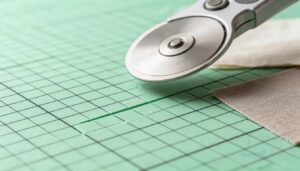
Think of it as a surface with material memory — the moment your blade lifts, polymer rebound kicks in and microseal formation begins, closing the cut line within milliseconds. This edge stabilization traps loose fibers through fiber trapping, reducing fraying on your next pass.
Selfhealing technology relies on polymer chain elasticity to restore the surface cleanly, so each cut feels consistent and controlled.
Multi-layer Construction and Blade Resistance
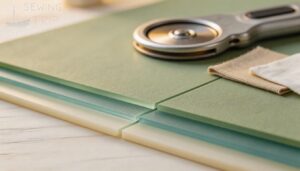
Self-healing cutting mats rely on MultiPly Layered Construction to manage every blade pass. Each layer performs a specific job — the top coating absorbs impact, the cushioning layer slows penetration, and the base ply distributes force evenly.
Layered Blade Shielding gives you real Blade Penetration Tolerance, protecting your table and extending blade life.
Acoustic Tactile Feedback — that subtle, controlled resistance that tells you your cut is tracking true.
Why Grooves Stay Shallower Over Time
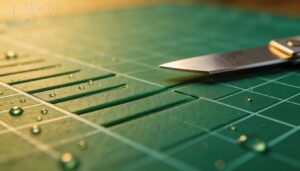
Here’s something most crafters don’t expect: grooves actually get shallower with regular use.
Polymer Swell from ambient humidity fills shallow cuts daily, while Micro-Glaze Formation — a polished film from repeated blade passes — resists deeper gouging.
Temperature Contraction works microscopic magic, nudging edges back together.
Add Humidity Healing and Blade Pressure Distribution across layered construction, and your mat’s material memory keeps recovery rates surprisingly high.
How They Differ From Regular Mats
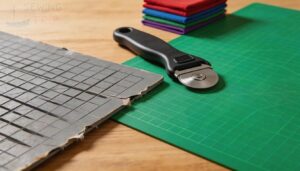
A regular mat can’t undo what a blade has done — but a self-healing mat can. The Healing Polymer inside literally closes behind the cut.
Here’s what sets them apart:
- Layer Interlock Design distributes blade impact across multiple plies
- Non-Slip Backing keeps fabric stable through every pass
- Heat Dissipation prevents surface softening during long sessions
- Eco-Friendly Materials reduce environmental impact without sacrificing cutting mat durability
- Blade edge retention stays higher because the surface absorbs, not resists
Better Accuracy for Fabric Cutting
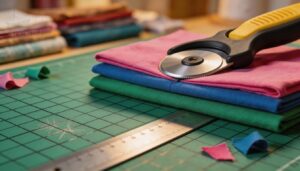
Accuracy isn’t just about having a steady hand — your cutting surface plays a bigger role than most people realize. A self-healing mat gives you consistent resistance every single time, which makes a real difference whether you’re trimming silk or stacking quilt squares.
A self-healing mat delivers the consistent resistance your cutting surface needs, from silk to quilt squares
Here’s how that shows up in practice.
Uniform Resistance for Straighter Cuts
Every cut depends on the surface beneath it. A self-healing mat’s Uniform Resistance Edge distributes pressure evenly across the surface — that’s Linear Force Distribution working quietly in your favor.
Without it, your blade deflects into soft patches, throwing off your line.
Vibration Damping keeps the blade steady, supporting Straight Line Guidance from start to finish. Uniform resistance is what makes precision cuts actually repeatable.
Fewer Errors on Long Cutting Lines
Long cuts are where small errors compound fast — that’s a cumulative error turning a straight line into a crooked one.
A self-healing mat’s uniform resistance for cutting precision keeps your blade on a low friction path from start to finish:
- Consistent Tension prevents mid-stroke drift
- Minimized Blade Drift locks your line true
- Steady Cutting Speed reduces veering
Grids and visual guides support accurate measurement retention throughout every pass.
Cleaner Edges on Delicate Fabrics
Delicate fabrics demand a different standard. Chiffon Glide and Silk Crispness aren’t just nice to have — they depend on your mat’s surface doing its job quietly underneath the blade.
Self-healing mats support precision cutting by absorbing Micro-splinter Capture before fragments reach your fabric, while Edge Fray Prevention and Fiber Pull Reduction keep threads intact after each pass.
| Fabric Type | Cutting Benefit |
|---|---|
| Silk | Fewer pulled threads per cut |
| Chiffon | Reduced drag and cleaner edges |
| Lace | Intact edges with minimal fraying |
| Organza | Controlled blade contact |
| Fine knit | Stretch retained without distortion |
Improved Ruler and Rotary Cutter Control
A flat, even surface does more than protect fabric — it changes how your tools behave.
With Steady Ruler Grip, your ruler stays planted during long cuts instead of creeping sideways. Reduced Cutter Vibration means your rotary cutter follows a Smooth Glide Path without skipping. Consistent Blade Pressure transfers evenly across the mat’s grid patterns, giving you Precise Cut Alignment from the first inch to the last.
Protecting Blades and Work Surfaces
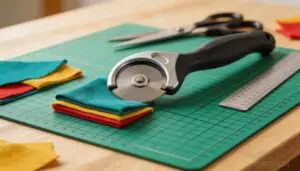
good cutting mat does more than protect your table — it quietly extends the life of every blade you own. The surface works in your favor each time you cut, absorbing impact instead of fighting back against it.
Here’s exactly how that protection plays out in practice.
Why Rotary Blades Stay Sharper Longer
When your rotary cutter glides across a self-healing mat, something important happens beneath the blade.
The cutting surface material absorbs impact instead of fighting it, which slows how fast a blade dulls.
High carbon steel and titanium nitride coating blades especially benefit here.
Three habits that support blade edge longevity:
- Maintain controlled cutting speed
- Check blade alignment precision regularly
- Allow heat dissipation between long cuts
Reduced Impact Compared With Hard Tables
Cutting on a hard table sends every blade strike straight into the wood — no buffer, no mercy. A self-healing mat changes that equation entirely.
| Impact Factor | Hard Table | Self-Healing Mat |
|---|---|---|
| Vibration Damping | None | Multi-layer absorption |
| Noise Reduction | Loud, sharp strikes | Quieter, cushioned cuts |
| Heat Transfer Mitigation | Direct surface contact | Distributed across layers |
Your furniture stays protected. Your blade stays sharper.
Preventing Scratches on Desks and Counters
Your desk deserves the same care as your fabric. A mat with non-slip backing stays anchored, so sudden shifts don’t drag grit across your finish.
Material compatibility matters too — PVC and polyester mats leave minimal residue on laminate or wood.
Edge protection prevents tool collisions near desk rims. Follow basic cleaning protocols to keep underside debris from turning your cutting mat into unintentional sandpaper.
Safer Cutting for Repeated Fabric Projects
When you cut fabric day after day, small risks add up fast. Self-healing mats give you real kickback control by absorbing blade impact before it travels back to your hand — that’s finger safety you can actually feel.
- Noise reduction from cushioned cuts keeps your workspace calm
- Dust management improves since debris doesn’t embed in hard grooves
- Ergonomic grip stays steady on the non-slip surface
- Blade Sharpness Preservation with Self-Healing Mats means fewer blade swaps
- Tool longevity and cutting accuracy both improve with consistent mat use
Grids That Improve Fabric Measuring
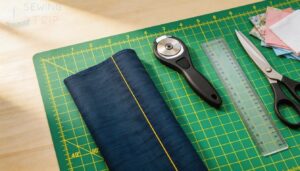
The printed grid on your cutting mat does more than fill space — it’s a built-in measuring tool that saves you from reaching for a ruler every few minutes. Most mats include both inch and metric markings, angle guides, and alignment lines designed to make your layout work faster and more accurately.
Here’s how each of those grid features actually helps when you’re cutting fabric.
Inch and Metric Markings for Layout
Your mat’s grid is more than decoration — it’s a built-in layout tool.
Dual Unit Grids display both inch and metric measurement scales side by side, so you don’t have to stop to convert numbers.
Color-Coded Scales separate imperial from metric at a glance.
Fine Subdivision Lines break each inch into sixteenths, giving you precise control on every pass.
| Feature | Benefit |
|---|---|
| Inch subdivisions to 1/16 | Fine layout precision |
| 5 mm metric highlights | Quick multi-fabric gauging |
| Color-coded measurement markings | Faster scale identification |
| Edge Ruler Integration | Instant 1-inch and 25 mm checks |
| Durable Ink Resistance | Grid lines survive 5,000+ blade passes |
The cut guide grid and grid patterns stay legible even under bright sewing lights, and the grid lines won’t fade from lint or routine cleaning.
Angle Guides for Bias Cuts
Bias cuts demand precision — and that’s exactly where angle guides earn their place. These printed lines on self-healing cutting mats are calibrated for Bias Angle Calibration at standard degrees like 45°, giving you a fixed reference for every pass.
High Visual Contrast markings improve cutting accuracy on woven and knit fabrics alike, while Guide Durability ensures the lines resist blade wear. Your fingers stay clear, too.
Faster Squaring for Quilting Pieces
Squaring quilting pieces gets faster when your selfhealing mat does part of the work. The grid patterns and measurement markings double as Precision Square Guides, letting you run a Batch Squaring Process without remeasuring every corner.
Corner Verification becomes a quick glance instead of a separate step.
Quilters find that Rapid Square Alignment cuts layout time noticeably — a real Time-saving Layout advantage during precision cutting sessions.
Easier Alignment Before Every Cut
Good alignment starts before the blade moves. Corner Anchors and Baseline Lines, built into the grid, let you position fabric instantly — no guessing, no remeasuring.
Magnetic Guides and Alignment Stickers let you mark project-specific placements without leaving residue.
With measurement markings, precise rulers, and grid patterns confirming grainline and template alignment, grid angles and visual guides handle the setup so your Pre-cut Marking stays accurate every time.
Fabric Stability During Cutting
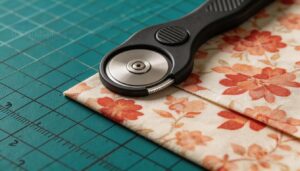
Fabric that shifts mid-cut is one of the fastest ways to ruin a clean line.
A self-healing mat gives your material a stable, grippy base that works with you instead of against you. Here’s how it keeps your fabric exactly where you need it.
Keeping Fabric Flat While Trimming
Flat fabric doesn’t happen by accident — it starts with the surface beneath it. A resilient top layer combined with a stable bottom layer works together through Mat Weight Distribution to hold fabric flush against the cutting surface. Tension Management stays consistent because Surface Friction and Edge Grip prevent drift during long cuts.
- Grid patterns align with fabric grainlines for precise trimming
- Fabric grip and stability keeps layers from shifting mid-cut
- Even Surface Friction distributes blade pressure across the full cut
- Temperature Stability prevents mat warping that lifts fabric edges
- Cutting ergonomics improve when fabric stays flat without repositioning
Better Control for Slippery Materials
Slippery fabrics like satin and silk shift the moment a blade touches them — unless your mat’s Enhanced Grip Textures and Micro-Patterned Surface hold them in place. These features create Responsive Tension Control across the work area, so fabric grip stays consistent.
Anti-Slip Edge Design and Adjustable Friction Zones let your resilient top layer and stable bottom layer work together, keeping even the trickiest synthetics steady.
Reducing Shifting During Multi-layer Cuts
Multi-layer cuts demand more from your mat than single-fabric passes do.
Layer Compression Uniformity keeps every ply pressed evenly, so the stack doesn’t creep as your blade moves through.
Pressure Distribution Control and Friction Balance Optimization work together — the mat grips without crushing — while Blade Dwell Minimization keeps layers from shifting mid-cut.
On self-healing cutting mats, Material Compatibility Matching accommodates wovens and knits equally well.
Helping Maintain Grainline Accuracy
Once your layers are settled, grainline accuracy becomes the next priority. Self-healing mats support this through Edge Guide Precision and Micro Grid Alignment — the grid lines stay readable after cut, and printed Grainline Arrow Contrast gives you a clear visual anchor.
Ruler Snap Consistency and Fabric Tension Control keep your ruler true, so measurement accuracy holds without second-guessing every placement.
Choosing The Right Mat Size
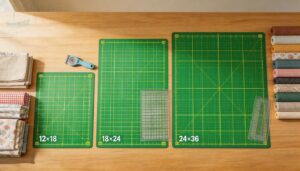
Mat size isn’t one-size-fits-all — the right choice depends on what you’re making and how much space you’re working with. A too-small mat slows you down; a too-large one eats up your whole table.
Here’s what to look for when matching a mat to your projects.
Matching Mat Size to Project Type
The right mat size isn’t just about workspace — it’s about project accuracy from the first cut. A 12×18-inch mat accommodates patchwork block fitting efficiently, while a 36×48-inch mat enables quilt top length and upholstery bulk size without repositioning.
Curtain panel width fits cleanly on an 18×24-inch mat. Size considerations shape every decision in size and workspace planning for sewing mats.
Best Sizes for Garment Sewing
Garment sewing demands more mat real estate than most crafters expect. Fabric roll length and garment width ranges — usually 44 to 60 inches — mean you’ll want at least an 18×24-inch fabric cutting mat.
For full pattern layout scaling with size grading impact across multiple sizes, a 24×36-inch mat manages seam allowance standards and keeps repositioning minimal.
Best Sizes for Quilting and Crafts
Quilting layout dimensions shift the size conversation considerably. For most quilt squares and standard block work, an 18×24-inch mat accommodates your cutting mat size and thickness needs without crowding your table.
Craft mat sizing drops to 12×12 inches for portable mat options like card making or small applique.
The crafting applications of self-healing mats prove that size is important — match it to your project, not your shelf.
Thickness, Portability, and Workspace Fit
Thickness is where portability and performance split paths. A 3mm mat travels easily — lightweight storage wins — but a 5mm delivers better cutting mat thickness stability for long straight runs.
Most portable mats weigh between 2 and 6 pounds, making compact storage design practical for small studios.
Match your thickness flexibility balance to how often you move your mat versus how hard you cut.
Caring for Your Cutting Mat
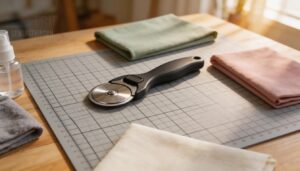
good cutting mat can last years — but only if you treat it right. The way you clean, store, and use your mat makes a bigger difference than most people expect.
Here’s what you need to know to keep yours in top shape.
Cleaning Lint and Fabric Residue
Fabric fibers and lint settle into your mat after every session — and ignoring them shortens its life faster than dull blades do. Build these cleaning techniques into your routine:
- Use a microfiber lint removal cloth, slightly damp, to lift loosened fibers without leaving adhesive residue.
- Run a static charge brush (carbon brush cleaning method) across the surface to pull debris from grooves.
- Spot-clean sticky buildup with a mild soap solution — this is standard care and maintenance of self-healing mats.
- A vacuum upholstery nozzle captures embedded lint in deeper cuts without surface damage.
Consistent adhesive residue management keeps your grid lines readable and helps smart fabric waste management over time.
Storing Mats Flat Away From Heat
Heat is the most common cause of damage to cutting mats — and it’s completely avoidable. Store it flat on a wide flat shelf with full support across its length.
Cool room storage between 60 and 75°F keeps the layers stable.
Avoid rolling or bending, and use heat resistant covers when moving it.
Good air circulation and basic humidity control go a long way.
Why Sunlight Can Cause Warping
Direct sunlight does more damage than most crafters expect. UV degradation breaks down the mat’s polymer layers, while thermal expansion causes thermal expansion at uneven rates — edges warm faster than the center, creating internal stress that bows the surface.
Moisture imbalance follows, pulling layers out of alignment. Color fading stress signals deeper material breakdown.
Keep your mat away from windows.
Rotating and Flipping for Even Wear
Just as sunlight degrades from the outside in, uneven cutting wears your mat from one spot out. Rotating your mat 45 to 90 degrees between projects — your rotation angles — spreads blade wear across the surface.
Flip it every few weeks, too.
This flip frequency and orientation schedule keep balanced impact consistent, protecting your rotary cutter and extending the mat’s life noticeably.
How Long Cutting Mats Last
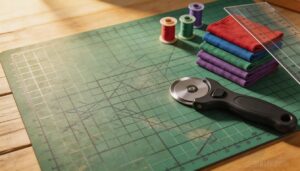
Even a well-loved mat has a limit, and knowing when yours is reaching it can save you from cutting mistakes you’ll trace back to the surface, not your technique. A few clear signals tell you it’s time to act—whether that means changing your habits or swapping in something new.
what to watch for.
Signs Your Mat is Wearing Out
Your mat quietly signals when it’s time to retire it. Watch for these warning signs:
- Deepening grooves that no longer close after blade passes
- Surface tackiness where fibers have compressed and bonded
- Edge feathering and corner rounding from repeated flexing
- Reduced rebound — cuts feel sluggish, and fiber debris nests in worn channels
Trust what you feel and see.
What Causes Permanent Grooves
Those warning signs point to a common set of causes. Blade dullness tops the list — a dull blade drags instead of slices, etching wider grooves with each pass.
Repeated directional cuts in the same path compound the damage. Add debris abrasion, temperature fluctuations, and surface hardness mismatches, and grooves stop closing.
Deep gouges eventually become permanent channels, your mat can’t recover from.
When to Replace a Fabric Cutting Mat
Even a well-loved mat eventually tells you it’s done.
Replace yours when Deep Groove Detection reveals channels that won’t close, Edge Warping Limits exceed one centimeter of curl, or you notice Layer Delamination Signs and Surface Cracking Indicators between plies.
A Thickness Loss Threshold of 20 percent or more means the cushion is gone — and so is your cutting accuracy.
Habits That Extend Mat Lifespan
Sharp blades are your mat’s best friend. Dull ones drag and tear, so maintain blade sharpness to limit deep cuts and avoid excessive pressure on the surface.
Keep your mat dry — moisture weakens the self-healing layers over time. Rotate it regularly to spread wear evenly, use a protective cover during storage, and always store it flat away from heat.
Top 5 Self-Healing Mats
Not every mat is built the same, and the right pick depends on how you cut and what you’re making. These five options cover a range of sizes, features, and price points worth knowing about.
Here’s a closer look at each one.
1. La Canilla Self Healing Cutting Mat
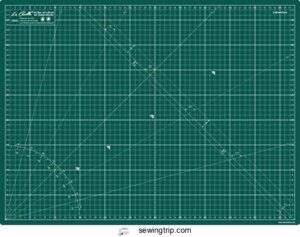
The La Canilla LC_A2 is a solid everyday option if you’re cutting fabric for quilting, patchwork, or general sewing projects. It’s built from five PVC layers, which gives it noticeably more thickness and rigidity than budget mats.
The double-sided surface prints metric and imperial grids across the full area, so you can align pieces without reaching for a separate ruler.
It measures approximately 43 cm × 58 cm and weighs 850 g — sturdy enough to stay put, portable enough to move between workspaces.
| Best For | Quilters, sewers, and papercraft enthusiasts who want a thick, reliable cutting mat with both metric and imperial grids for precise, everyday use. |
|---|---|
| Surface Type | Self-healing PVC |
| Sides | Double-sided |
| Grid Markings | Metric and imperial |
| Primary Use | Quilting and sewing |
| Rotary Compatible | Yes |
| Color | Green |
| Additional Features |
|
- Five PVC layers make it noticeably thicker and more rigid than typical budget mats, which means less blade wear and a more stable cutting surface.
- Double-sided grid covers the full area in both centimeters and inches, so measuring and aligning pieces is quick without grabbing a separate ruler.
- At 43 cm × 58 cm and 850 g, it’s sturdy enough to stay put on a table but still easy to move between workspaces.
- The actual size runs slightly smaller than advertised — closer to 43 × 58 cm rather than the listed 60 × 45 cm, so double-check if exact dimensions matter for your setup.
- PVC construction isn’t eco-friendly, which might be a dealbreaker if you’re trying to keep your craft supplies more sustainable.
- Self-healing properties will wear down over time with heavy use, so it’s not a permanent buy — plan for eventual replacement.
2. WorkLion Double Sided Cutting Mat
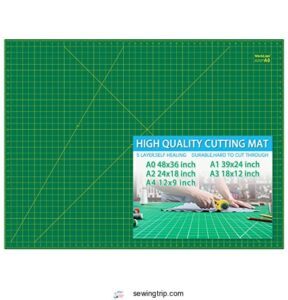
WorkLion Double Sided Cutting Mat gives you a serious working area — 47.2 × 35.5 inches — so you won’t constantly reposition fabric mid-cut.
Its five-layer PVC construction resists deep grooves, and the non-slip backing keeps everything anchored while your rotary cutter moves.
Both sides carry full grids with inch and centimeter markings, plus 30, 45, and 90-degree angle guides.
At $87.99, it’s built for quilters and sewists who cut large fabric pieces regularly.
| Best For | Quilters, sewists, and crafters who regularly cut large pieces of fabric or paper and want a durable, stable surface that lasts. |
|---|---|
| Surface Type | Self-healing PVC |
| Sides | Double-sided |
| Grid Markings | Metric and imperial |
| Primary Use | Quilting and sewing |
| Rotary Compatible | Yes |
| Color | Green, Yellow, White |
| Additional Features |
|
- Huge 47.2 × 35.5 in surface means less repositioning and smoother workflow
- Double-sided design extends the mat’s life — flip it when one side wears down
- Non-slip backing keeps the mat (and your worktable) protected while you cut
- Ships rolled, so you may spend several days weighting it flat before it’s usable
- Self-healing has limits — deep cuts can leave permanent marks over time
- Some buyers report scuffs or scratches right out of the package
3. Fiskars Self Healing Cutting Mat
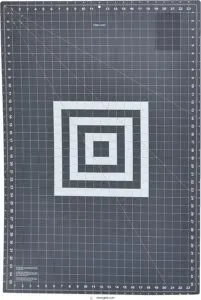
The Fiskars Self-Healing Cutting Mat gives you a 24 × 36‑inch surface that accommodates full‑width fabric without crowding your workspace. Its double‑sided design means you can flip it when one side shows heavy wear, effectively doubling your investment.
Both sides carry 30°, 45°, and 60° bias lines alongside inch and metric grids. The low‑glare gray surface reduces eye strain during long cutting sessions.
At $68.08, it’s a reliable mid‑range choice for quilters who need accuracy and durability without overspending.
| Best For | Quilters and fabric crafters who work with large pieces and need a durable, accurate cutting surface for everyday use. |
|---|---|
| Surface Type | Self-healing polymer |
| Sides | Double-sided |
| Grid Markings | Metric and imperial |
| Primary Use | Quilting and sewing |
| Rotary Compatible | Yes |
| Color | Gray |
| Additional Features |
|
- Huge 24 × 36" surface handles full-width fabric in one pass — no awkward repositioning.
- Double-sided design gives you a fresh surface when one side wears down, stretching the mat’s lifespan.
- Built-in angle guides (30°, 45°, 60°) make bias cuts fast and accurate without grabbing a separate ruler.
- At $68, it’s pricier than basic mats — and some buyers report it arriving with scratches or sticker residue.
- The 0.06" thickness feels pretty thin, which may bother anyone used to a sturdier, more rigid mat.
- It’s a big mat — great for the workroom, but a bit clunky if you’re short on space or need to haul it around.
4. Olfa Self Healing Rotary Cutting Mat
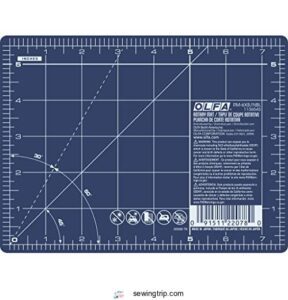
The OLFA RM-6×8/NBL packs a lot of function into a small footprint.
At just 6 × 8 inches, it’s purpose-built for small-scale work — bias strips, paper piecing, squares — right beside your machine.
The navy surface is double-sided, with inch-grid markings on one side for quick layout.
It’s designed exclusively for rotary cutters, so don’t reach for a utility knife here.
At 1.5 mm thick, it’s slim enough for travel kits without sacrificing that essential self-healing surface.
| Best For | Quilters, sewists, and crafters who need a compact, travel-friendly cutting mat for small projects like bias strips, paper piecing, and squares. |
|---|---|
| Surface Type | Self-healing plastic |
| Sides | Double-sided |
| Grid Markings | Imperial only |
| Primary Use | Quilting and sewing |
| Rotary Compatible | Yes |
| Color | Navy |
| Additional Features |
|
- Double-sided design with an inch grid makes measuring and cutting quick and easy
- Slim 1.5 mm profile fits neatly beside your sewing machine or in a travel kit
- Protects your work surface and helps extend the life of your rotary blades
- Only works with rotary cutters — utility knives will damage the mat
- Grid markings are inches only, so metric users are out of luck
- The small size limits you to cuts under about 3–4 inches for circles
5. Fiskars Rotating Cutting Mat
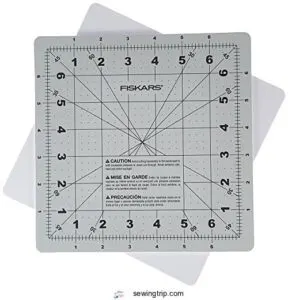
Want rotation built right into your mat? Fiskars Rotating Cutting Mat (Model 116250-1002) does exactly that. Its 8 × 8-inch surface spins a full 360 degrees, so you reposition the mat instead of wrestling with your fabric.
The self-healing rubber and silicone composite holds up through repeated passes, and the 1/8-inch grid with 30, 45, and 60-degree bias lines keeps your cuts accurate.
At $23.49, it’s a practical pick for quilters who cut small blocks and travel to workshops.
| Best For | Quilters who work with small blocks and travel to workshops or retreats, especially those with hand strain from arthritis or carpal tunnel. |
|---|---|
| Surface Type | Self-healing rubber/silicone |
| Sides | Single rotating surface |
| Grid Markings | Imperial with bias lines |
| Primary Use | Quilting and sewing |
| Rotary Compatible | Yes |
| Color | Yellow |
| Additional Features |
|
- The rotating surface lets you spin the mat instead of awkwardly repositioning fabric mid-cut
- Self-healing rubber and silicone composite holds up well through heavy, repeated use
- Bias lines for 30°, 45°, and 60° angles make cutting triangles and star shapes quick and accurate
- The usable marked area is really only about 6 × 6 inches, so larger fabric pieces won’t fit
- Heavy cutting over time can wear grooves into the center, which messes with precision
- The 1/8-inch grid lines look very similar to each other, making it tricky to read quickly near the edges
Frequently Asked Questions (FAQs)
Why do you need a self-healing mat?
Without a self-healing mat, every cut leaves a permanent groove in your work surface. Those grooves misdirect your blade, snag fabric, and dull your rotary cutter faster than you’d expect.
Do self-healing cutting mats work?
Yes, they do.
The surface closes after each blade pass, keeping cuts clean and consistent.
You get better accuracy, longer blade life, and a protected work surface — all in one mat.
What are the features of a self-healing cutting mat?
self-healing cutting mat features a polymer surface that reseals after blade passes, printed measurement grids, non-slip backing, and a multi-layer core that absorbs cutting pressure while keeping the surface flat.
Do cutting mats heal?
cutting mats don’t truly heal like skin does.
Instead, densely packed polymer layers press back together after each blade pass, closing minor cuts and keeping the surface smooth and consistent.
What is the best surface for cutting fabric?
The best surface for cutting fabric is a self-healing mat. It reseals after each blade pass, holds fabric steady, and keeps your cuts accurate without damaging your table.
Are self-healing mats safe for use with children?
These mats use non-toxic materials and meet consumer safety standards, making them suitable for family crafting. Always supervise children around rotary blades and establish clear cutting boundaries to keep little hands safe.
extend blade lifespan during sewing projects.
Do self-healing mats work with scissors or just blades?
Yes, self-healing mats work with scissors too. They keep fabric flat and reduce drag during cuts. Scissors cause less surface damage than rotary blades, so your mat stays smooth longer.
Can you use a self-healing mat on an uneven surface?
You can, but flat, stable base makes all the difference. An uneven surface causes the mat to flex, which throws off cut depth and accuracy.
Set a rigid board underneath for best results.
Conclusion
Imagine a medieval blacksmith hammering blades by candlelight—today’s precision tools demand equally thoughtful surfaces.
A self-healing mat transforms your workspace into a stable, forgiving foundation where every cut stays true. It preserves blade edges, stabilizes slippery silks, and turns error-prone tasks into confident strides.
Whether quilting heirloom pieces or sewing garments, this mat answers the question: why use a self-healing mat for fabric?
It’s the silent partner elevating your craft, stitch by seamless stitch. Choose wisely—your future projects depend on it.