This site is supported by our readers. We may earn a commission, at no cost to you, if you purchase through links.
Millions of sewers, meditators, and desk workers fold their legs beneath them without a second thought—and most of them are fine. The posture feels natural, even comforting, which is exactly why the internet’s dramatic warnings about permanent nerve damage and circulation collapse catch people off guard. The truth lands somewhere more nuanced than either extreme.
Sitting with legs folded under you does put measurable pressure on nerves and blood vessels, but brief sessions rarely cause lasting harm. Duration is the real villain here. After roughly 30–45 minutes, venous return drops, peroneal nerve conduction slows, and your feet may start signaling discomfort in ways worth paying attention to. Understanding what’s actually happening inside your legs transforms those warning signals from alarming mysteries into useful information you can act on.
Table Of Contents
Key Takeaways
- Duration is the real danger — brief folded-leg sessions rarely cause lasting harm, but staying tucked under for 30–45 minutes or more measurably slows blood flow, compresses the peroneal nerve, and starts building joint strain.
- Your body gives clear warnings worth listening to: tingling within five minutes signals early nerve irritation, and burning pain that lingers more than ten minutes after you shift position points to deeper nerve involvement.
- Static posture — not the position itself — is the underlying problem, because holding any fixed posture too long fatigues muscles, slows circulation, and forces ligaments to absorb load they weren’t built to carry.
- Small movement habits make the biggest difference: standing every 30–45 minutes, doing ankle pumps, and alternating which leg is folded can keep circulation moving and joint pressure balanced without giving up the posture entirely.
Is Sitting Legs Folded Under Bad?
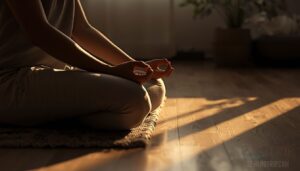
Sitting with your legs folded under you probably isn’t doing the permanent damage you fear — but that doesn’t mean it’s completely without risk. A few factors determine whether this posture is harmless or heading toward trouble for your body. Here’s what actually matters.
Usually Not Permanently Harmful
Most of the time, sitting with your legs folded under you causes no lasting damage. Your body is remarkably good at bouncing back — circulation returns within seconds of uncrossing, nerve sensation restores quickly, and any pelvic tilt reverses almost immediately once you shift position. These are short‑term physiological shifts, not permanent changes to your musculoskeletal health.
However, prolonged cross‑legged sitting can lead to peroneal nerve compression and transient foot numbness.
Risk Rises With Duration
The longer you stay folded, the more your body feels it. After just 30 minutes, venous return drops by 25%, slowing blood flow noticeably. By 45 minutes, nerve conduction in your peroneal nerve declines by 15%, and foot temperature falls measurably. Duration isn’t just a detail here — it’s the difference between a harmless habit and a genuine strain.
Pain Signals Matter Most
Your body communicates clearly when something’s off. Tingling usually starts within five minutes of crossing your legs — that’s your nervous system flagging early nerve irritation.
Numbness follows shortly after. If burning pain lingers beyond 10 minutes after you reposition, that signals deeper nerve involvement.
Diabetics should be especially cautious, since their nerves fire pain signals at pressures that others wouldn’t even notice.
Static Posture is The Issue
Static posture is the real problem — not the position itself.
Staying in any fixed position for too long strains your body, which is why choosing an ergonomic sewing chair reviewed by real sewists can make a surprising difference in how you feel after long sessions.
When you hold any posture too long, your slow-twitch muscle fibers fatigue, and your ligaments quietly absorb the load they weren’t designed to carry. Meanwhile, glucose uptake drops, metabolic waste accumulates, and circulation slows.
Moving regularly matters far more than which position you choose.
Why This Sitting Myth Persists
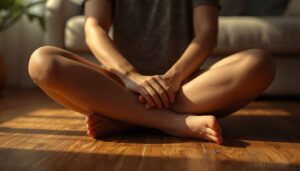
So why do so many people believe folded-leg sitting is genuinely dangerous? The answer comes down to a handful of real but misunderstood experiences that get blown out of proportion over time. Here’s what actually keeps this myth alive.
Temporary Numbness Feels Alarming
That sudden "my foot’s gone dead" panic is one of the most common reasons people worry about sitting with their legs folded. When you tuck your right leg folded underneath your left, sustained pressure blocks nerve oxygen supply, triggering that alarming pins-and-needles sensation. Here’s what’s actually happening:
- Nerve compression restricts blood flow to nearby nerves
- Oxygen deprivation causes temporary numbness within minutes
- Restoring normal sensation happens naturally once you shift position
Postural relief is usually enough — simply changing posture restores circulation quickly.
Crossed-leg Posture Confusion
Part of the confusion comes from lumping all crossed-leg postures together. Sitting with legs folded under you is quite different from simply crossing your knees — yet people treat them as identical risks.
| Position | Main Concern | Temporary or Permanent? |
|---|---|---|
| Knees crossed | Blood pressure rise (~8 mmHg) | Temporary |
| Legs folded under | Postural strain | Temporary with breaks |
| Ankles crossed | Minimal impact | Not significant |
Postural strain varies considerably by position, duration, and your individual anatomy.
Varicose Vein Misconceptions
Here’s a common misconception worth clearing up: folding your legs under you does not cause varicose veins. Research consistently points to valve failure in veins as the true culprit — not posture.
Key facts that challenge the myth:
- Genetics drives roughly 80% of varicose vein cases, meaning your family history matters far more than how you sit
- Both men and women develop varicose veins, with 55% female and 45% male prevalence — it’s not a posture-linked gender issue
- About 30% of adults across all ages develop the condition, including young adults in their 20s
- Varicose veins signal venous insufficiency, a genuine medical condition — not merely a cosmetic concern
Postural strain can worsen existing symptoms temporarily, but it won’t create the underlying vascular problem.
That said, reducing daily strain with proper support — like the tips in this guide on preventing back pain while sewing — can keep discomfort from compounding over time.
“Ladylike” Sitting Habits
The way women sit has never been just about comfort — it’s been shaped by centuries of social expectation. Historical modesty norms dating to the 1300s trained women to keep knees together as a signal of virtue.
That conditioning runs deep, reinforcing folded‑leg habits that feel natural even when they’re not ideal for your body.
What Happens to Circulation?
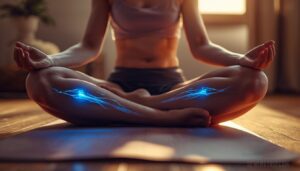
When you sit with your legs folded under you, your circulation doesn’t just pause — it shifts in ways worth understanding. The changes are usually temporary, but a few of them matter more if you already have certain health conditions. Here’s what’s actually happening in your body.
Reduced Venous Return
Think of your veins as a one-way highway sending blood back to your heart — but gravity works against that flow whenever you sit still.
Folding your legs keeps your calf muscles inactive, shutting down the skeletal muscle pump your body depends on to push blood upward. Without that movement, blood quietly pools in your lower legs.
Temporary Blood Pressure Changes
Crossing your legs at the knee — not the ankle — actually nudges your systolic blood pressure upward.
In hypertensive individuals, that rise can hit 8 mmHg or more. For healthy people, it’s a modest 2–3 mmHg.
Either way, it’s temporary: once you uncross, pressure returns to baseline within minutes.
That’s worth knowing before your next medical check-up.
Cold or Tingling Feet
That blood pressure blip isn’t the only thing folded-leg sitting stirs up. Cold or tingling feet are just as common — and just as misunderstood.
When your legs stay folded, localized blood restriction limits oxygen and heat delivery to your feet. Nerves that read temperature get irritated, making feet feel colder than they actually are. Shifting position usually brings relief quickly.
Higher-risk Medical Conditions
For most people, folded-leg sitting is a minor inconvenience.
But if you have a hypercoagulable condition — meaning your blood clots more easily than normal, due to cancer, lupus, or inflammatory bowel disease — the reduced venous return from this posture can raise your DVT risk five to tenfold. That’s a meaningful difference worth discussing with your doctor.
When Swelling Matters
Swelling after folded-leg sitting is usually harmless — it fades once you stand and move around.
But persistent or one-sided swelling lasting more than 48 hours deserves attention, as it can signal compromised venous return or even DVT.
And if swelling comes with shortness of breath or chest pain, seek emergency care immediately.
Nerve Compression and Numbness
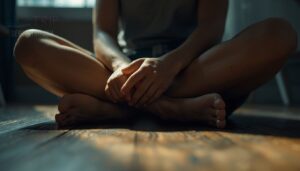
Beyond circulation, folded‑leg sitting can also press directly on the nerves running through your lower limbs — and that’s when things start to feel strange.
The sensations range from mild tingling to a foot that simply won’t cooperate when you stand up.
Here’s what’s actually happening inside your leg, and the signs that tell you time to shift position.
Pins-and-needles Sensation
That familiar prickling, buzzing feeling — called paresthesia — happens when sustained pressure disrupts nerve signaling to your lower limbs. Your nerves temporarily stop communicating clearly, much like a kinked garden hose losing water flow.
The sensation usually fades once you shift posture. If it lingers or keeps returning, that’s worth mentioning to your doctor.
Peroneal Nerve Pressure
The peroneal nerve runs along the bony outer edge of your knee — the fibula compression point — making it surprisingly vulnerable when you tuck your legs under you.
Sustained peroneal nerve pressure in this sitting position can slow nerve conduction speed noticeably and, in some cases, produce foot lift weakness, making it harder to raise your toes normally.
Foot “falling Asleep”
That odd, fizzing sensation when your foot "falls asleep" is your nervous system sending a clear message: blood circulation and nerve pressure have both been disrupted.
Vascular compression reduces venous return while nerve pressure interrupts normal signal transmission — two problems happening simultaneously.
Fortunately, quick resolution is normal; most temporary numbness clears within seconds to two minutes once you shift position and circulation recovers.
Warning Signs to Stop
Most numbness fades within two minutes of shifting position — but numbness lasting longer than five minutes is your body asking for more than a stretch.
If tingling doesn’t clear after standing and walking briefly, that points to genuine nerve compression.
Skin turning pale or bluish, persistent foot weakness, or swelling that pits when pressed all mean it’s time to change your habits.
Knee, Hip, and Ankle Strain
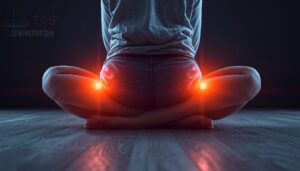
Folding your legs under you puts real mechanical stress on three joints that aren’t designed to hold that position for long. How much strain you actually feel depends on your anatomy, how long you sit, and which joints take the most load. Here’s what’s happening at each point of pressure.
Deep Knee Flexion Stress
When you tuck your legs beneath you, your knees bend sharply — often past 90 degrees. At that angle, tibiofemoral compression peaks, while meniscal translation shifts load onto smaller cartilage zones.
Your quadriceps work harder to stabilize the joint, stressing the patellofemoral tracking system. Over time, that repeated deep flexion quietly accumulates musculoskeletal strain.
Hip Rotation Pressure
Your hip is forced into external rotation when you fold your legs under you, compressing the piriformis muscle and the hip bursa. That concentrated pressure can trigger bursitis — a sharp or aching irritation that radiates toward your thigh or buttock.
Over time, your external rotators gradually weaken, creating asymmetrical joint loading that quietly stresses your sacroiliac joints and disrupts healthy pelvic alignment.
Ankle Compression Discomfort
Your ankles quietly bear the brunt of folded-leg sitting.
Tucking your feet under compresses the tarsal tunnel — a narrow channel along your inner ankle where the tibial nerve runs.
When that nerve gets pinched, you may feel burning or tingling spreading toward your foot, classic signs of tibial nerve impingement that deserve attention.
Patellofemoral Pain Triggers
Your kneecap — the patella — relies on precise tracking to glide smoothly during movement.
Folded-leg sitting can trigger patellar maltracking, where the kneecap shifts sideways under load. Quadriceps weakness and iliotibial band tightness both pull the patella off-center, stressing the retinaculum.
That imbalance builds patellofemoral pain — that familiar ache behind your kneecap when you finally stand up.
Ligament and Tendon Strain
Ligaments and tendons are surprisingly forgiving — until they’re not. When you fold your legs under you for long periods, sustained knee flexion gradually overstretches both structures.
Collagen fibers don’t snap immediately; instead, they uncrimp slowly under load, a process called creep deformation.
Hold that position long enough, and microscopic fiber damage quietly accumulates — the earliest stage of a strain.
Effects on Back and Pelvis
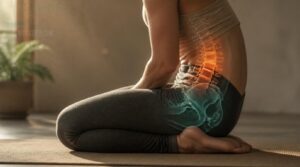
Your lower half isn’t the only thing that pays the price in this position — your back and pelvis feel it too. Folding your legs under you shifts how your spine and hips align, and those changes can build up quietly over time. Here’s what’s actually happening from the pelvis up.
Posterior Pelvic Tilt
When you fold your legs under you, your pelvis quietly tips backward — a shift called posterior pelvic tilt.
This happens partly because tight hamstrings and weak core muscles pull the bottom of your pelvis forward, rotating the top back.
Over time, that pattern can reinforce itself, making sagittal alignment shifts a real concern for your musculoskeletal health.
Flattened Lumbar Curve
That backward tilt from the previous section sets off a chain reaction deeper in your spine. When your pelvis rotates posteriorly, it flattens your lumbar lordosis — the natural inward curve that normally spans 40–60 degrees.
Without it, your spine loses its built-in shock absorber, and your center of gravity shifts slightly forward, quietly stressing the structures meant to keep you upright.
Lower Back Stiffness
That flattened curve does more than shift your posture — it quietly overworks the muscles holding you upright. Your paraspinal muscles along the spine begin compensating for what the lumbar curve no longer provides. Over time, that sustained effort leads to muscle fatigue and stiffness, especially noticeable the moment you stand up.
Tight hip flexors and shortened hamstrings make this worse.
Uneven Weight Distribution
When your legs fold under you, your weight doesn’t distribute evenly anymore — one side carries far more load. This creates lateral pelvic tilt, where one hip sits higher than the other.
That asymmetry generates a rotational moment in your lumbar spine, quietly stressing your sacroiliac joint and accelerating uneven wear across your hip and lower back.
Poor Chair Support
Your chair becomes part of the problem when it can’t adapt to you. Poor lumbar support flattens your spine’s natural curve, driving disc pressure higher. Consider these chair basics:
- Lumbar pad position — place it at belt height
- Seat depth — knees at 90 degrees, feet flat
- Backrest recline — 100–110 degrees reduces spinal load
Safer Sitting While Sewing
Sewing sessions have a way of pulling you in — one seam becomes two, and suddenly an hour has passed without you shifting an inch.
Since you folded‑leg sitting at the machine, the next best thing is making your setup work with your body, not against it. A few simple adjustments can go a long way, starting with these:
Feet Flat When Possible
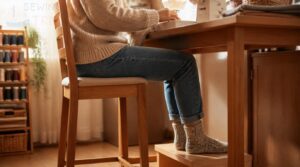
Keeping your feet flat on the floor is one of the simplest things you can do to protect your body while sewing. Flat foot placement promotes ideal venous return, maintains 90-degree alignment at your knees and hips, and keeps your pelvis level for pelvic tilt stability. If the floor feels too far away, a footrest delivers the same postural ergonomics benefit.
| What Happens With Feet Flat | What Happens Without It |
|---|---|
| Even weight distribution balance across both feet | Pressure concentrated on one side |
| Natural pelvic tilt stability maintained | Pelvis tilts, straining the lower back |
| Blood flows freely — ideal venous return | Circulation slows, feet feel cold or numb |
| Ideal seated position feels comfortable longer | Fatigue sets in faster, focus drifts |
Hips Back in Chair
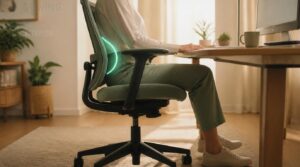
Sliding your hips all the way back into your chair is a small shift that pays big dividends. It maintains lumbar lordosis naturally, keeps your pelvis from tilting backward, and prevents the hip flexor shortening that sneaks up during long sewing sessions.
Think of your chair back as a built-in brace — only useful when you’re actually touching it.
Knees Slightly Apart

Your knees don’t need to be glued together.
Positioning them slightly apart — around 11 and 1 o’clock — distributes load evenly across both femoral condyles, keeps the patella tracking correctly, and opens space for venous vessels to drain efficiently. That small separation is doing a lot of quiet, important work for your circulation and joint health.
Use Lumbar Support
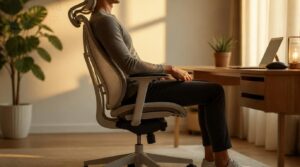
That small knee gap you’ve just created? Your lower back deserves the same attention.
Lumbar support maintains the natural inward curve of your lower back — your lumbar lordosis — so your paraspinal muscles don’t work overtime just to keep you upright. A contoured cushion, lumbar roll, or adjustable chair backrest placed in the hollow of your lower back provides those corrective support forces quietly, without effort from you.
Adjust Sewing Table Height
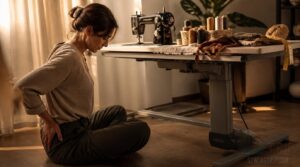
Table height is the quiet variable most sewists overlook.
Your ideal elbow alignment — elbows at roughly 90 degrees, shoulders relaxed — depends entirely on your surface sits at 72–75 cm.
A motorized lift lets you dial in precision height increments without strain, and aligning your sewing machine bed flush with the tabletop eliminates the reach that quietly builds postural strain over hours.
Better Habits Than Staying Still
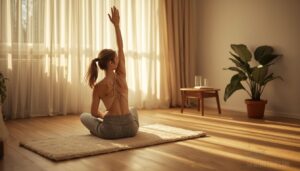
The good news is that small, consistent changes matter far more than any single "perfect" position. Your body thrives on variety, and even brief movement breaks can reset circulation, ease joint pressure, and keep stiffness from building up. Here are a few simple habits worth adding to your routine.
Change Positions Often
Your body wasn’t designed to hold one position indefinitely — and neither were your joints. Changing postures often redistributes muscle tension, shifts nerve pressure, and keeps circulation moving through your legs. Think of it as giving each muscle group a turn at rest.
If one side feels tight, alternate which leg is folded to balance the load across both hips.
Stand Every 30–45 Minutes
Standing up every 30–45 minutes does more than break the monotony. It restores blood circulation, nudges your core muscles back to work, and research shows it can reduce cardiovascular death risk by over 33%.
Standing every 30–45 minutes restores circulation, reactivates your core, and cuts cardiovascular death risk by over 33%
Even standing for just a few minutes helps regulate post-meal glucose levels — a real win for long-term metabolic health.
Do Ankle Pumps
When you can’t get up and move, your calves can do the heavy lifting for you. Ankle pumps — simply alternating between pointing your toes away and pulling them back — engage your calf muscles, which act as your body’s natural venous pump, pushing 60–90 ml of blood upward with each contraction.
- Reduce venous stasis (blood pooling in the legs)
- Prevent fluid accumulation and puffiness
- Boost blood return to the heart
- Complement circulation when folded-leg sitting limits movement
- Require zero equipment — do them right at your chair
Aim for 10 repetitions every hour to keep circulation moving without interrupting your flow.
Alternate Folded-leg Sides
Think of your folded-leg position like a workout — alternate sides every 15–20 minutes to keep both hips engaged equally. Switching legs restores balanced muscle activation, reduces lateral pelvic tilt, and protects your peroneal nerve from prolonged compression.
It also distributes sit-bone pressure evenly, preventing sacroiliac discomfort and keeping blood flowing through both legs.
Stretch Hips and Hamstrings
After extended folded-leg sitting, your hip flexors and hamstrings shorten and tighten, contributing to musculoskeletal pain over time. A kneeling hip flexor stretch — with a gentle posterior pelvic tilt — releases that tension without straining your lower back.
For hamstrings, hinge slowly at the hips with a straight leg, stopping before any nerve-like tingling appears. Hold each stretch for 20–30 seconds.
Frequently Asked Questions (FAQs)
Is it harmful to sit with legs crossed?
Like a river slowed by a dam, crossed-leg sitting restricts venous return and briefly spikes systolic pressure. For most people, these effects are temporary — real harm only builds with prolonged, repeated stillness.
What happens if you sit with your legs folded under?
When you sit with legs folded under, blood circulation slows, nerves compress, and joints stiffen. You may feel tingling, cold feet, or lower back ache — especially the longer you hold that position.
What can cause leg pain from a desk sitting job?
Desk sitting quietly stresses your body all day. Peroneal nerve compression, reduced venous return, muscle stiffness, hip rotation shifts, and patellofemoral joint stress are the main culprits behind leg pain at a desk job.
Is sitting with one leg tucked under bad for You?
Tucking one leg under you occasionally is mostly harmless, but your circulation slows, the calf muscle pump shuts down, and nerve pressure builds fast — so keep it brief.
Is it bad to cross your legs while sitting?
Crossing your legs occasionally is mostly harmless. However, it can temporarily raise blood pressure, compress veins, and press on the peroneal nerve — causing that familiar tingling. The real concern is doing it for hours without shifting position.
Why is cross-legged sitting bad for You?
Around 50% of adults in developed countries report back pain — and cross-legged sitting is often a contributing factor due to asymmetric pelvic loading, static pressure, and reduced blood circulation over time.
What are the negative side effects of sitting crossed legged?
Crossed-leg sitting strains the peroneal nerve, restricts venous return, and spikes blood pressure temporarily. It also triggers muscle imbalances, joint stress, and postural strain — especially with a sedentary lifestyle.
Is it bad to sit with your legs tucked under you?
Sitting with your legs tucked under you isn’t inherently dangerous, but duration is the real issue. Short sessions are generally fine; staying folded for hours strains joints, compresses nerves, and impairs circulation.
Is it bad to sit with your legs folded?
For most people, folding your legs occasionally is harmless. But held too long, it compresses nerves and reduces blood flow, causing tingling, stiffness, or discomfort — your body’s way of saying, move.
Is it bad to sit with legs bent?
Bent legs act like a slowly closing valve. Joint pressure, blood flow drops, and nerve compression can build quietly over time — especially past 90 minutes of unbroken stillness.
Conclusion
The body rarely lies. Regarding whether sitting with legs folded under is bad for you, the honest answer is: occasionally, not catastrophically.
Your legs will tell you when something’s wrong—numbness, tingling, and stiffness are signals worth heeding, not ignoring.
Shift postures every 30 to 45 minutes, stretch when you can, and stay mindful of duration. Treat discomfort as a cue, not a crisis, and this posture remains perfectly manageable for most people.
- https://docs.google.com/forms/d/1GAQr3Kn1cURCVHUA82hAga1Wv8DCH0IuqDLRUrOpN7M/viewform?ts=63f4f653&entry.1515682415=https://www.merriam-webster.com/dictionary%2Fsitting
- https://unabridged.merriam-webster.com/check-redirect-premium?utm_source=mw&utm_medium=inline-def&utm_campaign=evergreen&headword=sitting
- https://www.barrons.com/news/pakistan-s-mango-exports-shrink-as-middle-east-war-impacts-linger-65a07d7f
- https://www.salon.com/2026/06/20/beyond-banana-bread-what-to-do-with-your-overripe-bananas/
- https://www.wsj.com/business/hospitality/las-vegas-vacation-wealthy-e77c0e63