This site is supported by our readers. We may earn a commission, at no cost to you, if you purchase through links.
That fabric bin in the corner? It’s not a pile of leftovers—it’s a goldmine. Sewists who’ve been at this a while know that the scraps from one project quietly become the best parts of the next. A cotton lawn here, a fat quarter of holiday print there, and suddenly you’ve got enough to make something genuinely useful.
The trick isn’t having the right scraps. It’s knowing what to do with them. From zipper pouches and patchwork pillows to handmade gifts and pet toys, scrap sewing projects punch well above their weight in both charm and practicality. Small pieces, big results.
Table Of Contents
Key Takeaways
- Your scrap bin is basically a creative pantry — even the tiniest leftover pieces can become zipper pouches, coasters, pet toys, stuffed animals, and more without buying a single yard of new fabric.
- Knowing what to make matters more than having the "right" scraps — once you match your bits to a project (hair scrunchies for strips, drawstring bags for small cuts, rag rugs for old jeans), nothing goes to waste.
- A few smart storage habits — clear bins, color-coded labels, backing boards for larger pieces — turn a chaotic scrap pile into a ready-to-grab system that actually speeds up your sewing.
- Scrap sewing isn’t a workaround or a budget hack; it’s a legitimate creative practice that produces handmade gifts, home decor, and eco-friendly accessories with serious charm.
Easy Scrap Sewing Projects
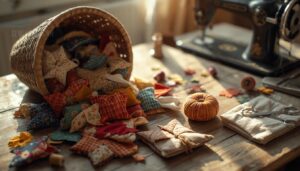
Got a pile of scraps sitting in a basket, begging to become something? Good news — you don’t need big yardage or a complicated pattern to make something you’ll actually use.
From quick patchwork pouches to cozy mug rugs, these fabric scrap sewing machine projects prove that small pieces can turn into something genuinely useful.
Here are some of the easiest places to start.
Zipper Pouches From Fat-quarter Scraps
A fat quarter is basically a zipper pouch waiting to happen.
Grab coordinating scraps — one for the exterior, one for lining — and layer them with fusible fleece for those stabilizer choices that keep your DIY zipper pouches standing tall.
Nail your zipper placement with a zipper foot, use topstitching techniques to finish clean, and swap in custom pulls to make each one yours.
For guidance, refer to the two contrasting fat quarter fabric details in the tutorial.
Hair Scrunchies and Headbands
Those leftover fabric strips? Perfect for hair scrunchies and headbands. DIY accessories made from scrap fabric never looked this good.
Fabric Selection really matters here: cotton and satin are beginner-friendly, while velvet adds a luxe touch. For Elastic Options, soft recovery elastic keeps the hold gentle.
Smooth Construction hides your seam inside the sleeve. Try Trend Colors like sage or terracotta to elevate your designs.
Follow simple Cleaning Guidelines: cold wash, air dry.
Fabric Flowers and Key Fobs
From tiny scraps punch way above their weight, fabric flowers and key fobs transform remnants into charming creations. Shape petals using a warm iron for gentle curves, then layer them for depth to build dimensional blooms.
Add floral embroidery at the center for a handmade touch, enhancing the artisanal appeal. For key fobs, a stiff fob core ensures durability, while a quick resin coating protects the design.
Wired stem options expand creative possibilities, making these fabric flower tutorials endlessly fun to explore.
Drawstring Bags for Tiny Items
Those same scraps that shaped your fabric flowers? They’re perfect for tiny drawstring pouches.
Bag Size Variations range from 2×3 to 3×4 inches — just right for Compact Storage Solutions for beads, buttons, or findings.
Choose Cord Material Options like cotton or polyester, then try Personalization Techniques such as iron-on patches.
Eco-friendly Fabric scraps make these small sewing accessories made from scrap fabric genuinely sustainable.
No-sew Fabric Garlands and Bows
No needle? No problem. A no‑sew fabric garland turns your fabric strips into charming DIY home decor using fabric remnants in minutes.
- Strip Preparation – Cut cotton or linen into 3–5 inch wide strips
- Knot Spacing – Tie strips every 6–12 inches along twine
- Starch Stiffening – Spritz with spray starch for crisper bows
- DIY Gift Tags – Add small labeled tabs for zero waste sewing ideas
Eco‑friendly materials and upcycling leftover fabric into functional items never looked this easy.
Home Decor Scrap Projects
Your scrap bin is basically a home decor store waiting to happen. A few leftover pieces can turn into something you’d actually want on your table or wall.
Here are some of the easiest ways to make that happen.
Quilted Coasters and Mug Mats

Fabric coasters might be the smartest thing you can sew from a scrap pile. Cut 4-to-5-inch squares, layer them with batting for heat protection, and run a few quilting stitches across the top. Miter the corners for a clean finish.
Fabric coasters are the smartest scrap project you’ll ever sew — small, useful, and endlessly satisfying
Mix prints for easy color coordination, and you’ve got patchwork mug mats that feel genuinely handmade — because they’re.
Placemats and Table Runners
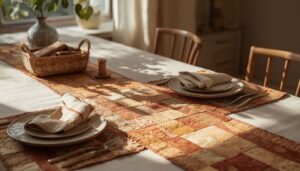
Placemats and table runners are where your scrap pile really shines. For lovely patchwork placemats or a strip weaving table runner, cotton and linen are your best fabric choices — they wash beautifully at 30–40°C.
Stick to sizing guidelines: 12×18 inches for placemats, 14–16 inches wide for runners.
Upcycling fabric scraps for home decor never looked this good, and seasonal styling keeps your table fresh year-round.
Patchwork Pillow Covers
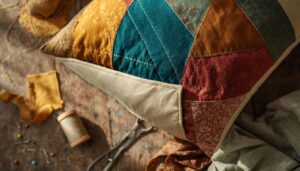
patchwork pillow cover might be the coziest thing your scrap bin ever produces. Grid those leftover pieces into color blocking sections, press seams flat, and add a thin batting layer for that cozy quilted texture.
Tuck in a hidden zipper, pick a solid back fabric, and play with thread contrast to outline each patchwork block design. Upcycling fabric scraps into handmade gifts doesn’t get more satisfying.
Fabric Bunting and Wall Art
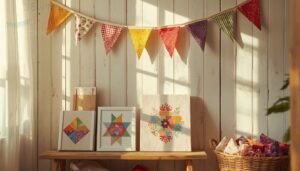
String together scraps into seasonal theme bunting — triangle flags edged with bias tape edging, hung using DIY hanging hooks that won’t damage your walls. Mix rainbow color schemes across prints for a festive, eye-catching look. Lean into mixed media frames for fabric wall art, layering patchwork panels over canvas.
Honestly, these DIY home decor projects using fabric remnants turn leftover bits into something genuinely beautiful.
Rag Rugs and Braided Baskets
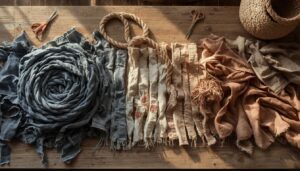
Old jeans, worn-out sheets, leftover cotton — a rag rug turns them all into something worth keeping.
Cut strips one to three inches wide using Strip Width Selection to control braid thickness. Coiling Techniques build your spiral, while Backings Stability keeps it flat underfoot.
Plan Color Gradient Planning before you start.
Finishing edges neatly and braiding upward creates a braided basket — upcycling fabric scraps for home decor has never felt this satisfying.
Gifts and Toys From Scraps
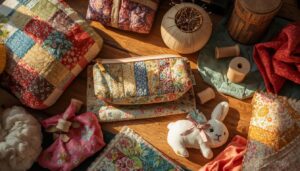
Scraps are basically gift-giving gold just waiting to happen. From soft stuffed animals to practical snack bags, there are so many things you can stitch up for the people (and pets) you love.
Here are some of the best gifts and toys you can make from your leftover fabric.
Reusable Snack Bags and Gift Wrap
Scraps don’t have to end up in the trash — they can become zero waste sewing ideas you’ll actually use. Reusable snack bags and fabric gift bags are perfect eco-friendly materials projects that feel as good as they look. Try these quick wins:
- Zipper or Velcro closure options keep food fresh and bags leakproof
- Festive design patterns and seasonal themes make cute DIY zipper pouches double as gift wrap
- Easy cleaning tips: machine wash, air dry, done
Stuffed Animals and Softies
Those reusable bags are great, but here’s something even more giftable — a handmade softie.
Fabric selection matters here: minky and fleece are beginner‑friendly and hold up through washing.
Use embroidery details for eyes instead of safety eyes on toys for little ones.
Eco-friendly fillings like wool roving add a natural touch.
Adorable stuffed owls, a fabric bunny softie, or simple fabric alphabet letters make genuinely memorable gifts.
Baby Bibs and Burp Cloths
Baby bibs and burp cloths are honestly some of the sweetest handmade gifts you can sew from leftover fabric.
- Fabric Choice — Cotton, flannel, and terry cloth are your best friends here — soft, absorbent, and baby-approved.
- Layered Construction — Stack two or three layers for burp cloths to handle real spit-up duty.
- Fastening Options — Snaps or Velcro make bibs easy on tired parents.
- Washability Tips — Prewash everything before sewing; it prevents shrinkage and softens fabric beautifully.
- Seasonal Designs — Patterned prints add personality while hiding stains between washes.
Mini Stockings and Gift Toppers
From sweet little bibs to something truly gift‑worthy — mini stockings make the cutest gift toppers you’ll ever stitch.
| Feature | Material | Embellishment |
|---|---|---|
| Tiny loop tab | Felt Material Choices | Holiday Embellishment Ideas |
| Gift card pocket | Cotton plaid | Embroidered initials |
| Attachment Loop Techniques | Fleece cuff | Mini pom-poms |
Mini Stocking Customization turns fabric scraps into Reusable Gift Accessories — better than any bow.
Pet Toys and Catnip Pouches
Your cat deserves a handmade treat too. Those tiny cotton scraps? Perfect for catnip toys that actually hold up to serious play. Try these quick ideas:
- Stitch Reinforced Seams on Double-Layered Pouches for durability
- Use Organic Catnip Fillers for safer, pesticide‑free fun
- Add crinkle material inside for extra texture
- Follow a Toy Rotation Schedule to keep things fresh
Interactive Wand Integration takes it up a notch — just attach a finished pouch to a stick and watch the chaos begin.
Top 4 Scrap Sewing Tools
The right tools make scrap sewing so much easier — and honestly, a lot more fun. A few smart picks can keep your fabric organized, your projects moving, and your workspace feeling less chaotic.
Here are four tools worth having in your corner.
1. Honey Can Do Rolling Storage Cart
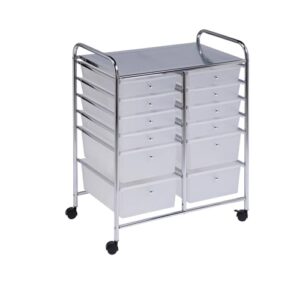
If your scraps are taking over the room, this cart is your new best friend. The Honey-Can-Do Rolling Storage Cart has 12 semi-transparent drawers — large and small — so you can actually see your fabric without digging around.
It rolls right to your sewing table, then locks in place when you need it steady.
At around $74, it fits under most work tables and holds up to 50 pounds. Organized scraps mean more sewing and less searching.
| Best For | Crafters, sewists, and hobbyists who need quick access to supplies and want to keep their workspace tidy without sacrificing floor space. |
|---|---|
| Material | Chrome aluminum & plastic |
| Primary Use | Craft room storage |
| Quantity Included | 1 cart (12 drawers) |
| Price Range | $73.62 |
| Dimensions | 15.25″D × 25.25″W × 32″H |
| Assembly Required | Yes, tools included |
| Additional Features |
|
- Semi-transparent drawers let you spot what you need at a glance — no more opening every drawer to find your scissors
- Rolls easily to wherever you’re working, then locks in place to double as a stable surface
- Compact enough to tuck under most work tables, and at ~$74, it’s easy on the wallet
- The frame can flex under heavier loads, and you’re capped at 50 lb total — not ideal if you’re storing dense materials
- Only two of the four casters lock, which can feel a little wobbly depending on your floor
- Screws may loosen over time, and a few users have run into drawer issues if assembly isn’t done carefully
2. mDesign Clear Plastic Kitchen Organizer
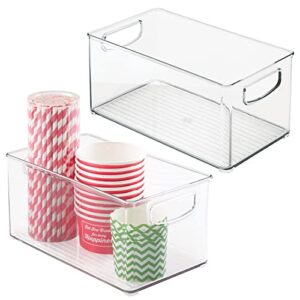
Organizing your scraps doesn’t have to mean spending a fortune. The mDesign Clear Plastic Kitchen Organizer pulls double duty in the sewing room — those built-in grips make it a breeze to lift out your color-sorted fabric bits without dumping everything on the floor.
Each bin measures 10 × 6 × 5 inches, so it fits neatly inside a drawer or shelf. You can see exactly what’s inside at a glance.
Grab the two-pack and dedicate one to cotton scraps, one to everything else.
| Best For | Sewists and crafters who want a quick, no-fuss way to sort and grab fabric scraps, spools, or small supplies from a shelf or drawer. |
|---|---|
| Material | Flexible clear plastic |
| Primary Use | Pantry/cabinet organization |
| Quantity Included | 2-pack bins |
| Price Range | Not specified |
| Dimensions | 10″L × 6″W × 5″H |
| Assembly Required | No |
| Additional Features |
|
- Clear plastic means you spot what you need instantly — no digging around
- Built-in handles make it easy to pull the whole bin out, even from a tight shelf
- Comes as a two-pack, so you can sort by type right out of the box
- Stacking two bins can get wobbly, especially with heavier fabric or supplies on top
- Stickers and labels don’t peel off cleanly, which is annoying if you like to relabel
- At 10 × 6 × 5 inches, it fills up fast if you’re storing bulkier cuts of fabric
3. BCW Silver Comic Book Backing Boards
Who knew comic book supplies could moonlight as sewing tools?
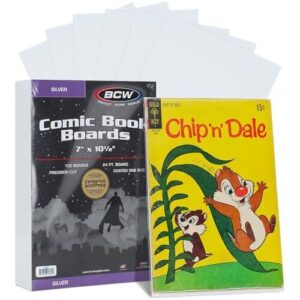
BCW Silver Comic Book Backing Boards are cut to a precise 7 × 10.5 inches and made from sturdy 24-point solid bleached sulfate — stiff enough to keep larger fabric pieces flat and wrinkle‑free on your shelf.
The acid‑free, calcium carbonate coating means no mystery yellowing on your prized yardage over time.
Slip a few into your storage system, and your bigger scraps stay organized, protected, and ready to grab when inspiration strikes.
| Best For | Sewists and crafters who store larger fabric pieces or quilt bolts and want affordable, acid-free backing that pulls double duty as comic book protection. |
|---|---|
| Material | Solid bleached sulfate board |
| Primary Use | Comic & craft backing |
| Quantity Included | 100 boards per pack |
| Price Range | Not specified |
| Dimensions | 7″ × 10.5″ |
| Assembly Required | No |
| Additional Features |
|
- Sturdy 24-point construction keeps bigger fabric pieces flat and wrinkle-free on the shelf
- Acid-free, calcium carbonate coating helps prevent yellowing on stored fabrics over time
- Cut to a precise 7 × 10.5 inches, so they slot neatly into a standard storage system
- Some boards arrive with minor warping or uneven edges, which can be annoying in a tidy display
- Only surface-buffered, not buffered all the way through — so it’s not the most heavy-duty archival option
- Finish consistency varies batch to batch, with some boards glossy on one side and others on both
4. Leisure Arts Pincushion Sewing Patterns
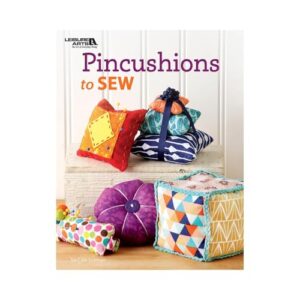
A good pincushion is the unsung hero of any sewing space — and this little book from Leisure Arts might just become your new favorite.
For $8.49, you get 15 distinct designs with step-by-step instructions, including Log Cabin, Prairie Points, and Stacked styles, all written by Edie Eckman.
At 28 pages, it’s tight and focused — no filler.
Perfect for burning through small scraps while practicing embroidery techniques. Beginners especially love it, and the finished cushions make sweet handmade gifts too.
| Best For | Beginners who want a quick, low-cost way to practice basic stitching and embroidery while making something actually useful for their sewing space. |
|---|---|
| Material | Paper/paperback |
| Primary Use | Sewing & embroidery guide |
| Quantity Included | 1 book (28 pages) |
| Price Range | $8.49 |
| Dimensions | 11″ × 8.5″ × 0.2″ |
| Assembly Required | No |
| Additional Features |
|
- 15 different designs with clear step-by-step instructions — plenty of variety for the price
- Great for using up small fabric scraps without committing to a big project
- Finished cushions make charming handmade gifts, so nothing goes to waste
- Only 28 pages, so don’t expect deep dives into complex techniques
- No digital files or printable templates included — just the printed patterns in the book
- Fabrics, threads, and tools are all on you to source separately
Store Fabric Scraps by Type
A good storage system makes all the difference when you’re sewing with scraps. Knowing where everything lives means less digging and more creating.
Here are five simple ways to sort and store your fabric pieces so they’re always ready to go.
Sort Scraps by Size, Color, or Project
Think of your fabric stash as a little library — it only works if things are shelved with intention. sorting scraps by size, color, or project makes all the difference.
Use color-coded bins and a color wheel guide to group warm and cool tones separately. size-tiered shelving keeps small, medium, and large pieces distinct.
project tote organization pulls everything together when you’re ready to sew.
Keep 2-inch Squares Together
Once you’ve sorted by size, those little 2-inch squares deserve their own home.
Tuck them into Divided Storage Boxes with Quick-Reference Labels showing color family and count.
A Layered Tray System keeps everything visible without digging.
Color-Coded Bins make color sorting fabric scraps genuinely fast.
Set up a simple Rotating Inventory Chart so you always know what you have ready for your next patchwork quilting project.
Fold and Label Fat-quarter Pieces
Fat quarters are worth a little extra care. Fold each one in half widthwise, then again to create a tidy 9 by 11 inch bundle — that fold orientation keeps creases minimal.
Tuck a Color-Coded Tag along the folded edge for instant Label Placement, you can read at a glance. Jot down project suitability like "pouches" or "patchwork."
Smart Inventory Rotation starts here, making color sorting fabric scraps genuinely easy.
Use Clear Bins for Fast Visibility
Once your fat quarters are labeled and folded, clear bins make the next step almost easy. Instant Fabric Identification happens naturally when you can see every color through the bin walls — no lid-lifting, no rummaging.
Color-Coded Sorting stays visible at a glance, which makes Quick Project Planning a breeze.
Space-Saving Stacking keeps your shelves tidy, and Easy Cleanup means organizing and storing fabric scraps by color actually sticks.
Store Larger Pieces on Backing Boards
Clear bins handle the small stuff beautifully — but larger pieces need a little more structure. That’s where backing boards come in.
Acid-Free Boards keep big cuts flat and wrinkle-free, and Board Size Guidelines are simple: go 2–4 inches bigger than your fabric.
A solid Labeling System (fiber content, dimensions, date) saves serious time.
Add Moisture Protection, and practice Upright Storage, and your fabric storage solutions for crafters finally feel complete.
Frequently Asked Questions (FAQs)
Can you use scrap fabric for sewing projects?
The tiniest scraps hold the most potential.
Yes, you can absolutely use scrap fabric for sewing projects — from upcycled accessories to zero waste crafting, even small bits can fuel endless DIY sewing projects.
What are some scrap fabric project ideas?
Scrap fabric works beautifully for zipper pouches, scrunchies, coasters, baby bibs, pet toys, and upcycled fabric gift tags.
Even tiny pieces become mini fabric wallets, holiday fabric ornaments, or eco-friendly fashion accessories.
Nothing goes to waste.
What do you do with scrap fabric?
You can turn scrap fabric into zipper pouches, coasters, pet toys, and more.
It’s sustainable sewing at its best — sustainable sewing that transforms leftovers into handmade gifts from leftover fabric or upcycled fashion pieces.
What are fabric scraps?
Fabric scraps are leftover fabric pieces saved after cutting larger projects.
These small remnants — upcycling fabric scraps goldmine — come in every size, color, and material, making fabric scrap organization and creative reuse endlessly rewarding.
How to sew fabric scraps for quilting?
Trim your scraps into 2–4 inch squares, press seams in one direction, and use Basting Methods to keep layers steady.
Piecing Layout Planning and Quilting Seams Reinforcement help turn patchwork block designs into beautiful patchwork quilts.
What tools are needed for scrap sewing?
You don’t need much. Sharp scissors, a rotary cutter, measuring tape, and a good lighting lamp cover most of it. Add a simple pinning system, and you’re ready to go.
How to match fabric scraps effectively?
Matching fabric scraps can feel like solving the world’s most colorful puzzle.
Start with Color Harmony — pick three to five hues that repeat across pieces.
Then consider Pattern Scale, Texture Matching, and Layout Planning before finishing.
Can scraps be used for pet projects?
Scraps are perfect for pet projects.
Use cotton or fleece for DIY Pet Beds, Enrichment Toys, or a catnip toy — just follow basic Safety Guidelines and smart Material Selection for happy, safe pets.
What are eco-friendly scrap sewing options?
Waste not, want not.
Scrap sewing is eco-friendly by nature — upcycling fabric scraps for home decor, using zero waste patterns, and choosing organic cotton scraps keeps textiles out of landfills beautifully.
How do I prepare scraps before starting projects?
Start by sorting scraps using Size Segmentation and Color Grouping.
Prewash Treatment prevents bleeding, Iron Flattening keeps cuts accurate, and Bin Tagging speeds up selection — smart fabric storage solutions for crafters make every project smoother.
Conclusion
Picture your fabric bin differently now — not as overflow, but as a creative pantry stocked with possibilities. Every strip, square, and remnant holds something worth making.
Sewing projects using scraps aren’t a workaround; they’re a whole creative practice in their own right.
You’ve already got the the materials, the ideas, and now the roadmap. So dig in, cut boldly, and let those little pieces of fabric become exactly what they were always meant to be.
- https://www.sewcanshe.com/blog/2017/8/17/show-off-saturday-some-cute-quilted-pixie-cups
- http://sewdelicious.com.au/2014/04/scrappy-pot-holders-tutorial.html
- http://thecraftyblogstalker.com/tutorial-pom-pom-pen/
- https://bloggingcornerblog.blogspot.com/2013/03/diy-braided-basket.html
- https://ph.pinterest.com/Homespirecreativity/