This site is supported by our readers. We may earn a commission, at no cost to you, if you purchase through links.
Foundation piecing turns fabric scraps—once dismissed as too small or oddly shaped—into precise, stunning creations. This technique provides a paper guide for stitching, ensuring points land sharply and seams remain true, even with challenging cuts. It empowers quilters to master intricate designs like Mariner’s Compass or Flying Geese rows without frustration.
Whether tackling your first Log Cabin block or advancing to Pineapple construction, the best foundation piecing patterns adapt to your skill level. They meet you where you are, fostering growth and confidence as you refine your craft.
Table Of Contents
- Key Takeaways
- Best Foundation Piecing Patterns
- Log Cabin Foundation Piecing Pattern for Beginners
- Flying Geese Pattern for Sharp Points
- Economy Block Pattern for Fussy Cutting
- Pineapple Quilt Block Pattern
- Mariner’s Compass Pattern for Advanced Quilters
- Modern Geometric Foundation Piecing Blocks
- Animal-themed Foundation Paper Piecing Patterns
- Holiday and Seasonal Quilt Block Patterns
- Free Foundation Piecing Patterns
- Beginner-Friendly Pattern Ideas
- Advanced Foundation Piecing Designs
- Top 4 Foundation Piecing Items
- Frequently Asked Questions (FAQs)
- Conclusion
Key Takeaways
- Foundation paper piecing uses a printed guide to keep your seams accurate and your points sharp, so even tricky designs like Mariner’s Compass become manageable.
- Patterns scale to your skill level, from the simple Log Cabin block for beginners all the way up to advanced multi-section designs with tight geometric points.
- You don’t need to spend money to get started — quality free patterns covering everything from pumpkins to Flying Geese are widely available online.
- A few key tools, like a rotating cutting mat, serrated scissors, and flat-head pins, make a real difference in how clean and precise your finished blocks turn out.
Best Foundation Piecing Patterns
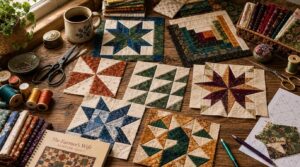
Whether you’re just starting out or you’ve been quilting for years, there’s a foundation piecing pattern that’s just right for you. The trick is finding one that matches your skill level and keeps you excited to sit down at the machine.
If you’re not sure where to begin, this guide to quilting at home for every skill level can help you find the right starting point.
Here are some of the best options to get you started, ensuring there’s a pattern suited to every quilter’s experience and enthusiasm.
Log Cabin Foundation Piecing Pattern for Beginners
If you’ve never tried foundation paper piecing, the Log Cabin block is your perfect starting point. Cut your center square at 2.5 inches, then build outward with 1-inch strips in alternating light and dark fabrics. For detailed instructions, explore the free Mod Log Cabin pattern.
- Center Square Cutting: Measure twice, cut once
- Seam Pressing Direction: Always press toward darker fabric
- Paper Stabilization Tips: Use lightweight foundation paper for easy tear-away
A size 80/12 needle keeps stitches clean.
Flying Geese Pattern for Sharp Points
Flying Geese blocks elevate your precision piecing with a 2:1 goose ratio for crisp points. Master the technique using the Four-Strip Method, which yields four units from one set with no waste. Template rulers ensure fast, locked-in accuracy.
| Tip | Why It Matters |
|---|---|
| Color Contrast | Makes points pop |
| Precise Pressing | Prevents tucked tips |
| Foundation Paper Piecing patterns | Guides exact placement |
| Free foundation paper piecing patterns collection | Great for practicing Beginner-Friendly Foundation Paper Piecing |
Explore the free foundation paper piecing patterns collection to practice these techniques in a beginner-friendly format.
Economy Block Pattern for Fussy Cutting
Where Flying Geese train your eye for points, the Economy Block puts your favorite fabric front and center. Fussy cutting lets you frame a motif perfectly inside a 2½-inch center square.
- Lock in center motif alignment before cutting
- Match triangle scrap sizing to avoid waste
- Keep precise seam allowance at ¼ inch throughout
- Control fabric grain for clean, flat edges
Pineapple Quilt Block Pattern
Ready to level up from the Economy Block? The Pineapple block builds on that Square in Square foundation — eight rounds of 45 Degree Wedge strips radiating outward from a bold Center Contrast Hue. Foundation Paper Piecing techniques keep every angle sharp.
| Element | Beginner Approach | Expert Construction Tips |
|---|---|---|
| Center Square | Solid contrast color | Fussy-cut focal print |
| Ring Color Gradient | Light to dark progression | Scrappy mixed tones |
| Sashing Pineapple Blocks | Simple straight sashing | Mitered corner joins |
| Wedge Angles | Pre-printed foundation lines | Ruler-cut 45° strips |
| Assembly Order | Center outward, press as you go | Assembly-line batch pressing |
Free Foundation Paper Piecing patterns and Beginner-friendly quilting tutorials make this quilt block design for beginners surprisingly approachable.
Mariner’s Compass Pattern for Advanced Quilters
If you’re chasing a real challenge, the Mariners Compass Quilt Block delivers. Foundation Paper Piecing patterns handle Center Circle Accuracy and Radiating Point Count—anywhere from 16 to 32 sharp points—with surprising control. Fabric Contrast Strategy drives the drama, while Quarter-circle Construction keeps curves smooth. Scale Placement Tips help you size it perfectly.
For experienced quilters tackling ambitious, showstopping projects, these techniques ensure expert-level construction mastery.
Modern Geometric Foundation Piecing Blocks
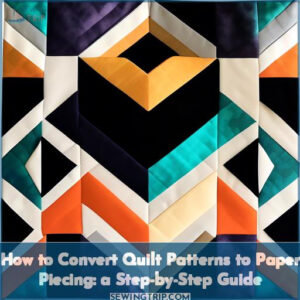
Modern geometric quilt block designs are where bold ideas meet precision, blending tessellation motifs, chevrons, and angular grids. These patterns rely on Seam Intersection Accuracy to maintain crisp, sharp points. A High-Contrast Palette and strategic Angular Color Contrast transform simple shapes into striking optical illusions, creating dynamic visual depth.
Whether exploring Paper Piecing Patterns or tackling Foundation Paper Piecing, these techniques ensure structural integrity and bold aesthetics. Intermediate and expert quilters can achieve serious visual impact through meticulous execution, turning foundational precision into artful design.
Animal-themed Foundation Paper Piecing Patterns
Animal-themed foundation paper piecing patterns bring your quilt to life in the most satisfying way. From a Maple fox to a Butterfly Paper Piecing Pattern, you can capture fur shading, pose variations, and facial appliqué details with surprising accuracy. Scale-friendly fabrics make texture feel real.
Combine blocks into quilted animal scenes or try a free foundation paper pieced bee pattern—the Birds in the Air Quilt Block Pattern pairs beautifully alongside any Fox quilt.
Holiday and Seasonal Quilt Block Patterns
Holiday and seasonal quilt block designs are where foundation paper piecing truly excels. This technique brings precision to motifs like sharp Christmas trees, crisp snowflakes, and geometric mittens, all crafted into a neat 12-inch finish—ideal for seasonal sashing between blocks.
For quilters ready to push beyond seasonal basics, advanced pattern-making techniques like dart manipulation can bring impressive custom precision to even the most intricate holiday motifs.
Enhance festive motifs with sparkle thread use to achieve a festive shimmer. Experiment with block size variations, border design ideas, and embellishment techniques across free paper piecing patterns, intermediate projects, and expert-level creations alike.
Free Foundation Piecing Patterns
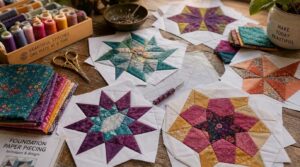
You don’t have to spend a dime to start foundation paper piecing. There are some genuinely great free patterns out there, and they cover everything from simple shapes to fun seasonal blocks.
Here’s a look at the ones worth downloading first.
Granny Square Block Pattern
The Granny Square Pattern is one of the most loved Free Foundation Paper Piecing templates, building outward through Round Growth and adding clusters with each iteration. Maintain Yarn Tension to ensure the block remains flat during construction.
Incorporate Stitch Variations like bobbles for added texture, and experiment with Color Transitions between rounds to refresh the design.
A simple Border Finish completes the piece, tying all elements together neatly.
Pumpkin Foundation Paper Piecing Block
The Pumpkin Block is one of the most charming free FPP patterns you’ll find, available in size options of 4, 6, and 8 inches to suit pillows or wall hangings.
Use light-box alignment for precise fabric placement and ensure thread color matching to complement your oranges and greens.
Finish with post-piecing stabilization to achieve a crisp, firm block.
Strawberry Quilt Block Templates
From pumpkins to berries — the strawberry quilt block is just as sweet to sew. Free FPP patterns include the 3-Inch Strawberry Block and Large Strawberry Block, both with downloadable Foundation Paper Piecing templates.
Here’s what makes these Beginner-friendly quilting tutorials so satisfying:
- Red fabric selection sets the mood — cherry, scarlet, or deep crimson all work beautifully
- Leaf piece layout uses simple triangle units for a natural, realistic look
- Seed detailing adds texture through thread play or printed fabric choices
- Mini block scaling fits placemats, wall hangings, or gift project ideas perfectly
- Free FPP patterns make it easy to start this afternoon
American Flag FPP Pattern
The American Flag Block is a free FPP pattern that rewards careful fabric grain alignment and precise stripe alignment. Sew the blue canton separately, then join it to the striped body. Canton-trimming keeps star field edges sharp, ensuring clean lines throughout the design.
Strong color contrast between red, white, and blue makes every section pop—no sophisticated construction tips needed. This bold palette enhances the flag’s visual impact, emphasizing simplicity and clarity in execution.
Small Heart Quilt Block Pattern
The Small Heart Block finishes at 6 inches and works beautifully as a gift—think pillows or mini quilts.
Free, beginner-friendly quilting tutorials simplify the process, making it accessible for newcomers.
Heart Block Variations let you experiment with Fabric Color Contrast, adding creative flair to your projects.
Scale designs effortlessly using Scaled Block Sizing techniques.
Free Foundation Paper Piecing templates are included to streamline your crafting experience.
Free Hexagon Templates for Pieced Borders
Hexagon templates open up a whole new world for border quilts. Free Foundation Paper Piecing templates come in an impressive size variety — from 1-inch minis to 4-inch options — so you can match your border width perfectly.
Print at 100% scale for template accuracy, and check with a ruler before cutting.
These Beginner-Friendly Foundation Paper Piecing downloads are true free paper piecing patterns worth bookmarking.
Downloadable PDF Quilt Block Templates
Downloadable PDF quilt block templates eliminate the guesswork when starting a project. Most include Color‑Coded Layers for easy fabric placement and a Test Square Verification box to prevent printer scaling issues before cutting. Licensing Guidelines are conveniently printed inside.
Key features to look for include:
- Scaling Accuracy markings for true-size printing
- Paper Weight Selection notes for your foundation
- Multiple block sizes in one download
These free Foundation Paper Piecing templates work beautifully for Beginner‑Friendly Foundation Paper Piecing and Intermediate and expert quilting projects alike — making downloadable free paper piecing patterns a smart starting point for any PDF pattern collection.
Beginner-Friendly Pattern Ideas
Starting with foundation paper piecing doesn’t have to feel overwhelming. The right pattern makes all the difference, and there are some great options that ease you in without the stress.
Here are a few beginner-friendly ideas worth trying.
Simple Blocks With Fewer Fabric Sections
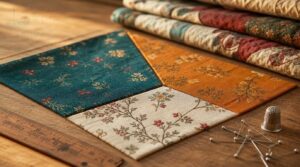
Simple blocks are your best friend when you’re just starting out. With only three or fewer fabric sections, the minimal seam count keeps things manageable and cuts down on fabric waste. You get sharp point tips without the stress.
Blocks like the 6-inch Economy Block come together fast, making quick block finishing totally doable. Your section layout strategy stays simple, and your confidence grows with every stitch.
Patterns With Numbered Sewing Lines
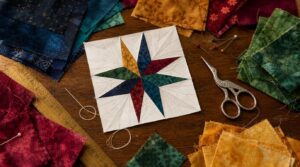
Numbered sewing lines are an essential tool for beginners. They turn confusing blocks into clear, step-by-step paper piecing instructions you can actually follow.
- Numbering conventions tell you exactly which piece goes where
- Reading line numbers keeps your sequence on track
- Aligning numbered sections prevents costly mix-ups
- Troubleshooting misalignments gets easier when numbers guide you back
- Designing custom cues helps you personalize Free Paper Piecing Patterns
Beginner-Friendly Foundation Paper Piecing starts here.
Scrap-friendly Foundation Piecing Projects
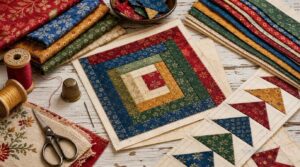
Got a pile of scraps you can’t bear to toss? Foundation paper piecing transforms them into something beautiful. Log Cabin blocks use light and dark strips for stunning Color Gradient Backgrounds, while Flying Geese Free Paper Piecing Patterns maximize every inch of Mixed Fabric Inserts.
Even tiny pieces find purpose in Recycled Fabric Collages or Upcycled Fabric Gifts. This Beginner-Friendly Foundation Paper Piecing approach makes scrap fabric utilization genuinely satisfying.
Small Blocks for Afternoon Sewing Projects
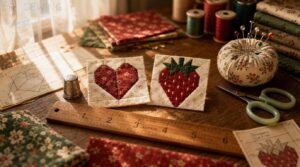
Have a free afternoon? Small blocks are your sweet spot. Pocket‑size projects like the Small Heart Block or 3‑Inch Strawberry Block finish in one to three hours using Free Paper Piecing Patterns.
Beginner‑Friendly Foundation Paper Piecing keeps it manageable — rapid fabric cutting, minimal seam allowance, and quick press methods move you along fast.
Time‑boxed quilting like this builds real confidence before tackling intermediate and complex quilting projects.
Small, time-boxed quilting projects build real confidence before tackling complex designs
Cushion, Pillow, and Tote Bag Pattern Ideas
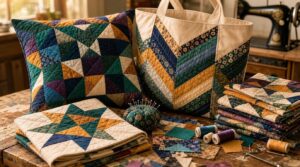
Foundation piecing isn’t just for quilts — your skills translate beautifully into cushions, pillows, and tote bags too. These DIY quilt projects using scrap fabric let you practice Beginner-Friendly Foundation Paper Piecing on a smaller scale with real, usable results.
- Cushions use reinforced seam techniques and custom insert sizing for a polished finish
- Totes need interfacing selection and handle design variations for structure and comfort
- Coordinated colorways tie your free foundation paper piecing pattern collection together across all three projects
Coordinated colorways ensure your projects harmonize visually, creating a cohesive collection from your free foundation paper piecing patterns.
Directional Fabric Placement Tips
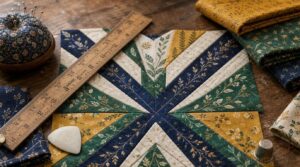
Once your cushions and totes take shape, fabric placement becomes your secret weapon for polished results.
Master Grain Alignment by running directional prints parallel to each block’s long edge—this stabilizes seams and prevents waviness. Prioritize Motif Orientation too: position bold design elements toward the center to balance visual weight. Always prewash fabrics before cutting to ensure Prewash Alignment and maintain dimensional accuracy.
| Placement Tip | What to Do | Why It Matters |
|---|---|---|
| Grain Alignment | Parallel to long edge | Prevents wavy seams |
| Motif Orientation | Center-facing elements | Balances visual weight |
| Seam Directionality | Stitch along grain | Reduces puckering |
| Fabric Stretch Management | Use quilting cotton | Holds direction better |
Color Coordination for Clean Block Designs
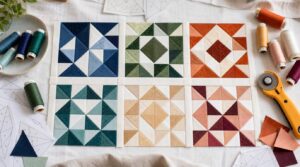
Color brings your blocks to life — but too many choices can muddy the whole design. Start with Palette Limiting: pick three to five colors max.
Use Analogous Pairing for neighboring blocks to keep flow smooth.
Add Neutral Breathing with white or gray to separate busy areas.
Check Contrast Ratios so your design reads clearly.
Let Mood Tones guide your color story from the start.
Advanced Foundation Piecing Designs
Once you’ve got the basics down, it’s time to push your skills further.
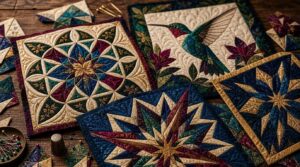
Expert foundation piecing opens up a whole new world of intricate designs — from tight geometric points to detailed nature motifs.
Here’s a look at the techniques and patterns that serious quilters love to tackle.
Multi-section Quilt Blocks
Some of the most rewarding Foundation Paper Piecing patterns come from multi-section quilt blocks. Each section locks into the next through Interlocking Seam Chains, while Precise Quarter-Inch Allowances keep everything square.
Plan your Sectional Color Progression early so the design flows across the Multi-Section Layout Grids.
Good Fabric Orientation Techniques make every seam land exactly where it should.
Tight-point Patterns Like Mariner’s Compass
Once you’ve nailed multi-section blocks, Mariner’s Compass is the definitive test. Every wedge demands Wedge Angle Precision and Center Hub Alignment to ensure all points meet cleanly at the center.
Employ Fabric Contrast Strategy—lights against darks—to make those spokes pop.
Paper Template Laminating adds durability, while Seam Allowance Minimization eliminates bulk at tight intersections.
Expert construction tips like these separate good blocks from stunning ones.
Curved-look Foundation Piecing Designs
Curved-look designs take your skills somewhere new. Instead of straight lines, you’re working with arc seam techniques and radial wedge alignment to create smooth, flowing shapes.
Choose your curved fabric selection carefully — lightweight, stable cottons behave best. Mind your seam allowance and curvature, ensuring precision for seamless results.
Always press curved seams from the top to keep edges flat, maintaining the integrity of your design.
Foundation Paper Piecing templates make these sophisticated construction tips for experienced quilters surprisingly manageable.
Detailed Animal and Nature Motifs
Animal and nature motifs bring your work to life. Think symbolic fauna like the Midnight Fox FPP pattern or a forest woodpecker rendered with textural shading and earth-tone seasonal palettes. Botanical integration weaves leaves around mythic creatures, turning blocks into tiny landscapes.
- Butterfly Foundation Paper Piecing pattern for delicate wing detail
- Midnight Fox FPP pattern with rich autumn tones
- Woodland birds using fine-line feather shading
- Floral borders framing animal centerpieces
Many free paper piecing patterns make these beginner-friendly foundation paper piecing options surprisingly accessible.
Large Wall Hanging and Quilt Patterns
Few projects feel as satisfying as creating a large wall hanging that stops people mid-step. Foundation Paper Piecing patterns like starburst and compass designs excel at this scale, preserving every sharp point with precision.
Use bold color palettes to ensure your design reads clearly from across the room. Choose oversized backing fabric to minimize seams and incorporate structural reinforcement at corners for durability.
Consider floating mounting with directional lighting to enhance textures and create a dynamic visual impact.
Assembly-line Piecing for Repeated Blocks
Think of assembly-line piecing as your quilting superpower for repeated blocks. Instead of finishing one block at a time, you work smarter.
- Use Template Reuse to pre-cut all foundations identically
- Lock in a Standard Seam Allowance across every seam
- Apply a Batch Pressing Workflow after each sewing round
- Keep Consistent Stitch Length at 1.5mm throughout
- Run Single-Point Quality Control checks before moving forward
Joining Numbered Sections Accurately
Numbered sections are your roadmap — follow them wrong and the whole design falls apart.
| Step | What to Do |
|---|---|
| 1. Hierarchical Header Structure | Match numbered units to your printed foundation |
| 2. Cross‑Reference Accuracy | Pin each section seam before joining |
| 3. Numbering Consistency Checks | Confirm unit order matches your pattern guide |
| 4. Page Break Alignment | Press seams flat before final assembly |
| 5. Automatic Section Linking | Nest units together in sequence, never skipping |
Top 4 Foundation Piecing Items
The right tools can make or break your foundation piecing experience. A few well-chosen items will save you time, reduce frustration, and help your blocks come out crisp every single time.
Here are four essentials worth adding to your sewing space.
1. Olfa 12×12 Self Healing Rotating Cutting Mat
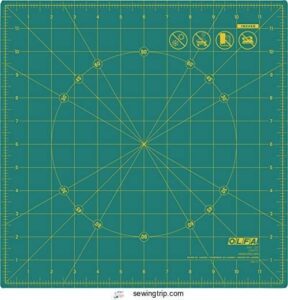
The Olfa 12×12 Rotating Cutting Mat is a revolutionary tool for foundation piecing. Its 360° rotation offers a huge benefit when trimming tiny FPP sections, as you can cut fabric from any angle without moving your work.
The self-healing polymer surface keeps your rotary blade sharp longer, while the built-in grid lines ensure precise 30°, 45°, and 60° cuts feel seamless.
At just 12×12 inches, it fits perfectly on any small cutting table or portable workspace.
| Best For | Quilters, sewists, and patchwork enthusiasts who work in tight spaces and want to cut fabric from any angle without constantly repositioning their project. |
|---|---|
| Primary Use | Quilting & patchwork cutting |
| Material | Self-healing polymer plastic |
| Color | Green top, black bottom |
| Unit Count | 1 rotating mat set |
| Fabric Layers | Multiple layers supported |
| Precision Support | Yellow grid markings |
| Additional Features |
|
- 360° smooth rotation lets you trim and cut from any direction without lifting or shifting your fabric
- Self-healing polymer surface protects your rotary blade and keeps the cutting area clean and smooth over time
- Compact 12×12 footprint slides easily onto a small table or portable setup without taking over your workspace
- Only works with rotary cutters—using a regular utility knife will damage the mat
- Needs to be stored flat and away from sunlight, or it can warp over time
- The 12×12 size works great for small projects, but larger quilts or fabric pieces will quickly outgrow it
2. OLFA 17×17 Rotating Cutting Mat
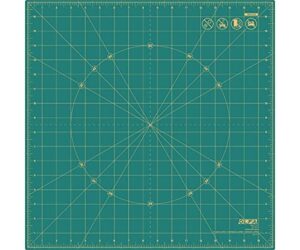
The 17×17 Rotating Cutting Mat offers more room to breathe compared to a 12×12 mat, accommodating larger fabric sections without crowding your workspace. Its expanded surface area ensures comfort and flexibility for bigger projects.
The mat features a 360° rotating top for smooth, effortless movement, while its non-slip base maintains stability during use. This dual-layer design combines functionality with precision.
Crafted with a self-healing surface, the mat protects both your rotary blades and worktable from damage, ensuring longevity for all components.
Measuring is simplified with grid lines and angle guides (30°, 45°, 60°, and 90°) printed directly on the mat, enabling quick, accurate cuts without additional tools.
| Best For | Quilters and sewers who want to cut and rotate fabric without constantly repositioning their work, especially on mid-sized projects. |
|---|---|
| Primary Use | Quilting & patchwork cutting |
| Material | Self-healing polymer plastic |
| Color | Green top, yellow grid |
| Unit Count | 1 rotating mat unit |
| Fabric Layers | Multiple layers supported |
| Precision Support | Yellow grid markings |
| Additional Features |
|
- The 360° rotating top saves a ton of time — spin the fabric instead of moving it around your table.
- The self-healing surface keeps your rotary blades sharper longer and protects your work table underneath.
- At 17×17 inches, it fits most sewing tables easily and handles bigger fabric pieces than a standard 12×12 mat.
- It only works with rotary cutters — grab a utility knife and you’ll damage the mat.
- The price is noticeably higher than a basic stationary mat, which might give budget-conscious hobbyists pause.
- 17 inches still isn’t huge; if you’re working on large quilts with long cuts, you may find yourself wishing for more surface area.
3. Karen Kay Buckley 6 Inch Serrated Scissors
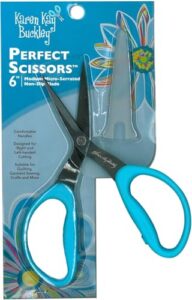
Once you’ve got your cuts sorted, you need scissors that keep up with the detail work. The Karen Kay Buckley 6 Inch Serrated Scissors are a go-to for foundation piecing because those micro-serrated blades grip fabric instead of letting it slide around. Slippery fabrics and tiny shapes? Not a problem.
The soft, ergonomic handgrips make long clipping sessions way more comfortable. At $31.41, they’re an investment — but when you’re trimming precise points, a reliable pair of scissors makes all the difference.
| Best For | Quilters and sewists who work with slippery fabrics, tiny shapes, or layered projects and need precise, comfortable cuts. |
|---|---|
| Primary Use | Fabric trimming & quilting |
| Material | Stainless steel blades |
| Color | Blue |
| Unit Count | 1 pair of scissors |
| Fabric Layers | Up to 8 layers |
| Precision Support | Micro-serrated grip edge |
| Additional Features |
|
- Micro-serrated blades grip fabric so it doesn’t slide — great for curves and tricky cuts
- Ergonomic handles make long trimming sessions much easier on your hands
- Can cut up to 8 layers at once, which is a real time-saver for quilting and appliqué
- At $31.41, they cost more than a basic pair of sewing scissors
- The protective blade cover isn’t always included, which is a bit frustrating
- Not ideal for heavy materials like leather or thick canvas — these are built for lighter fabrics
4. Clover Multicolor Flower Head Pin
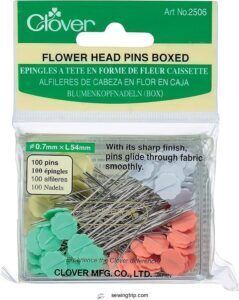
Pinning matters just as much as cutting. The Clover Multicolor Flower Head Pins are a real favorite for foundation piecing because their flat heads slide right under your presser foot without bunching fabric. Each pin is 54mm long, so it holds multiple layers together without budging. The colored heads make grabbing and spotting them a breeze.
You can even label them with a Sharpie to track quilt sections. Just remember: don’t iron directly over the heads.
| Best For | Quilters and sewists working with thick or multi-layered fabrics who need strong, visible pins that won’t shift mid-project. |
|---|---|
| Primary Use | Quilting & layered fabric pinning |
| Material | Steel shaft, resin head |
| Color | Multicolor heads |
| Unit Count | 21 pins per pack |
| Fabric Layers | Multiple layers supported |
| Precision Support | Flat head for alignment |
| Additional Features |
|
- Flat resin heads glide under the presser foot smoothly, no fabric bunching
- Long 54mm shaft holds multiple layers firmly in place
- Colored heads are easy to spot, and you can label them with a Sharpie to track quilt sections
- Plastic heads will melt if you iron directly over them
- The thicker gauge can leave noticeable holes in delicate fabrics
- Pins can dull over time, and the storage case has a habit of popping open on its own
Frequently Asked Questions (FAQs)
Which paper type tears away most cleanly after stitching?
Tissue-based and lightweight mulberry papers tear away most cleanly after stitching.
They pull off smoothly without snagging your cotton fabric or leaving messy fibers behind — making cleanup quick and easy.
Can foundation piecing patterns be resized for different blocks?
Yes, you can resize foundation piecing patterns. Scale your printed template by a percentage, ensuring adjustments are consistent. Always maintain ¼ inch seam allowances to preserve accuracy.
Before cutting fabric, test-print your scaled template to verify sizing and alignment. This step prevents errors and ensures precise results.
How do you press seams flat without distorting blocks?
Press seams from the wrong side using medium-to-high steam. Keep your iron perpendicular to the seams and let the block cool before handling.
This prevents stretching and keeps your block perfectly flat.
Where can beginners find foundation piecing video tutorials?
YouTube is your best starting point. Channels like Quilt from the Roots and The Little Green Bean offer clear, beginner-focused walkthroughs covering prep, seam allowances, and paper removal — all free.
Conclusion
A seasoned quilter once said her first Log Cabin block felt like learning to write her name—shaky at first, then suddenly natural. That’s exactly what happens when you find the best foundation piecing patterns for your skill level. Each block you finish builds your confidence. Each sharp point you nail proves you’re growing.
Start simple, push further when you’re ready, and let the paper guide carry you somewhere you never expected to go.
- https://www.nationalquilterscircle.com/post/best-foundation-piecing-method
- https://www.sewmamasew.com/free-paper-piecing-patterns/
- https://www.generations-quilt-patterns.com/free-paper-piecing-patterns.html
- https://remivailstudio.com/blogs/modern-quilting-tips/piece-perfect-mastering-the-art-of-foundation-paper-piecing-for-beginners?srsltid=AfmBOopcox8gEv-Po8xpinQVh_qtFpkXIuJWYaL5Eowo0ckcU6EXqFNq
- https://babylock.com/11-quilting-tips-for-flawless-foundation-paper-piecing?srsltid=AfmBOop6wLxp-o6fKneN-aCLZfnlk3n9xePzScbxnp1_Y73UQvBbRQlk