This site is supported by our readers. We may earn a commission, at no cost to you, if you purchase through links.
Your first sewing project probably came with a rude awakening: thread tangled into bird’s nests, seams puckering like accordion pleats, and hems that looked more “rustic” than refined. The culprit wasn’t your skill level—it was using the wrong stitch for the job.
Mastering essential stitches for home sewing transforms frustrating attempts into polished results, whether you’re hand-basting a dress fitting or machine-stitching stretchy knits. Think of each stitch as a specialized tool in your sewing kit: running stitches hold fabric temporarily, backstitches create bulletproof seams, and slip stitches vanish into hems like magic.
Once you understand which stitch solves which problem, you’ll stop fighting your fabric and start creating garments that actually look professional.
Table Of Contents
Key Takeaways
- Mastering eight foundational hand stitches (running, backstitch, basting, slip, catch, whip, blanket, and chain) gives you complete control over repairs, hems, and garment finishing without needing a machine.
- Your sewing machine’s four core stitches—straight stitch for wovens, zig-zag for stretch and fray prevention, overcast for edge finishing, and blind stitch for invisible hems—handle 90% of home sewing projects when paired correctly with fabric type.
- Matching needle size and type to your fabric weight (60/8 for delicates, 90/14 for denim) prevents skipped stitches and fabric damage, while thread selection between cotton, polyester, and blends determines seam strength and longevity.
- Proper fabric prep (pre-washing, ironing, grain alignment) and machine adjustments (stitch length 2.0-3.0mm for wovens, balanced tension, correct presser foot pressure) transform frustrating results into professional-looking seams.
Essential Hand Stitches for Home Sewing
You don’t need a sewing machine to create strong, beautiful projects—your hands are powerful tools once you master a few foundational stitches.
These eight hand stitches will give you the control to repair, hem, and finish garments with professional results.
Here’s what you need in your skillset to tackle almost any hand-sewing challenge.
Running Stitch—Uses and How-To
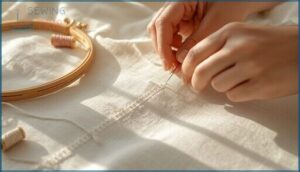
Think of the running stitch as your sewing gateway—it’s where hand stitch mastery begins. This foundational hand sewing technique lets you control fabric tension while you’re learning basic sewing skills.
Perfect for:
- Temporary seaming when you’re adjusting fit before committing
- Basting fabric layers together (2-3mm stitch length control works great)
- Gathering ruffles by pulling thread gently along the seam
- Edge finishing techniques on lightweight projects
- Quick repairs when hand sewing fundamentals are all you need
Just weave your needle in and out evenly—you’ll build confidence fast.
Backstitch—Strengthening Seams
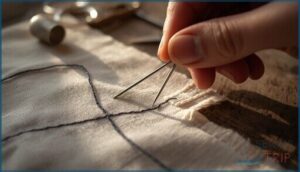
When you need seam reinforcement that won’t quit, backstitch is your go-to hand sewing technique. It creates a continuous line by doubling back on itself—think of it as stitch security on steroids. Start and end with 2-3 backstitches to anchor firmly.
Backstitch creates bulletproof seams by doubling back on itself—anchor each end with 2-3 reinforcing stitches for maximum hold
Watch your stitch tension to avoid fabric distortion, especially on delicate materials. Master this seam technique and backstitch variations will handle your toughest repairs.
Basting Stitch—Temporary Holds and Fitting
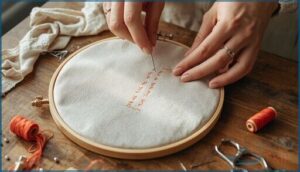
Unlike backstitch’s permanence, basting stitch gives you freedom to experiment. These long, loose running stitches—about 1/4 to 1/2 inch apart—hold fabric layers temporarily during fitting and fabric preparation. You’ll remove them easily after sewing.
Key basting techniques for temporary holds:
- Hand sewing offers precision control for delicate fabrics
- Machine basting speeds up larger projects with longest stitch length
- Contrasting thread makes stitch removal quick and painless
For perfect garment fits, mastering the sewing machine is essential.
Slip Stitch—Invisible Hems and Finishing
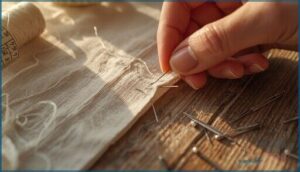
Slip Stitch Tips make the difference between visible and invisible hem finishing. This hand sewing technique creates invisible seams by catching just a few threads with each pass—about 2 to 3 millimeters apart.
Match your thread selection to your fabric choice for the best results. You’ll fold the fabric edge, then gently weave through the layers. Perfect hem work starts here.
Catch Stitch—Curved Edges and Flexibility
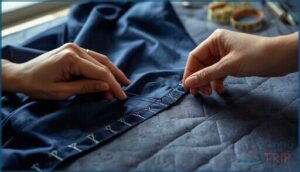
Curved edge finishing demands flexibility your other hand sewing techniques can’t deliver. The catch stitch creates small looped stitches on the fabric surface, providing edge stabilization that lets curved hems breathe without puckering.
You’ll space your fabric drape management stitches closer together—about 6 to 8 millimeters apart—on curves to maintain smooth curvature. This flexible seam technique prevents gaps while accommodating stretch better than a whip stitch ever could.
Whip Stitch—Joining and Edge Protection
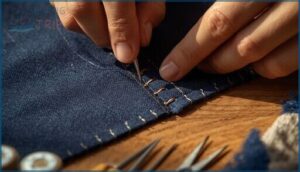
Whip Stitch transforms raw fabric edges into secure, fray-resistant finishes. This diagonal hand sewing technique wraps thread over edges, delivering edge protection with every pass—you’ll master fabric reinforcement that’s both quick and reliable.
Whip Stitch essentials for edge finishing:
- Thread selection: Choose sturdy polyester or embroidery floss that matches your fabric weight
- Stitch tension: Keep it even to prevent puckering or loose gaps
- Seam security: Space stitches 3-5mm apart for maximum coverage
Your sewing fundamentals just leveled up.
Blanket Stitch—Securing and Decoration
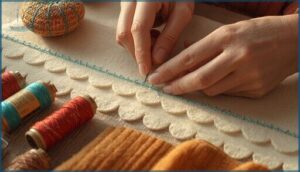
Blanket Stitch creates loops that dance along fabric edges—you’re securing and decorating at once. This hand sewing technique stops fraying while adding visual punch.
Master blanket stitch applications:
| Purpose | Technique | Best For |
|---|---|---|
| Edge finishing | Perpendicular diagonal stitches | Fleece blankets, felt projects |
| Fabric embellishment | Contrasting thread loops | Appliqués, decorative edging |
| Securing techniques | Even spacing, steady tension | Hems, bound edges |
Space your stitches 5-8 mm apart for consistent stitch patterns that protect and wow.
Chain Stitch—Decorative Details

Chain stitch weaves a continuous line of linked loops that brings texture and visual pop to your fabric surface. This hand sewing technique creates decorative stitches perfect for embroidery borders and appliqué outlines.
Master chain stitch variations with these essentials:
- Stitch tension control prevents puckering on woven fabrics like cotton poplin
- Thread selection tips: contrasting embroidery threads heighten decorative looping visibility
- Secure endpoints with backstitch to maintain fabric stability
- Adjust loop length for different stitch patterns and effects
Must-Know Machine Sewing Stitches
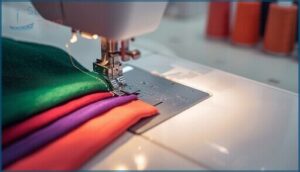
Now that you’ve got hand stitches under your belt, it’s time to fire up that machine and get comfortable with the stitches that’ll carry you through most of your sewing projects.
Your machine can do way more than you think—and mastering just a handful of core stitches will give you the freedom to tackle everything from simple hems to stretchy fabrics.
Here are the four machine stitches you absolutely need to know.
Straight Stitch—Foundational Machine Stitch
Think of the straight stitch as your sewing machine’s workhorse—it’s the default setting you’ll use constantly. Set your stitch length between 2.0 and 2.5 millimeters for most projects. Machine tension matters here: balanced tension keeps threads even on both sides without puckering or looping.
| Factor | Setting/Choice | Why It Matters |
|---|---|---|
| Stitch Length | 2.0-2.5mm | Perfect spacing for woven fabrics |
| Machine Tension | Balanced | Prevents puckering and looping |
| Fabric Choice | Woven materials | Straight stitch works best here |
| Thread Weight | Match to fabric | Ensures smooth, clean seams |
| Sewing Speed | Steady pace | Controls accuracy and precision |
Master this stitch and you’ll conquer machine sewing basics.
Zig-Zag Stitch—Stretch and Fray Prevention
Your sewing machine’s zig-zag stitch is your secret weapon for stretch stitching and fray prevention. Set a medium width with short length for fabric edge finishing on knits—you’ll maintain seam integrity without breaking threads.
This stitch distributes tension control beautifully, preventing puckering on woven fabric while covering raw edges. It’s perfect for stretch stitch applications where straight seams would snap.
Overcast Stitch—Edge Finishing
While zig-zag stitches handle stretch beautifully, the overcast stitch takes edge finishing to another level. Your sewing machine creates a narrow zigzag along raw edges that locks down fabric fraying before it starts.
Perfect for both woven and knit seam allowances, you’ll want to:
- Use lightweight thread selection to minimize bulk
- Adjust stitch density for tighter weaves
- Practice hand sewing techniques on scraps first
This sewing technique saves your seams from unraveling.
Blind Stitch—Invisible Hemming
Want hems that vanish like magic? The blind hem stitch on your machine creates invisible seams by catching just a few threads on the fabric face. Adjust stitch tension carefully—too tight puckers, too loose shows.
Hem allowances around 1/2 inch work best for most fabric selections. Practice hand sewing techniques first, then let your machine handle edge finishing with professional results.
Choosing The Right Needle and Thread
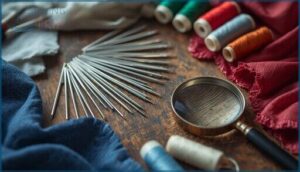
You can’t build a house without the right tools, and you can’t sew well without the right needle and thread. These two work as a team—get the pairing wrong, and you’ll end up with skipped stitches, broken thread, or fabric damage.
Let’s break down how to match your supplies to your project so every stitch comes out clean and strong.
Needle Types for Different Fabrics
Your fabric compatibility depends entirely on the needle you choose. Ballpoint needles glide through knits without snagging, while sharp needles pierce wovens cleanly.
Needle sizing matters too—60/8 for delicate silks, 90/14 for denim’s fabric thickness. Match your needle to your fabric’s personality, and you’ll achieve sewing precision that makes every stitch count.
Wrong needle? Hello, skipped stitches and frustration.
Thread Material and Weight Selection
Once you’ve picked the right needle, thread selection becomes your next power move. Your fiber blends and thread types shape every seam’s destiny.
Here’s what you need to know:
- Cotton thread works beautifully with natural fabrics and standard seams
- Polyester thread delivers exceptional tensile strength and colorfastness for synthetics
- Cotton-polyester blends balance both worlds with less shrinkage
- Weight selection matters—40 weight for everyday sewing, 60 for delicate work
Higher numbers mean finer thread, so choose wisely.
Matching Needle and Thread for Projects
Matching your needle and thread to fabric selection isn’t guesswork—it’s straight-up precision. For lightweight cottons, pair a 60/8 to 70/10 needle with fine polyester thread. Denim demands a 90/11 heavy-duty needle and sturdy thread for stitch tension control. Jersey knits? Grab a ballpoint needle and stretch thread.
Master this needle compatibility formula, and your hand sewing and sewing techniques will level up fast.
Key Sewing Techniques and Tips
Mastering the stitches is only half the battle—knowing how to use your machine and prep your fabric makes all the difference. These techniques will help you avoid puckered seams, wobbly lines, and those frustrating “why won’t this work?” moments.
Let’s cover the essential skills that’ll take your sewing from shaky to solid.
Adjusting Stitch Length and Tension
Think of stitch length control and tension balancing as the secret handshake between you and your machine—get it right, and your seams sing. Start with manufacturer defaults (usually 2.0–3.0 mm for wovens), then adjust based on fabric perforation and thread visibility.
Quick tuning checklist:
- Test on scrap fabric matching your project
- Check both sides for balanced appearance
- Increase tension if loops appear underneath
- Lengthen stitches for basting (over 4.0 mm)
- Shorten stitches (1.5–2.0 mm) for dense fabrics
Perfect seam integrity comes from practice, not excellence.
Using a Presser Foot for Accuracy
Your presser foot is the unsung hero of straight seams—it holds fabric flat while guiding it through feed dogs, so alignment stays locked and layers don’t wander. Lowering foot pressure on delicate silks prevents marks, while cranking it up keeps thick denim from lifting mid-stitch.
Modern machines let you adjust foot pressure to match fabric weight—heavier pressure for dense seams, lighter touch for chiffon. Practice on scraps until your needle centerline and foot edge become best friends, and those wobbly lines? History.
Foot Type Match-Up
| Foot Type | Best For | Accuracy Boost |
|---|---|---|
| Standard | General seams | Balanced fabric feed control |
| Walking | Multiple layers | Prevents slippage on slippery fabrics |
| Edge-stitch | Topstitching | Built-in seam allowance management guides |
Fabric Preparation Before Stitching
You can’t stitch your way to flawlessness if the fabric itself is a wrinkled mess. Pre-washing prevents fabric shrinkage after you’ve sewn, while ironing smooths out creases that sabotage seam accuracy.
Align grainlines before cutting—misaligned grain alignment twists hems and distorts drape.
Trim loose thread, inspect for flaws, and store fabric flat. This prep work transforms chaotic yardage into a canvas ready for hand sewing mastery using the right needle and thread selection for foolproof sewing techniques.
Practicing Stitches for Consistency
Your fingers won’t magically nail stitch consistency overnight—building muscle memory demands deliberate practice routines. Run the same hand sewing techniques (running stitch, backstitch) for five-minute focused blocks, then rest.
Studies show rhythm-based training cuts stitch length errors by 28%, boosting sewing accuracy. Grid templates improve technique while you weave straight stitch rows.
Track your progress: tighter tolerances prove you’re leveling up.
Decorative and Specialty Stitches

Once you’ve got the basics down, it’s time to have some fun with stitches that add personality and flair to your projects.
These decorative and specialty stitches let you take your sewing from purely functional to downright artistic. You’ll find they’re surprisingly easy to learn and incredibly satisfying to use.
Herringbone Stitch—Decorative and Functional
When your project needs serious holding power wrapped in elegance, the herringbone stitch delivers both. This hand sewing gem creates distinctive zigzag patterns while reinforcing edges that take a beating.
Master this adaptable technique and you’ll:
- Secure hems on heavy fabrics without bulky seams
- Add decorative topstitching to jackets and denim
- Reinforce fraying edges with flexible, stretchy coverage
- Control stitch tension for perfect flat finishes
- Explore herringbone variations across different fabric selections
Sashiko Stitch—Japanese Embellishment
From Japan’s Edo period comes the sashiko stitch—a simple running stitch that transforms plain fabric into art. This Japanese embroidery technique uses evenly spaced stitches (2-3 mm apart) to create geometric patterns with cultural significance.
Originally developed for reinforcing workwear, sashiko history reveals how practical hand sewing evolved into beloved decorative embroidery. Master this stitch anatomy and you’ll discover centuries of HandSewing for Beginners tradition.
French Knot—Adding Texture
While sashiko brings clean lines, French Knot embroidery creates tiny raised dots that pop off your fabric. This Hand Sewing Techniques gem uses thread wrapping around your needle—1 to 2 wraps for lightweight fabrics.
Knot tension matters: too tight puckers, too loose flops. Your Fabric Choice affects texture control, and this embellishment technique transforms flower centers or berries into dimensional art through strategic Sewing Stitches and Techniques.
Using Blanket and Overcast Stitches Creatively
Beyond dots and lines, blanket stitch and overcast stitch release your creative sewing freedom. These hand-sewing workhorses do double duty: edge finishing meets fabric embellishment when you break tradition.
Textile art moves you’ll love:
- Blanket Stitch with contrasting thread turns appliqué edges into bold graphic statements
- Loose spacing mimics whip stitch for folk-art vibes on felt
- Overcast Stitch creates fringe-like texture when extended past the edge
- Layer both at corners where bias-cut fabric needs extra muscle
- Mix thread weights between stitch variations for intentional design contrast
Your edge work just became your signature.
Frequently Asked Questions (FAQs)
How do I fix skipped stitches on my machine?
Nearly 70% of skipped stitches stem from threading errors or dull needles. Check your bobbin maintenance first, then inspect your needle.
Re-thread completely, adjust tension, and test stitch selection on scrap fabric.
Whats the best way to sew stretchy fabrics?
Use a stretch stitch or zig-zag stitch on your machine with a ballpoint needle. This lets your elastic seams move with knit stitching while preventing thread breaks and preserving fabric recovery.
How do I prevent thread from tangling while sewing?
Tangling? Let’s call it what it is—your machine throwing a tantrum. Check your thread tension first, clean that bobbin area, match your needle to fabric weight, and prep fabric properly for tangle prevention.
When should I replace my sewing machine needle?
Replace your needle every 8 to 12 hours of sewing or after each project. Bent needles, thread breakage, and fabric snags signal it’s time for fresh needle replacement—essential sewing machine maintenance.
How do I sew buttonholes without a buttonhole foot?
Picture buttonhole edges framed by careful stitches—no special foot needed. Create guide marks, set your machine to narrow straight stitch, pivot at corners, and hand-guide with steady precision for professional manual buttonholes.
Conclusion
Think of essential stitches for home sewing as your liberation toolkit—each one unlocks a new level of independence from tailors, repair shops, and ill-fitting clothes.
You’ve now got the technical vocabulary and hands-on know-how to diagnose fabric problems and pick the exact stitch that solves them. No more guessing or botched hems.
Just grab your needle, thread your machine, and start building garments that actually fit your life—and your body.
- https://www.seamwork.com/sewing-tutorials/topstitching?srsltid=AfmBOoo6dVVgMDOMpwcoogKu7P1Kpmz316c28owMFdBYiIKvG-jpUXVL
- https://sabrinawhartonbrown.wordpress.com/2011/05/23/how-to-get-your-sewing-machine-thread-tension-and-stitch-quality-right/comment-page-2/
- https://siemachtsewingblog.com/2023/05/how-to-fix-puckered-fabric/
- https://madamsew.com/blogs/sewing-blog/basting-technique-everything-you-need-to-know-about-basting-in-sewing
- https://www.youtube.com/watch?v=vVoCJOD8z7M