This site is supported by our readers. We may earn a commission, at no cost to you, if you purchase through links.
size 80/12 needle punched through silk chiffon leaves a trail of tiny holes that no amount of pressing will fix. That single wrong choice can ruin yards of expensive fabric before you’ve sewn a single seam. Needle sizing isn’t complicated, but the consequences of ignoring it are.
numbers on needle packaging—those paired figures like 90/14 or 100/16—tell you exactly how thick the shaft is and how much force it delivers through your fabric. Match them correctly, and your stitches land clean and even. Get them wrong, and you’re fighting skipped stitches, broken threads, and damaged weaves all afternoon.
Knowing size needle for different fabrics separates guesswork from precision—and the chart and guidelines ahead make that choice straightforward.
Table Of Contents
- Key Takeaways
- How Sewing Machine Needle Sizes Work
- Needle Size Chart for Different Fabrics
- Universal Needles: When to Use Them
- Ballpoint and Stretch Needle Sizes
- Denim and Heavy Fabric Needle Sizing
- Leather and Vinyl Needle Requirements
- Specialty Needle Sizes and Applications
- Top 9 Sewing Machine Needles
- 1. Schmetz Universal Sewing Machine Needles
- 2. Organ Ball Point Sewing Machine Needles
- 3. SCHMETZ Stretch Sewing Machine Needles
- 4. Schmetz Denim Machine Needles
- 5. SCHMETZ Leather Sewing Needles
- 6. Schmetz Quilt Machine Needles
- 7. Brother Embroidery Machine Needles
- 8. SCHMETZ Microtex Sewing Machine Needles
- 9. SCHMETZ Twin Stretch Sewing Machine Needle
- How to Choose The Right Needle
- Common Needle Problems and Solutions
- Frequently Asked Questions (FAQs)
- Conclusion
Key Takeaways
- Needle size maps directly to fabric weight — sizes 60–75 for delicate sheers, 80–90 for everyday cottons and linens, and 100–110 for heavy denim or canvas, with no room for guesswork.
- needle type matters — universal needles handle most wovens, but knits need a ballpoint or stretch needle, leather demands a wedge point, and forcing the wrong tip ruins the fabric permanently.
- thread breakage aren’t tension problems — they’re your machine telling you the needle is the wrong size or past its useful life, which tops out at 6–8 hours of sewing.
- Thread weight and needle eye size must match — a 40-weight polyester runs cleanly through an 80/12, but metallic or heavy topstitch thread needs a 90/14 to 100/16 with a larger eye to prevent shredding.
How Sewing Machine Needle Sizes Work
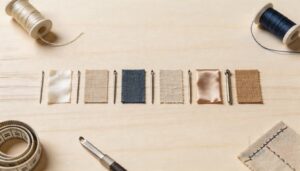
Needle sizing isn’t random — there’s a real system behind those numbers, and once you understand it, picking the right needle becomes second nature. Both European and American scales follow a clear logic tied directly to shaft thickness.
If you want a side-by-side breakdown of both systems, this sewing needle size and selection guide maps out exactly how European and American numbers line up.
Here’s how each system works and what those numbers actually mean.
European Sizing System (60-110)
European sizing system measures needle shaft diameter in hundredths of a millimeter — so a size 60 needle is 0.60 mm across, and a size 110 hits 1.10 mm. No guesswork, no arbitrary scale.
Larger number, thicker needle, heavier fabric.
Your needle size chart will show these European sizes paired with their US equivalents, like 80/12, using dual-system labeling that keeps fabric weight categories crystal clear.
American Sizing System (8-18)
The American sizing system runs 8 to 18 — think of it as the simplified sibling of the European metric scale. Size 8 manages lightweight fabrics; size 18 addresses heavy ones. Most packages show both together (80/12), making needle size conversion straightforward.
Quick gauge conversion tips to keep handy:
- Size 8–11 suits delicate, lightweight fabrics
- Size 12–14 covers everyday medium-weight projects
- Size 16–18 powers through heavyweight materials
That dual labeling is your best machine compatibility check.
How Size Numbers Relate to Needle Thickness
Both systems follow the same logic: higher numbers mean thicker needles. The metric size literally tells you the shaft diameter — size 80/12 has a 0.80 mm blade, size 90/14 measures 0.90 mm, and size 100/16 reaches 1.00 mm.
The guide lists recommended needle sizes for fabrics such as 60/8 for silk and 90/14 for denim.
That shaft diameter impact is real. Thicker needles pierce dense fabrics cleanly but punch oversized holes in delicate ones. Match your needle thickness to your fabric weight, and your thread tension follows naturally.
Match needle thickness to fabric weight, and thread tension follows naturally
Ignore the number-thickness correlation, and you’re auditioning for a ruined project.
Needle Size Chart for Different Fabrics
Getting the right needle size comes down to knowing your fabric’s weight. Every fabric category has a sweet spot — use the wrong size and you’ll end up with puckered seams or broken thread.
Here’s how the sizes break down across the four main fabric weight groups.
Lightweight Fabrics (Size 8-11 / 60-75)
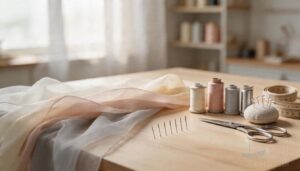
Delicate fabrics punish the wrong needle fast. For lightweight materials — silk, chiffon, organza, and voile — stay within size 60–75 (US 8–11). These fabrics generally fall in the 60–75 GSM range, and fiber blend selection matters: silk blends, viscose, and fine cotton each behave differently under the foot. A size 60 (US 8) universal needle minimizes visible holes in sheers, protecting drape and flow.
| Fabric Type | Needle Size |
|---|---|
| Silk & Chiffon | 60–70 (US 8–10) |
| Organza | 60–65 (US 8–9) |
| Fine Cotton / Voile | 65–75 (US 9–11) |
| Viscose / Rayon | 70–75 (US 10–11) |
Breathability factors and summer garment tips go hand in hand here — loose weaves need gentle penetration. Check your sewing machine needle size chart before you cut a single seam.
Medium Weight Fabrics (Size 12-14 / 80-90)
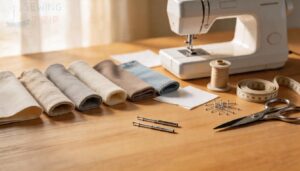
Most everyday sewing projects land squarely in the medium weight range — cotton poplin, linen, polyester blends, and flannel all belong here. Reach for size 80/12 or size 90/14, and you’ll get clean penetration without tearing the weave.
The real skill is reading drape vs structure. A ponte knit holds its shape; a viscose blend wants to flow. Both fall in this range, but they behave under tension. Fabric pre-washing benefits you here — skip it, and your finished seam allowances shift after the first wash. Use stabilizing interfacings at collars and hems to hold form without bulk.
| Fabric | Needle Size |
|---|---|
| Cotton Poplin / Linen | 80/12 – 90/14 |
| Polyester Blend / Flannel | 80/12 |
| Ponte Knit / Light Denim | 90/14 |
Set thread tension to mid-range. Keep stitch length between 2.5–3.0 mm. Check your needle size chart before every project — choosing the correct needle size for fabric weight isn’t optional.
Heavyweight Fabrics (Size 16-18 / 100-110)
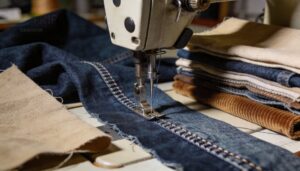
Dense fabrics don’t forgive weak needles. For heavyweight fabrics — denim, canvas, twill — you need size 100/16 or size 110/18. Denim and heavy fabric needle sizing starts here.
Use a reinforced jeans needle, set stitch length to 3.0–3.5 mm for Stitch Length Optimization, and adjust Thread Tension Adjustment slightly looser.
Fabric Pre-washing Benefits include reduced shrinkage before Layered Seam Reinforcement on multi‑ply projects.
| Fabric | Needle Size | Application |
|---|---|---|
| Heavy Denim | 110/18 | Jeans, jackets |
| Canvas | 100/16 – 110/18 | Bags, upholstery |
| Twill | 100/16 | Workwear, aprons |
| Corduroy | 100/16 | Pants, coats |
| Duck Cloth | 110/18 | Heavy outerwear |
Extra Heavy Fabrics (Size 18-20 / 110-120)
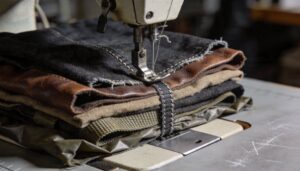
When fabric stacks hit three or four layers, a size 110/18 needle stops being optional — it’s the floor. For upholstery canvas, thick leather, or multi-layer denim, push to size 120/20.
Apply Stitch Length Adjustment (3.5–4.0 mm), loosen Thread Tension Management slightly, and always account for Fabric Pre-wash Effects before cutting.
Reinforced Seam Allowance and proper Pressing Techniques prevent blowouts on heavy seams.
| Fabric | Needle Size |
|---|---|
| Multi-layer Denim | 110–120 / 18–20 |
| Thick Leather | 110–120 / 18–20 |
| Heavy Upholstery Canvas | 110–120 / 18–20 |
| Reinforced Webbing | 110–120 / 18–20 |
| Industrial Canvas/Tarps | 120 / 20 |
Universal Needles: When to Use Them
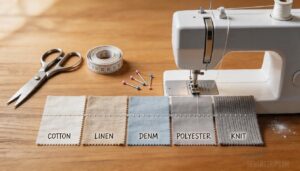
Universal needles are the workhorse of your sewing kit — adaptable enough to handle most everyday fabrics without a second thought. But knowing exactly when to reach for one (and when not to) makes all the difference between a clean seam and a ruined project.
Here’s what you need to know.
Best Fabrics for Universal Needles
Universal needles are the workhorse of your needle collection—reliable across most woven fabrics without fuss. Match the needle size to fabric weight, and you’ll get clean stitches every time.
They work well on:
- Fine silk chiffon and light organza at size 60–70 (US 8–10)
- Soft voile fabric and batiste with a 70/10
- Cotton poplin blend at 80/12 for crisp, even seams
- Linen-cotton mix at 80–90 for consistent penetration
- Medium-weight polyester blends where fabric compatibility isn’t a concern
Skip universal needles on knits and leather.
Recommended Size Range for Everyday Sewing
Most household sewing lands squarely in the 70/10 to 90/14 range—and for good reason. These three sizes handle the majority of woven projects without fuss.
- Size 70/10 — sheer silks, voile, and delicate wovens
- Size 80/12 — your baseline for cotton, standard shirtings, and polyester blends
- Size 90/14 — heavier linen, calico, and light denim
- Thread Compatibility — match all-purpose polyester thread to needle size and fabric weight
- Stitch Length Adjustment — dial down to 2.0–2.5 mm on lighter fabrics; increase for heavier layers
Start at 80/12, adjust from there.
Limitations of Universal Needles
A universal needle is a workhorse — but even workhorses stumble on the wrong terrain. Knit fabrics are where they fail first: the slightly rounded tip still pierces yarn instead of parting it, causing snagging, runs, and limited stretch performance.
On elastic or spandex blends, expect thread tension mismatch and skipped stitches. Push one through heavy denim or canvas, and heavy fabric deflection can bend or break the shaft entirely.
Burr accumulation happens faster, too, making needle maintenance non‑negotiable. Here’s what universal needles struggle with:
| Fabric Type | Needle Problem | Better Alternative |
|---|---|---|
| Knits, jersey | Fabric puckering risk, runs | Ballpoint or stretch needle |
| Heavy denim, canvas | Deflection, breakage | Denim needle, size 100–110 |
| Leather, vinyl | Irregular holes, tearing | Wedge‑point leather needle |
Match fabric compatibility to the right tool — every time.
Ballpoint and Stretch Needle Sizes
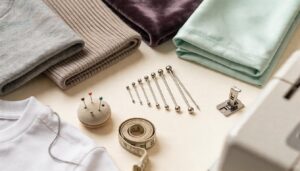
Knit fabrics don’t play by the same rules as wovens, and your needle choice has to reflect that. The wrong tip tears through yarn loops instead of sliding between them — and that’s how a perfectly good t-shirt gets ruined.
Here’s what you need to know about sizing for every stretch situation.
Needle Sizes for Knit Fabrics
Knit fabric handling punishes wrong needle choices fast. A universal needle cuts yarn loops, causing knit fabric puckering and broken seams before you’ve finished a single seam. Choosing the correct needle size for fabric weight is everything here.
- Lightweight knits: ballpoint needles, size 60–75 (US 8–11) for minimal needle marks
- Mid-weight jersey and interlock: size 70–80 (US 10–12) for stitch length optimization
- Heavier fleece: size 90–100 (US 14–16) to manage knit yarn tension
- Highly elastic spandex blends: stretch needles, size 80–90 (US 12–14) for needle shaft flexibility
- Poor knit seam finish? Move up one size immediately
Jersey and T-Shirt Fabric Recommendations
Jersey and T-shirt fabrics demand ballpoint needles sized 70/10 or 75/11 for lightweight cotton and viscose knits — choosing the correct needle size for fabric weight prevents yarn damage and protects print quality. Medium-weight tees need 75/11 or 80/12. Heavier sweatshirt jersey jumps to 90/14.
Pre-shrinking techniques before cutting also improve fabric stretch recovery and thread compatibility throughout construction.
Highly Elastic Material Guidelines
Sweatshirt jersey tops out at 90/14 — but spandex blend sizing is a different game entirely. Swimwear and activewear fabrics (think nylon stretch needles for 15–40% spandex nylon blends) need a true stretch needle, not a ballpoint.
Elastic fabric tension is unforgiving; the wrong needle skips stitches every time.
- Use 75/11 stretch needles for lightweight rayon elastane tension and Lycra cuts.
- Handle latex thread handling carefully — pair with polyester thread for 17–20% give.
- Ballpoint and stretch needle sizes diverge precisely here: ballpoint crushes yarn; stretch needles slip through.
Denim and Heavy Fabric Needle Sizing
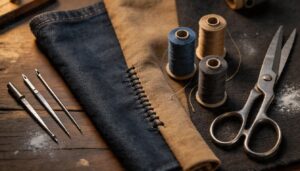
Heavy fabrics don’t forgive the wrong needle — they’ll bend it, skip stitches, or chew through your thread before you finish a seam. Denim, canvas, and upholstery each have their own demands, and the size you choose makes or breaks the project.
Here’s what you need to know for each one.
Best Needle Size for Denim
Denim weight classes dictate everything. Light denim (7–9 oz) works well with a 90/14 needle. Step up to size 100/16 for standard 10–12 oz fabric — it drives through dense weaves without puckering.
Heavyweight fabrics at 12 oz and above need a 110/18. Use this needle size chart as your baseline, then match thread size to avoid skipped stitches on every seam.
Canvas and Upholstery Fabric Needles
Canvas and upholstery fabrics aren’t forgiving — they’ll expose a weak needle fast. For light canvas (7–10 oz), start with size 100/16; move to size 110/18 for anything heavier. Skip universal needles entirely.
A denim needle’s reinforced shaft resists bending through dense weaves, while its large eye design ensures thread compatibility with bonded nylon or polyester.
Needle coating options reduce friction in industrial sewing applications and layered canvas techniques.
Multiple Layer Stitching Considerations
Stacking three or more heavy layers is where most home machines meet their match. For fabric layer stitching through dense seams, a 100/16 or 110/18 jeans needle prevents deflection at bulk intersections — your needle size directly impacts stitch quality and fabric damage risk.
- Layer Alignment Techniques: Pin or baste edges before feeding to prevent shifting
- Walking Foot Use: Distributes even pressure across thick stacks for consistent feeding
- Presser Foot Pressure: Reduce slightly to avoid crushing bulk at seam intersections
- Stabilizer Selection + Stitch Length Adjustment: Use a backing stabilizer and lengthen stitch to 3.0–3.5mm to prevent tunneling
Leather and Vinyl Needle Requirements
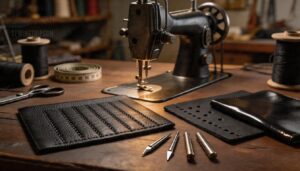
Leather and vinyl don’t forgive the wrong needle — one bad pass, and you’ve got permanent holes you can’t undo. These materials need a purpose-built approach, from wedge-point sizing to handling faux alternatives and thick non-wovens.
Here’s what you need to know before you sew a single stitch.
Wedge-Point Needle Sizes for Leather
Leather doesn’t forgive the wrong needle — tip geometry is everything here. Use a leather wedge needle in sizes 70/10 to 90/14 for hides up to 1.2 mm.
Heat treatment keeps the tip sharp through dense passes.
Eye size matching matters too: thread compatibility between a size 80/12 and your thread weight prevents fraying.
For thicker hides or layered assemblies, step up to 90/14 or 100/16.
Faux Leather and Synthetic Materials
Faux leather isn’t one material — it’s a family. PU versions are soft and flexible; PVC runs stiffer with a glossier Surface Finish. That difference drives your needle choice. PU Backing Material Types respond well to a wedge or Microtex 80/12. Heavier PVC layers need 90/14 to 100/16 leather needles. Breathability Concerns don’t affect stitching, but Cleaning & Maintenance habits mean holes are permanent — no fabric recovery here.
Follow these fabric compatibility rules:
- Use Microtex 70/10 or 80/12 for thin PU faux leather
- Choose leather needles 90/14–100/16 for stiff PVC surfaces
- Set stitch length to 2.5–3.0 mm to limit perforation damage
- Fit a Teflon presser foot to prevent dragging on coated finishes
- Always test on scrap — thickness varies widely across synthetic leather types
Heavy Non-Woven Fabric Guidelines
Heavy non-woven fabrics — think industrial filtration media, needle‑punched felt, or thermally bonded interfacing — demand the same weight‑based logic as any woven material. Their Bonding Techniques and surface treatments affect how a needle penetrates, so fabric weight still drives your size choice.
Start at 90/14 for medium Heavyweight non‑wovens; jump to 100/16 when Mechanical Strength and density increase. Needle Punching structures especially resist penetration — use a sharp universal, never a ballpoint.
Test scraps first. These substrates don’t forgive bad choices.
Specialty Needle Sizes and Applications
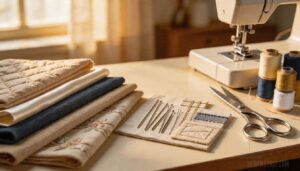
Not every project fits neatly into the universal-ballpoint-denim box, and that’s where specialty needles earn their place.
Quilting, embroidery, twin stitching, and topstitching each demand a specific needle size and design to do the job right. Here’s what you need to know for each one.
Quilting Needle Size Recommendations
Quilting needles have a tapered point built to pierce multiple layers without shredding cotton fibers or displacing quilt batting. Your needle size guide starts with fabric weight. Here’s how to match the right needle to each stage:
- Piecing quilt top fabric – Use 70/10 or 75/11 with 50-weight thread for clean seams.
- Stitching through batting layers – Switch to 90/14; it accommodates quilt batting thickness without skipping.
- Managing quilt stitch length on lightweight quilts – An 80/12 works adequately.
- Dense quilts with heavy thread – Move to 100/16 for quilt thread compatibility and clean penetration.
Embroidery Needle Sizing
Embroidery needles are built around one rule: thread weight determines needle eye size. Start with a 75/11 for standard 40-weight thread — it accommodates most fabrics and stitch density without punching visible holes.
Move to 80/12 or 90/14 when thread gets heavier or stabilizer matching demands more fabric penetration. For metallic needles and metallic threads, the larger eye prevents shredding.
Twin and Triple Needle Options
twin and triple needles mount two or three points on one shank, sharing a single bobbin thread. Twin needle spacing runs from 1.6 mm to 4.0 mm — narrower gaps suit lightweight fabrics, wider ones handle denim. Foot compatibility matters; confirm your machine can handle multiple threads before starting. Adjust thread tension and stitch length carefully on a scrap first.
Three common setups worth knowing:
- 2.5/80 universal twin for medium fabric weight wovens
- 4.0/75 ballpoint stretch twin for knits
- 2.5/80 triple for bold decorative lines on stable wovens
Topstitch and Metallic Thread Needles
Standard needles shred metallic thread fast — the eye is too small, and friction is too high. Topstitch and metallic needles solve this with a larger Eye Size Design that feeds thick or multi‑filament threads cleanly. Many feature Coated Needle Benefits like titanium or Teflon finishes, reducing Heat Dissipation issues during long runs. Shank Compatibility stays standard 130/705H, so no machine adjustments needed.
| Thread Type | Needle Size | Needle Type |
|---|---|---|
| 40-weight metallic | 90/14 | Metallic coated |
| Thin metallic | 80/12 | Metallic coated |
| Heavy topstitch | 100/16 | Topstitch |
| Standard topstitch | 90/14 | Topstitch |
| Decorative thick | 80/12 | Topstitch |
Match size to thread weight first, then fabric. Proper Thread Tension Management prevents bird-nesting at the bobbin — loosen upper tension slightly when running metallics.
These topstitch needle considerations apply whether you’re consulting a Sewing machine needle size chart and reference guide or working from experience. Metallic needle requirements and topstitch needles aren’t optional upgrades; they’re damage control.
Top 9 Sewing Machine Needles
Not all needles are created equal, and the brand and type you reach for can make or break your project.
These nine options cover the full range — from everyday wovens to stretch knits, denim, leather, and beyond. Here’s what’s worth keeping in your sewing kit.
1. Schmetz Universal Sewing Machine Needles
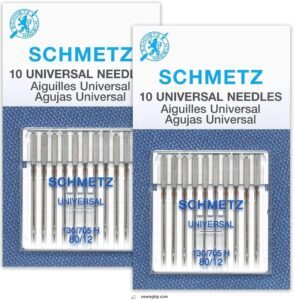
If you need one needle that manages most of what lands on your cutting table, Schmetz Universal is it. These System 130/705 H needles cover roughly 80% of everyday sewing — cotton shirts, linen blends, lightweight home décor, even casual knits. The slightly rounded point works its way through woven and knit constructions without punching visible holes or snagging fibers.
Sizes run from 60 to 110, so you can dial in the right fit for your fabric weight. The model 1833 pack gives you 20 needles across two cards for $11.67 — solid value when you’re rotating needles every 6–8 hours as you should. Stitch quality stays consistent across polyester and cotton threads.
Just don’t reach for these on heavy denim, leather, or anything that demands a specialty point.
| Best For | Hobbyists and everyday sewers who work with a mix of woven and knit fabrics and want one reliable needle that handles most projects without breaking the bank. |
|---|---|
| Brand | Schmetz |
| Pack Size | 20 needles |
| Price | $11.67 |
| Machine Compatibility | Most home machines |
| Fabric Type | Wovens and light knits |
| Needle System | 130/705 H |
| Additional Features |
|
- Works with most home sewing machines — no hunting for brand-specific needles
- The slightly rounded point glides through wovens and knits without snagging or leaving holes
- 20 needles for $11.67 is great value, especially when you’re swapping them out regularly
- Not the right call for heavy denim, leather, or thick materials that need a sharper or specialty point
- Only one needle type in the pack, so you’ll need separate purchases for ballpoint or denim needles
- Size 80/12 only — if your project needs a different weight, this pack won’t cover you
2. Organ Ball Point Sewing Machine Needles
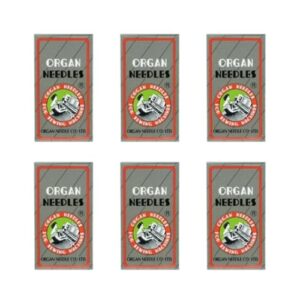
Knit fabrics punish the wrong needle fast — runs, snags, and skipped stitches are the price of using a sharp point on jersey or interlock. That’s where Organ ball point needles earn their place. The rounded tip slides between yarns instead of piercing them, preserving the fabric’s loop structure stitch after stitch.
This NaFurAhi set gives you 60 needles across six sizes — 65/9 through 100/16 — so you’re covered from lightweight jersey to heavier fleece without buying separate packs. Match your size to fabric weight: 70/10 to 80/12 for light knits, 90/14 to 100/16 for medium to heavy. Needle threaders are included, which is a small but practical touch.
At $15.97, it’s a workable investment for anyone regularly sewing stretch materials.
| Best For | Home sewers who regularly work with knit, jersey, or stretch fabrics and want a reliable needle variety pack without buying multiple separate sets. |
|---|---|
| Brand | Organ/NaFurAhi |
| Pack Size | 60 needles |
| Price | $15.97 |
| Machine Compatibility | Most home machines |
| Fabric Type | Knit and stretch fabrics |
| Needle System | Ball point |
| Additional Features |
|
- 60 needles across six sizes means you’re covered for everything from thin jersey to heavy fleece — all in one purchase.
- The ball-point tip slides between fabric fibers instead of piercing them, so no more snags or runs on stretch materials.
- Needle threaders are included, which is a genuinely handy addition most packs skip.
- These won’t work on woven or non-stretch fabrics — you’ll still need a separate sharp needle pack for those.
- Compatibility isn’t guaranteed on every machine, especially industrial or specialty models.
- Needles dull over time and need regular swapping out, so the pack won’t last forever if you sew heavily.
3. SCHMETZ Stretch Sewing Machine Needles
Highly elastic fabrics like spandex and lycra will expose every shortcut — and using the wrong needle is the most expensive one.
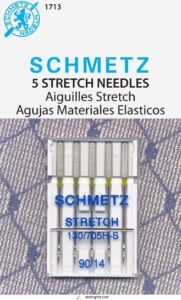
The SCHMETZ Stretch needle, identifiable by its yellow color band, is engineered specifically for these materials.
Its medium ball point tip glides between fibers rather than piercing them, while the deeper scarf geometry keeps thread loops tight and consistent, eliminating the skipped stitches that plague standard jersey needles on performance fabrics.
Reach for size 75/11 on lightweight stretch materials — think activewear liners or thin swimwear.
Move up to size 90/14 for thicker elastic layers or heavier spandex blends.
The reinforced blade resists deflection through dense seams, so you won’t be nursing a bent needle mid-project.
Compatible with most flat-shank domestic machines, this five-needle pack covers everything from minky baby blankets to athletic compression gear with no tension drama.
| Best For | Home sewists who regularly work with stretch fabrics like spandex, knits, or minky and want clean, skip-free stitches without fighting their machine. |
|---|---|
| Brand | Schmetz |
| Pack Size | 5 needles |
| Price | $4.72 |
| Machine Compatibility | Most flat-shank domestic |
| Fabric Type | Highly elastic stretch fabrics |
| Needle System | Medium ball point |
| Additional Features |
|
- The medium ball-point tip slides between fibers instead of piercing them, which means less distortion and smoother stitches on stretchy materials.
- Works with most major home sewing machine brands right out of the box — no adapters, no fuss.
- Covers a wide range of stretch projects, from lightweight activewear to thick elastic waistbands, all in one five-needle pack.
- These are built for home machines only — if you’re running industrial equipment, you’ll need to look elsewhere.
- Very stretchy fabrics may still require some tension and stitch length tweaking before things look right.
- A few customers have reported receiving the wrong needle type due to fulfillment mix-ups, so it’s worth double-checking your order when it arrives.
4. Schmetz Denim Machine Needles
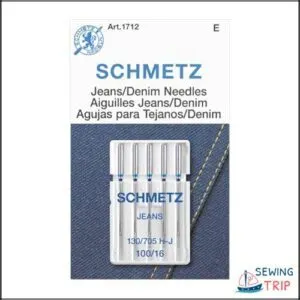
Denim doesn’t negotiate — and neither should your needle. The Schmetz Denim needle (blue band, model 0630706) is built with a reinforced blade and a modified medium ball point that punches through dense weaves, multiple layers, and flat-felled seams without bending or snapping mid-stitch.
Size selection is straightforward: use 90/14 for standard single-layer denim, step up to 100/16 for thick seams or quilted layers, and reach for 110/18 when you’re stacking extra-heavy material. The larger eye manages topstitching thread without fraying, and the reinforced shaft resists deflection where universal needles would buckle.
Each pack includes five needles at $4.72 — enough to cover a full jeans project with spares. Compatible with most domestic machines including Juki, these needles deliver clean, consistent stitches on canvas, heavy twill, and upholstery fabric too.
| Best For | Home sewers and professionals who regularly work with denim, canvas, or other heavy fabrics and need a reliable needle that won’t bend or break under pressure. |
|---|---|
| Brand | Schmetz |
| Pack Size | 5 needles |
| Price | $4.72 |
| Machine Compatibility | Most domestic machines |
| Fabric Type | Denim and heavy fabrics |
| Needle System | Modified ball point |
| Additional Features |
|
- Built tough — the reinforced blade handles thick seams, multiple layers, and dense weaves without snapping mid-stitch
- Works with a wide range of domestic machines (including Juki) and tackles everything from jeans hems to upholstery
- Great value at $4.72 for a pack of five, plenty to get through a full project with extras to spare
- Size 16/100 only — not the right pick for lightweight or delicate fabrics, so you’ll need a different needle for those
- Five needles per pack can go fast if you’re sewing at high volume and may mean frequent repurchasing
- No info on warranty or needle tip specifics, so it’s hard to know exactly how it’ll perform on every fabric type
5. SCHMETZ Leather Sewing Needles
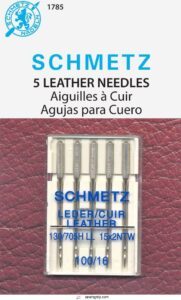
Leather eats ordinary needles alive — that’s just the physics of dense, non-woven material.
The SCHMETZ Leather Needle (model 73083) solves that with an LL cutting point, a wedge-shaped blade that slices through hides instead of punching ragged holes.
You get clean entry, flat-sitting seams, and none of the skipped stitches that wreck an otherwise solid project.
The left-twist point creates a distinctive angled stitch — functional and surprisingly decorative on belts, wallets, and upholstery work.
Size 100/16 accommodates thick leather, faux leather, vinyl, and heavy synthetics up to about 3 mm.
For lighter suede or thin faux leather, drop to 90/14.
Each five-needle card runs $8.90 and fits any standard 130/705H machine.
One warning: never use these on woven or knit fabrics.
That cutting point doesn’t discriminate — it will damage textile fibers fast.
| Best For | Leatherworkers, hobbyists, and DIYers tackling handbags, belts, wallets, upholstery, or any project involving thick leather, vinyl, or heavy non-woven materials on a standard home sewing machine. |
|---|---|
| Brand | Schmetz |
| Pack Size | 5 needles |
| Price | $8.90 |
| Machine Compatibility | Standard 130/705H |
| Fabric Type | Leather and vinyl |
| Needle System | LL cutting point |
| Additional Features |
|
- The LL cutting point slices cleanly through leather and vinyl — no ragged holes, no skipped stitches
- The angled left-twist stitch looks intentional and sharp, adding a nice visual detail to finished pieces
- Works with any standard 130/705H home machine, so no special equipment needed
- Keep these far from woven or knit fabrics — the cutting point will chew through textile fibers without hesitation
- Thicker materials and high-speed runs may need occasional needle lubrication to keep things smooth
- At five needles for $8.90, the cost adds up faster if you’re working through heavy projects regularly
6. Schmetz Quilt Machine Needles
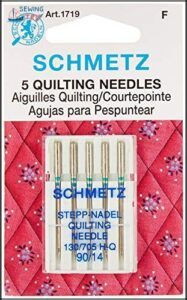
Quilting through three layers of cotton — top, batting, and backing — is where most needles start misbehaving. SCHMETZ Quilting Needles (system 130/705 H Q) fix that with a slim, tapered point engineered to pierce tightly woven fabric and batting without snagging or skipping.
The blade is slightly rounded, not sharp like a microtex tip, so it glides through quilt sandwiches rather than dragging threads out of alignment.
Size 75/11 is your go-to for fine piecing with 50-weight thread. Move up to 90/14 when you’re working through thicker batting or 40-weight thread — that extra shaft strength prevents flex and keeps stitches consistent. Color-coded shanks make swapping between sizes fast during multi-project days.
Each five-needle pack runs $8.49. Replace every 6–8 hours; a dull tip on a quilt sandwich causes puckering you won’t catch until it’s too late.
| Best For | Quilters and home sewists who regularly stitch through multiple layers and want a reliable, long-lasting needle that handles cotton, batting, and satin without skipping or snagging. |
|---|---|
| Brand | Schmetz |
| Pack Size | 5 needles |
| Price | $8.49 |
| Machine Compatibility | System 130/705 H Q |
| Fabric Type | Quilting cotton and batting |
| Needle System | 130/705 H Q |
| Additional Features |
|
- The tapered point glides through quilt sandwiches smoothly, reducing fabric damage during long stitching sessions.
- Color-coded shanks make it easy to grab the right size fast, especially when juggling multiple projects.
- Made in Germany with solid construction — users find them durable for both quilting and everyday sewing.
- Only comes in size 14/90, so if your project calls for a finer or heavier needle, you’ll need to shop elsewhere.
- Five needles per pack goes quickly with heavy use, meaning you might be reordering more often than you’d like.
- A few buyers noted the needle holder looks different from standard Schmetz packaging, which raised some authenticity concerns.
7. Brother Embroidery Machine Needles
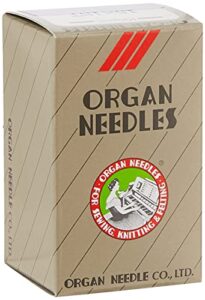
Dense embroidery eats needles fast — and a wrong size will shred your thread before you finish the second color pass. Brother’s SAEMB7511 embroidery needles solve that with a 75/11 build that balances eye clearance with clean fabric penetration on woven cloth, poplin, and even lightweight toweling.
The enlarged eye accommodates rayon and metallic thread without fraying at high stitching speeds. The flat-back shank locks precisely into PE770, CP7500, Innovis, and Entrepreneur Pro 1000e frames, and it’s compatible with automatic needle threaders — no squinting required.
At $31.50 for 100 needles (packaged in 10-needle foil sub-packs), this Organ-manufactured set gives you enough supply to change every 6–8 hours without guilt. For dense stabilizer work, step up to 90/14; the 75/11 covers most standard embroidery projects cleanly.
| Best For | Hobbyists and small-production embroiderers who go through needles quickly and want a reliable, cost-effective supply on hand for Brother machines. |
|---|---|
| Brand | Brother/Organ |
| Pack Size | 100 needles |
| Price | $31.50 |
| Machine Compatibility | Specific Brother models |
| Fabric Type | Embroidery on wovens |
| Needle System | Flat-back shank |
| Additional Features |
|
- 100 needles for $31.50 means you can swap freely every few hours without stressing over cost
- Works with automatic needle threaders, so setup is faster and less frustrating
- Handles everything from lightweight polyester to toweling and metallic thread without constant breakage
- Only works with specific Brother models — not a universal fit for every machine you might own
- Packaging can get crushed in shipping, which is a little annoying even if the needles survive
- Price fluctuates, so you might see it cheaper right after you buy
8. SCHMETZ Microtex Sewing Machine Needles
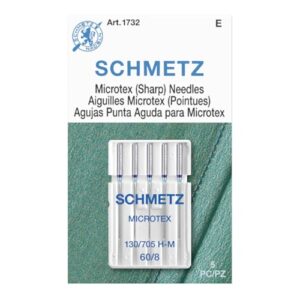
Where embroidery needles prioritize eye clearance, Microtex needles are built around one thing: point geometry. The slim, acute tip on this 60/8 needle cuts through tightly woven silk, microfiber, satin, and polyester blends without pushing fibers aside — it parts them cleanly.
That matters on fabrics where a blunt universal tip would cause puckering or skipped stitches before you finish a single seam. The 60/8 size keeps the hole microscopic, which is exactly what chiffon and cotton lawn demand.
Each card holds five needles at $9.49, and the purple color-code makes them impossible to mix up in your kit. Swap one in every 4–6 hours on fine fabrics — the thin construction dulls faster than heavier-gauge needles. Don’t push it; a dull Microtex on silk is a ruined project.
| Best For | Sewists working with fine, delicate fabrics like silk, chiffon, and microfiber who need clean, precise stitches without puckering or damage. |
|---|---|
| Brand | Schmetz |
| Pack Size | 5 needles |
| Price | $9.49 |
| Machine Compatibility | Most home machines |
| Fabric Type | Fine delicate fabrics |
| Needle System | Slim acute tip |
| Additional Features |
|
- The ultra-sharp point slices through tightly woven and lightweight fabrics cleanly, so you get straight stitches instead of skipped ones or puckering
- Purple color-coding makes it easy to grab the right needle fast, no squinting at tiny size markings
- Five needles per card at $9.49 gives you enough to swap regularly, which is exactly what fine fabrics require
- The tiny eye is genuinely tricky to thread, especially if your vision isn’t great or your fingers are on the larger side
- Thin construction means it breaks easily on anything heavier than a medium-weight fabric — denim or canvas will snap it fast
- A few customers got only four needles instead of five, so it’s worth counting when you open the package
9. SCHMETZ Twin Stretch Sewing Machine Needle
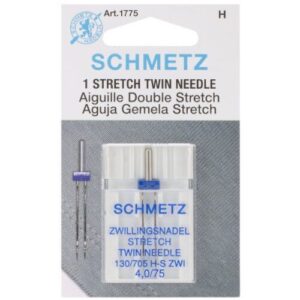
Where the Microtex manages precision on wovens, twin needle work is a different discipline entirely — parallel stitching on stretch fabric, done in one pass.
The Euro-Notions SCHMETZ Twin Stretch needle mounts two ball-point tips on a single 130/705H shank, spaced 4.0 mm apart. That spacing produces two simultaneous rows of stitching — clean, professional hems on jersey, rib knits, and activewear without a coverstitch machine.
At $8.49 for a single needle, it’s a low-cost workaround that actually holds up.
The ball-point tips slide between knit fibers rather than piercing them, so you won’t get runs or snags on T-shirt fabric. Size 75/11 manages lightweight to medium knits well. Before you sew, confirm your presser foot has enough clearance for the twin configuration — skipping that check snaps both needles at once.
| Best For | Home sewers who want clean, professional-looking hems on T-shirts, activewear, and stretchy knits without investing in a serger or coverstitch machine. |
|---|---|
| Brand | Schmetz |
| Pack Size | 1 needle |
| Price | $8.49 |
| Machine Compatibility | Most home machines |
| Fabric Type | Elastic knit fabrics |
| Needle System | Twin shank |
| Additional Features |
|
- Sews two parallel rows at once, giving you that polished double-stitch look in a single pass
- Ball-point tips slide between knit fibers instead of piercing them, so no snags or runs
- At $8.49, it’s a genuinely affordable way to level up stretch fabric hems
- Sold as a single needle, so stocking up for bigger projects means multiple purchases
- A few users have reported it breaking quickly, so it can feel fragile under pressure
- Won’t fix the inside of your seams — if you need a clean interior finish, you still need a serger
How to Choose The Right Needle
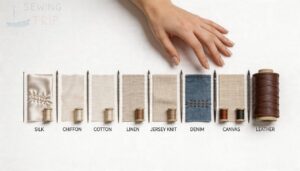
Picking the right needle comes down to two things: your fabric’s weight and your thread. Get either one wrong and you’re looking at skipped stitches, puckered seams, or a ruined project.
Here’s what to match before you sew a single stitch.
Matching Needle to Fabric Weight
Fabric weight is your starting point — always. Lightweight fabrics like chiffon need sizes 60–75 (US 8–11); medium-weight cotton or linen, sizes 80–90 (US 12–14); heavyweight denim or canvas, sizes 100–110 (US 16–18).
Fabric density impact is real — wrong sizing causes skipped stitches and puckering. Always test on scrap first. Your needle size chart doesn’t lie.
Considering Thread Type and Weight
Once fabric weight is locked in, thread weight and needle eye size compatibility becomes your next call. The needle eye must fit the thread — not squeeze it.
- 40-weight polyester pairs cleanly with 80/12 for balanced thread tension adjustment
- 60-weight fine thread needs sizes 60–75 to prevent drag
- 30-weight metallic thread handling demands 90/14–100/16 to cut friction
- Heavy nylon matches 100/16–110/18 for strength stitching
Polyester cotton choice covers most projects reliably.
Common Needle Problems and Solutions
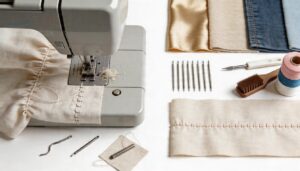
Even the right needle can cause problems if you ignore the warning signs that your machine is sending. Most sewing issues trace back to needle condition or size — and both have straightforward fixes.
Here’s what to watch for.
Signs You Need a Larger Needle
Puckering seams, thread breakage, and skip stitches aren’t random — they’re your machine telling you something’s wrong. Needle bending on bulky layers, excessive heat building at the tip, and noise popping through dense weaves all confirm the needle is undersized.
Fabric tear prevention starts with reading these signals early. Catch them fast, size up, and protect your project before the damage compounds.
When to Change Your Needle
Even a sharp needle becomes a liability after five to eight hours of continuous sewing. Replace needles at every project phase — especially when switching fabric types from lightweight silk to heavyweight denim.
Watch for these needle wear indicators:
- A popping sound signals that a dull tip is destroying your seam
- Visible bends or nicks confirm needle breakage before it worsens
- Bobbin maintenance triggers a check — lint buildup accelerates wear
- Skipped stitches mean your needle replacement interval is already overdue
Preventing Skipped Stitches and Fabric Damage
Most stitch failures trace back to one overlooked variable — wrong needle for the job. Start every project with a fresh needle matched to your fabric weight, and skipped stitches drop dramatically. Needle Alignment matters too; a slightly bent shaft throws off bobbin timing and produces missed loops before you notice anything’s wrong.
Check your Presser Foot Pressure when switching between fabric weights — too much crushes delicate layers, too little lets fabric drift. Fabric Feed Adjustment keeps material moving evenly under the foot, preventing the bunching that mimics poor tension. Thread Tension Balance between upper and bobbin threads eliminates puckering on stable weaves.
Run a Lint Removal Routine every eight hours. Buildup around the hook disrupts timing and accelerates fabric damage faster than a dull needle ever could.
Frequently Asked Questions (FAQs)
What size needles for different fabrics?
Use sizes 60–120 (US 8–20), matched to fabric weight. Lightweight silks need 60–75; medium cottons use 80–90; heavy denim demands 100– Your needle size chart and reference guide starts here.
What size needle for tirzepatide?
Tirzepatide injections use 29G–32G needles, with 4 mm length at a 90-degree injection angle. A 32G needle offers the best patient comfort through minimal tissue trauma.
What is a 90-14 needle used for?
A 90/14 needle works with medium to heavyweight fabrics — cotton, denim blends, canvas — with reliable seam strength optimization and fabric puckering prevention.
It’s your go-to size for everyday garment and home decor sewing.
Is a 23 or 25 gauge needle smaller?
A 25 gauge needle is smaller. In needle gauge, higher numbers mean thinner diameters — the inverse of sewing’s American needle sizing, where a size 80/12 runs larger than a size 60/
Can I use serger needles in regular machines?
No — serger needles aren’t compatible with regular machines. Shank compatibility differs, groove design conflicts cause thread tension issues, and forcing the wrong needle risks machine warranty risks and fabric damage.
Do needle brands affect stitch quality significantly?
Yes, brand matters. Schmetz’s tight tolerances in tip geometry, eye alignment, and coating durability outperform budget options.
Poor brand consistency causes skipped stitches and puckering — no amount of machine calibration fixes a bad needle.
What causes needles to break during sewing?
Metallic objects like zippers, buttons, and rivets cause instant needle breakage.
Excessive friction, improper alignment, thread tension issues, and a damaged needle all accelerate needle wear, creating needle problems that ruin stitching and compromise needle sharpness mid-project.
Should needle size match bobbin thread weight?
Bobbin thread weight doesn’t dictate needle size. Fabric weight does.
Match your needle to the fabric first, then align thread tension and needle eye size to prevent puckering and stitch skipping.
How do I store needles to prevent dulling?
Keep needles in a dry, airtight case with separate compartments and silica gel packets.
Avoid humidity, heat, and open containers.
Wipe each needle clean before storing, and inspect monthly for dulling or damage.
Which needle brands offer the best value?
Why pay more than you need to? Schmetz leads on color-coded identification and specialty range. Organ wins on price per needle. Klasse offers solid pack size economics for beginners.
Conclusion
Your sewing journey is a tapestry of choices, and the right needle size is the thread that weaves it all together. Mastering what size needle for different fabrics ensures every stitch is a deliberate brushstroke on the canvas of your creation.
With this guide, you’re equipped to navigate the nuances of needle sizing, transforming potential pitfalls into smooth successes. Your fabric, your needle, your art—now perfectly aligned.
- https://www.schmetzneedles.com/pages/sewing-machine-needle-chart
- https://www.organneedle.com/img/pdf/Organ-Nadelindex-web-e.pdf
- https://www.carlfriedrik.com/magazine/what-is-faux-leather
- https://www.yarwoodleather.com/latest-news/faux-leather-vs-real-leather/
- https://www.herculite.com/blog/the-history-of-synthetic-fabrics