This site is supported by our readers. We may earn a commission, at no cost to you, if you purchase through links.
Thread tells a story before you even touch it.
A hand-stitched heirloom carries the maker’s fingerprints—literally—in every irregular, intentional stitch, while a machine-embroidered logo on 500 corporate polos arrives identical down to the last thread tension measurement.
Both outcomes represent mastery; they just speak different languages.
The embroidery machine vs hand embroidery pros and cons debate isn’t really about which method wins.
It’s about matching the right tool to what you’re actually trying to accomplish—whether that’s a one-of-a-kind wedding gift or a branded uniform order shipping Monday morning.
Your budget, timeline, fabric choice, and skill level all pull the decision in different directions, and knowing where each method excels changes everything about how you plan your next project.
Table Of Contents
Key Takeaways
- Hand embroidery gives you creative freedom and heirloom-quality texture that machines simply can’t replicate, making it the right call for one-of-a-kind gifts and emotionally meaningful pieces.
- Machine embroidery wins on speed, consistency, and scale—once a design is digitized, it reproduces identically across hundreds of pieces, which is non‑negotiable for branded uniforms and bulk orders.
- Your budget tells the story fast: hand embroidery starts under $25, while machines range from $379 to over $16,000, meaning the cost-per-piece math only favors machines once you’re producing roughly 50+ units.
- Neither method is universally better—the smartest makers match the tool to the project, and many combine both techniques to get machine precision on the base design with handstitched details that make the finished piece feel crafted, not cloned.
Design Flexibility and Creative Control
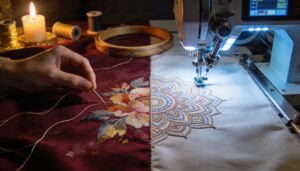
Design flexibility is where hand and machine embroidery truly split into different worlds.
Hand embroidery lets you follow any creative whim, while machine work thrives on precision—exploring both is a great way to discover which embroidery style fits your creative vision.
Each method gives you a different kind of creative control — one thrives on improvisation, the other on exactness. Here’s how they compare across the details that matter most.
Hand Embroidery for One-of-a-kind Details
Hand embroidery is where artisanal craftsmanship meets intention. Every stitch you place carries personal touch — whether you’re working custom motifs into a collar or weaving cultural symbolism into a gift meant to last generations.
That heirloom quality comes from texture and individuality, no machine can replicate. It’s emotional storytelling through thread, narrative embroidery with unique charm built one careful stitch at a time.
Machine Embroidery for Precise Repeat Designs
Where hand embroidery prizes individuality, machine embroidery delivers repeatable accuracy at scale. Once your design digitization is complete, every motif lands exactly where it should — same stitch density calibration, same automated thread tension, every time.
Proper tension settings follow the recommended bobbin tension range for ideal stitch quality.
- Registration mark usage keeps multi-hoop synchronization precise across long borders.
- Real-time error detection catches thread breaks instantly.
- Design replication maintains speed and consistency and precision across bulk runs.
Custom Shading, Texture, and Stitch Variation
Precision has its place, but when you want shading that breathes, hand embroidery opens a different door entirely.
Long‑Short Stitch builds smooth gradients, while Directional Shading shifts how light reads across thread surfaces.
Raised Satin adds sculptural lift, and Thread Painting with layered Blend Techniques produces color sequencing no machine fill can rival.
Texture shading through thread variation simply lives in the hands.
Digitized Patterns, Logos, and Monograms
Where hand shading thrives on instinct, digital embroidery runs on logic — and that’s exactly its strength.
Tools like Wilcom Embroidery Studio and Hatch handle Vector File Optimization, Software Compatibility, and Production Workflow Integration, so corporate logos and monograms reproduce identically every time.
- Stitch Type Matching pairs satin for borders, tatami for large fills
- Color Thread Management keeps brand palettes consistent across hundreds of pieces
- Machine vs Hand Embroidery trade-offs shift decisively toward machines for repeat runs
- DST and PES formats guarantee cross-machine reliability without redesigning
When Uniqueness Matters More Than Consistency
When the goal is emotional resonance over exact replication, hand embroidery wins every time. Each piece carries an artisan signature — slight stitch shifts, varied tension, freeform layout — that no digitized file can replicate.
That’s the heart of heirloom appeal and narrative stitching. Limited edition hand details, shaped by creative freedom and artistic texture, give hand stitching a living quality that machine uniformity simply can’t manufacture.
Speed, Scale, and Repeatability
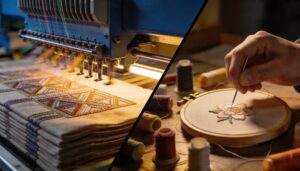
Speed is one of the biggest deciding factors between hand and machine embroidery, especially once your projects start growing in scale. Whether you’re stitching a single keepsake or fulfilling a bulk uniform order, the method you choose directly shapes your timeline and output.
Here’s how each approach stacks up regarding speed, volume, and getting consistent results every time.
How Fast Machine Embroidery Finishes Designs
Machine embroidery’s speed and consistency come down to stitch count impact more than anything else. At 600–700 SPM variations, a 10,000-stitch logo finishes in roughly 14 minutes of run time.
However, color change delays and setup overhead for hooping and threading add real minutes. Complexity bottlenecks from dense fills or poor digitization slow rapid production further—making smart design choices essential for true production scaling.
Why Hand Embroidery Takes More Time
Every stitch in hand embroidery is a deliberate act—the stitch-by-stitch process means curves, fills, and fine details all build up manually, one motion at a time.
Design transfer steps add setup before the needle ever touches fabric, while thread change interruptions, tension adjustment pauses, and hoop setup time break the rhythm constantly.
Intricate and complex designs intensify this time-consuming process, and the repetitive motion of stitching creates real physical strain, including hand and wrist fatigue.
Bulk Orders and Production Efficiency
When bulk orders hit your production floor, speed and consistency stop being optional — they become your baseline.
A four-head machine running at 1,100 stitches per minute multiplies throughput effortlessly, and a tight digitizing workflow built around thread waste reduction and setup optimization keeps those heads moving with minimal interruption.
For large-scale projects, that multi-head coordination is fundamentally your quality assurance metrics system working in real time.
Small Personal Projects Vs Commercial Output
A handstitched gift takes time — and that’s exactly the point.
For personal projects, your Project Timeline is flexible, customization limits are nonexistent, and Client Communication is just a conversation with yourself. Commercial output flips all of that.
- Hand embroidery suits small, meaningful pieces where uniqueness drives value
- Machine stitching manages volume with consistent Pricing Strategies and Production Logistics
- Cost and time considerations in embroidery shift dramatically once quantity enters the equation
Repeatable Results for Uniforms and Branding
When team steps onto the floor, every logo needs to land in exactly the same spot. That’s where machine embroidery earns its place.
Standardized Digitized Files lock in stitch placement across unlimited runs, while Pantone Thread Matching keeps colors consistent from the first batch to the fiftieth.
| Element | What It Controls | Why It Matters |
|---|---|---|
| Logo Placement Consistency | Position on garment | Keeps uniforms polished |
| Stabilizer Selection | Fabric behavior during stitching | Prevents puckering or distortion |
| Bulk Quality Assurance | Output uniformity | Protects brand integrity |
Repeatable stitches and branding through embroidered logos make mass production feel intentional — not mechanical.
Costs, Tools, and Maintenance
Money is often the deciding factor when choosing between hand and machine embroidery. Both methods carry their own set of costs — some upfront, some ongoing — and knowing what you’re signing up for can save you a lot of surprises down the road.
Here’s a breakdown of where your dollars actually go.
Low Startup Cost of Hand Embroidery
Getting started with hand embroidery barely dents your budget. Your minimal tool set — a needle, hoop, fabric, and thread — can come together for as little as $14 to $25 in a starter kit.
Affordable thread options like DMC floss cost roughly $2 per skein. That low barrier entry means you can test the craft before committing anything significant.
Embroidery Machine Purchase and Software Expenses
Machines are a different financial animal altogether. Budget models start around $379, mid-range options climb to $3,000, and commercial-grade units can exceed $16,000 — so Machine Purchase Financing often makes sense.
Software Compatibility Costs add up too, with License Activation Fees like Chroma’s $1,799 and Hatch subscriptions near $69 monthly shaping your embroidery cost analysis before you stitch a single thread.
- Entry-level machines: ~$379–$600
- Mid-range with USB/auto-cut: $600–$3,000
- Multi Needle Pricing (7–10 needles): $3,000+
- Digitizing software licenses: $149–$1,799+
- Annual Service Contracts: 5–10% of machine value yearly
Ongoing Costs for Thread, Stabilizers, and Needles
Beyond the machine price tag, the real embroidery cost analysis lives in your consumables. Thread consumption climbs quickly with dense fills and color change cost adds up quickly — each new color needs its own spool ready.
Stabilizer waste, needle replacement frequency, and thread types all feed into ongoing expenses.
Bulk purchase savings help, but smaller projects rarely spread those costs comfortably.
Maintenance, Repairs, and Electricity Use
Owning a machine means committing to maintenance routines for embroidery machines that most beginners underestimate. Routine Cleaning after heavy sessions, a consistent Lubrication Schedule, and timely Needle Replacement all factor into your operational costs.
Add Power Consumption — generally 50–150 watts per session — and Service Interval Planning starts looking less optional. Electricity and maintenance together quietly shape your real cost of production.
Cost Per Piece for Hobbyists and Businesses
Cost per piece tells the real story. Here’s how the numbers break down depending on your method:
- Thread runs about $0.21 per design; stabilizer adds $0.08 — material markup stays minimal at scale.
- Hand labor rates at $12–$20/hour make single pieces expensive.
- Software licensing and machine overhead raise your break-even volume considerably.
- Economies of scale favor machines past roughly 50+ units.
- Hobbyists prioritize upfront costs; businesses must absorb ongoing expenses.
Skill Level and Learning Curve
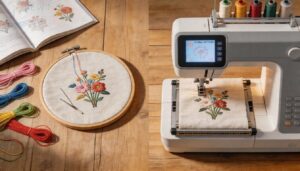
Both hand and machine embroidery have their own learning curves, and knowing what each demands upfront saves you a lot of frustration. The skills you’ll need look pretty different depending on which path you choose.
Here’s what each method actually requires from you.
Basic Stitches Beginners Need for Hand Embroidery
Hand embroidery starts with just five essential stitches.
Running stitch forms dashed outlines, while back stitch builds clean, solid lines — both are foundational hand stitching tips every beginner needs.
Split stitch and stem stitch add textured, rope-like curves ideal for stems and lettering.
French knot creates raised dots for detail and dimension.
Master these with needle and thread, varying stitch length deliberately, and you’ll have real control.
Machine Setup, Digitizing, and Tension Control
Machine embroidery demands a steeper technical climb than picking up a needle.
You’ll navigate Threading Path Sequence, Hoop Tightness Adjustment, and Tension Dial Calibration before stitching a single design — small missteps here cascade into puckered fabric or skipped stitches.
Digitizing Stitch Density inside your digitizing software determines how polished the final result looks across machine vs hand embroidery comparisons.
Key machine embroidery tips to master early:
- Thread upper and lower paths correctly before each run
- Calibrate tension dial in small increments for balanced lockstitches
- Match digitizing stitch density to fabric weight during design digitizing
- Secure hoops firmly — hoop tightness directly affects stitch registration
- Run firmware update process regularly for consistent machine performance
Troubleshooting Thread Breaks and Fabric Issues
Thread breaks almost always trace back to one of four culprits: Thread Path Friction, Tension Balance, Needle Wear, or Hoop Stability. Start by re-threading completely — friction from a misrouted path snaps thread faster than anything.
Then check your thread tension in small increments. Poor fabric stabilization and wrong stabilizer selection compound Stitch Density Issues, especially on stretchy substrates where fabric compatibility and thread selection directly determine whether your design holds.
Time Needed to Build Confidence With Each Method
Confidence doesn’t arrive on a schedule — it follows a feedback loop. With hand embroidery, your Confidence Threshold builds through Initial Stitch Mastery, stitch by stitch, across weeks of repetition. Machine embroidery compresses that timeline dramatically through Setup Fluency and First Design Completion in a single session.
- Hand stitching takes several small projects before tension and spacing feel natural
- Machine learners usually reach basic fluency within 3–6 hours of guided practice
- Feedback Loop Speed favors machines — a monogram finishes in under an hour
- Hand skill development is slower but deeply natural and time‑efficient for solo work
- Both methods reward consistency: repeat the same project, sharpen your learning curve faster
Which Option is Easier for Beginners
For true beginners, the answer depends entirely on your goal.
If you want minimal equipment and immediate creative satisfaction, hand embroidery wins — a needle, floss, and hoop get you started under $50.
Machine embroidery offers repeatable precision once the setup is learned, but the learning curve is steeper.
| Factor | Hand Embroidery |
|---|---|
| Motivation Factors | Creative freedom, personal expression |
| Age Appropriateness | Suitable for most ages |
| Physical Comfort | Gentle, low-strain movements |
| Accessibility Features | Minimal equipment needed |
| Learning Resources | Widely available, low-cost |
Texture, Durability, and Fabric Choice
Beyond speed and skill, texture and durability are where embroidery gets personal. The fabric you’re working with shapes everything — from how the stitches sit to how long they hold up over time.
what you need to know before choosing your method.
Tactile Depth and Handmade Character
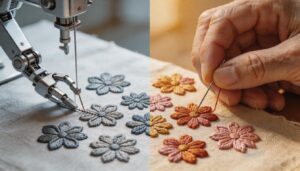
Stitching by hand builds something machines simply can’t replicate — an Organic Depth Profile that shifts across the design as your rhythm and pressure change. That’s the Maker’s Imprint at work.
Hand stitching leaves a maker’s imprint no machine can replicate — an organic depth that shifts with every rhythm and stroke
Through artisanal control and texture development, hand embroidery creates:
- Layered Stitch Relief that raises some areas visibly above others
- Variable Stitch Elevation across flowers, borders, and lettering
- Tactile Surface Variation where dense and open stitches contrast naturally
- Organic depth through handcrafted textiles that invite touch
- Tactile depth shaped by your personal stitch choices
That’s what makes each piece unmistakably yours.
Uniform Stitch Quality and Clean Finishes
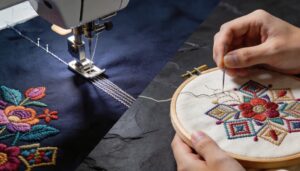
Where hand embroidery gives you soul, machine embroidery gives you standards.
Stitch density control and thread tension balance work together to deliver precision stitching that stays consistent from the first piece to the hundredth.
Edge finishing techniques look sharp, seam alignment precision keeps logos centered, and thread trimming practices leave no loose ends — literally.
That’s consistent quality you can build a brand on.
Fabric Compatibility for Hand and Machine Work
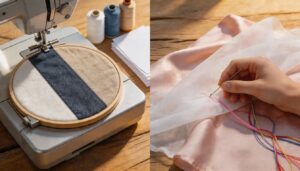
Your fabric selection shapes every outcome. Woven fabrics — cotton, linen, denim — offer the weave stability and grain alignment both methods rely on.
Machine embroidery demands high stretch tolerance and weight suitability, since knits and delicate silks distort under dense fills.
Hand embroidery adapts more easily to fiber compatibility challenges, handling loosely woven or lightweight substrates with far greater forgiveness.
Stabilizer Needs for Machine Embroidery
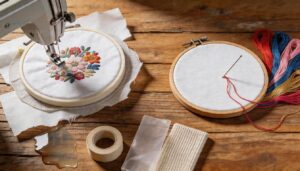
Stabilizer selection is where machine embroidery gets real. Without the right backing, even a perfect design puckers, shifts, or gaps.
- Cut-away Selection suits knits and dense, stitch-heavy designs — it stays put permanently
- Tear-away Application works cleanly on stable wovens with moderate stitch counts
- Wash-away Removal manages sheers like organza, dissolving completely without residue
Match your Stabilizer Weighting to fabric stretch and design density — and use Adhesive Backing for anything that won’t hoop flat.
Which Method Lasts Longer on Everyday Items
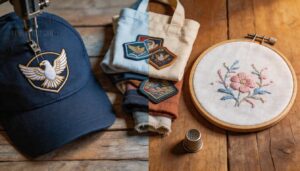
When durability is the priority, machine embroidery wins on everyday items like caps, uniforms, and tote bags. Tight stitch tightness, polyester thread material, and built‑in abrasion resistance keep designs sharp through repeated washing — especially at cool wash temperatures.
Item placement matters too; flat, low‑contact areas outlast cuffs and corners.
hand embroidery shines for display pieces, but machine work simply holds up better under daily pressure.
Best Uses for Each Method
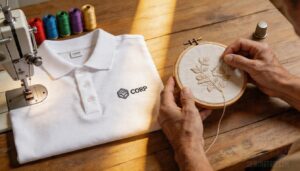
Knowing your method’s strengths is only half the battle — knowing when to use each one is where it all comes together. Whether you’re stitching a one-off heirloom or producing branded uniforms by the dozen, the right choice depends on more than just preference.
Here’s how to match your method to your project.
When Hand Embroidery is The Better Choice
Some projects simply don’t need a machine — they need your hands. When gift personalization, heirloom preservation, or cultural heritage stitching is the goal, hand embroidery’s adaptive stitching and tool minimalism make it the natural fit.
The therapeutic nature of hand work — calming and meditative — adds real value too.
Choose it when:
- Uniqueness and texture and individuality of hand stitching matter most
- You’re creating one-off gifts or keepsakes
- Your budget favors minimal startup costs
- The fabric is delicate or irregularly shaped
- The advantages of hand embroidery — creative control and organic shading — outweigh speed
When Machine Embroidery Makes More Sense
When consistency is non‑negotiable, machine embroidery takes over. Standardized Stitch Density means every logo, badge, or monogram lands identically — critical for Regulatory Labeling, uniforms, and Supply Chain Integration across large orders.
| Scenario | Why Machine Wins | Key Benefit |
|---|---|---|
| Bulk branded apparel | Speed and scalability | Production efficiency |
| Time‑Critical Delivery | Automated 1,200–2,000 SPM output | Faster turnaround |
| Digital Asset Management | Reusable digitized files | Design customization at scale |
Choosing by Budget, Timeline, and Project Size
Three questions cut through the noise every time: What’s your budget threshold, how tight is your timeline, and how many pieces do you need?
A single custom piece with no deadline calls for hand embroidery — low upfront cost, no digitizing fees.
Batch size climbs past a dozen, though, and machine stitching wins on speed and resource allocation.
Match the method to the math.
Hybrid Embroidery With Machine and Hand Details
Hybrid embroidery approaches combining machine and hand techniques give you the best of both worlds — and smart makers already use them.
Your design workflow integration might look like this:
- Machine lays precise satin-fill logos or outlines.
- Hand stitches add French knots or shading for warmth.
- Quality assurance techniques confirm stitch integrity before finishing.
Hybrid embroidery strategies let your brand narrative embroidery feel crafted, not cloned.
How to Pick The Right Method Quickly
Choosing between machine and hand embroidery comes down to five quick questions: What’s your deadline pressure? What are your budget limits? How high is the design intricacy? Does fabric sensitivity require special handling? And what’s your order volume?
If most answers point toward speed, consistency, and scale, go machine. If they favor uniqueness and craft, your hands are already the right tool.
Frequently Asked Questions (FAQs)
Is it better to embroider by hand or machine?
Neither method wins outright — it depends on your goal. Hand embroidery brings emotional value and cultural heritage; machine embroidery delivers speed and uniformity.
Match the method to your project, budget, and intent.
Why is embroidery declining?
Embroidery is declining because fast fashion rewards speed over craft, aging artisans retire without replacements, apprenticeship decline cuts the pipeline, and digital printing offers brands a cheaper path.
What embroidery items sell the most?
Custom T‑shirts, monogrammed towels, custom pillows, and kids clothing top the embroidery market trends.
Corporate logos and custom gifts drive commercial production, while logo embroidery on custom apparel remains the strongest, most consistent seller.
Can embroidery be done on stretchy knit fabrics?
Yes, knit fabrics can be embroidered — but like taming a moving target, they demand the right stabilizer, ballpoint needle choice, and hoop pressure balance to keep your stitches clean and distortion-free.
Which method works best for 3D embroidery effects?
For bold, raised logos, the Foam Puff Technique wins — machine stitching delivers the speed, precision, and Stitch Density Optimization needed.
Hand stitching suits sculptural one-off details, but can’t match machine repeatability.
How do thread types affect finished embroidery results?
Thread is the paint on your canvas.
Fiber sheen, weight impact, and variegated color all shape your final result — affecting texture, finish, and fabric compatibility more than most stitchers initially expect.
Is embroidery suitable for waterproof or outdoor gear?
Embroidery works on waterproof outdoor gear, but fabric compatibility and stitch density impact the membrane’s integrity. Proper membrane sealing techniques and thread material selection keep weather protection intact after stitching.
Can you mix embroidery with other textile art techniques?
Absolutely — why stop at thread alone?
Painted Embroidery Fusion, Shibori Embroidery Blends, Quilted Embroidery Layers, Applique Edge Embroidery, and Felting Beading Integration all prove that hybrid approaches open up endless creative possibilities in modern embroidery.
Conclusion
The right choice has been hiding in plain sight all along. Every project carries quiet signals—your deadline, your budget, the story you want the finished piece to tell.
Understanding the embroidery machine vs hand embroidery pros and cons isn’t about picking a winner; it’s about reading those signals clearly. One method scales your vision across hundreds of pieces; the other stitches your fingerprint into one.
Now you know which thread to pull.
- https://www.dmc.com/IE/en-GB/sbs-embroidery-stitch-diagrams
- https://www.needlenthread.com/2011/08/5-points-about-hand-embroidery.html
- https://anahiv.com/blogs/coords/mastering-the-art-of-hand-embroidery-with-sequins-a-look-at-november-28s-exceptional-craftsmanship
- https://www.legendaryfashion.com/how-to-maintain-handmade-clothing-so-it-stays-beautiful/
- https://www.sakura-thread.com/info/art-features-of-hand-embroidery-83540368.html