This site is supported by our readers. We may earn a commission, at no cost to you, if you purchase through links.
You’ve finally finished that perfect seam, only to realize the zipper’s upside down or the side seam puckers where it should lie flat. Every sewist faces this frustrating moment, and it’s how you respond that determines whether your project survives intact.
Ripping out stitches might seem straightforward—just yank and pull, right?—but that approach leaves holes, frayed edges, and fabric that never quite looks the same. Learning how to unsew a seam safely protects your work from permanent damage and turns mistakes into simple fixes.
With the right tools and techniques, you can remove any seam cleanly, preserving your fabric for a flawless do-over.
Table Of Contents
- Key Takeaways
- What is Seam Ripping in Sewing?
- Essential Tools for Safe Seam Removal
- Understanding Seam Ripper Parts and Functions
- Preparing Your Fabric for Seam Removal
- Step-by-Step Guide to Unsewing a Seam
- Safety Tips and Precautions for Seam Ripping
- Cleaning Up and Caring for Fabric After Unsewing
- Frequently Asked Questions (FAQs)
- Conclusion
Key Takeaways
- A seam ripper‘s three key parts—the sharp point, U-shaped blade, and red safety ball—work together to cut stitches cleanly while protecting your fabric from tears, snags, and permanent damage.
- Successful seam removal requires working slowly at a shallow angle (20-30 degrees), cutting every third or fourth stitch rather than yanking threads, and stabilizing your fabric flat before you begin.
- Different stitch types demand specific removal strategies: straight stitches release with evenly spaced cuts, backstitch requires working from one end backward, and serged seams need you to cut needle threads first before pulling looper threads.
- After removing stitches, you must clear loose threads with tweezers or a lint roller, press the fabric from the wrong side with steam to smooth needle holes, and test your iron settings on scrap material before reseaming.
What is Seam Ripping in Sewing?
Seam ripping is the process of carefully removing stitches from fabric when you need to undo a seam. Whether you’re fixing a mistake or altering a garment, knowing how to unsew properly protects your fabric from damage.
If you’re curious about other clever uses for your seam ripper, covers everything from opening buttonholes to removing decorative stitches.
Let’s look at what seam ripping actually means, why you’ll need this skill, and when it becomes necessary in your sewing projects.
Definition and Purpose of Seam Ripping
Seam ripping is the deliberate act of removing stitches from fabric using a seam ripper or unpicker. You’ll use seam ripping techniques to correct sewing mistakes or alter garments without severely damaging your material.
If you’re new to this technique, understanding what a seam ripper is used for will help you choose the right tool and approach for each project.
The purpose of stitch reversal is simple: it lets you reopen a seam so you can resew it accurately. Mastering thread removal and fabric preservation keeps your project looking professional while enabling precise sewing corrections.
Understanding essential sewing machine features every sewist should understand helps you confidently use reverse stitching alongside other functions to strengthen seams and fix mistakes efficiently.
Common Reasons to Unsew a Seam
You’ll need to remove stitches for several fabric repairs and garment alterations. Here are four common reasons you’ll reach for your seam ripper:
- Fitting problems — side seams need adjusting when your garment’s too snug or loose, usually within 1 to 2 cm
- Placement errors — pockets, darts, or zippers landed in the wrong spot
- Thread issues — weak stitches split or pucker along the seam line
- Finishing tweaks — you want a neater edge or cleaner appearance
When Seam Ripping is Necessary
Beyond everyday fixes, you’ll need seam ripping techniques when your fabric must be preserved and resewn rather than replaced. Here’s when stitch removal becomes your best move for textile restoration.
| Situation | Why Seam Repair Works |
|---|---|
| Converting unfinished seams | Reshapes seamlines without affecting fabric integrity |
| Removing decorative topstitching | Undoes embroidery that shouldn’t be cut |
| Separating joined pieces | Allows garment alteration for better fit |
Essential Tools for Safe Seam Removal
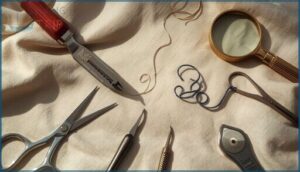
You can’t unsew a seam safely without the right tools in hand.
The good news is that you don’t need much—just a few reliable items that protect both your fabric and your fingers. Let’s look at the essential tools that make seam removal smooth and stress-free.
Seam Ripper Types and Features
You’ll find seam rippers in several designs, each suited to different situations. Here’s what you should know:
- Forked head rippers feature a U-shaped blade that slides under stitches without slicing your fabric
- Curved blade models offer a narrower sharp tip for tight spots and sit flush against seams
- Electric rippers use battery power to cut multiple threads quickly with side-to-side action
- Lighted versions include small LEDs illuminating dark folds for better visibility
Alternative Tools for Unsewing
You don’t always need a dedicated seam ripper to remove stitches safely. Small embroidery scissors work as an effective thread remover when you snip carefully along the seam line.
Eyebrow razors double as a fabric protector and stitch eraser, lifting threads without slicing fibers. Pointed tweezers pull loose ends from tight spots, while thin craft knives act as precise unsewing aids for stubborn stitches.
Choosing The Right Seam Ripper
A sharp tip matters more than you think when selecting your unpicker. Look for hardened steel blade materials that stay keen through multiple projects, paired with handle ergonomics that fit comfortably in your palm.
Safety features like protective caps and recessed blades prevent accidents during storage. Consider seam ripper types with interchangeable heads for different fabrics, and remember that proper tool maintenance keeps your seam ripper techniques effective longer.
Understanding Seam Ripper Parts and Functions
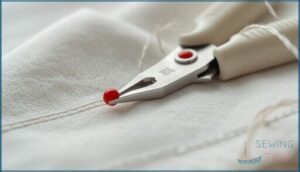
Your seam ripper isn’t just a pointy tool—it’s actually designed with three key parts that work together to protect your fabric while removing stitches. Each component has a specific job, and understanding what they do will help you use your seam ripper more confidently and safely.
Before you start removing stitches, make sure your machine is properly maintained—check out these beginner-friendly sewing machine project plans to practice your skills and build confidence with basic repairs.
Let’s break down how the sharp point, U-shaped blade, red safety ball, and handle design all play a role in successful seam removal.
Sharp Point and U-Shaped Blade
Your seam ripper‘s sharp tip is engineered to pierce fabric threads cleanly, not tear them. The point sharpness depends on hardened steel, usually rated between HRC 58 and 62 for edge retention.
That U-shaped blade isn’t just for looks—its curved cutting edge skims multiple stitches in one pass while providing fabric protection. This blade geometry maximizes cutting efficiency during seam ripping without snagging delicate weaves.
Red Safety Ball and Handle Design
That red safety ball isn’t decoration—it’s your fabric’s best friend during seam removal. The bright red color helps you spot the safety tip instantly, while its rounded shape glides under stitches without snagging.
Ergonomic grips with textured grip designs give you precise control, keeping your hand steady as the sharp blade cuts. Ball materials are impact-resistant, so your seam ripper survives workshop tumbles. These safety features work together, transforming a potentially risky task into confident, controlled seam ripping.
How Each Part Protects Your Fabric
Every component of your seam ripper works in sync to safeguard delicate fibers during removal. Here’s how blade protection and cutting precision combine to preserve seam integrity:
- U-shaped blade guides fibers away from the cutting zone, preventing snags
- Safety ball stops deep blade entry that could pierce fabric layers
- Precision edge shaves stitches cleanly without pulling or distorting weave
- Narrow tip targets thread lines, avoiding accidental cuts in surrounding material
Preparing Your Fabric for Seam Removal
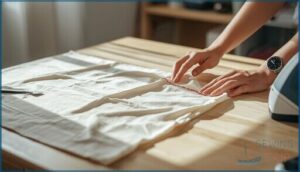
Before you start cutting stitches, you need to set yourself up for seam ripper success. Taking a few moments to prepare your fabric makes the whole process safer and easier.
Here’s what you should do before you pick up that seam ripper.
Stabilizing and Positioning The Fabric
Before you pick up your seam ripper, think of your fabric like a patient on an operating table—it needs support. Stabilize it by laying the fabric flat on an ironed surface, then gently pin along the seam edge to prevent shifting.
For delicate weaves, slip tissue paper or washaway stabilizer underneath as fabric backing. Maintain even fabric tension with both hands, keeping edge alignment square using a gridded mat for seam guidance.
For more on why fabric stabilization methods matter, learning about different approaches can help you achieve more professional results.
Identifying Stitch Type and Location
Once your fabric is steady, take a moment to study what you’re actually working with. Fabric analysis starts with spotting the stitch pattern—is it a straight lock stitch from your sewing machine, or looped chain stitches?
Thread identification helps you plan your attack:
- Lock stitches need cutting every few stitches along the seam
- Chain stitches unravel quickly once you find the tail
- Serged edges require careful seam inspection before you start
Understanding stitch classification means your seam ripper or unpicker becomes a precision tool, not a gamble.
Working on Right Side Vs. Wrong Side
Now you need to decide where to work. Most pros choose the right side because fabric visibility is everything—you’ll spot stitch lines, knots, and loose threads without guessing.
Right side benefits include clearer markings and easier alignment when you resew. Wrong side challenges? Hidden knots and accidental snags in lining. Your seam ripper becomes more accurate when you can actually see what you’re cutting.
Step-by-Step Guide to Unsewing a Seam
Now that you’ve prepped your fabric, it’s time to walk through the actual process of removing those stitches. You’ll learn how to position your seam ripper, cut threads without damaging your fabric, and handle different types of seams you might encounter.
Follow these steps carefully, and you’ll have that seam undone in no time.
Inserting The Seam Ripper Correctly
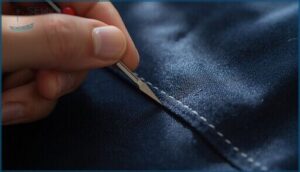
Position your seam ripper with the pointed blade angled slightly downward toward the thread—this keeps fabric protection front and center.
Start just inside the seam line, letting the red ball rest flush against the surface to prevent deep cuts. Use short motions instead of long passes, and pause every few stitches to confirm you’re catching only thread, not the weave beneath.
Cutting and Removing Stitches Safely
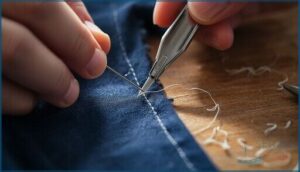
Once your seam ripper is in position, apply gentle upward pressure to slice the thread cleanly. Work every third or fourth stitch to loosen the seam without stressing the fabric. Avoid yanking—controlled cuts preserve the weave and prevent puckering.
After you’ve snipped along the line, flip the fabric and gently tug both edges apart, letting the threads release naturally for safe stitch removal.
Techniques for Different Stitch Types
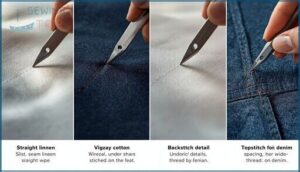
Different stitches demand different strategies when you need to remove stitches and repair a seam. Your unpicker can handle them all, but you’ll get better results with the right sewing techniques for each type.
- Straight stitches: Cut every third or fourth thread along the seam, then gently pull the fabric apart for smooth stitch removal
- Backstitch: Start at one end and work backward, since these interlocking stitches resist standard seam ripper cuts
- Zigzag stitches: Insert your tool under each peak and slice carefully—rushing damages fabric handling and leaves messy threads
- Topstitching: Use longer cuts between snips since the stitch reinforcement sits farther apart than regular seams
Thread management gets easier when you match your approach to the stitch. For more on essential hand and machine stitches, see this guide to types of sewing stitches.
Removing Serged or Overlocked Seams
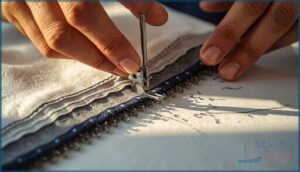
Serged seams look intimidating, but a careful approach makes thread management straightforward. Start by lifting your seam ripper under the overlock stitch near the seam line, cutting only thread while leaving fabric intact. Work from the outside edge inward to prevent breakage, then gently pull the allowance away.
| Step | Action | Purpose |
|---|---|---|
| 1 | Stabilize fabric with clips or weights | Prevents shifting during serged seam removal |
| 2 | Cut needle threads every few stitches | Releases overlock stitch tension safely |
| 3 | Grab looper threads and pull firmly | Unravels remaining stitches quickly |
| 4 | Trim stray threads carefully | Avoids fraying after stitch removal |
| 5 | Press fabric lightly with steam | Smooths fibers for seam correction |
After removing stitches, inspect for frays and maintain your seam ripper by cleaning the blade regularly.
Safety Tips and Precautions for Seam Ripping
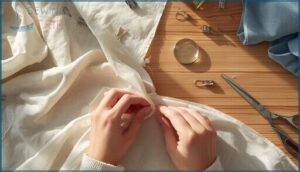
Seam ripping doesn’t have to be stressful if you know how to protect yourself and your fabric. A few simple precautions will save you from accidental cuts, torn fabric, and hours of frustration.
Let’s walk through the essential safety habits that keep your project on track.
Avoiding Fabric Damage and Injury
A sharp blade can turn a simple fix into a disaster if you’re not careful. Hold your seam ripper at a shallow 20 to 30 degree angle to protect delicate fabrics from snagging. Keep your fingertips away from the blade and let the red safety ball guard against accidental punctures.
For fabric protection, use gentle techniques with firm, controlled pressure rather than quick jabs that risk tearing.
Working Slowly and Patiently
Rushing through stitch removal is like threading a needle while sprinting—it never ends well. Take a slow pace with your seam ripper, pausing after every few cuts to check your progress.
Seam ripping demands patience—rushing through stitch removal risks tearing fabric and ruining your work
Mindful sewing means listening to the fabric’s resistance and maintaining steady hands for fabric control. A gentle touch during unsewing prevents snags and gives you the precision this sewing tool demands for safe, clean stitch removal.
Maintaining Control for Best Results
Tool grip starts with your wrist firm to steady the seam ripper during precision cutting. Your non-dominant hand controls fabric tension while you guide the sewing tool with micro movements, not sweeping strokes.
Think of stitch removal as surgery, not demolition. Ergonomic handling means relaxed shoulders and light pressure that lets you feel the thread give way. That’s how you master unsewing without battling your seam.
Cleaning Up and Caring for Fabric After Unsewing
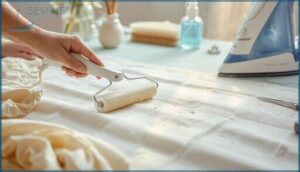
Once you’ve removed all the stitches, your work isn’t quite done yet.
You’ll need to clean up the fabric and get it ready for whatever comes next. Here’s how to finish the job properly and keep your tools in good shape.
Removing Loose Threads and Debris
Once you’ve pulled all the stitches, you’ll notice loose threads everywhere. Use tweezers or your fingers to grab these tails at a shallow angle, working from the seam line outward.
A lint roller works wonders on woven fabrics, while a soft brush lifts fuzz from textured materials. For stubborn debris, gently wipe with a microfiber cloth to prevent new snags during reseaming.
Inspecting and Pressing The Fabric
After clearing the threads, check your fabric under good light for needle holes or shiny stress spots. Run your fingertips across the opened seam to catch raised fibers you might miss visually.
Now it’s time for pressing techniques: set your iron to a suitable steam level and press—don’t slide—from the wrong side first. This fabric restoration method helps grain alignment settle back into place, softening stitch grooves so your fabric care routine delivers professional results.
Preparing for Reseaming or Repairs
Once your fabric looks smooth, you’re ready for repair planning. Match your thread selection to the original fiber—polyester stretches with ready-to-wear garments.
Check stitch settings on scrap fabric first, aiming for 2 to 2.5 millimeters on lightweight material. For seam reinforcement in stress zones like armholes, consider adding fusible interfacing along weakened edges before you resew.
Storing and Maintaining Your Seam Ripper
Now that you’re back on track with your project, protect your investment in quality seam ripper storage and blade sharpening. A sharp sewing tool lasts years with simple ripper cleaning routines and handle care habits.
- Store your seam ripper with its protective cap on in a dedicated case away from moisture.
- Wipe the blade after each sewing tool usage to remove lint and fibers.
- Test sharpness monthly on thread scraps—replace dull blades promptly for clean cuts.
- Lightly oil metal parts every few months to prevent rust in your sewing tools and equipment.
- Keep a backup ripper handy so you’re never stuck mid-project without a sharp edge.
Think of tool maintenance like pressing seams—small consistent efforts prevent bigger headaches later.
Frequently Asked Questions (FAQs)
What are 5 safety rules for sewing?
Keep your workspace organized, wear eye protection when cutting stitches, maintain sharp seam ripper tools, hold fabric securely to prevent hand slips, and store pins in magnetic holders for accident prevention.
What are the three basic rules for making seams in sewing?
The three basic rules are: always sew with right sides together for proper seam alignment, maintain consistent seam allowance throughout, and press seams after stitching to reduce bulk and improve accuracy.
Can I reuse thread from removed seams?
Thread reuse after seam removal carries risk—fibers weaken during ripping.
You can salvage intact portions for light-duty, decorative areas, but fresh thread ensures seam strength and fabric compatibility.
Test carefully before reusing on critical projects.
How to prevent needle holes after unsewing?
Ironically, the act of fixing a mistake can create new ones.
Use a sharp seam ripper and work slowly through existing stitches. Light pressing with a cloth afterward smooths fibers and minimizes visible needle marks.
What causes fabric puckering during seam removal?
Fabric puckering happens when thread tension pulls fibers unevenly, weave instability causes seam relaxation, or your seam ripper damages yarns during removal.
Thread imbalance and fabric repair mistakes compound the wrinkling you’ll see.
Should I mark seam allowances before ripping?
You don’t need to mark every seam allowance before ripping, but marking helps when working with curved seams, delicate fabrics, or wide seam allowances you’ll reuse—protecting fabric and ensuring accurate stitches later.
How often should seam rippers be replaced?
Replace your seam ripper every six to twelve months with regular use.
If the blade dulls, tears fabric, or the red safety ball loosens, swap it out sooner to maintain blade sharpness and safe tool maintenance.
Conclusion
Most sewists spend nearly 20% of their sewing time fixing mistakes—time that’s never wasted when you know how to unsew a seam safely. Each careful cut with your seam ripper protects your fabric’s integrity and builds your confidence.
You’re not just removing stitches; you’re mastering control over every step of your craft. The next time a seam goes wrong, you’ll fix it cleanly, press it smooth, and move forward without hesitation.
- https://www.intouch-quality.com/blog/5-common-fabric-defects-prevent
- https://egausa.org/tips-removing-embroidery-stitches/
- https://www.hooptalent.com/blogs/news/easy-ways-to-remove-embroidery-without-damaging-fabric
- https://abcseams.com/laboratory-tests-and-methods-for-seams/
- https://threadsmonthly.com/sewing-thread-types-uses/