This site is supported by our readers. We may earn a commission, at no cost to you, if you purchase through links.
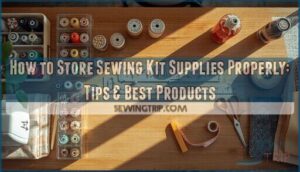
You spend twenty minutes hunting for that perfect shade of thread, only to find it tangled with fifteen others at the bottom of your basket. Sound familiar? Most sewists lose up to 40 percent of their creative time searching through chaotic supplies instead of actually sewing. The culprit isn’t your memory or your busy schedule—it’s a storage system that works against you instead of for you.
When you store sewing kit supplies properly, everything changes. Your needles stay sharp and findable. Your buttons don’t scatter across three different drawers. Your workspace becomes a launchpad for creativity rather than a source of frustration.
The right organization approach transforms those frantic searches into smooth, satisfying moments where your hands reach for exactly what you need.
Table Of Contents
Key Takeaways
- Organizing your sewing kit with clear containers, labels, and color codes can save up to 40% of your creative time by making supplies easy to find.
- Using dedicated storage solutions like stackable bins, modular totes, pegboards, and labeled compartments keeps small items safe, prevents damage, and stops thread from tangling.
- Regular maintenance—like monthly audits, cleaning routines, and updating labels—ensures your sewing kit stays tidy and ready for any project.
- Adapting your storage setup as your sewing needs change, with flexible layouts and inventory tracking, transforms your workspace into a calm, creative command center.
Benefits of Organizing Sewing Kit Supplies

A chaotic sewing kit can turn a fun creative session into a frustrating scavenger hunt. When your supplies are organized, you’ll work faster, waste less, and actually enjoy the process instead of dreading the mess.
Start by making sure you have the essential tools every sewing kit needs, from quality thread and sharp scissors to measuring tape and seam rippers.
An organized sewing kit transforms frustrating supply hunts into faster, waste-free creative sessions you’ll actually enjoy
Let’s look at the specific ways smart storage transforms your sewing experience.
Save Time and Boost Sewing Productivity
When your sewing kit is organized, you’ll shave up to 40 percent off search time every session—that’s real time management in action. A dedicated sewing station with labeled supplies and prewound bobbins keeps your workflow optimization smooth and your sewing productivity soaring.
These simple productivity hacks turn chaos into task automation, so you spend less time hunting and more time creating.
Prevent Loss and Damage of Small Items
Small Item Retention becomes easy when you use clear labeled containers—think screw-top bottles for pins and divided boxes for buttons. Protective Packaging with tissue wrap shields delicate notions from drops, while Dry Environments using silica gel packets stop rust on metal tools. Secure Access through dedicated storage spots and Quick ID Systems with color codes mean you’ll never lose a needle again. That’s thread storage and sewing accessories management that works.
Improve Accuracy With Labeled Compartments
Once you’ve protected your tools, Label Design moves into focus. Compartment Planning with distinct tags for each sewing kit category—thread, needles, buttons—lets you grab supplies without second-guessing.
Supply Categorization by color codes boosts Accuracy Metrics by up to 60%, while Storage Optimization through clear labels prevents those “where did I put that?” moments.
Smart organization means you’ll nail every seam the first time.
Enhance Creativity With a Clear Workspace
Beyond pinpoint accuracy, Workspace Efficiency fuels Creative Flow. When your sewing station isn’t buried under fabric scraps and mystery notions, your brain shifts from hunting mode to maker mode.
Organized storage means you’ll spend less time digging and more time designing. A tidy sewing space with sewing supplies at arm’s reach turns frustration into inspiration—and that’s where your best work happens.
Choosing The Right Sewing Kit Storage
The right storage setup transforms chaos into calm—and it starts with choosing containers that fit how you actually sew. You need options that keep everything visible, accessible, and protected without taking over your entire craft room.
Let’s look at the storage solutions that work hardest for sewists at every skill level.
Stackable Boxes and Clear Bins
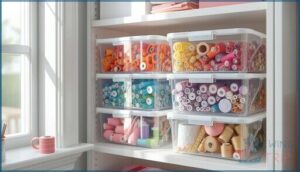
When your sewing supplies sprawl across every surface, clear storage bins and stacking systems become your best allies. Here’s why they transform chaos into control:
- See-through fronts let you spot thread spools and notions without unstacking every bin.
- Interlocking rims guarantee shelf management stays stable, even when fully loaded.
- Nestable designs collapse for storage efficiency when not in use.
- Labeled compartments turn bin organization into a quick-scan process.
Using is especially effective for organizing sewing kit supplies in a compact and visible way.
Modular and Portable Storage Options
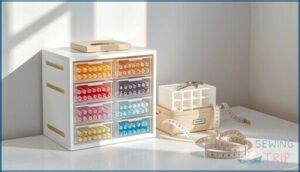
When project deadlines loom or you crave stitching on the go, modular storage and portable totes become game-changers. Flexible storage lets you reconfigure compact units as your sewing supplies grow, while stackable drawers lock together for stable transport between classes or retreats.
| Feature | Modular Shelves | Portable Totes |
|---|---|---|
| Weight capacity | Up to 150 lbs per shelf | 25–75 lbs depending on material |
| Setup time | Snap together in minutes | Detachable inserts, instant access |
| Adjustability | 1-inch or 2-inch grid spacing | Configurable trays for threads and notions |
| Portability | Wall-mounted or freestanding | Recessed grips, anti-slip bottoms |
| Best for | Long-term sewing kit organization | Quick trips and workshops |
Interchangeable brackets mean you’ll reposition shelves without wrestling bolts, and clear inserts in your portable storage reveal contents at a glance—no more digging through mystery bags. When choosing storage, consider how can further optimize your sewing area.
Pegboards, Tackle Boxes, and Magnetic Strips
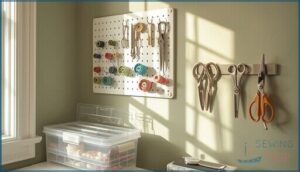
Three wall-mounted champions transform your sewing space: pegboards with evenly spaced holes let you rearrange hooks and shelves without tools, tackle boxes feature adjustable dividers that prevent tiny needles from wandering, and magnetic strips grip metal scissors securely while freeing precious counter space.
Metal pegboard installation beats plastic for heavy loads, while neodymium magnetic strip placement ensures tools stay put during vibrant stitching sessions.
Selecting Storage by Supply Type (Threads, Notions, Tools)
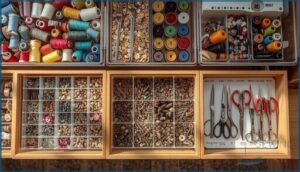
Match your storage to what you’re protecting. Thread organization thrives with transparent bins holding up to 50 spools each, sorted by weight to speed selection.
Notion sorting demands shallow compartments with lids—buttons by size, pins secure from scattering.
Tool placement wins with magnetic strips for scissors and labeled drawers for rotary cutters in blade guards.
Supply categorization isn’t complicated; it’s strategic sewing tool storage that cuts search time dramatically.
Top 5 Products for Sewing Kit Storage
You’ve learned how to choose the right storage for your sewing kit, and now it’s time to put that knowledge into action. The products below will help you create a system that actually works—one where you can find your supplies in seconds instead of digging through chaos.
These five essentials cover everything from storing tiny buttons to organizing your most-used tools.
1. Ball Wide Mouth Glass Mason Jars
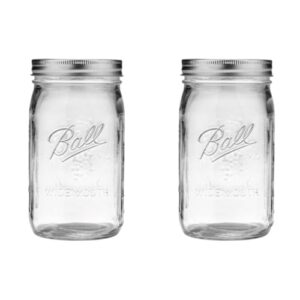
Ball wide mouth mason jars transform how you organize sewing notions. The 3-inch opening makes it ridiculously easy to drop in buttons, beads, or spare bobbins without fumbling. You’ll love the clear glass—it lets you spot exactly what you need at a glance.
These BPA-free jars come in 16-ounce and 32-ounce sizes, giving you flexibility for different supplies. They’re dishwasher safe and made in the USA, so they’ll handle daily use without cracking.
Plus, the two-piece lid system keeps everything secure and dust-free on your shelf.
| Best For | Crafters and sewers who need clear, durable storage for buttons, beads, thread, and other small notions they want to see without digging through drawers. |
|---|---|
| Material | Glass |
| Color | Clear |
| Primary Use | Food Storage |
| Reusable | Yes |
| Mounting Required | No |
| Dishwasher Safe | Yes |
| Additional Features |
|
- Wide 3-inch mouth makes it super easy to drop in and grab supplies without spilling
- Clear glass lets you spot what you need instantly without opening every jar
- Dishwasher safe and made in the USA so they hold up to regular cleaning and use
- Might arrive with sticky tape residue if you order less than 8 jars at once
- Some people have noticed metallic smells from the lids
- Limited to just two sizes, so you can’t get smaller options like 20-ounce jars
2. Mason Jar Canning Bands Rings
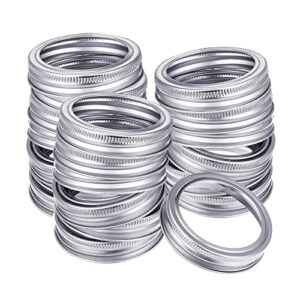
If you’re already using mason jars, these 24-piece regular mouth canning bands will keep everything secure. Each 2.7-inch silver band creates an air-tight seal that blocks dust from settling on your threads and notions. The durable tinplate construction means they’ll survive hundreds of uses without bending or losing their grip.
Hand-dry them with a cloth after washing to prevent rust, and they’ll last for years. You can even color-code your storage by mixing silver and gold tone bands to separate different supply categories at a glance.
| Best For | Anyone who already uses mason jars and wants reliable, reusable bands that create air-tight seals for organizing craft supplies, notions, or pantry items. |
|---|---|
| Material | Tinplate |
| Color | Silver |
| Primary Use | Jar Sealing |
| Reusable | Yes |
| Mounting Required | No |
| Dishwasher Safe | No |
| Additional Features |
|
- Creates a leak-proof, air-tight seal that keeps dust off stored items
- Durable tinplate construction holds up through hundreds of uses without bending
- Compatible with most mason jars including Kerr and Ball brands, plus you can color-code with different finishes
- Requires hand-drying with a cloth after washing to prevent rust
- Some users received damaged products due to poor packaging during shipping
- Not ideal for extreme temperatures without taking extra care
3. Avery Removable Labels
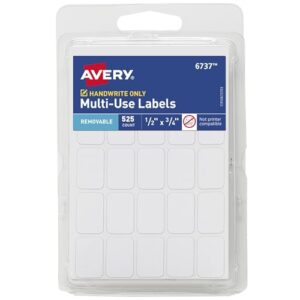
Once your jars are sealed and ready, you’ll want to label them so you can spot what you need without squinting or opening every container. Avery’s 1/2″ x 3/4″ removable labels (model 6737) give you 525 tiny white stickers that stick to glass, plastic, and metal—then peel away clean when you reorganize.
Handwrite directly on each one to mark thread colors, button sizes, or zipper lengths. They won’t leave sticky residue behind, so you can update your system whenever your projects shift direction.
| Best For | Crafters and organizers who need to label small containers, supplies, or storage bins and want the flexibility to relabel as their projects change. |
|---|---|
| Material | Paper/Plastic |
| Color | White |
| Primary Use | Labeling |
| Reusable | Yes |
| Mounting Required | No |
| Dishwasher Safe | N/A |
| Additional Features |
|
- Removable adhesive peels off cleanly without leaving sticky residue, so you can reorganize without mess
- Works on multiple surfaces like glass, plastic, and metal jars or containers
- Compact 1/2″ x 3/4″ size fits perfectly on small items like thread spools, button boxes, or mini storage bins
- Handwrite-only format means no printer compatibility, which can be slow for bulk labeling
- May peel off too easily on curved or textured surfaces like round plastic bottles
- Pricier than similar label options, especially if you’re labeling hundreds of items
4. Wall Control Metal Pegboard
Wall Control’s 32 x 16-inch metal pegboard (model 30-P-3232B) gives you a vertical surface that won’t sag under heavy scissors, rotary cutters, or fabric rolls.
Made from 20-gauge galvanized steel with a rust-resistant black finish, it mounts straight into studs or drywall without extra framing.
The vertical slot system locks hooks and shelves in place so they won’t slide around when you grab your tools.
You can combine multiple panels to cover an entire wall as your collection grows.
| Best For | Crafters and sewers who need a heavy-duty wall storage system that can handle the weight of fabric bolts, cutting tools, and accessories without sagging. |
|---|---|
| Material | Metal Steel |
| Color | Black |
| Primary Use | Tool Organization |
| Reusable | Yes |
| Mounting Required | Yes |
| Dishwasher Safe | N/A |
| Additional Features |
|
- 20-gauge steel construction is over 10 times stronger than standard pegboard and won’t bend under heavy loads
- Vertical slot system keeps hooks and shelves locked in place so they won’t shift when you’re grabbing supplies
- Mounts directly to studs or drywall without building a frame, and panels can be combined to expand your storage
- Some customers received damaged products due to poor packaging during shipping
- The narrow slots can limit what types of mounting hardware you can use
- May not align perfectly with standard 16-inch stud spacing in all walls
5. Hogurity Metal Pegboard Wall Organizer
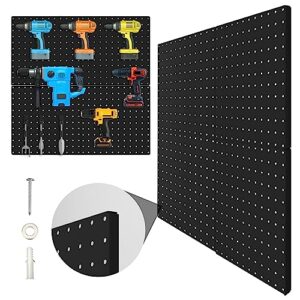
If you’d rather keep things compact, Hogurity’s 12 x 12-inch metal pegboard panels let you build custom layouts that fit tight spaces. Each black powder-coated panel holds up to 20 pounds and works with standard 1⁄4-inch hooks—no special adapters needed.
The bent frame keeps pegs from scraping your wall and adds just enough depth for wire baskets or bulky scissors.
Snap four panels together for a 24 x 24-inch square, or line them up horizontally to create a sleek ribbon organizer above your worktable.
| Best For | Anyone working with limited wall space who wants a modular pegboard system they can arrange however they need. |
|---|---|
| Material | Metal Steel |
| Color | Black |
| Primary Use | Tool Organization |
| Reusable | Yes |
| Mounting Required | Yes |
| Dishwasher Safe | N/A |
| Additional Features |
|
- Standard 1/4-inch compatibility means you can use hooks and accessories you already own
- Magnetic surface adds bonus storage for metal tools and small parts
- Bent frame design keeps the panel off the wall so hooks slide in easily
- Panels might need some fiddling to hang flush against each other
- You’ll probably need to buy extra hooks and bins separately
- 20-pound weight limit per panel rules out heavy power tools or large equipment
Maintenance Tips for Sewing Kit Organization
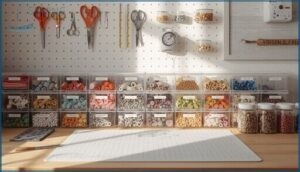
Getting your sewing supplies organized is just the beginning—keeping them that way is where the real magic happens. Without a maintenance plan, even the best storage system can turn into a chaotic mess within weeks.
Here are four simple strategies to keep your sewing kit in perfect working order so you can spend more time creating and less time searching.
Labeling and Color Coding for Quick Identification
Think of Color Coding as your organization’s secret language—it speaks instantly. Use a label maker to create waterproof labels in high-contrast pairs, placing Category Markers at the front edge of bins so Visual Clues pop from eye level.
A six-color scheme maps threads, notions, and tools at a glance. Label Placement on drawers and Storage Signs near your worktable complete your sewing supply organization system, turning chaos into confidence.
Regular Cleaning and Supply Audits
Once a month, carve out fifteen minutes for a quick audit of your sewing kit—it’s Maintenance Tips magic. Check each item’s condition, tag worn tools for replacement, and watch your sewing supply organization thrive effortlessly.
Wipe surfaces daily to banish lint, replace storage cloths weekly, and deep-clean bins quarterly. These Cleaning Routines keep your sewing supplies fresh and your organization rock-solid.
Inventory Tracking After Each Project
Accountability transforms your sewing kit into a well-oiled machine. After every project, track exactly what you used—Post Project Analysis and Inventory Reconciliation reveal which sewing supplies and sewing tools vanished and which stayed put:
- Record what you started with and what remains in storage to maintain Stock Level Management.
- Note shortages or surprises for smarter Supply Chain Optimization next time.
- Create simple Project Audit Trails linking materials to finished work.
- Update your master list so organization stays honest and your sewing kit stays ready.
Adapting Storage as Your Sewing Needs Change
Your sewing kit won’t stay frozen in time—and neither should your storage. Flexible Storage evolves when you swap out rigid bins for Modular Systems with removable dividers.
Reassess Adaptive Layouts every few months, relocating frequently used sewing supplies to within arm’s reach.
Color code zones, update labels, and sketch a quick inventory map so your Active Organization reflects real-world demands instead of fighting them.
Frequently Asked Questions (FAQs)
Should I store my sewing machine with the needle up or down?
Most manuals recommend storing your sewing machine with the presser foot down and needle down—ideally resting on a soft fabric scrap.
This needle storage position protects machine maintenance, ensures sewing safety, and prevents internal shifting.
Why should we store the sewing items in closed containers?
Closed containers offer dust prevention and moisture protection that keep your sewing supplies spotless.
They provide pest control, prevent tangling, and guarantee container safety by securing sharp tools away from children and pets.
How do you organize patterns and instruction sheets?
Keep your “pattern filing” game sharp—store instruction sheets in clear sleeves within labeled binders, scan for digital storage, attach fabric swatches, and maintain a master index tracking your sewing archives by category.
Should bobbins be stored wound or empty?
You can store bobbins either way—wound bobbins with thread management labels save setup time, while empty ones prevent tangles and simplify sewing kit organization.
Choose based on your storage solutions and sewing efficiency needs.
How do you prevent thread from tangling in storage?
To prevent unwinding, slip thread nets over your spools, or snap spool caps onto each end to lock threads in place.
Store spools vertically in dedicated thread boxes with individual compartments for reliable tangling prevention.
What temperature is safest for fabric storage?
Picture your fabrics as sleeping guests—they need just-right conditions. Fabric storage thrives between 60°F and 75°F, paired with 50% humidity levels, ensuring climate stability protects your fabric preservation from fading, brittleness, and mold damage.
Conclusion
Here’s the irony: the tools meant to spark your creativity have been stealing it all along. But now you know how to store sewing kit supplies properly—with clear containers, smart labels, and systems that actually work for you.
Your needles won’t hide. Your threads won’t tangle. Your projects won’t stall before they start. That chaotic basket becomes your creative command center.
Stop organizing your supplies around frustration. Start organizing them around possibility.