This site is supported by our readers. We may earn a commission, at no cost to you, if you purchase through links.
My quilting group swears by fabric bundles, but I spent my first year buying them blind—grabbing charm packs for queen-sized quilts and wondering why I ran out of fabric halfway through.
Most bundles contain between 4 and 6 yards total, though the exact amount depends entirely on the type you choose. A charm pack delivers roughly one yard in tiny squares, while a jelly roll gives you around 3-4 yards in long strips.
Understanding these quantities before you buy saves you from midproject panic trips to the fabric store. Once you know which bundle matches your project size, you’ll plan smarter and waste less fabric.
Table Of Contents
Key Takeaways
- Most fabric bundles contain 4 to 6 yards total, but the exact amount depends entirely on the bundle type—charm packs give you roughly 1 yard while jelly rolls deliver 3 to 4 yards.
- Match your bundle size to your project dimensions by calculating finished block measurements, not raw precut sizes, and always add 10 to 15 percent extra for seam allowances and trimming.
- Precut bundles save prep time but cost 15 to 25 percent more than buying yardage off the bolt, so weigh convenience against budget when planning larger quilts.
- Pinked edges on precuts create measurement variance of 1/8 to 1/4 inch, so measure from just inside the zigzag edge with a clear ruler before you start cutting or sewing.
What is a Fabric Bundle?
A fabric bundle is a curated collection of coordinating fabrics packaged together, usually featuring prints and patterns that share a common color palette or design theme. Think of it as a ready-made fabric wardrobe that takes the guesswork out of matching patterns and colors for your next project.
If you’re wondering how fabric bundles compare to fat quarters, the main difference lies in size and variety—bundles offer more coordinated options while fat quarters give you larger cuts of individual fabrics.
Bundles save you time at the fabric store and give you everything you need to start sewing without hunting down individual pieces that work well together.
Definition and Purpose of Fabric Bundles
A fabric bundle is a handpicked collection of fabric pieces sold together, making fabric coordination and color coordination simple. These curated precut sets take the guesswork out of fabric selection and deliver bundle benefits that simplify quilter needs.
The benefits of fabric bundles include:
- Cohesive color palettes guarantee your pieces work together beautifully
- Precut sizing eliminates measuring and cutting time
- Variety in one package lets you test designs without buying full yardage
- Sewing simplification through matched fabric bundles from the same line
Common Uses in Quilting and Sewing Projects
You’ll reach for fat quarter bundles when you’re tackling quilt patterns that call for a mix of coordinating prints—they’re perfect for sampler quilts, scrappy patchwork designs, and color matching experiments.
These sewing tips simplify project planning since everything’s already sized and ready to stitch, and precut strips speed up border piecing and binding. Fat quarter bundles work beautifully for tote bags and pillow covers.
How Bundles Differ From Buying Individual Yardage
When you buy fabric off the bolt, you’ll pay about 10 to 13 dollars per yard and can cut any dimension you need—ideal for borders or large pattern pieces. Yardage offers flexibility and fabric savings.
Precut varieties save prep time but add a 15 to 25 percent convenience fee, sometimes hitting 30 dollars per yard for charm packs. Bundles deliver instant variety and sewing efficiency.
To learn about the role of necessary cookies in website functionality, it’s helpful to understand how fabric retailers manage online user experience.
Types of Fabric Bundles and Their Quantities
Fabric bundles come in several standard types, each with its own size and piece count. The naming might sound like dessert menu items, but these precuts follow industry standards that make planning your projects much easier.
Here’s what you’ll find when shopping for bundles.
Fat Quarter Bundles (18 X 22 Cuts)
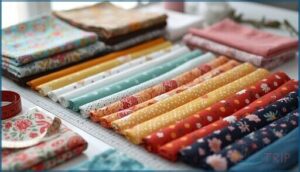
You’ll find fat quarter bundles packed with 12, 16, or 20 pieces, each measuring 18 by 22 inches. This fabric selection gives you more usable space than traditional quarter-yard cuts, and it’s perfect for quilt planning when you need variety without full yardage commitment.
Here’s what makes these quilt fabric precuts so practical:
- Each piece comes from a different print within a coordinated color family
- The bundle organization provides light to dark values for balanced quilt blocks
- Fabric measurement stays consistent since cuts preserve the fabric grain
- You can test fabric requirements and color combinations risk-free
- Fabric storage stays simple when you keep them folded flat in labeled bins
These bundles work beautifully for scrap projects and coordinating quilt tops, offering ready-to-use color sets that take the guesswork out of sewing tips beginners often struggle with.
Fat Eighth Bundles (9 X 22 Cuts)
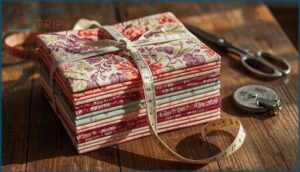
These half-sized fabric precuts give you 9 by 22 inch pieces, ideal for sewing tips that call for controlled fabric calculations without leftover yardage.
Before you stock up on fat quarters, check out pricing guides for secondhand sewing machines to make sure your equipment budget is on track.
Bundle variations range from 20 to 50 cuts, depending on the collection. You’ll get about 2.5 yards total in a 20-piece stack—perfect for quilt patterns needing many prints.
Fat eighth sizes work beautifully for scrappy blocks and small appliqué. To learn more about commonly used pre-cut fabric types, check out this helpful guide.
Charm Packs (42 Pieces of 5 Squares)
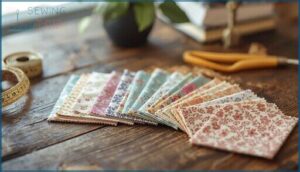
Charm packs give you forty-two perfectly coordinated 5-inch precut squares from a single fabric collection, making color coordination a breeze. You’ll get about 1,050 square inches of material—enough for small quilt patterns without buying full yardage.
These fabric precuts shine when you need variety:
- Test fabric selection across an entire color family before committing
- Create sampler quilts that showcase coordinated prints
- Build scrappy projects by mixing charm pack sizes from different collections
- Practice sewing tips for precise piecing with uniform squares
Most charm packs feature 100% cotton quilting fabric with pinked edges to prevent fraying.
Layer Cakes (42 Pieces of 10 Squares)
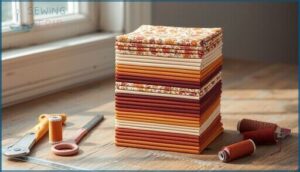
Layer cakes offer forty-two precut squares measuring 10 by 10 inches—perfect for quilt patterns that demand larger fabric selection without the fuss of cutting.
These quilt fabric precuts maintain consistent fabric grain across coordinated color families, so you can stack and sew without worrying about distortion. Most bundles deliver 4 to 5 yards total, making them ideal for lap quilts when you pair them with matching fabric bundles.
Jelly Rolls (40 Strips of 2.5 X 44)
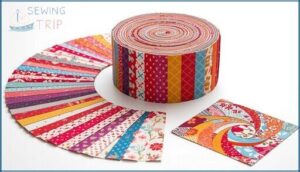
Jelly rolls include forty strips of fabric precuts, each measuring 2.5 by 44 inches, rolled together for easy handling. These quilt fabric precuts simplify strip piecing and color coordination, giving you a ready-made fabric selection from one designer collection.
With about 8 to 10 yards total, you’ll breeze through quilt patterns like log cabin designs—and the consistent width means your sewing tips pay off instantly.
Other Precut Varieties (Honey Buns, Dessert Rolls)
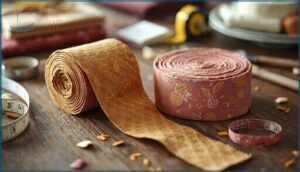
Beyond jelly rolls, you’ll find honey buns and dessert rolls—two fabric precuts and bundles that expand your strip quilting options. Honey bun uses include skinny borders and string quilts with forty 1.5-inch strips, while dessert roll projects feature twenty 5-inch strips perfect for precut rectangles.
- Honey buns: Forty strips at 1.5 by 42 inches, roughly 1.75 yards total
- Dessert rolls: Twenty strips at 5 by 42 inches, about 2.9 yards combined
- Strip width variety: Honey buns offer narrow detail; dessert rolls give quick assembly
- Fabric strip management: Both arrive rolled and coordinated by collection
- Precut comparisons: Different widths suit different project scales and layouts
How Much Total Yardage in a Bundle?
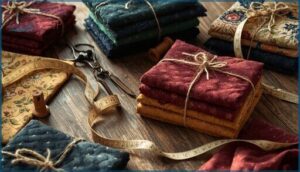
Most fabric bundles contain between 4 and 6 yards of fabric total, but that can vary quite a bit depending on what type of precut you’re buying.
If you’re planning a project and need to know exactly how much fabric you’ll have to work with, it helps to understand how different bundle types translate into actual yardage. Let’s break down the math for the most common precut formats so you can shop with confidence.
Typical Yardage Range (4-6 Yards Total)
Most fabric bundles give you four to six yards total when you combine all the pieces inside. That range works well for many quilt projects without overwhelming your stash.
Here’s a quick breakdown of typical precut quantities:
| Bundle Type | Pieces Included | Approximate Total Yardage |
|---|---|---|
| Fat Quarter Bundle | 8–16 cuts | 4–6 yards |
| Charm Pack | 42 squares (5″) | 0.75–1 yard |
| Layer Cake | 42 squares (10″) | 1–1.5 yards |
| Jelly Roll | 40 strips (2.5″ × 44″) | 3–4 yards |
| Fat Eighth Bundle | 16–24 cuts | 4–6 yards |
Always check the product page for exact fabric requirements before you buy.
Calculating Yardage From Fat Quarters
Four fat quarters equal about one yard of fabric when you do the math. Each 18 by 22 inch cut gives you roughly 0.25 yards, so the yardage conversion is straightforward for quilt block planning.
Here’s what you need to know for fabric scaling:
- A 5 fat quarter bundle provides 1.25 yards total
- Fabric cutting should account for seam allowances
- Sewing efficiency improves when you plan fabric bundles ahead
- Quilt making techniques often mix fat quarters with yardage
Yardage Equivalents for Different Precut Types
Understanding yardage calculations across different precut comparisons helps you plan better. Charm packs give you roughly 0.5 yard, while layer cakes offer about 2.0 yards of fabric. Jelly rolls provide around 1.25 yards in strip form, and fat eighth bundles contribute 1.5 yards collectively.
| Precut Type | Total Yardage | Best Use |
|---|---|---|
| Charm Pack | 0.5 yards | Small quilts |
| Layer Cake | 2.0 yards | Lap projects |
| Jelly Roll | 1.25 yards | Strip designs |
These bundle estimates guide your fabric requirements for different quilt sizes.
Checking Product Specifications Before Purchase
Before you click that buy button, you’ll want to verify a few key details to avoid surprises. Most product pages list everything you need, but it’s worth double-checking.
- Total yardage: Confirm the stated yards match your project needs
- Precut count: Check how many pieces come in the bundle
- Fabric manufacturer: Look for brand names and collection details
- Return policy: Make sure the seller offers exchanges if specs don’t match
Bundle Weight and Fabric Composition
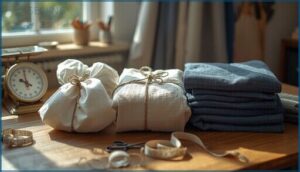
Weight matters more than you might think when you’re ordering fabric bundles online or planning a project.
A typical fabric bundle weighs between 1 and 3 pounds, but that range shifts quite a bit depending on what type of fabric you’re working with.
Here’s what influences the weight and how to know what you’re getting.
Standard Weight Range (1-3 Pounds)
Most fabric bundles you’ll find weigh between 1 and 3 pounds, which is a useful reference point when you’re planning your next project or comparing bundle variations across brands.
Weight factors like the number of precuts and fabric density play a role here. A lighter bundle around 1 pound works for baby quilts, while heavier bundles closer to 3 pounds give you enough fabric for larger lap quilts.
Fabric Type Impact on Weight (Cotton Vs. Denim)
You’ll notice a big difference when you compare quilting fabric to denim bundles. Quilting cotton usually runs 3 to 5 ounces per square yard, while denim thickness starts around 10 ounces and can climb to 21 ounces for heavier varieties.
That denser weaving and fiber content means two bundles with identical yardage can differ in weight by 50 to 100 percent based on fabric types alone.
GSM Measurements for Different Bundle Types
GSM reveals fabric density and thickness across different precut bundles. Most quilting fabric in charm packs, layer cakes, and fat quarters sits in the 120 to 160 GSM range, helping you predict drape and warmth.
- Lightweight bundles (120–135 GSM) suit baby quilts with soft, flexible feel
- Medium bundles (135–150 GSM) handle everyday patchwork and table runners
- Heavier bundles (150–160 GSM) add structure for bags and cushions
Fabric manufacturers usually keep GSM consistent across all precut types within one collection.
Choosing The Right Bundle for Your Project
Picking the right bundle type saves you time, money, and a lot of frustration halfway through your project. The key is matching your bundle to the size of quilt you’re making—think of it like choosing the right pan for a recipe.
Let’s break down which bundles work best for each quilt size so you can shop with confidence.
Matching Bundle Size to Quilt Dimensions
You’ll want to think about finished block size when matching your fabric bundle to quilt dimensions. Divide your target quilt width and length by the actual finished block measurement—not the raw precut size—then multiply to find how many pieces you need.
Always factor in extra bundle allowance for seam trimming and layout tweaks, plus remember that borders and sashing stretch precuts further across your quilt design.
Baby Quilts (1 Charm Pack)
One standard charm pack holds 42 five-inch squares that sew down to a 27 by 31.5 inch center—small for a baby quilt.
Most quilt patterns pair that single pack with about 1.25 yards of background fabric and borders, stretching your precuts to around 36 by 44 inches, which gives babies room to grow and makes tucking around a crib mattress easier.
Lap Quilts (3 Charm Packs)
Three charm packs give you 126 five-inch squares—enough to piece a 40 by 60 inch lap quilt top. You’ll tap into about 1.5 to 2 yards of total yardage across those precuts, letting you play with color schemes and block designs without buying full yardage.
Add 2 yards of background fabric and borders, and your quilting techniques suddenly have room to shine in cozy lap quilt patterns.
Queen Size Quilts (8 Charm Packs)
Eight charm packs deliver 336 five-inch squares for a queen quilt top—roughly 4.5 to 6 yards of fabric selection spread across coordinated precut fabric types and sizes.
Your color coordination options expand dramatically with this fabric bundle, letting you arrange squares in a striking quilt pattern. Add background yardage and borders to reach standard queen dimensions, then apply your favorite quilting techniques to showcase that bundle organization.
Combining Multiple Bundles for Larger Projects
Larger quilting projects often need two or more fabric bundles to reach your target dimensions.
When you’re mixing fabric bundles, choose at least three color families for balanced contrast and include two bundles with light neutrals to anchor your design.
Add up the yardage from each bundle, then tack on 10–15% extra for seam allowances and trimming—that buffer keeps fabric coordination stress-free.
Tips for Working With Fabric Bundles
Once you’ve picked the right bundle, a few simple habits will save you time and frustration at your cutting table.
Precuts aren’t always perfectly uniform, and knowing how to handle those quirks makes all the difference. Here’s what to keep in mind as you unwrap your fabrics and start planning your layout.
Measuring Precuts Accurately (Pinked Edges)
Pinked edges can throw off your sewing accuracy if you don’t measure correctly. Always use measurement tools like a clear ruler aligned just inside the decorative zigzag, not at the outer tips.
Precut fabrics usually show edge variance of 1/8 to 1/4 inch due to cutting techniques and weaving inconsistencies. Check a few pieces from your bundle before you start—fabric shrinkage and manufacturer differences happen, and confirming your actual dimensions helps you meet quilting fabric standards without running short mid-project.
Coordinating Patterns and Color Families
Once your measurements check out, it’s time to think about how your fabrics play together. Color family transitions work best when you move from warm reds to cool blues gradually.
Pattern scale harmony means balancing large florals with tiny geometrics so nothing overwhelms the eye. Value progression—light to dark—adds depth, while monochrome unity keeps things cohesive.
Color theory guides fabric coordination techniques, helping you mix patterns without clashing.
Avoiding Common Mistakes With Mixed Manufacturers
Mixing fabrics from different manufacturers can create headaches you didn’t see coming. Even when precut accuracy looks similar, color consistency between brands rarely matches perfectly.
Here’s what to watch for:
- Shrinkage rates vary wildly—cotton from one maker might shrink 5% while another’s stays put
- Fabric hand differences affect drape and sewing ease
- Care instructions that don’t align can ruin your finished quilt
Always check fiber content before combining bundles.
Frequently Asked Questions (FAQs)
How many yards of fabric is 60×80?
Think of fabric yardage like converting a recipe: a 60×80-inch piece equals about 7 to 4 yards, depending on your fabric width. Standard quilting fabric at 44 inches wide needs roughly 7 yards.
Can you mix different bundle types together?
Yes, you can mix different bundle types in one project. Just confirm each type contributes compatible yardage and maintains color harmony.
Combining jelly rolls with fat quarters or charm packs creates beautiful scrappy quilts.
Do bundles include backing or batting fabric?
Most fabric bundles supply only top fabric for your quilt making—no backing options or batting requirements included.
You’ll purchase backing fabric and batting separately to complete the quilt layering process for any project.
How long do fabric bundles stay fresh?
Contrary to popular belief, your precious fabric bundles won’t last forever like some immortal textile relic.
With proper fabric storage and moisture control, most bundles stay fresh six to twelve months before color fading begins.
Are precut bundles more expensive than yardage?
When you compare precut fabrics to yardage, bundles usually cost more per square inch because of handling and packaging.
However, bundle discounts during sales can narrow the price gap for quilting supplies considerably.
Can you return or exchange opened bundles?
Most quilt shops won’t accept opened bundles for refunds—only unopened, factory-sealed packages qualify. Return policies treat opened precuts as final sale, though stores may exchange defective bundles with proof.
Conclusion
I’ve planned entire quilts on napkins, only to discover my charm pack math was wildly optimistic. Now I measure twice and buy once, because knowing how much fabric comes in a bundle transforms guesswork into confidence.
Check those product specs, match your bundle type to your project size, and keep one extra fat quarter stash for emergencies. Your future self—standing at a cutting table with perfectly measured pieces—will thank you for doing the homework upfront.