This site is supported by our readers. We may earn a commission, at no cost to you, if you purchase through links.
Your first embroidery sampler probably won’t hang in a gallery—and that’s exactly the point. Think of it as the artist’s equivalent of a musician’s practice room, where you run your scales without an audience. A basic stitch sampler tutorial gives you permission to mess up, to pull out wonky stitches, and to discover that your tension control needs work before you tackle that gorgeous floral hoop you’ve been dreaming about.
Each row becomes a mini-experiment: Can I keep my running stitch straight? Does my chain stitch look like actual links or tangled spaghetti? By dedicating fabric space purely to practice, you build the muscle memory that transforms shaky beginner attempts into confident, even stitches that’ll make your future projects absolutely sing.
Table Of Contents
Key Takeaways
- A stitch sampler functions as your personal embroidery practice playground where you build muscle memory and tension control without the pressure of creating a perfect finished project.
- Mastering ten foundational stitches—including running stitch, backstitch, chain stitch, and satin stitch—gives you the building blocks to tackle virtually any embroidery pattern with confidence.
- Success comes from smart habits like maintaining consistent spacing through grid guidelines, preventing thread tangles with proper needle selection, and tracking your progress to stay motivated through incremental wins.
- Your completed sampler becomes a permanent reference library you’ll revisit for years, eliminating the need to rewatch tutorials every time you forget a technique.
What is a Stitch Sampler and Why Practice One?
Think of a stitch sampler as your embroidery practice playground—a single piece of fabric where you try out different stitches without the pressure of creating a perfect project. It’s basically how you build your skills one stitch at a time, kind of like musicians running scales before playing a song.
Just like when you’re choosing fabrics for a quilted jacket, gathering physical samples helps you understand how different materials actually behave under your needle.
Let’s look at what makes stitch samplers such a breakthrough for anyone picking up needle and thread.
Understanding The Purpose of Stitch Samplers
A stitch sampler is your personal embroidery textbook—fabric where you rehearse hand embroidery techniques from simple to complex. Think of it as a playground for basic stitches and stitching techniques.
The stitch sampler benefits are fabulous:
- You’ll catalog embroidery fundamentals in one compact reference
- Sampler design builds stitch mastery through deliberate repetition
- Your finished piece becomes a visual archive you can revisit anytime
It’s structured practice that transforms uncertainty into confidence!
Benefits for Beginner Embroiderers
When you’re just starting your hand embroidery for beginners journey, a beginner sampler offers real skill building through gentle repetition. You’ll spot common mistakes—like uneven tension—and fix them before they become habits.
Each completed stitch boosts your stitch confidence and keeps practice motivation high. Plus, online learning resources and the embroidery community cheer you on, turning basic embroidery stitches into your personal masterpiece!
Building Muscle Memory and Consistency
Once you’ve built that early confidence, repetition transforms your movements into second nature. Each stitch repetition strengthens muscle formation, letting your fingers “remember” the right tension control.
A stitch sampler gives you kinaesthetic feedback—you’ll feel when thread glides smoothly or tugs awkwardly. Progressive learning means basic embroidery stitches become automatic, freeing your mind to explore new embroidery techniques with joy!
Through touch and repetition, your fingers learn each stitch until embroidery becomes instinct rather than instruction
Essential Supplies for Your Stitch Sampler
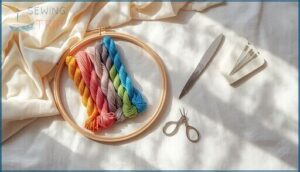
You don’t need a craft store‘s worth of supplies to start your first sampler—just a few basics. Think of these essentials as your embroidery toolkit, the foundation that’ll make practicing stitches so much easier.
Let’s walk through what you actually need and why each piece matters.
Choosing The Right Fabric and Hoop
Your fabric selection and embroidery hoop are the foundation of every gorgeous stitch sampler—and honestly, picking the right combo makes your hand embroidery journey so much smoother! Cotton fabric works beautifully for beginners because it’s tightly woven and gives you crisp stitch visibility without puckering.
If you’re ready to level up your technique, check out this guide on how to sew step by step to master stitch control and fabric handling.
- Wooden hoops (6–8 inches) offer lightweight tension control for portable practice
- Even weave fabrics like Aida provide built-in grids for consistent spacing
- Fabric stabilization through prewashing prevents shrinking and keeps stitches aligned
Selecting Embroidery Needles and Thread
Choosing your embroidery needles and thread colors might feel overwhelming at first—but here’s the secret! Size 7 needles glide through cotton beautifully without snagging, while 6-strand embroidery floss gives you flexibility to create delicate lines or bold fills.
For your stitch sampler, grab 100 percent cotton thread in varied thread colors and pair with sharps needles for crisp hand embroidery techniques.
Transfer Tools and Pattern Options
With the right pattern transfer methods, your stitch sampler projects spring to life! Iron methods work beautifully for quick designs, while fabric markers and stencil designs offer flexibility.
Here’s what you’ll love:
- Water-soluble pens vanish after a gentle rinse—no fuss
- Grid templates keep your stitch guides perfectly aligned
- Carbon paper creates crisp embroidery patterns and designs
Transfer onto fabric becomes second nature once you find your favorite technique.
10 Basic Embroidery Stitches to Master
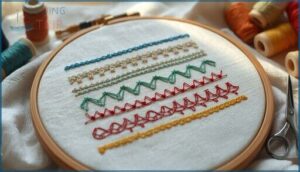
Now that you’ve got your supplies ready, it’s time to learn the foundational stitches that’ll turn your fabric into a masterpiece!
These ten foundational stitches are the building blocks of hand embroidery—once you’ve practiced them, you can tackle just about any pattern that catches your eye.
Let’s break down each stitch so you can see exactly how they work and where they shine.
Running Stitch
Think of the running stitch as embroidery’s simplest building block—an up-and-down rhythm that creates a charming dashed line.
You’ll weave the needle through fabric at even intervals, keeping your thread tension relaxed and your stitch length consistent (about 1 to 3 millimeters works beautifully). This fundamental technique is perfect for outlines, basting, and quick decorative borders in hand embroidery and stitch sampler projects.
To learn about its historical use and technique, see this introduction to running stitch.
Back Stitch
Back stitch builds a solid, rope-like line that mimics the look of machine stitching—perfect for outlining shapes and lettering in hand embroidery. You’ll bring your needle up, step back a stitch length, then push through—repeating this rhythm creates crisp, connected lines.
Why back stitch belongs in your stitch library:
- Controls fabric tension beautifully without puckering
- Creates impeccable outlines in embroidery patterns
- Mastering stitch length control keeps lines uniform
- Works with any thread selection for bold or delicate effects
- Essential foundation for sophisticated embroidery techniques and tips
The historical use of back stitch dates as far back as 16th century English Jacobean crewel work, highlighting its significance in embroidery traditions.
Split Stitch
Split stitch acts like a fine-tipped pen for your hand embroidery—you pierce through each previous stitch as you move forward, creating a smooth chain-like line perfect for outlines and lettering.
Control your stitch length to keep curves neat, and pick an even number of floss strands so the split maintains balanced tension control. This technique belongs in every stitch library!
Chain Stitch
Chain stitch creates those adorable looped links you see in vintage embroidery—each stitch loops through the last, forming a flexible line that moves with your fabric. You’ll want to practice stitch tension control and stitch length management to keep loops uniform.
This hand embroidery favorite works beautifully for outlining and decorative borders, plus chain stitch variations let you explore fabric compatibility with different embroidery thread choices as you learn new stitches!
Satin Stitch
Satin stitch fills shapes with smooth, side-by-side parallel stitches—think glossy flower petals and bold lettering. This hand embroidery technique demands tension control and fabric selection with a stable weave to prevent puckering.
Here are satin stitch tips for beautiful results:
- Keep stitch length between 2–4 millimeters for tight coverage
- Use single-strand floss for the smoothest finish
- Maintain even spacing so stitches touch without gaps
- Try optional split stitch outlines for crisp edge finishing
Additional Foundational Stitches
Beyond the basics you’ve learned, stem stitch loops thread along contours for beautiful outlines.
French and colonial knot stitches add raised texture—perfect for flower centers and eyes.
Couching techniques secure metallic threads with tiny tacks, while long and short stitch variations blend colors for gentle shading.
Satin fill covers small areas with dense parallel threads, and combining backstitch, running stitch, and chain stitch creates endless design possibilities!
Step-by-Step Tutorial for Creating Your Sampler
Ready to turn those practice stitches into something real? This is where the magic happens—you’ll prep your fabric, thread your needle, and work through each stitch with confidence.
Let’s break it down into simple steps so you can create a sampler you’ll actually be proud of.
Preparing Your Fabric and Pattern

Fabric selection starts your sampler journey right! Choose 14-count Aida or 28-count even weave, then prewash to prevent future shrinkage. Iron gently and secure in your hoop—taut but not stretched—to keep embroidery stitches from warping.
For pattern transfer onto fabric, use a water-soluble pen or lightbox tracing. Mark your center point, align with the weave, and you’re ready to stitch your basic embroidery stitches with perfect stitch alignment!
Threading Your Needle and Starting Knots
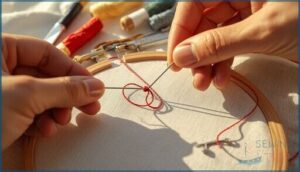
You’re all set with fabric—now let’s talk Thread Management! Cut about 18 inches, trim at a 45-degree angle, and slide it through your Embroidery needles smoothly.
For Knot Tying, try a tiny tailor knot that lies flat. Hold everything taut for Tension Control and Fray Prevention.
This Needle Selection and Needlework techniques foundation makes Learning basic embroidery stitches feel like a masterpiece in progress!
Practicing Each Stitch With Proper Technique
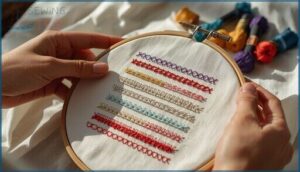
Hold your needle at a gentle angle—this transforms your Hand Positioning and Needle Angle from awkward to fabulous. As you practice Hand Embroidery for Beginners, focus on Stitch Length Control by keeping each stitch uniform.
Thread Tension matters too—not too tight, not too loose. These Basic Embroidery Stitches and embroidery tutorials teach practicing hand embroidery techniques that build confidence. Your Fabric Choice complements every move.
Achieving Uniform Spacing and Tension
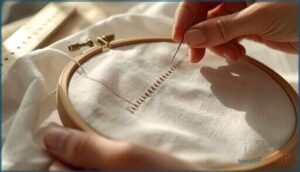
Your hoop keeps Fabric Stability locked in—no bunching or shifting during those Basic Embroidery Stitches. Pull Thread Tension gently so stitches lie flat without puckering the fabric. Aim for Even Spacing by following light grid lines or counting roughly 2–3 millimeters between each stitch.
Consistent Needle Control and Stitch Length turn embroidery sampler patterns into masterpieces. Hand embroidery for beginners feels achievable when embroidery tutorials guide your rhythm!
Tips for Successful Stitch Sampler Practice
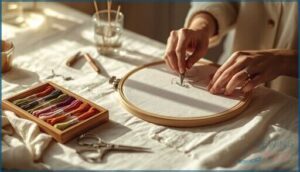
You’ve got the stitches down—now let’s talk about the little tricks that’ll keep your sampler looking fabulous and your sanity intact.
These aren’t fancy rules, just smart habits that prevent headaches like tangled thread and wonky lines. Here’s what’ll help you practice like a pro and actually enjoy the process.
Preventing Thread Fraying and Tangling
Nothing kills your stitching flow faster than thread that tangles or frays mid-project! Here are my favorite Thread Care Tips and Fray Prevention strategies for smooth embroidery stitches:
- Match your needle size to fabric thickness — sharp microtex needles reduce thread wear
- Keep tension consistent — Tension Control prevents loose loops that catch and fray
- Store thread away from heat — Storage Solutions that protect from sunlight prevent brittle ends
- Replace dull needles regularly — Needle Maintenance eliminates roughened thread edges
Using Grids and Shapes for Guidance
Think of your sampler fabric as a treasure map—grids and shapes show you exactly where to place each stitch. Grid alignment keeps your running stitch and backstitch rows perfectly straight, while proportional guides help you scale chain stitch and satin stitch evenly.
Try masking techniques to outline stem stitch practice zones, or use color coding to separate different stitch types for fabulous clarity.
Tracking Your Progress and Next Steps
Every stitch you complete is a tiny victory—and tracking those wins keeps you motivated! Start a simple practice journal to log your daily sessions and watch your skill assessment reveal real progress.
Here’s your roadmap:
- Set weekly goals for mastering two stitches from your basic embroidery stitches sampler
- Record spacing improvements using progress metrics and photos
- Build practice routines with 15-minute sessions at the same time each day
Celebrate each achievement—you’re building your embroidery for beginners foundation one beautiful stitch at a time!
Frequently Asked Questions (FAQs)
How do I finish and display my sampler?
Your sampler deserves the spotlight—literally! Wash and press it first, then mount on acid-free board with gentle pins.
Frame with UV-protective glass, hang at eye level using sturdy hooks, and keep it away from harsh sunlight.
Can I wash my completed stitch sampler?
Yes—you can wash your embroidery sampler! Hand wash gently in cool water with mild detergent, avoiding wringing.
Press lightly, lay flat to dry, then iron on low heat for best stitch protection and color preservation.
What thread weight works best for samplers?
For most hand embroidery samplers, 40-weight thread delivers fabulous stitch visibility and fabric compatibility—your running and back stitches stay crisp, thread tension behaves beautifully, and stitch consistency practically takes care of itself!
How long does a sampler typically take?
Most beginners complete a basic embroidery sampler in one to three hours.
Session duration depends on stitch complexity and your practice pace—breaking it into two shorter sessions helps build consistency without fatigue.
Should I practice on printed or blank fabric?
Printed fabric shows clear stitch visibility and guides spacing—perfect for basic embroidery stitches.
Blank fabric builds muscle memory and tension control. Try both for your embroidery sampler to master hand embroidery techniques without ink considerations!
Conclusion
Studies show that embroiderers who practice stitch techniques retain them 60% better than those who jump straight into projects. Your basic stitch sampler tutorial isn’t just practice fabric—it’s your personal reference library.
When you forget how to start a French knot next month, you’ll pull out this hoop instead of watching tutorials again. That’s the real magic here: you’re not just learning stitches, you’re building your own handmade textbook that grows more valuable with every project you tackle.