This site is supported by our readers. We may earn a commission, at no cost to you, if you purchase through links.
Thread choice shapes the entire outcome of an embroidery project—and nowhere is that more apparent than in the long-running standoff between polyester and rayon. Rayon pulls ahead on aesthetics: its cylindrical filaments produce a silk-like gloss that catches light in ways synthetic threads rarely match.
Polyester fights back with tensile strength clocking in at 4.5–6.0 cN/dtex, colorfastness past 200 wash cycles, and the ability to run clean at 1,200 stitches per minute. Two genuinely different threads, built for genuinely different jobs. Knowing which one suits your project could mean the difference between embroidery that holds up and embroidery that turns heads.
Table Of Contents
- Key Takeaways
- Polyester Vs Rayon at a Glance
- Fiber Makeup and Thread Weight
- Sheen, Color, and Stitch Appearance
- Softness, Drape, and Fabric Feel
- Strength and Wash Resistance
- Machine Performance and Breakage
- Needles, Tension, and Settings
- Best Uses by Project Type
- Cost, Value, and Sustainability
- Which Thread Should You Choose?
- Frequently Asked Questions (FAQs)
- Conclusion
Key Takeaways
- Polyester is your workhorse for anything that faces real wear — it holds tensile strength between 4.5 and 6.0 cN/dtex, survives 200+ wash cycles, and shrugs off bleach while rayon quietly falls apart.
- Rayon earns its place the moment appearance leads the brief — its cylindrical filaments mirror light like silk, delivering color depth and sheen that no synthetic thread reliably replicates.
- The two threads aren’t interchangeable at the machine: polyester runs clean at 900–1,200 stitches per minute with built-in tension forgiveness, while rayon demands precise calibration and tops out around 600–800 SPM before breakage becomes a constant fight.
- When budget and sustainability both matter, rayon’s cone pricing undercuts polyester per yard and it biodegrades within weeks — but polyester’s lower reject rates and fewer mid-run breaks make it the smarter call for high-volume production.
Polyester Vs Rayon at a Glance
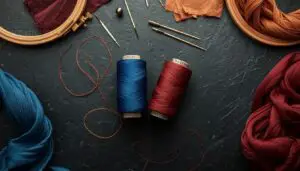
Choosing between polyester and rayon isn’t really about which threads are better — it’s about which one fits your project.
Each material shines in different scenarios, much like how embroidery machines work influences which thread type delivers the best results.
Both have real strengths, and the gap between them shows up fast once you start comparing specific categories. Here’s a quick look at where each thread wins.
Core Differences in Performance
Think of polyester and rayon as two specialists—each excellent, but for entirely different reasons.
| Performance Factor | Polyester | Rayon |
|---|---|---|
| Tensile strength | Higher | Lower |
| Elastic recovery | Better | Minimal |
| Colorfastness | Excellent | Good |
| Tension forgiveness | More forgiving | Precision-required |
| Speed resilience | 900+ SPM stable | Moderate speeds preferred |
Polyester’s elastic recovery and fiber fatigue resistance make it the workhorse. Rayon wins on sheen comparison and thread performance under commercial laundering conditions where softness matters most.
Durability Vs Luxury Finish
Polyester is your go-to for durable elegance — it holds tensile strength between 4.5 and 6.0 cN/dtex, shrugs off bleach, and delivers serious thread abrasion resistance through heavy wear. Rayon, by contrast, offers luxurious sheen and colorfastness that catches every light. When comparing these threads, it’s truly resilience vs radiance — longevity vs luster.
Polyester endures, rayon enchants — one thread built for resilience, the other for radiance
| Category | Winner |
|---|---|
| Stain resistance | Polyester |
| Luxurious sheen | Rayon |
| Eco luxury | Rayon |
| Durability vs appearance | Polyester |
Best Choice for Frequent Washing
If durability was the show, wash resistance is the encore. In commercial laundering, polyester wins without debate. Its Hot Water Tolerance holds firm at 60–90°C across hundreds of cycles, with near-zero Moisture Swell Impact. Rayon, however, absorbs up to 13% moisture, triggering thread shrinkage control issues quickly.
| Factor | Polyester | Rayon |
|---|---|---|
| Cycle Count Longevity | 200+ cycles | 20–40 cycles |
| Bleach Resistance | Strong | Weak |
| Industrial Laundry Compatibility | Excellent | Poor |
Best Choice for Decorative Embroidery
Decorative work is where the debate shifts entirely. For decorative purposes, rayon’s luxurious sheen and enhanced color vibrancy make it the natural front-runner — its high sheen mimics silk, giving monograms and floral motifs that premium finish clients actually notice. Project theme alignment and color palette harmony both favor rayon when the finished look leads the brief.
| Factor | Rayon | Polyester |
|---|---|---|
| Sheen and color vibrancy | Silk-like, rich | Bold, consistent |
| Embroidery style suitability | Fashion, home décor | Logos, structured designs |
| Client preference weighting | Appearance-first projects | Durability-first projects |
Fiber Makeup and Thread Weight
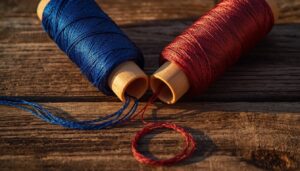
Before you pick a spool, it helps to know what you’re actually working with. Polyester and rayon don’t just look different — they’re built differently, from the ground up.
Here’s what shapes each thread before it ever touches your fabric.
What Polyester Embroidery Thread is Made From
At the heart, polyester embroidery thread starts with petrochemical feedstock — crude oil derivatives processed into PET polymer chemistry. This foundational material sets the stage for the thread’s creation.
From there, continuous filament extrusion pulls long, unbroken synthetic fibers into smooth, consistent thread. Many brands engineer a trilobal fiber shape to boost shine, enhancing the thread’s visual appeal.
Some manufacturers even offer recycled rPET content options, reflecting sustainability efforts. The result? A petroleum-derived polyester thread built from the ground up for strength and consistency.
What Rayon Embroidery Thread is Made From
Unlike polyester’s oil-derived origins, rayon embroidery thread starts somewhere far more natural. Its cellulose source is usually wood pulp — and sometimes cotton linters — chemically purified through viscose formation and forced through spinnerets to produce a regenerated filament. The result is 100 percent rayon built from natural cellulose fibers.
Key facts about cellulose-based rayon production:
- Wood pulp is the primary raw material
- Cotton linters serve as an alternative cellulose source
- Viscose formation dissolves and regenerates cellulose into continuous filaments
- The finished rayon embroidery thread is classified as a regenerated, not spun, fiber
40 Wt Thread and Why It Matters
Thread weight selection shapes everything downstream — from Thread Thickness Precision to Fabric Coverage Consistency. At 40wt Thread, you’re working with the industry’s sweet spot: 0.25 mm thick, Tex 25, 225 denier.
Both 40wt rayon and 40wt trilobal polyester offer Design Detail Control without sacrificing Yarn Consumption Rate or Spool Compatibility Standards.
| Feature | 40 Wt Thread |
|---|---|
| Thickness | 0.25 mm |
| Denier | 225 |
| Coverage | Medium |
| Best Use | Detail + general |
| Needle | 75/11 or 80/12 |
Dtex and Denier Explained Simply
Two systems measure thread weight — and yes, they’re different. Denier counts grams per 9,000 meters; dtex counts grams per 10,000 meters.
Since heavier threads need larger needles to match, it’s worth brushing up on twin needle and thread pairing basics before you commit to a project.
The conversion formula is simple: multiply denier by 0.9 to get dtex. For example, 120 denier becomes 108 dtex.
Denier dominates U.S. labels, while dtex follows ISO standards abroad.
Standard embroidery thread sits at 135 × 2 dtex — same thread, different regional labeling.
Why Equal Weight Does Not Mean Equal Feel
Same thread weight label doesn’t guarantee the same feel in your hands. Density-driven hand, moisture-induced softness, surface texture friction, and fiber cross-section effect all shape tactility independently of thread weight measurement.
- Rayon absorbs 11–13% moisture, swelling fibers for a soft hand and silky sheen
- Polyester’s trilobal cross-section increases surface texture friction, adding stiffness
- Rayon’s cellulose structure creates perceived bulk variance — feeling lighter despite equal weight
- Comfort and feel favor rayon; durability favors polyester
Sheen, Color, and Stitch Appearance
Thread appearance isn’t just about color — it’s about how light hits the stitch and what story that finish tells. Rayon and polyester behave very differently under the same conditions, and those differences show up in ways that actually matter to the finished piece.
Here’s what you need to know about how each one looks in action.
Rayon’s Silk-like Gloss
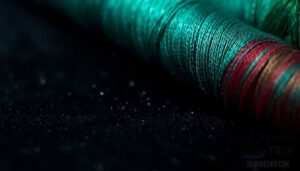
Rayon’s silk-like gloss isn’t accidental — it comes down to fiber smoothness and geometry. The cylindrical filaments act like tiny mirrors, producing specular reflection that sends light in one clean direction rather than scattering it.
This reflection creates the highlight depth and light directionality seen in satin fills. The result? A luxurious sheen with genuine color vibrancy that polyester rarely matches.
Polyester’s Trilobal Shine

Polyester takes a different path to brilliance. High-quality trilobal polyester — think Magnifico or Fantastico — uses fibers with three flat sides that act like micro-prisms, producing prismatic reflection and enhanced sparkle across every stitch angle. This tri-lobed light play delivers:
- High sheen consistency across dense fills
- Luster retention after repeated washing
- Artificial gloss with genuine visual punch
It’s structured shine — engineered, not inherited.
Color Vibrancy Differences
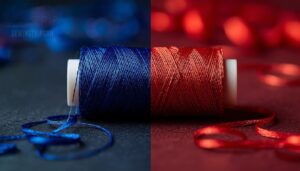
Shine tells half the story — color tells the rest. Rayon’s exceptional dye absorption produces saturation depth that polyester simply can’t match fresh off the spool. Those jewel-toned reds and cobalt blues look richer because the fiber drinks in pigment rather than wearing it on the surface.
However, Polyester counters with stronger colorfastness and better color retention after repeated washing. This contrast highlights the trade-off between initial vibrancy and long-term durability.
| Category | Rayon | Polyester |
|---|---|---|
| Dye absorption | Excellent | Moderate |
| Initial color vibrancy | Very high | High |
| Color fade resistance | Lower | Outstanding |
| Visual brilliance (new) | Silk-like richness | Consistent brightness |
| Long-term color retention | Decreases with washing | Stays stable |
For display pieces, rayon’s light reflectivity and sheen advantage wins. For workwear, polyester’s colorfastness holds the line.
How Dense Stitching Affects Luster
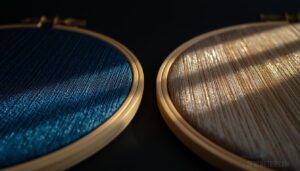
Stitch density changes everything about how light reads your design. At ideal fill density — around 0.4 mm spacing — thread packing creates surface smoothness that mimics polished weaves, pushing opacity increase from 77 to 95 percent coverage. That’s where sheen vs luster separates winners from flat finishes.
High stitch count aligns filaments parallel, maximizing light reflection and intensifying thread luster across both fiber types.
Which Thread Looks More Premium
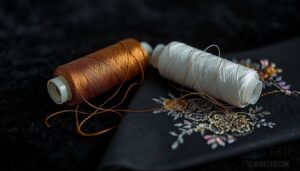
When rayon wins the premium argument, its natural gloss and refined coloration create a couture look that polyester’s polished sparkle cannot quite replicate. Polyester reads crisp and professional, but rayon reads elegant.
For upscale fashion pieces, rayon’s opulent texture and high sheen deliver the sheen vs. luster difference that separates boutique-quality embroidery from ordinary alternatives. This distinction elevates its premium appeal in high-end applications.
Softness, Drape, and Fabric Feel
Sheen gets all the attention, but how a thread feels on fabric matters just as much — sometimes more. The difference between rayon and polyester shows up clearly the moment you touch a finished piece, and even more when you wear it or drape it over a surface.
Here’s how each thread performs where softness and feel are concerned.
Which Thread Feels Softer on Fabric
Rayon wins this category without much debate. Its natural cellulose filaments deliver a tactile luxury that polyester simply can’t replicate — the soft feel of rayon on skin reads closer to silk than synthetic thread.
Hand-feel perception tests consistently rank rayon higher for fabric softness and comfort under skin, making it the go-to for skin-friendly touch in dense decorative work.
How Thread Choice Affects Drape
Thread choice shapes how a finished garment moves — and that comes down to fiber bend. Rayon’s soft hand and natural pliability support panel flow and drape retention far better than polyester. Here’s what separates them:
- Rayon’s low stiffness preserves thread flexibility across the full embroidered zone
- Polyester’s elastic properties resist folding, reducing fabric compatibility on fluid designs
- Higher stitch mass with polyester locks cloth panels into place
- Rayon allows garment feel to stay supple even under moderate coverage
Stiffness in Dense Embroidery Areas
Dense stitching transforms the polyester vs. rayon choice into a structural decision. Polyester’s higher tenacity (4.5 to 6.0 cN/dtex) introduces thread stiffness when stitch density interactions compound across fills. Conversely, rayon lays flatter, maintaining pliability in stitched areas.
Adding stabilizer bulk and underlay strategies further complicates tension optimization, making it critical. Poor settings alone can increase stiffness by 15–20%, underscoring the need for precise adjustments.
Comfort on Garments and Home Textiles
Where design actually touches skin, thread choice matters more than most people expect. Rayon wins on skin comfort—it’s soft to the touch, allows air permeability, and facilitates moisture wicking in garments like ladies’ wear or bedding.
Polyester feels slightly rougher but offers solid moisture resistance and flexibility, reducing irritation and maintaining tactility through repeated wear. Its durability ensures performance despite frequent use.
Choosing Thread for a Softer Finish
If rayon’s silky hand is hard to argue with.
Its gentle luster and tender drape make it the clear pick for decorative work where delicate feel matters most. Polyester can look sharp, but it reads practical rather than plush.
- Soft to the touch even in dense fills
- Subtle sheen stays elegant without appearing artificial
- Best for monograms, fashion details, and keepsake projects
Strength and Wash Resistance
Looks and feel matter, but at some point, thread has to survive real life.
Polyester and rayon hold up very differently once you factor in washing, friction, and chemical exposure.
Here’s how they stack up across the durability measures that actually count.
Tensile Strength Comparison
Polyester wins the strength battle on almost every metric.
In dry tensile strength tests, 40-weight polyester embroidery thread breaks at 120–150 grams versus rayon’s 100–130 grams.
Wet tensile strength tells an even starker story — polyester holds its full breaking force metrics when saturated, while rayon loses up to 50% of its thread strength.
Polyester’s elongation before break (20–30%) gives your machine a meaningful forgiveness in stitch tension capacity.
Abrasion Resistance in Daily Wear
Strength on paper doesn’t always translate to strength on the body. Abrasion resistance separates the two threads fast. Collar friction, cuff abrasion, and pocket edge wear hit embroidery hard — and rayon fades first.
Polyester withstands knee bend stress and backstrap friction through 1,000+ cycles without breakdown. For workwear and high-wear items, polyester vs rayon isn’t a close call.
Performance After Repeated Laundering
Wash cycles tell the real story. Rayon’s color fade kinetics accelerates quickly — warm water and strong detergent strip vibrancy fast, and tensile resilience loss follows. Surface crispness decline shows within dozens of cycles.
Polyester’s elasticity retention keeps stitch edges clean and its colorfast quality intact. For commercial laundering environments, polyester’s wash resistance of embroidery thread and thread durability aren’t debatable — it simply outlasts rayon.
Resistance to Bleach, Chlorine, and Chemicals
Beyond laundering, bleach and chlorine are where the gap really opens up. Polyester thread’s Chemical Stability Rating holds strong against Oxidizer Sensitivity — Bleach Compatibility is practically built into its synthetic structure. Rayon thread, with its cellulose base, has almost no Sanitization Durability under chlorinated water.
For bleach-resistant embroidery on uniforms or pool gear, chemical resistance clearly favors polyester thread every time.
Moisture Exposure and Long-term Durability
Moisture hits rayon hard. Repeated wetting cycles trigger Moisture-Induced Brittleness, gradually robbing the fiber of tensile strength, while Drying Cycle Effects compound the damage over time.
Polyester’s Thread moisture resistance holds steady, shrugging off Water Retention Impact and Humidity-Driven Stretch with little degradation. If Moisture-Related Fading or long-term wear concerns you, polyester wins this round cleanly.
Machine Performance and Breakage
How your machine manages thread under pressure says a lot about which fiber belongs on your next project. Polyester and rayon behave very differently once the needle starts moving at speed.
Here’s what you need to know about breakage, tension sensitivity, and real-world performance.
Which Thread Breaks Less During Stitching
Polyester wins this one — and it’s not particularly close. Its 17–20% elongation absorbs tension spikes that would snap rayon mid-stitch.
Thread finish smoothness and lubricated thread usage reduce guide wear effects and friction along the thread path. This minimizes wear and ensures smoother operation compared to rayon.
Spool design also matters — a properly cross-wound polyester cone feeds cleanly, even at higher stitching speeds, keeping machine tension and thread breakage issues manageable where rayon often falls short.
Rayon Sensitivity to Machine Tension
Rayon embroidery thread walks a tension tightrope—aim for 100–130 grams of upper-thread pull, or you’ll cross its breakage threshold quickly. A dial notch adjustment of 1–2 steps below your polyester setting is the safest starting point.
When tension climbs too high, stitch lock-point control suffers, pushing the bobbin thread visibly upward.
Minimizing guides and ensuring solid fabric hooping stability keep rayon running smoothly without fighting the machine.
Polyester Elasticity and Smoother Runs
Unlike rayon’s tightrope act, polyester’s thread elasticity provides a genuine safety net. Its stretch recovery absorbs minor tension fluctuations, ensuring a resilient stitch flow even on imperfectly calibrated machines.
This low-friction glide and tension-friendly yarn behavior minimizes mid-run interruptions — a decisive advantage in thread performance comparisons where consistency matters most.
Common Causes of Thread Shredding
Thread shredding rarely has one culprit. Small needle eyes create brutal friction at high stitch speeds — thread rubs against the eye roughly 1,000 times per minute.
Burr formation on rotary hooks and needle plates compounds the damage fast, accelerating wear.
Improper thread path routing adds 20% extra tension, especially punishing rayon.
Poor thread quality and low humidity — below 40% — make both fiber types brittle and snap-prone.
High-speed Embroidery Performance
Polyester manages 900 to 1,200 stitches per minute with reliable stitch rate optimization, making high-speed embroidery far more predictable. Rayon tops out around 600 to 800 SPM — pushing beyond that risks frequent thread breakage in high-speed machines, turning maintenance into a constant struggle.
In comparing polyester and rayon threads, polyester wins on machine settings and thread breakage prevention, offering greater reliability at higher speeds.
Needles, Tension, and Settings
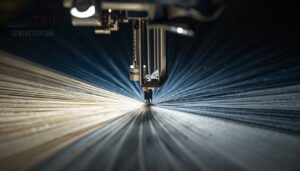
Getting your needle, tension, and settings right separates a clean run from a frustrating one. Both polyester and rayon respond differently to the same machine setup, so small adjustments can make a big difference.
Here’s what you need to know across five key areas.
Best Needle Size for 40 Wt Thread
For 40wt thread, needle size selection is crucial—it balances thread weight and fabric. A 75/11 to 80/12 range provides a reliable starting point, with an eye diameter sufficiently wide to minimize thread friction while avoiding noticeable holes.
Point style also matters: sharp embroidery needles ensure clean piercing of stabilized fabric.
Always test on scrap fabric first, especially when comparing polyester and rayon threads.
Tension Differences Between Polyester and Rayon
Once you’ve nailed your needle size, thread tension becomes your next calibration point. Polyester runs best at a higher upper tension range — around 120–150 grams — while rayon prefers 100–120 grams. That gap matters. Friction-induced tension from rayon’s smoother surface makes it snap under strain, which polyester manages easily.
When choosing between polyester and rayon embroidery thread, machine tension adjustment isn’t optional — it’s your foundation.
Preventing Loops, Puckering, and Uneven Coverage
Getting tension right is just the start. Loops, puckering, and uneven coverage usually trace back to four overlooked variables — and fixing them changes everything when Choosing Between Polyester and Rayon Embroidery Thread:
- Stitch Density — Stay between 10–12 stitches per millimeter; anything above 14 stresses the fabric.
- Underlay Optimization — Run underlay at 70–80% of final density to anchor stitches cleanly.
- Hoop Tension — Compress no more than 2–3 mm; over-hooping causes permanent knit distortion.
- Pull Compensation — Apply 0.5–1% software compensation to prevent gaps on stretch fabrics.
- Thread Lubrication — Factory-lubricated polyester runs 15–20% smoother, reducing thread looping issues in rayon considerably.
Machine tension and fabric tension work together. Thread Tension Troubleshooting always starts here.
Matching Thread to Fabric and Stabilizer
Fabric stretch compatibility matters more than most beginners expect. Polyester pairs naturally with synthetic blends — its recovery mirrors the fabric’s movement. Rayon belongs on cotton, linen, or silk, where thread-fabric weight match and a softer hand matter most.
Stabilizer type selection follows the same logic: cut-away for knits, tear-away for stable wovens.
Sheen versus backing and stabilizer rigidity impacts your finished drape considerably when choosing between polyester and rayon embroidery threads.
Reducing Bobbin Show-through
Bobbin show-through often comes down to four things: bobbin tension, thread weight, a clean bobbin path, and machine speed. Target 18–22 grams of bobbin tension, use a lighter 60 wt bobbin thread, and brush out lint regularly.
High stitch density and full-speed runs pull the lower thread upward — slow down, and the balance corrects itself.
Choosing between polyester and rayon thread doesn’t change that math.
Best Uses by Project Type

Knowing which thread wins on paper is one thing — knowing which one to actually reach for is another. The right choice almost always comes down to what you’re making and how it’ll be used.
Here’s how each thread stacks up across the most common project types.
Uniforms, Workwear, and Sportswear
Polyester wins here, no contest. For uniforms, workwear, and sportswear, moisture-wicking durability and thread chemical resistance matter more than gloss.
Polyester withstands repeated laundering, chlorine exposure, and high-visibility branding without fading or weakening. Its practical advantages lie in resilience over aesthetics.
The material’s antimicrobial thread options and ergonomic fit compatibility establish it as the standard for flame-resistant embroidery applications, serving both industrial and athletic garments effectively.
Fashion Embroidery and Boutique Garments
When fashion is the goal, rayon earns its place. Its silk-like sheen aligns naturally with runway embroidery styles and seasonal color trends, delivering the luxury finish boutique clients expect.
For custom monogram techniques and silhouette enhancement, rayon’s softer hand keeps garments draped, not stiff.
In the polyester vs. rayon embroidery thread debate, luxury finish vs. durability in embroidery tips toward rayon here — colorfastness and care considered.
Home Décor and Appliqué
Home décor pulls both threads in opposite directions — and that’s exactly where the choice gets interesting.
- Curtain Edge Reinforcement & Wall Art Structure: Polyester wins for durability considerations; its stiffness holds appliqué shapes firmly.
- Pillow Sheen Accents & Table Runner Embellishment: Rayon’s silk-like gloss elevates decorative quilting and formal settings.
- Quilt Layer Bonding: Polyester’s tensile strength secures layers; rayon’s sheen enhances the depth of comparison.
Swimwear and Chlorine-exposed Items
Chlorine is brutal on embroidery. A 2024 study recorded a 12.4% drop in breaking force after 200 hours of pool exposure — fiber degradation starts long before a suit looks worn.
For swimwear and bleach-resistant applications, polyester wins clearly. Its thread chemical resistance, colorfastness performance, and UV resistance handle UV exposure and repeated rinsing.
Blend optimization and smart rinsing protocols slow damage, but damage indicators appear structurally, not visually.
Gifts, Monograms, and Keepsake Projects
Monogram placement on a keepsake box or photo album matters more than most people realize. For Keepsake Box Embroidery and Anniversary Monogram Etiquette pieces, rayon’s luxurious sheen makes initials feel intentional and refined.
Individualized gift trends increasingly favor polyester for everyday-use items — its durability and strength outlast repeated handling.
Choosing between rayon and polyester thread comes down to one question: Will this gift be displayed or used?
Cost, Value, and Sustainability

Thread choice isn’t just a creative decision — it’s a financial decision too. What you spend per spool, how far your budget stretches across bulk orders, and even what happens to the thread after its useful life all factor into the bigger picture.
Here’s what you need to know before reaching for your wallet.
Price Differences Per Spool or Cone
Price per spool tells only part of the story. A standard polyester spool runs about $5 for 1,000 meters, while rayon usually costs 10–25% more for comparable yardage.
However, cone bulk savings shift the math: rayon cones hit 0.0024 cents per yard versus polyester’s 0.005. This yardage price ratio, combined with brand pricing gaps, makes per-yard economics your smartest cost and quality consideration.
Best Option for Bulk Production
When bulk production is your reality, polyester wins on nearly every front. It aids runtime optimization through fewer thread breaks, stronger batch-to-batch consistency across dye lots, and smoother high-speed stitching runs. These factors collectively minimize disruptions, ensuring efficient operations.
Polyester also reduces production line downtime, while its superior thread color retention after washing tightens quality control metrics by lowering reject rates. This reliability is critical for maintaining standards in high-volume embroidery workflows.
For commercial embroidery strategies centered on inventory turnover and volume, cost considerations clearly favor polyester. Its durability, consistency, and efficiency align perfectly with the demands of large-scale production.
Rayon’s Biodegradability Benefits
Polyester wins on cost, but rayon quietly wins on conscience. Made from natural cellulose fibers, it breaks down in 6 to 8 weeks through rapid soil breakdown and achieves full compost integration in as little as 21 days.
Its marine decay speed and ability to prevent microfiber pollution keep ecosystems cleaner—no microplastics, no landfill permanence.
For eco-conscious projects, biodegradable thread material matters.
Polyester’s Synthetic Tradeoffs
That eco-win for rayon comes at polyester’s expense — literally. As a synthetic fiber thread built from petroleum-based materials, its environmental footprint doesn’t disappear after the project ships.
UV resistance of polyester thread is genuinely impressive, but chemical inertness means it persists in landfills indefinitely.
That plastic feel and elasticity compromise certain fabric drape, while heat distortion remains a real concern on delicate substrates.
Balancing Budget With Finished Look
The cost-appearance tradeoff hinges on the project’s purpose. Rayon offers economical luster and a luxury finish, making it ideal for display pieces. Polyester, however, excels in colorfastness and care, suiting everyday wear.
For budgeted shine, rayon provides superior visual value per spool. Its affordability and aesthetic appeal prioritize immediate impact over longevity.
Polyester justifies its cost through lasting color and durability. While less glamorous initially, it outperforms rayon in sustained use and maintenance, ensuring long-term practicality.
Which Thread Should You Choose?
By now, you’ve seen how polyester and rayon each pull their weight in different situations. The right choice really comes down to what your project demands most.
Here’s a straightforward breakdown to help you decide.
Choose Polyester for Durability-first Projects
When durability comes first, there’s really no debate. Industrial-Strength Threads made from polyester outlast rayon on every demanding front — and the numbers back it up.
- Thread strength for garments: Polyester’s tensile strength resists breakage under stress better than rayon.
- High-Stress Embroidery: Collars, cuffs, and bags demand the abrasion resistance rayon simply can’t match.
- Extended Service Life: Polyester holds up through repeated commercial laundering without fading or weakening.
- Outdoor Equipment: The UV resistance of polyester thread keeps designs intact where sun and moisture hit hard.
- Cost-Effective Strength: In the polyester vs. rayon embroidery thread debate, polyester wins on long-term value — lower cost per wear, fewer replacements.
The impact of thread material on garment durability and feel is real. For durability considerations in quilting and embroidery, polyester is your steadiest partner.
Choose Rayon for Appearance-first Projects
When appearance is everything, rayon earns its place without argument. Its opulent sheen and vivid color depth make finished designs look genuinely luxurious — not just stitched, but crafted. That luxurious handfeel and refined stitch elegance translate directly into high-end decorative finishes that polyester’s fractured shine simply can’t replicate.
| Project Type | Rayon Advantage | Why It Matters |
|---|---|---|
| Monograms | Luxurious sheen | Reads as premium |
| Fashion appliqué | Vivid color depth | Richer visual contrast |
| Ceremony textiles | Luxurious handfeel | Softer against skin |
| Boutique garments | Refined stitch elegance | Elevates brand perception |
| Gift keepsakes | High-end decorative finishes | Impression lasts longer |
In the durability vs. appearance debate, rayon wins on sheen and color vibrancy — every time.
Quick Decision Guide by Fabric Type
Fabric type is your first real filter when deciding between polyester vs rayon embroidery thread. Here’s a quick Knit Fabric Guide, plus Denim Embroidery Tips and Stretch Activewear Advice to simplify your fabric type selection:
- Knit fabrics — polyester wins; its give matches the stretch
- Woven cotton — either works; rayon for glossy, polyester for hard wear
- Denim — polyester withstands abrasion and repeated washing reliably
- Delicate Decorative Decision — rayon delivers the luxurious finish stable fabrics deserve
Quick Decision Guide by Care Needs
How you care for a finished piece often matters more than how it looks on the hoop. Your Care-Level Decision hinges on four critical factors: Wash Frequency, Bleach Compatibility, Moisture Resistance, and Heat Tolerance.
Polyester excels in durability-heavy categories, dominating these care-focused areas. In contrast, rayon performs well under gentle care conditions, prioritizing aesthetics when the Durability-Appearance balance leans toward visual appeal.
What to Buy for Beginners and Pros
Start with a starter kit — 10 mini cones of 1000m gives beginners enough thread inventory strategy without overspending. Brands like Isacord and Madeira Polyneon are solid for polyester; Sulky and Floriani lead in rayon.
Pros doing bulk-cone planning should stock 5000m cones for better cost-per-meter analysis.
Your brand reliability guide and budget together decide the winner in polyester vs. rayon embroidery thread.
Frequently Asked Questions (FAQs)
Is rayon or polyester better for embroidery?
Polyester wins on durability; rayon wins on finish. Your best choice depends on whether the project demands toughness or a silk-like sheen that makes every stitch catch the light.
For projects that require extra strength, consider the thread’s high tensile strength.
Is rayon thread the same as polyester thread?
No, rayon thread and polyester thread aren’t the same. Rayon comes from regenerated wood-pulp cellulose, while polyester is petroleum-based PET. Different origins, different behavior — they serve distinct embroidery goals entirely.
Is rayon embroidery thread good?
Yes — for decorative work, rayon embroidery thread genuinely delivers. Its silk-like sheen, color vibrancy, and soft hand make it a strong choice when appearance leads and durability follows.
Can rayon and polyester threads be combined in one design?
Absolutely — both threads work together in one design. Use rayon for decorative sections and polyester where durability counts.
Match weights (40 wt) and test stitching first to ensure even tension and consistent coverage.
Does thread color fade faster in rayon or polyester?
Rayon fades faster. Its dye composition absorbs beautifully but struggles with UV light damage, detergent fading, and bleach resistance.
Polyester wins on colorfastness and thread color retention after washing through commercial laundering cycles.
Which thread works better on dark-colored fabrics?
On dark fabric, rayon thread’s silk-like sheen creates striking visual depth.
Polyester delivers sharper stitch contrast and better thread color retention after washing.
Your best pick depends on whether you prioritize beauty or durability.
How do storage conditions affect thread longevity?
Store thread in cool, dry, and dark conditions. Temperature control (15–25°C), humidity management (40–60%), and light exposure limits directly affect thread longevity.
Dust protection and smart bulk storage strategies keep spools performing longer.
Are rayon and polyester threads interchangeable mid-project?
Yes, but timing matters. A mid-project swap works best when both threads share the same 40 wt weight — keeping stitch consistency intact and minimizing breakage risks across fabric types.
Conclusion
The best thread is the one that disappoints you least. That’s the quiet truth hiding inside every polyester vs. rayon embroidery thread debate—neither wins universally, because winning depends entirely on what you’re asking the thread to do.
Reach for polyester when durability is non-negotiable. Reach for rayon when the eye has final say. Master both, and you don’t have to choose between embroidery that lasts and embroidery that dazzles—you’ll know exactly when each earns its place.
- https://www.mh-chine.com/blog/products/polyester-vs-rayon-thread
- https://www.madeira.com/embroidery-solutions/service/support/faq/when-to-use-rayon/viscose-and-when-to-use-polyester-threads
- https://blog.sulky.com/machine-embroidery-series-rayon-vs-polyester/
- https://embroiderylegacy.com/embroidery-threads/
- https://www.superiorthreads.com/education/thread-weight