This site is supported by our readers. We may earn a commission, at no cost to you, if you purchase through links.
The wrong thread doesn’t just look bad — it breaks seams, distorts fabric, and turns a clean project into a frustrating do-over. Most sewers don’t realize that something as small as a 10-weight difference in thread can mean the difference between a seam that holds under stress and one that puckers on the first wash.
Thread selection is a system, not a guess. Fiber type, weight, needle size, and fabric GSM all interact — and getting one wrong throws off the rest.
This thread guide for different threads cuts through the confusion with specific numbers, clear fabric-matching rules, and tension fixes that actually work.
Table Of Contents
Key Takeaways
- Thread selection is a system where fiber type, weight, needle size, and fabric GSM must all align — getting one variable wrong disrupts the entire seam.
- Weight numbers run inversely: 30wt is heavier and thicker than 100wt, so matching the right weight to your fabric’s GSM prevents puckering, distortion, and seam failure.
- Every fabric category demands a specific thread type — corespun polyester for stretch knits and heavy denim, 60–80wt silk or polyester for sheers, and 50wt cotton for quilting — because no single thread handles all conditions well.
- Most sewing problems like breakage, skipped stitches, and puckering trace back to three fixable causes: tension imbalance, a mismatched needle eye, or a dull/bent needle that needs immediate replacement.
Thread Types and Best Uses
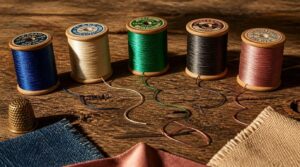
The thread you choose shapes everything — seam strength, stretch, finish, and how long your project actually holds up. Each thread type has a specific role, and using the wrong one can cost you more than just time. Here’s a breakdown of the five main thread types and where each one performs best.
Whether you’re finishing a delicate knit or reinforcing a heavy canvas seam, understanding how thread count affects performance is just as important as the thread type itself — automatic overlock machines simplify that process by adapting thread configurations to match your fabric’s needs.
Choose the wrong thread and you pay in more than time — every seam, stretch, and finish suffers
All-Purpose Polyester Thread
All-purpose polyester thread works for the widest range of projects without compromising strength. It’s usually 50wt for lighter fabrics and 40wt for everyday sewing — enough muscle for denim seams, enough finesse for quilting cotton.
This material is ideal for high-stress seam handling on various fabric weights.
Low moisture absorption means it dries fast and resists mildew. Color fastness stays consistent through repeated washing cycles, so your seams won’t fade before the fabric does.
Cotton Thread
Polyester holds up well under stress, but cotton earns its place where fiber compatibility matters most. Made from staple fibers, cotton thread has low extensibility — which keeps woven fabrics dimensionally stable under tension.
Mercerized cotton goes further. The process improves dye penetration, so colors stay vivid through repeated washes. Long-staple varieties produce smoother seams with less lint buildup in your machine’s tension guides.
For hand sewing, wax or thread conditioner reduces fraying and improves feeding. One caveat: heavy washing cycles can weaken lower-quality cotton threads over time.
Silk Thread
Cotton keeps woven fabrics stable — silk takes fine sewing somewhere else entirely. Spun from continuous silkworm filaments, silk thread is built on fibroin protein, a crystalline structure that delivers high tensile strength at remarkably low weight.
Mulberry silk is the standard for quality sewing threads, prized for its smooth surface, natural luster, and near-invisible seams on chiffon or organza. Weights from 60wt to 100wt suit delicate work best.
What sets it apart:
- Glides through dense weaves with minimal needle drag
- Reflects light naturally due to its protein-based refractive structure
- Resists pilling when ironed on low heat with a pressing cloth
Rayon Embroidery Thread
Silk flatters fine fabrics — rayon flatters the design itself. Its silk-like luster makes fills and satin stitches look genuinely luminous, especially on cotton and linen.
Standard rayon runs 40wt for machine embroidery, 60wt for detailed hand work. Drop your tension slightly in dense columns — excessive tension crazes the thread. Launder on a gentle cycle to preserve that sheen long-term.
Corespun Heavy-Duty Thread
Corespun thread is engineered for punishment. A high-tenacity polyester center delivers tensile strength, while the cotton or polyester wrap shields it from needle heat and abrasion during high-speed stitching — cutting lint and fraying a lot.
For denim, canvas, and workwear exceeding 340 GSM, this is your thread. Seams hold under repeated industrial wash cycles without weakening or roping.
How Thread Size and Weight Work
Thread sizing can feel like alphabet soup — Tex, Denier, weight numbers, metric counts — but each system tells you something specific about the thread you’re working with.
Pairing the right thread weight with the right needle matters too — a fine Tex 25 thread calls for a sharp, slender point, so brushing up on hand and machine sewing needle differences can save you a lot of frustrating skipped stitches.
Once you understand what the numbers actually mean, choosing the right thread becomes a lot more straightforward. Here’s a breakdown of the four main measurement systems you’ll encounter.
Tex and Denier Explained
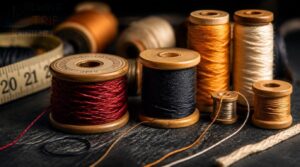
Two systems dominate thread sizing in manufacturing: Tex and Denier.
Tex measures grams per 1,000 meters — so a Tex 27 thread weighs 27 grams across that length. Denier stretches the baseline to 9,000 meters. Converting between them is straightforward: Denier ÷ 9 = Tex. Higher numbers always mean thicker thread, regardless of which system you’re reading.
Weight Numbers Explained
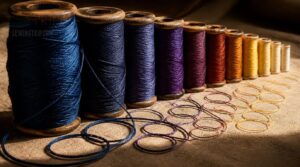
Weight numbers run backward from what you’d expect. A 30wt thread is heavier and thicker than a 100wt — the number reflects how many length units fit into a fixed mass, so finer thread produces a higher count.
That’s why 50wt all-purpose polyester suits most garments, while machine embroidery drops to 30wt–40wt for bolder coverage. Think of it as thread diameter expressed inversely through mass-per-length.
Metric and Cotton Counts
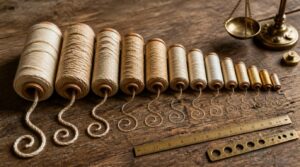
Two systems, one yarn. Metric Count (Nm) measures kilometers of thread per kilogram — Nm 20 means 20 km per kg. Cotton Count (Ne) counts 840-yard hanks per pound. Both run the same direction: higher numbers mean finer, more drapable thread.
Converting between them uses a factor of approximately 1.69 — multiply Ne by 1.69 to get Nm.
Common Sewing Thread Sizes
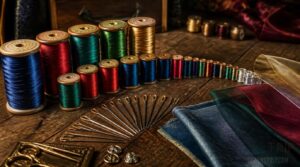
Most sewists work within a narrow band: 40wt and 50wt handle the majority of garment and general sewing tasks.
Drop to 30wt for topstitching denim — the thicker diameter demands a 90/14 to 100/16 needle. Go finer with 60wt for delicate fabrics, pairing it with a 65/9 needle. Remember, lower numbers mean thicker thread — the system runs backwards.
Match Thread to Fabric and Project
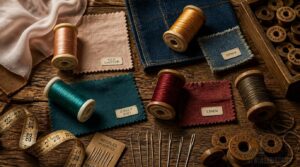
The right thread isn’t just about color or convenience — it’s about how well your seam holds up under real conditions. Every fabric type has specific demands, and matching thread to those demands is what separates a lasting result from a failing one. Here’s how to approach the most common fabric and project types.
Lightweight Fabrics
Sheer fabrics punish the wrong thread fast. For breathable summer textiles like chiffon (30–70 GSM) or cotton lawn (40–70 GSM), use 60wt to 80wt thread — anything heavier distorts the drape.
Match these threads to lightweight fabrics:
- 60wt silk thread — fine finishing on silk chiffon
- 60wt polyester — voile and georgette, moisture-wicking
- 80wt cotton — lawn and batiste, clean stitch quality
- 60wt rayon — decorative sheers needing luster
Knits and Stretch Fabrics
Knits move — their loop architecture stretches crosswise and lengthwise simultaneously, unlike wovens. Rigid cotton thread can’t keep up; it tears seams under flex.
Choose polyester or corespun thread with 15–25% elongation. Elastane blends (1–20% content) demand corespun specifically — it holds dimensional stability through repeated wash cycles without breaking down.
| Knit Fabric | Recommended Thread |
|---|---|
| Jersey | 50wt polyester |
| Rib knit | Corespun heavy-duty |
| Interlock | 50wt polyester |
| Activewear/elastane | Corespun stretch |
Moisture management finishes on activewear won’t save a seam sewn with the wrong thread. Get that match right first.
Denim and Canvas
Denim and canvas sit at the heavy end of the cotton spectrum — and both punish weak thread fast.
Denim’s 3×1 twill weave hides wear but demands Tex 60 or higher thread. Canvas, a plain weave at 8–24 oz, needs the same minimum.
- Use 90/14 to 100/16 needles
- Choose corespun or heavy-duty polyester
- Match thread weight to fabric GSM
- Expect indigo fading — colorfast thread prevents contrast bleed
- Strengthen stress points with double-stitched seams
Quilting Cotton Projects
Quilting cotton sits at the lighter end of the spectrum — usually 100% cotton, midweight — so your thread choice shifts accordingly.
Use 50wt cotton thread for piecing. It matches the fiber, cuts seam distortion by roughly 30%, and won’t pucker baby quilt seams or overwhelm delicate table runner prints.
For machine quilting pillow covers or wall hangings, a 75/11 sharp needle with 2.5 mm stitch length keeps everything crisp.
Outdoor and Upholstery Fabrics
Outdoor and upholstery projects demand more than standard thread can manage. UV resistance and abrasion testing matter here — marine canvas and heavy-duty upholstery fabrics routinely face 5,000–20,000 rub cycles.
Use Tex 60 or higher nylon thread for structural seams. It grips moisture, dries fast, and won’t degrade under salt spray. For silk upholstery, match silk thread — synthetics cause seam distortion.
Choose The Right Needle for Thread
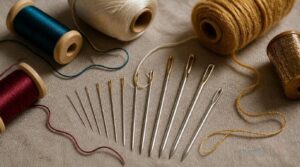
The thread you choose only works as well as the needle you pair it with. Getting that match right comes down to a few key factors — eye size, tip shape, and what your fabric actually needs. Here’s what to look at when selecting your needle.
Needle Eye Size
The needle eye is the gateway everything depends on. Too small, and thread frays; too large, and stitches wander.
- Round eyes suit standard threads for consistent feeding
- Elongated eyes ease flat or multi-filament thread passage
- Polished edges cut thread friction and heat buildup
- Larger eyes prevent metallic thread shredding
- Nicked eyes fray thread — replace immediately
Needle eye clearance must run roughly 40% wider than your thread diameter.
Universal Needles
The workhorse of most sewing rooms, universal needles handle woven fabrics reliably without specialized setup.
| Needle Size | Fabric Type | Thread Weight |
|---|---|---|
| 70/10 | Voile, chiffon | 60wt–100wt |
| 80/12 | Cotton blends | 50wt |
| 90/14 | Denim, canvas | 30wt–40wt |
Change your needle every 8 hours — burrs cause snagging instantly. Always test on scrap first.
Sharp Needles
Sharp needles cut clean — tip geometry design slices through woven threads without fiber displacement.
- Bevel angle impact drives penetration efficiency on tight weaves
- Surface coating benefits reduce insertion friction noticeably
- Tissue trauma prevention keeps fabric structure intact
- Pairs with denim, canvas, and vinyl reliably
- Needle sharpness maintenance preserves the cutting edge longer
Size 90/14 suits 30wt–40wt thread selection on heavy wovens. Sharp point style is your go-to for dense fabrics.
Ballpoint and Stretch Needles
Knit fabrics punish the wrong needle fast.
Ballpoint needles push fibers apart rather than piercing them — sizes 70/10 to 90/14 handle most jersey and interlock projects cleanly. When elasticity climbs higher, switch to a stretch needle: its deeper scarf lets a longer thread loop form, eliminating skipped stitches on spandex and Lycra blends.
Leather Needles
Leather demands a needle that cuts, not tears. Diamond point needles slice through dense hides cleanly — critical for heavy dry leather exceeding 340 GSM.
Choose by density:
- Diamond points — dense, dry leather without surface tearing
- Round points — soft leathers needing minimal abrasion
- Glover’s needles — multiple layers with thick waxed thread
- Curved needles — tight seams and saddle projects
Inspect points after every project; one burr ruins a surface fast.
Adjust Tension and Prevent Thread Problems
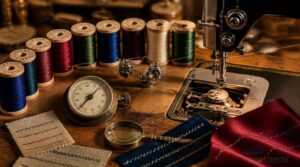
Even the best thread-and-needle pairing can fall apart if your tension is off. Most sewing problems — breakage, skipped stitches, puckering — trace back to a handful of fixable causes. Here’s what to check for each one.
Thread Breakage Fixes
Thread breakage rarely happens without warning — it’s your machine signaling something’s wrong. Start by rethreading completely, from spool to needle, ensuring the thread seats in the take-up lever groove. Clear lint from tension discs and the bobbin case.
Inspect the needle for burrs; replace it immediately if damaged. Mismatched needle and thread sizes alone can spike breakage by 50%.
Skipped Stitch Causes
Breakage and skipped stitches often share the same root causes — but skips have their own quirks. A bent or dull needle misses the hook’s loop entirely. Check needle timing alignment first; even slight drift causes consistent skips.
Lint-clogged feed dogs disrupt fabric advance, and incorrect presser foot pressure lets fabric slip. Recalibrate bobbin tension before anything else.
Puckering and Seam Distortion
Puckering rarely strikes at random. Structural jamming is the usual culprit — densely woven fabrics can’t absorb thread insertion without distorting adjacent yarns, and the seam buckles on both sides.
Unbalanced thread tension compounds this fast. Too tight, and fibers near the seam line pull inward, forming ridges. Raise your SPI on lightweight fabrics and watch distortion follow.
Metallic Thread Tips
Seam distortion from unbalanced tension is fixable — metallic thread introduces a different problem: friction. That friction causes breakage fast. A few targeted fixes keep decorative topstitching clean and consistent.
- Wax lightly with beeswax or silicone conditioner
- Mount spool vertically to cut twisting
- Lower top tension slightly
- Slow machine speed to reduce heat buildup
- Pair with cutaway stabilizer on woven fabrics
Specialty Thread Handling
Friction is the common enemy across nearly every nonstandard thread — metallic, elastic, bonded, or monofilament. Each type demands its own handling strategy.
| Thread Type | Key Handling Tip |
|---|---|
| Elastic/shirring | Use a separate spool pin |
| Monofilament | Lower tension a lot |
| Bonded/Kevlar | Lubricate the thread path lightly |
Spool orientation and smooth cone placement prevent kinking before the needle — fix the path first, then tune tension.
Frequently Asked Questions (FAQs)
How to tell different thread types?
Start with the spool label — it lists fiber content, weight, and needle size. Then compare luster: silk and rayon shine; cotton stays matte. Rub the thread; polyester feels smooth, cotton slightly rough.
Do you need a specific thread for threading?
Not always. For most fabrics, standard all-purpose polyester thread works without swapping. Match thread weight to needle size, check your machine manual, and align color to your project for clean, consistent results.
How do I store thread to prevent tangling?
Store spools upright on a vertical rack, secure every loose end in its notch, and keep humidity between 40–60% with silica gel. Sort by weight — lighter threads on top — and your collection stays tangle-free.
Can old thread cause sewing machine problems?
Yes — old thread degrades over time, losing up to 30% tensile strength. Brittle fibers break more, shed lint into tension discs, and cause skipped stitches. It’s 40% more prone to breakage than fresh thread.
What causes thread to break during sewing?
Your machine doesn’t break thread — it just reveals what’s wrong. Tension set too tight, a dull or bent needle, lint buildup in the bobbin race, or abrasive dense fabric: each cuts the line first.
How do I match thread color perfectly?
Hold your fabric and thread spools up in natural daylight — it’s the fastest way to see true color. Over 90% of professionals rely on this method. When in doubt, go one shade darker.
Should I use different threads for seams vs hems?
Not always — but thread choice matters here. Use strong polyester (50wt) for high-stress seams, where durability wins. Switch to finer thread (60–80wt) at hems for cleaner, flatter finishes that stay invisible.
How do I store thread to prevent deterioration?
Keep thread in a cool, dark space — 15°C to 25°C, with 40–60% relative humidity. Use opaque, sealed containers to block UV light and dust. A hygrometer helps you monitor conditions before fiber degradation sets in.
Can I use old thread from my grandmother?
Yes — but test it first. Pull a short length; if it snaps cleanly or sheds fibers, don’t use it. Silk and rayon degrade fastest. Polyester holds up better. Clean thread with no odor or brittleness is safe for light stitching.
What causes thread to break during machine sewing?
Thread breakage usually comes down to three culprits: tension imbalance, a rough thread path, or a mismatched needle eye. A needle too small for your thread increases breaks by 50% — and dull needles make it worse fast.
Conclusion
The simpler your thread choice looks, the more technical precision it actually demands. A single wrong weight unravels everything — literally.
This thread guide for different threads isn’t just a reference chart; it’s a decision framework built on fiber, weight, needle, and tension working as one system. Match each variable deliberately. Get the thread right, and the fabric does the rest. Every clean seam you sew from here proves that the smallest choice carries the heaviest load.
- https://www.threadart.com/blogs/learn-from-threadart/a-beginners-guide-to-understanding-thread
- https://www.sailrite.com/Ultimate-Guide-Sewing-Thread
- https://www.sewingpartsonline.com/blogs/education/ultimate-thread-reference-guide-2
- https://www.thesewingdirectory.co.uk/ultimate-sewing-thread-guide
- https://blog.connectingthreads.com/a-guide-to-thread