This site is supported by our readers. We may earn a commission, at no cost to you, if you purchase through links.
A serger can feel like a cheat code for clean, professional seams—until you thread it up with the wrong fabric and watch the feed dogs chew through your project like they owe them money. The machine isn’t broken; it’s just picky.
Fabric choice shapes everything: stitch quality, seam stretch, and whether your finished edges look polished or puckered. Knits behave differently than wovens, lightweight chiffon needs a completely different setup than canvas, and fiber content quietly influences tension in ways most sewists don’t expect.
Once you match your fabric to the right settings, a serger becomes the most satisfying tool in your sewing space.
Table Of Contents
Key Takeaways
- Knits are a serger’s sweet spot—jersey, interlock, and activewear blends thrive with a 4-thread overlock, stretch needles, and differential feed set between 1.5 and 2.0.
- Fabric weight (measured in GSM) should drive your settings: lighter fabrics need reduced tension and finer feed adjustments, while heavy canvas or denim demands stronger stitches and graded seam allowances to cut bulk.
- Delicate fabrics like chiffon and voile won’t forgive a rushed setup—drop to a size 60/8 needle, narrow your stitch width, and dial down the differential feed to around 0.7 to keep sheers flat and pucker-free.
- Always test your settings on scraps first, because fiber content quietly affects tension in ways you won’t catch until you’ve already cut into your good fabric.
Match Fabric to Serger Features
Not every fabric plays by the same rules, and your serger is only as good as the match you make. A few key factors determine whether your seams come out clean or end up a frustrating mess.
Getting familiar with how different fabrics behave on a serger can save you a lot of ripped seams and wasted material.
Before you cut a single piece, here’s what to look at.
Stretch Vs. Non-stretch Fabrics
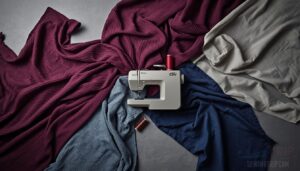
Here’s the thing about fabric choice: stretch and non-stretch fabrics behave completely differently on a serger. Knit and woven fabrics each demand their own approach to tension tuning, differential feed, and fabric feeding.
Stretch fabrics require specific adjustments, such as elastic recovery built into every seam, where stretch needles and seam stretchability are critical. Non-stretch wovens, however, prioritize clean, consistent control to maintain stability.
Stretch fabrics are usually knit constructions providing elasticity.
Fabric Weight and Seam Bulk
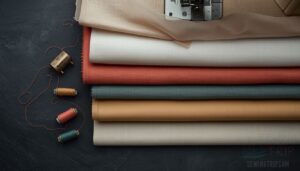
Weight matters just as much as stretch. Fabric weight — measured in GSM classifications — tells you how your serger needs to respond. Lightweight fabrics (60–120 GSM) need lower stitch density and fine-tuned differential feed tuning to stay flat. Heavier ones (300+ GSM) demand bulk minimization through seam allowance grading. Here’s how weight shapes your decisions:
- 60–120 GSM — Use a 3-thread overlock with reduced tension.
- 120–180 GSM — Standard 4-thread settings work reliably here.
- 180–300 GSM — Increase differential feed values toward 1.5–2.0.
- 300+ GSM — Grade seam allowances to reduce stiffness at intersections.
- All weights — Always test stitch density impact on a scrap first.
Fraying Edges and Clean Finishing
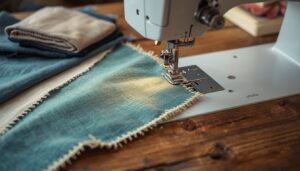
Once you’ve got weight sorted, fraying is the next thing your serger solves almost automatically. In one pass, it trims, wraps, and seals the raw edge — that’s the real magic of edge sealing techniques.
Wovens like cotton and linen unravel fast, so overlock tension balance keeps those loops tight and even.
Good looper blade maintenance and smart seam finish selection mean smooth seams, every time.
How Fiber Content Affects Stitch Quality
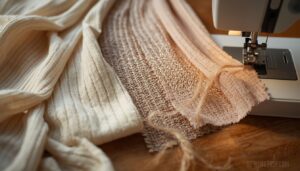
Fiber content quietly runs the show. Natural fiber lint from cotton and linen builds up fast, throwing off tension mid-project. These issues disrupt stitching consistency during serger operations.
Synthetic threads’ elasticity ensures seams remain flexible, particularly with elastane stretch-impact fabrics like swimwear. This adaptability prevents seam failure under stress, making synthetics ideal for dynamic garment construction.
Fiber fineness consistency and blend ratio tension directly influence stitch integrity. For stretchy serger projects, polyester and woolly nylon serve as optimal choices, balancing durability and stretch recovery to achieve clean, locked stitches.
Why Testing on Scraps Matters
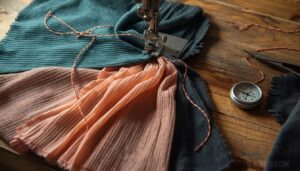
Before cutting into your good fabric, test settings on scraps first. Confirm tension, differential feed, stitch length, and blade sharpness together—not separately. Testing fabric tension before sewing reveals imbalances quickly.
This process lets you achieve stretch recovery on knits, adjust differential feed to prevent waves, and ensure fabric stretch control. Scraps save projects by allowing you to verify critical adjustments without risking your main material.
Scraps save projects.
Knits Work Best on Sergers
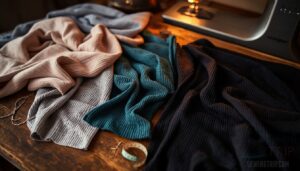
If there’s one fabric category that truly shines on a serger, it’s knits. The serger’s stretchy stitch moves right along with the fabric, keeping seams strong without popping.
Knits shine brightest on a serger, where stretchy stitches move with the fabric to keep seams strong
Here are the knit fabrics you’ll want to know.
Jersey for T-shirts and Everyday Wear
Jersey is your serger’s best friend. For knit garments like t-shirts, fabric selection for serger projects starts with knowing your blend — 95/5 cotton-spandex gives 25–40% stretch.
For quilted knit projects, the stretch matters just as much at the seams — serger machines built for quilters handle that cotton-spandex blend without puckering the batting layers.
Managing fabric stretch during serging requires setting the ideal differential feed around 1.5–2.0. Use ballpoint and stretch needles (75/11) to prevent skipped stitches.
Common tension issues — puckering, wavy seams — disappear when needle tension is adjusted near 4.
Breathability considerations favor cotton blends. Care and washing tips are simple: use cold water, low heat.
Interlock for Stable Knit Seams
Unlike jersey, interlock is a stable knit that behaves predictably on the serger. Its double-knit construction reduces edge curl, creates flatter seams, and enhances shape retention — simplifying fabric selection for serger projects.
For optimal results, set differential feed between 1.0–1.5, use a ballpoint needle, and maintain balanced thread tension. These adjustments ensure smooth fabric handling during serging.
Managing fabric stretch remains effortless, and seam recovery is consistently clean, making interlock a reliable choice for precise finishes.
Rib Knit for Cuffs and Neckbands
Rib knit elasticity gives cuffs and neckbands their satisfying snap-back fit. Cut your rib band to 80–85% of the opening length—this cuff fit allowance ensures a snug fit without distortion.
Use a ballpoint needle choice, such as a 75/11, to glide through loops cleanly.
When serging with knits, adjust the differential feed on a serger to 0.8–1.0 to prevent seam puckering. Employ offset seam placement during rib band cutting to maintain manageable bulk.
French Terry for Sweatshirts and Loungewear
French terry occupies the sweet spot between a light tee and a plush fleece. Its Looped Back Comfort interior delivers breathable warmth without bulk, while offering Moisture Wicking for all-day comfort.
To serge this fabric confidently, follow these essential steps:
- Use a ballpoint or stretch needle (75/11) to prevent seam puckering in knit garments.
- Set differential feed to 1.5–2.0 to optimize serger settings for varying knit weights.
- Choose a 4-thread overlock for flexible, durable seams.
- Follow Cold Wash Care instructions to prevent shrinkage.
- Rotate garments during wear to reduce friction and minimize pilling.
Activewear Knits for Stretchy Seams
Activewear knits — polyester-spandex, scuba, and four-way stretch blends — are where your serger truly earns its place.
Set differential feed to 1.5–2.0 and use stretch needles to prevent skipped stitches.
Wooly nylon in the loopers ensures optimal thread compatibility and seam recovery.
A 4-thread overlock with adjusted stitch length performs panel insertion cleanly, keeping seams flat and flexible.
Swim and Lingerie Fabrics With Elastic Stitches
Swim and lingerie fabrics take elastic stitching to the next level. Nylon spandex blends and powernet mesh handle demanding precision—but your serger manages both beautifully with the right setup.
Key techniques include:
- Use ballpoint needles and stretch thread for knitted elastic integration on lingerie edges.
- Master the quarter pinning technique to distribute braided swim elastic evenly.
- Set differential feed to 1.5–2.0 for consistent fabric feeding on nylon spandex panels.
Wovens That Serge Cleanly
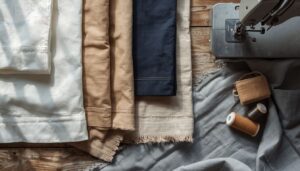
Woven fabrics might not stretch like knits, but they’re surprisingly serger-friendly when you match your settings to the fabric. A 3- or 4-thread overlock and standard tension are usually all it takes to achieve clean, fray-free edges on most wovens.
Here are the ones that perform best.
Cotton Poplin for Crisp Seams
Cotton poplin is a dream to serge — its tight plain weave and medium weight (around 90–130 gsm) feeds through cleanly without bulk or drag.
First, prewash stabilization is recommended to prepare the fabric. Set your differential feed to 1.0 and maintain balanced tension at 3-3-3-3 for optimal results.
Using a four-thread overlock with 70/10 or 80/12 needle sizes ensures crisp seam-edge finishing, achieving a genuinely professional finish every time.
Quilting Cotton for Beginner Projects
If quilting cotton is the fabric that holds your hand through your first serger project. Its tight, stable weave — pure 100% cotton — feeds evenly without shifting, making cutting accuracy and seam allowance basics feel less stressful.
Set tension to 3-3-3-3, use cotton thread, and let the feed dogs do the work.
Perfect for quilting projects, bags, and home sewing projects.
Linen and Linen Blends for Breathable Garments
Linen breathes like nothing else — its open, slubby weave gives garments an airy drape perfect for summer layering.
Pure linen frays eagerly, so serge seams right after straight-stitching. Use a 4-thread overlock with a 3mm stitch length and balanced tensions near 4. Adjust differential feed to 1.0–1.5 to prevent seam puckering.
Linen-cotton blends feed cleanly during sewing. For lightweight linen-viscose, straight-stitching first ensures a professional finish.
Chambray for Lightweight Structured Sewing
Chambray’s plain weave and lightweight structure — usually 3 to 5 ounces per square yard — make it surprisingly serger-friendly. Use a 3- or 4-thread overlock with balanced tensions around 4 and differential feed near 1.0 to keep seam puckering prevention on point.
Sharp needles support clean seam edge finishing, while contrast topstitching, custom pockets, blind hemming, buttonhole reinforcement, and layered lining all reward a precise, professional finish.
Canvas for Bags and Home Decor
Built for structure, canvas is a dream fabric for bags and home decor. Opt for 10–12 oz cotton duck for tote bags and cushion covers — it feeds steadily through fabric feeding mechanisms without bunching.
Set the serger’s differential feed values around 1.0–1.5, use high-quality thread, and denim needles for clean seam edge finishing.
Reinforced corners, bag straps, printed patterns, waxed finish options, and outdoor durability all become effortlessly achievable.
Denim for Durable Overlocked Edges
Denim rewards you when your serger settings are dialed in correctly. Most denim is cotton or a cotton-spandex blend — and that denim fiber blend changes how it behaves on overlock machines.
- Needle size: 100/16 to 110/18
- Thread choice: Tex 40–60 polyester
- Overlock tension: slightly higher than standard wovens
- Serger differential feed values: 1.5–2.0
- Seam finishing methods: 4- or 5-thread overlock
Delicate Fabrics Need Extra Care
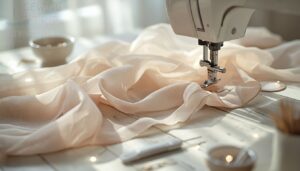
Delicate fabrics like chiffon and voile are gorgeous to work with, but they don’t forgive mistakes the way sturdier materials do. Your serger can handle them beautifully — you just need to know which adjustments to make before you start.
Here’s what to keep in mind for each of these lightweight materials.
Chiffon With Narrow Overlock Finishes
Chiffon is basically liquid on a table — beautiful, but it’ll slide right out from under you. The secret lies in using a size 60/8 Microtex Needle and Rasant Thread in the loopers, paired with fine tension settings (right needle at 3.5, upper looper at 2.0).
Set your stitch width to 1.0 mm, engage a clean trim knife, and let the narrow overlock stitch safeguard the fabric’s delicate drape. This approach ensures drape preservation beautifully while maintaining structural integrity.
Voile for Lightweight Clean Edges
Voile is a step up from chiffon — slightly more stable, but still beautifully sheer. Its plain weave and minimal stretch mean your serger can deliver truly crisp, professional finish techniques without fighting the fabric.
- Use a Ballpoint Needle and reduce Micro Tension to prevent puckering.
- Set Differential Feed to 0.7 for a flat Trim‑and‑Wrap Edge.
- Practice Slip‑Control Guiding for clean rolled hems and neat seam allowance management.
Steam press lightly after serging.
Georgette and Sheer Scarf Fabrics
Georgette floats—a characteristic that demands precision. Whether working with silk versus polyester, both require micro-needle selection (size 60/8) and a low differential feed (around 0.7) to prevent fabric distortion on a serger.
A light serger tension adjustment ensures the matte finish maintains smooth handling. Employ drape control techniques by guiding the fabric without pulling, preserving its delicate structure.
After stitching, gently steam press the material to finalize the finish, enhancing its graceful drape.
Rolled Hems on Thin Woven Fabrics
Thin wovens like voile, silk dupioni, and rayon respond beautifully to rolled hems—once you nail the settings.
Tighten your lower looper tension to 6 or 7, loosen the upper looper to around 3.5, and keep needle tension normal. Stitch length fine-tuning matters too: 1 to 1.5 mm gives dense, clean coverage.
Retracting the blade, using 60-weight thread, and pressing after stitching are essential final steps.
Preventing Puckering on Slippery Materials
Slippery fabrics like satin, silk, and chiffon puckers when they shift under the foot. A quick starch spray stiffens them just enough to behave. If that’s not enough, use a temporary stabilizer underneath.
Adjust machine settings to manage fabric movement: set reduced tension so threads don’t grip too tight, lower the light presser foot pressure, and add a walking foot for smoother feeding.
Best Uses for Narrow Stitch Width
Once you’ve tamed puckering, narrow stitch width opens up a whole new world of clean, refined finishing. Here’s where it truly shines:
- Circle skirt hems and tablecloth corner trims — curves lie flat without bunching.
- Ruffle edge refinement and baby garment finishes — lightweight overlock keeps drape soft.
- Lettuce edge knits — stretch plus narrow width create that playful, ruffled finish naturally.
Heavy Fabrics Need Stronger Stitches
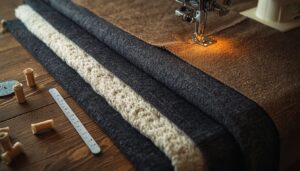
Heavy fabrics like fleece, thick sweater knits, and upholstery canvas don’t play by the same rules as lighter materials. Your serger can handle them beautifully, but only if you match the stitch type and settings to the weight.
Here’s what you need to know for each one.
Fleece and Thick Sweater Knits
heavyweights of your fabric stash are the fleece and thick sweater knits — rewarding to sew, but only when your serger is dialed in.
Pile compression under the presser foot can distort seams, so adjusting differential feed on a serger above 1.0 keeps things flat.
Choose a ballpoint needle for knit fabrics, load your loopers with woolly polyester for thread elasticity, and tackle seam bulk management by widening your stitch.
Finish with light pressing techniques using steam.
Heavy French Terry and Sweatshirt Fleece
Both French Terry and sweatshirt fleece demand respect — and the right setup. French Terry’s looped interior traps air beautifully, while brushed fleece adds plush warmth, but both can distort without optimizing serger settings for different knit weights.
To handle these fabrics effectively, increase presser foot pressure and set the differential feed to 1.5. For thread selection, prioritize polyester or woolly nylon to ensure stretchy seams.
When working with elastane blends, bump thread tension slightly to maintain recovery. This adjustment helps preserve the fabric’s stretch and shape during sewing.
Upholstery-weight Canvas and Bulky Seams
Upholstery-weight canvas — think 12 oz duck or heavier — puts your serger through its paces. Use denim needles and strong polyester thread, paired with a 5-thread safety stitch for durability.
Graded seam allowances and diagonal corner trimming reduce bulk in thick materials. These techniques ensure smoother assembly and prevent excessive layering.
A hump-jumper shim helps navigate thick ridge crossings, while reinforced edge binding cleanly finishes raw edges for a polished result.
When to Use a 4-thread Overlock
When your project calls for construction seams that actually hold up—think T-shirts, fitted dresses, or activewear—the 4-thread overlock is your go-to. It uses two needles for seam reinforcement, ensuring stretchable seams won’t split under pressure.
This adaptable stitch works beautifully with knit and woven fabrics, creating durable interiors and clean edges in a single pass.
When to Use a 5-thread Safety Stitch
The 5-thread safety stitch is your serger’s heavy hitter, pairing a chain-stitch advantage with a 3-thread overlock in one pass. This dual-stitch system dramatically enhances garment durability, making it perfect for high-stress zones like inseams in pants construction and workwear applications.
Its robust design excels for ideal for denim, canvas, and loosely woven fabrics, preventing fraying that lighter overlocks cannot withstand. By combining two stitch systems, it delivers unmatched strength where garments need it most.
Fabrics That May Need a Regular Sewing Machine First
Not every fabric is ready for the serger right away. Some need a regular machine first.
- Thick seam layers at waistband construction or pocket reinforcement seams can jam your knife and loopers
- Silk’s slip control is easier when basting stabilizes the fabric before overlocking
- Reinforcement stitching on stress points prevents distortion when serging knits versus regular sewing machine finishing
Build the seam, then serge.
Frequently Asked Questions (FAQs)
Can you serge faux leather or vinyl fabrics?
Yes, but it demands respect. Faux leather and vinyl don’t fray, so serging is about control, not edge-stopping.
Use longer stitch length, sharp blades, and a Teflon foot for clean results.
How does fabric color affect thread color choice?
Match your thread to your fabric’s value first. Light contrast pops, so shade matching hierarchy matters more than hue.
A daylight thread test confirms the real look before you serge.
Which fabrics benefit from a rolled hem finish?
Lightweight fabrics shine with rolled hems. Silk organza, sheer tulle, fine lace, delicate gauze, and microfiber scarves all benefit — the narrow finish stays nearly invisible while keeping edges neat and fray-free.
Can sergers handle multiple fabric layers at once?
Sergers can handle multiple layers — but there are limits. Knife capacity, needle selection, and thread tension scaling all matter.
Adjust differential feed and test on scraps first to keep fabric feeding smoothly.
Do specialty fabrics require special serger feet?
Not always. Your standard foot manages most knits and wovens just fine.
But an elasticator foot, non-stick foot, gathering foot, or clear foot can make tricky fabrics much easier to control.
Conclusion
You don’t need a fabric library to get started—just one good match between material and machine. Understanding what fabrics work best with a serger isn’t about memorizing rules; it’s about building instincts, one scrap test at a time.
Knits, wovens, sheers, heavyweights—each one teaches you something new about how your serger thinks. The more you sew, the more those settings stop feeling like guesswork and start feeling like second nature.
- https://www.sewingmachinesplus.com/understanding-sergers.php
- https://www.janome.ca/wp-content/uploads/2025/02/needle-select-poster.pdf
- https://janomelife.wpcomstaging.com/category/janome-sergers-2/
- https://www.fioboc.com/blogs/fabricnology/stretch-fabric-vs-regular-fabric-whats-the-difference
- https://refiberdesigns.com/blog/the-why-and-how-of-stretch-fabrics