This site is supported by our readers. We may earn a commission, at no cost to you, if you purchase through links.
Sergers used to cost as much as a decent used car—and for most hobbyists, that price tag meant the machine stayed on the wishlist forever. That’s changed.
Today, solid serger machines for crafters on a budget start around $200, and some of the most reliable models come from the same brands supplying professional workrooms.
The gap between "affordable" and "capable" has quietly closed. Metal frames, differential feed, and color-coded threading guides aren’t luxury features anymore—they’re standard on machines like the Brother 1034DX and Juki MO654DE.
Knowing which features actually matter for your projects separates a smart buy from a shelf-sitter.
Table Of Contents
- Key Takeaways
- 9 Best Budget Sergers for Crafters
- 1. Brother 1034DX Metal Frame Serger
- 2. Singer S0230 Heavy Duty Serger
- 3. Singer X5004HD Metal Frame Serger
- 4. Juki MO654DE White Serger
- 5. Juki MO644D Portable Serger
- 6. JUKI MO655 Pearl Serger Sewing Machine
- 7. Janome 8002D Overlock Serger Machine
- 8. Janome 8933 Serger Lay In Threading
- 9. Brother 1034D Metal Frame Serger
- Key Features That Matter Most
- Ease of Use for Beginners
- How to Match Your Projects
- Budgeting Beyond The Purchase Price
- Smart Buying Tips for Value
- Frequently Asked Questions (FAQs)
- Conclusion
Key Takeaways
- Budget sergers like the Brother 1034DX and Juki MO654DE now come standard with metal frames, differential feed, and color-coded threading — features that used to cost serious money.
- Differential feed is the one feature you don’t want to skip, especially if you sew knits, jersey, or anything stretchy, since it’s what keeps fabric from warping as it feeds through.
- The sticker price is just the beginning — needles, thread cones, replacement blades, and annual servicing can quietly add $150–$300 or more to your yearly costs.
- Matching the machine to your actual projects matters more than chasing brand names or paying extra for features you’ll never use.
9 Best Budget Sergers for Crafters
Finding a reliable serger without blowing your budget is easier than you’d think. These nine machines cover a solid range of prices, features, and skill levels — so there’s something here whether you’re just starting out or ready to level up.
Each pick is broken down in detail over at serger machines for home sewists, so you can compare specs and find the one that actually fits how you sew.
Here’s a closer look at each one.
1. Brother 1034DX Metal Frame Serger
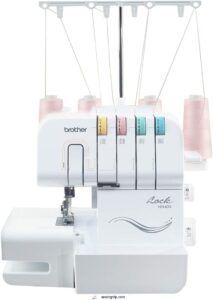
The Brother 1034DX is a solid starting point if you want reliable seams without breaking the bank.
Its metal frame keeps things steady at up to 1,300 stitches per minute, and the color-coded threading guides make setup far less intimidating than you’d expect.
You get 3- and 4-thread capability, a built-in rolled hem, and a trim trap that doubles as foot-controller storage.
Three accessory feet come included, so you’re ready to sew right out of the box.
| Best For | Home sewers and beginners who want professional-looking seams on everyday garments without a steep learning curve. |
|---|---|
| Thread Capacity | 3/4-thread |
| Max Stitch Speed | 1,300 spm |
| Differential Feed | Yes |
| Color-Coded Threading | Yes |
| Rolled Hem | Not specified |
| Frame Construction | Metal frame |
| Additional Features |
|
- Metal frame keeps it stable at full speed, so you get clean, consistent stitches even on heavier fabrics like denim or knits.
- Color-coded threading guides take a lot of the guesswork out of setup — great if you’re not a serger veteran.
- Three accessory feet included right out of the box, so you can do gathers, blind stitches, and standard serging without buying extras.
- It runs loud and vibrates noticeably, which gets tiring fast during longer sewing sessions.
- The 75W motor is on the weaker side, so thick or multi-layered fabrics can push it to its limits.
- Tension adjustments aren’t super precise — you have to release everything at once by lifting the presser foot, which makes fine-tuning a bit clunky.
2. Singer S0230 Heavy Duty Serger
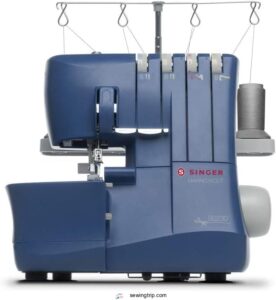
If you want to step up the speed a little, the Singer S0230 is worth a look. Its metal frame supports denim and canvas without flinching, and at 1,300 stitches per minute, it moves fast enough for bigger projects.
You get 2-, 3-, and 4-thread capability, a differential feed system for stretch fabrics, and color-coded threading guides to keep setup simple.
The free arm and built-in rolled-hem plate are nice touches too.
Just note — there’s no waste bin, so keep a brush nearby.
| Best For | Sewers who work with stretch, sheer, or heavy fabrics and want professional-looking seam finishing at a solid speed. |
|---|---|
| Thread Capacity | 2/3/4-thread |
| Max Stitch Speed | 1,300 spm |
| Differential Feed | Yes |
| Color-Coded Threading | Yes |
| Rolled Hem | Built-in plate |
| Frame Construction | Metal frame |
| Additional Features |
|
- Metal frame handles denim, canvas, and knits without breaking a sweat
- 1,300 SPM with differential feed keeps projects moving on tricky fabrics
- Color-coded threading and a built-in rolled-hem plate make setup less of a headache
- No waste bin means trimmed threads end up all over your workspace
- No printed manual — you’re relying on a PDF or hunting online when things go wrong
- Some users run into needle alignment and tension issues, especially with heavier specialty fabrics
3. Singer X5004HD Metal Frame Serger
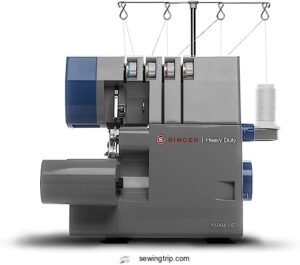
If you need something with even more muscle, the Singer X5004HD steps things up.
The heavy-duty metal frame keeps vibration low, and the cutting knife is about 60% larger than standard serger knives — a real advantage when you’re pushing through denim or upholstery.
It processes 2-, 3-, and 4-thread stitching, runs at 1,300 spm, and the adjustable differential feed controls both stretchy knits and heavier wovens.
Dual LED lights and built-in accessory storage are handy extras.
Threading takes patience, though — no auto-thread here.
| Best For | Sewers who regularly work with heavy fabrics like denim, leather, or upholstery and need a serger that can keep up without stalling. |
|---|---|
| Thread Capacity | 2/3/4-thread |
| Max Stitch Speed | 1,300 spm |
| Differential Feed | Yes |
| Color-Coded Threading | Yes |
| Rolled Hem | Yes |
| Frame Construction | Metal frame, SS bed |
| Additional Features |
|
- Heavy-duty metal frame cuts down on vibration, so you get clean, consistent stitches even through thick material
- The oversized cutting knife handles bulky fabric with ease — no jamming or skipping
- Fast 1,300 spm speed paired with adjustable differential feed makes it versatile for everything from knits to heavy wovens
- Threading is a manual process and takes some getting used to — expect a learning curve
- The included scrap bag is pretty small, which gets frustrating fast if you’re doing high-volume work
- A few users have run into power and startup hiccups, with limited official support to help sort them out
4. Juki MO654DE White Serger
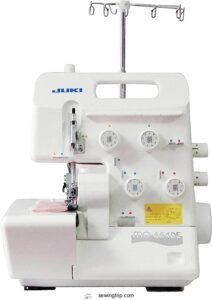
Juki takes things to another level with the MO654DE.
This machine manages 2-, 3-, and 4-thread stitching, hits 1,500 spm, and the color-coded threading system makes setup surprisingly painless — even on a bad day.
The differential feed adjusts from 0.7 to 2.0, so knits and silks behave themselves.
It’s built on an aluminum body, so it’s solid without being a beast to move.
No coverstitch here, but for clean overlock work across light to heavy fabrics, it punches well above its ~$350 price tag.
| Best For | Home sewers and hobbyists who work with knits, stretchy fabrics, or mixed-weight materials and want a reliable, easy-to-thread serger without breaking the bank. |
|---|---|
| Thread Capacity | 2/3/4-thread |
| Max Stitch Speed | 1,500 spm |
| Differential Feed | Yes, 0.7–2.0 |
| Color-Coded Threading | Yes |
| Rolled Hem | Automatic |
| Frame Construction | Aluminum body |
| Additional Features |
|
- Color-coded threading makes setup fast and way less frustrating than most sergers at this price
- Differential feed (0.7–2.0) keeps stretchy and delicate fabrics from puckering or stretching out
- Solid aluminum body feels sturdy and handles everything from lightweight silks to heavier upholstery fabric
- No coverstitch function — you’ll need a separate machine if that’s part of your workflow
- Only runs on 110V, so international users will need a step-down transformer
- The manual is pretty thin on detail, so beginners may need to lean on YouTube or a supplemental guide
5. Juki MO644D Portable Serger
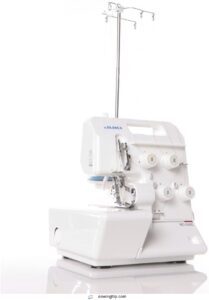
If portability matters to you, the MO644D deserves a serious look.
It weighs just 15 lb, has a built-in handle, and suction cups on the base keep it steady wherever you set it down — kitchen table, craft fair, class. It hits 1,500 spm, manages 2- to 4-thread stitching, and switches to rolled hem without swapping feet or needle plates.
Color-coded threading keeps setup straightforward.
For around $400, it’s a capable, go-anywhere overlocker that doesn’t cut corners.
| Best For | Home sewists and crafters who need a reliable overlocker they can take to classes, fairs, or move between workstations without a hassle. |
|---|---|
| Thread Capacity | 2/3/4-thread |
| Max Stitch Speed | 1,500 spm |
| Differential Feed | Yes |
| Color-Coded Threading | Yes |
| Rolled Hem | Automatic |
| Frame Construction | Not specified |
| Additional Features |
|
- Color-coded threading makes setup faster and less frustrating, especially if you’re new to sergers
- Automatic rolled hem and differential feed handle stretchy knits and lightweight fabrics with ease
- Quiet operation and a compact build make it a good fit for apartments, shared spaces, or classrooms
- Not self-threading, so the setup learning curve can trip up first-time serger owners
- Only rated for light to medium fabrics — heavy denim or upholstery will likely be a struggle
- Needs a voltage transformer outside North America, which adds cost and an extra thing to carry
6. JUKI MO655 Pearl Serger Sewing Machine
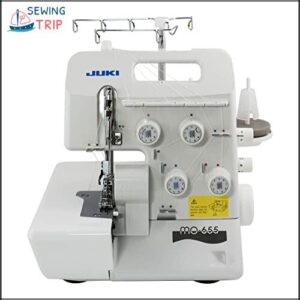
The MO655 Pearl punches well above its weight class. It manages 2- to 5-thread stitching, including chainstitching and a 5-thread safety stitch — options you won’t find on most budget sergers.
Rolled hems are built in, so no plate swapping is required. The color-coded threading and 1-rotation tension dials make setup genuinely less frustrating.
It maxes out at 1,500 spm and differential feed runs from 0.7 to 2.0.
If you want serious versatility without buying two machines, this one earns its spot.
| Best For | Home sewers and small studio owners who want one machine that handles overlocking, rolled hems, and chainstitch without needing a second serger. |
|---|---|
| Thread Capacity | 2/3/4/5-thread |
| Max Stitch Speed | 1,300 spm |
| Differential Feed | Yes |
| Color-Coded Threading | Yes |
| Rolled Hem | Yes |
| Frame Construction | Not specified |
| Additional Features |
|
- Runs 2- to 5-thread stitching with chainstitching built in — serious range for one machine
- Rolled hem is built right in, no plate swapping needed
- Color-coded threading and easy tension dials make setup way less painful
- Threading is genuinely tricky and takes practice to get right
- The chain-stitch function can be finicky — some users deal with bunching or it not engaging at all
- Shipping inconsistencies pop up (missing cone caps, voltage label confusion, occasional damage out of the box)
7. Janome 8002D Overlock Serger Machine
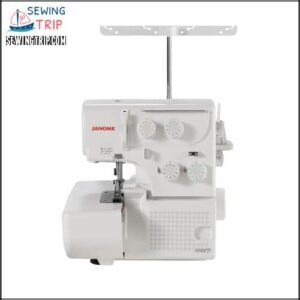
The Janome 8002D sits right in the sweet spot for crafters who want reliability without the complicated learning curve. It switches between 3- and 4-thread overlock, accommodates rolled hems with a built-in changeover device, and tops out at 1,300 stitches per minute.
The differential feed dial — ranging from 0.5 to 2.25 — keeps knits and jerseys from stretching out on you. Color-coded threading helps a lot.
Threading the lower looper takes some patience, but once you’re set up, this machine delivers clean, consistent results.
| Best For | Crafters and sewers who want a reliable, beginner-friendly serger for finishing seams, working with knits, and creating rolled hems without spending a fortune. |
|---|---|
| Thread Capacity | 3/4-thread |
| Max Stitch Speed | 1,300 spm |
| Differential Feed | Yes |
| Color-Coded Threading | Yes |
| Rolled Hem | Yes |
| Frame Construction | Metal and plastic |
| Additional Features |
|
- Switching between 3- and 4-thread overlock is dead simple — just flip a lever
- The differential feed handles stretchy fabrics like jerseys and knits without puckering or distortion
- Color-coded threading guides and clear tension dials make setup way less intimidating for beginners
- Threading the lower looper is genuinely tricky and requires some patience (and maybe a good light)
- It runs loud, and the front cover can rattle — not ideal if you’re sewing in a shared space
- No dust cover included, and it won’t replace a regular sewing machine since it lacks a straight-stitch function
8. Janome 8933 Serger Lay In Threading
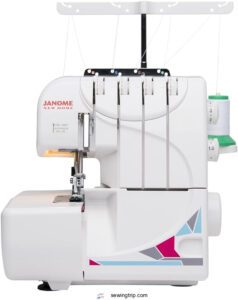
Threading a serger is where most beginners lose their nerve — and that’s exactly what the Janome MOD-8933 was built to fix. The lay-in threading system uses color-coded guides for every path: lower looper, upper looper, left needle, right needle. You follow the colors, and guesswork disappears.
At $329.99, you get 3- and 4-thread capability, differential feed, and a mostly metal frame. The lower looper still takes a little practice, but it’s far less intimidating than on most comparable machines.
| Best For | Beginners and intermediate sewers who want a compact, durable serger that takes the frustration out of threading and handles everything from knits to heavy denim. |
|---|---|
| Thread Capacity | 3/4-thread |
| Max Stitch Speed | 1,300 spm |
| Differential Feed | Yes |
| Color-Coded Threading | Yes |
| Rolled Hem | Quick-change attachment |
| Frame Construction | Predominantly metal |
| Additional Features |
|
- Color-coded lay-in threading makes setup fast and way less stressful, especially if you’re new to sergers
- Handles tough fabrics like denim and canvas without skipping a beat, thanks to solid metal construction
- Differential feed keeps stretchy and knit fabrics smooth — no puckering, no stretching
- No free-arm attachment, so serging cuffs, sleeves, or anything tubular gets tricky
- Runs pretty loud at high speeds, and tension can drift a bit over time
- Accessories like needles and screwdrivers come loose — there’s no case to keep them organized
9. Brother 1034D Metal Frame Serger
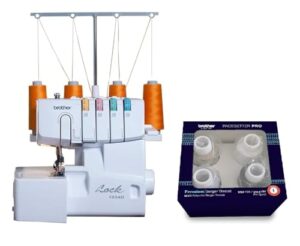
The Brother 1034D keeps showing up on best-of lists for good reason.
At around $300, you get an all-metal frame, 3- and 4-thread overlock capability, and color-coded threading guides that make setup far less stressful. The differential feed manages knits and delicate wovens without puckering, and the convertible free arm lets you tackle cuffs and sleeves with ease.
It sews at 1,300 stitches per minute — plenty fast for hobby use.
It’s a dependable, no-drama machine that punches well above its price.
| Best For | Hobbyists and home sewers who want a reliable, easy-to-thread serger that can handle everything from delicate knits to heavy denim without breaking the bank. |
|---|---|
| Thread Capacity | 3/4-thread |
| Max Stitch Speed | 1,300 spm |
| Differential Feed | Yes |
| Color-Coded Threading | Yes |
| Rolled Hem | Yes |
| Frame Construction | All-metal frame |
| Additional Features |
|
- All-metal frame means it’s built to last — this thing won’t flex or rattle under pressure
- Color-coded threading guides make setup way less intimidating, especially if you’re new to sergers
- Differential feed handles stretchy knits and thin wovens smoothly, no puckering or skipped stitches
- Some useful stitch types (blind hem, flat lock) require buying extra presser feet separately
- At 17 lbs, it’s on the heavier side — not the easiest to haul to a class or a friend’s place
- Warranty only covers the US, so it’s a no-go if you’re outside the country or plan to move abroad
Key Features That Matter Most
Not every feature on a serger is worth paying extra for — but a few of them can make or break your whole experience. Knowing which ones actually matter helps you skip the noise and pick the right machine for your projects.
Here’s what to look for before you buy.
3. thread Vs 4-thread Stitch Options
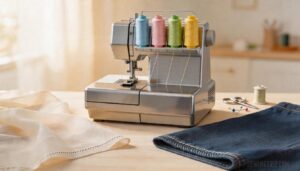
Think of 3‑thread and 4‑thread stitch options as the difference between a safety net and a double‑reinforced one. A 3‑thread serger manages edge appearance and lightweight fabric suitability well. A 4‑thread adds a second needle, boosting seam strength for denim and stress‑prone seams. The 4‑thread configuration also offers a safety stitch feature for high‑stress areas.
Key differences to know:
- Seam strength: 4‑thread wins for everyday garments
- Fabric suitability: 3‑thread suits sheers; 4‑thread manages medium to heavy weights
- Edge appearance: 3‑thread looks lighter; 4‑thread looks denser
- Thread consumption: 4‑thread uses more thread per seam
Differential Feed for Knits and Stretch Fabrics
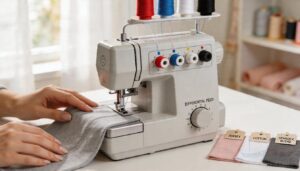
Where 3-thread and 4-thread stitches handle structure, the differential feed manages movement — specifically, keeping knit fabric from stretching out as it feeds through. Most budget sergers let you dial the feed ratio anywhere from 0.5 to 2.0. Stretchy jersey? Push it toward 2.0. Fine wovens that pucker? Drop below 1.0. Always do swatch testing first.
| Setting | Best Use |
|---|---|
| 0.5–0.9 | Fine, tightly woven fabrics |
| 1.0 | Neutral — stable fabrics |
| 1.2–1.5 | Light knits, moderate stretch |
| 1.6–1.9 | Stretchy jersey, spandex blends |
| 2.0 | Highly elastic knits |
Feed ratio tuning, stitch tension balance, and edge flatness optimization all connect here. Fabric stretch compensation only works if you test first — a 10-inch swatch on the actual fabric tells you everything before you touch your project.
Adjustable Stitch Width and Stitch Length
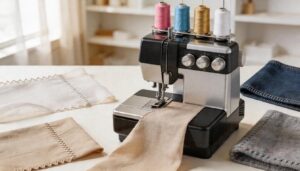
Once you’ve sorted your feed settings, stitch width and length become your next two dials to know.
Width controls edge coverage balance — Brother models generally run 5 to 7 mm.
Length manages stitch density control, usually 2 to 4 mm.
For fabric thickness matching, shorter lengths suit lightweight fabrics; longer ones handle heavier work.
Width-length coordination keeps your zigzag edge styling clean every time.
Rolled Hem, Flatlock, and Blind Hem Capability
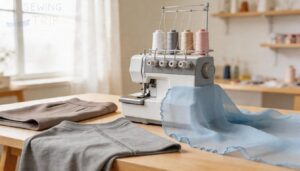
Beyond width and length, what you can actually stitch matters just as much. Budget sergers for home sewing often include rolled hem, flatlock, and blind hem options — and each one opens different doors.
Rolled Edge finishing suits scarves and chiffon. Flatlock Flexibility keeps activewear seams flat and stretchy. Blind Hem Precision hides stitches on skirts and trousers.
Fabric Compatibility and Stitch Consistency improve when you match the right finish to your project.
Sewing Speed, Cutting Performance, and Trim Control
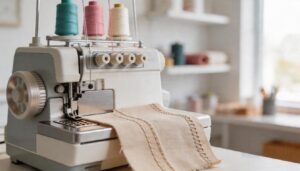
Speed makes a real difference once you’re in a groove. Most budget-friendly sergers hit 1,000–1,500 stitches per minute — the Juki MO644D tops out at 1,500.
Blade timing accuracy and feed dog synchronization keep your cutting blade clean and your seam edges even. Trim width adjustability lets you dial in tight rolled hem finishes or wider overlocks, giving you stitch consistency from start to finish.
Free Arm, LED Lighting, and Workspace Visibility
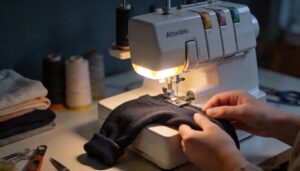
Small details add up fast. A free arm lets you slip cuffs, sleeves, and pant legs around the machine without wrestling the fabric — arm maneuverability makes a real difference on kids’ clothes and knit cuffs.
Built-in LED lights improve illumination uniformity and ergonomic light position near the needle, so you catch skipped stitches before they multiply.
- Free arm guides curved seams smoothly
- LED brightness control reduces eye strain
- Glare reduction helps on dark fabrics
- Budget-friendly LED lighting benefits detailed sewing without extra cost
Ease of Use for Beginners
If you’re new to sergers, the learning curve doesn’t have to be steep. The right machine makes setup, adjustments, and day-to-day use feel surprisingly straightforward.
Here’s what to look for when ease of use is your top priority.
Color-coded Threading Guides and Lay-in Threading
Threading a serger can feel like solving a puzzle blindfolded — unless your machine uses a color-coded threading system. With Visual Thread Mapping, each thread path gets its own color, so you follow dots instead of decoding diagrams. Open Guide Design makes Lay-in Setup Speed real: no tunnels, just drop the thread in and go.
| Feature | Beginner Benefit |
|---|---|
| Color-coded thread guides | Reduces setup errors fast |
| Lay-in threading | No tight eyelets to fight |
| Thread Path Visibility | Clear route at a glance |
| Built-in threading chart | Rethreading without the manual |
Budget sergers and affordable sergers for home sewing increasingly include these color-coded thread guide benefits, making Color-coded Learning genuinely accessible.
Tension Dials and Quick Setting Adjustments
Tension dials might look intimidating, but they’re easier than they seem. Most budget sergers give you separate dials for Needle Tuning and Looper Balance — start every new fabric with a Midpoint Reset.
Fabric Thickness and Thread Influence both shift your settings, so adjust one dial at a time.
Brother’s 1034D runs best around 4, while Juki’s MO-654DE recommends 3–5 as baseline.
Easy Cleaning Access and Removable Side Panels
Lint builds up fast in a serger — faster than you’d expect. That’s why easy cleaning access isn’t a luxury; it’s a must-have for machine maintenance. Budget serger machines like the Juki MO644D open their side panels completely for direct dust removal from serger internals.
Look for these time-savers:
- Looper Brush Access for clearing fluff around blades
- Throat Plate Removal to reach packed lint under feed dogs
- Side Panel Latches or Quick-Release Panels for tension disc cleaning
Compact Footprint for Small Craft Rooms
cramped craft room doesn’t have to mean cramped options. Most budget sergers stay under 12 inches tall, with a slim machine height and machine footprint that fits standard studio cabinets.
Portable lightweight serger models often include a foldable accessory tray, integrated cable channels, and a compact storage shelf underneath. Some even offer wall-mount compatibility — keeping your whole workspace clear.
Noise Level and Comfort During Longer Sessions
Long sewing sessions can wear you down fast — and noise is a bigger culprit than most crafters expect. Machines with a quiet motor design and vibration damping sit much more easily during marathon finishing runs.
- Metal frames improve quiet operation by cutting rattling at the source
- Anti-vibration mats boost acoustic insulation under your machine
- ergonomic seating with hearing protection to protect your ears above 70 dB
Brand Tutorials, Manuals, and Beginner Support
Good support can be just as valuable as a quiet motor. Brother and Juki both offer video threading guides, step-by-step manuals, and FAQ troubleshooting pages that walk sewing beginners through every setup mistake.
Active sewist community forums fill in the gaps that brands miss. That combination of online video guides and community forums turns a confusing first stitch into a confident one.
How to Match Your Projects
Not every serger manages every project the same way, and picking the wrong one can cost you time and frustration. The good news is that once you know what you’re making, finding the right match gets a lot easier.
Here’s how different project types line up with the features that matter most.
Best Serger Features for Garment Sewing
Garment sewing asks more of your serger than basic hemming does. You’ll want differential feed to keep seams flat, plus adjustable stitch width and adjustable stitch length for different fabric weights.
Thread Tension Balance keeps everything clean across layers.
Features like a quiet motor design, rolled hem capability, adjustable pressure foot, and generous thread capacity mean fewer interruptions and better-looking results from collar to cuff.
Choosing for Knits, Jersey, and Stretchy Fabrics
Knits and jersey are where differential feed really earns its place. Without it, stretchy fabrics ripple and stretch out of shape as you sew.
Watch these settings closely:
- Thread Tension Settings for each looper
- Fabric Feed Consistency across seam lengths
- Needle Type Matching for knit fabrics
- Stitch Density Control on lightweight jersey
Seam Type Selection and thread tension adjustment keep everything flat and professional.
Handling Denim, Canvas, and Thicker Seams
Thick fabrics like denim and canvas demand more from your serger. Start with Heavy-Duty Needles (size 90/14 or 100/16) and Walking Foot Feed to move layers evenly.
Stitch Length Tuning to 3–4mm prevents perforation. Always do a Fabric Pre-Wash to control shrinkage first.
| Technique | Why It Matters |
|---|---|
| Bartack Reinforcement | Holds stress points on pocket corners |
| Differential Feed | Prevents drag on dense layers |
Lightweight Fabrics and Rolled-hem Finishing
Lightweight fabrics like chiffon and voile need a gentle touch. That’s where Fabric Drape Control and Sheer Edge Stability really come into play.
Use Needle Gauge Selection of 60/8 to 70/10, and focus on Thread Weight Matching with fine polyester. Tension Fine-tuning keeps the rolled hem wave-free. Budget sergers with differential feed and lightweight and compact design handle this fabric handling beautifully.
When a Budget Serger is Enough for Hobby Use
Here’s the truth — if you sew a few times a month, budget sergers cover nearly everything you need. A hobby setup works well when you can check these five boxes:
- Project Frequency stays at casual or occasional
- Skill Development is still in early or mid stages
- Space Constraints favor a lightweight and compact design
- Thread Consumption stays low with home use projects
- Portability Needs matter more than sophisticated automation
Budget-friendly sewing equipment built for ease of use genuinely delivers.
Budgeting Beyond The Purchase Price
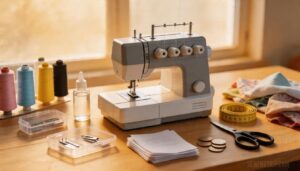
The sticker price is just the starting point. Owning a serger comes with a few ongoing costs that are worth knowing before you buy.
Here’s what to expect once the machine is in your hands.
Typical Budget Serger Price Ranges
Budget sergers span a wider range than most crafters expect. Entry-Level Pricing starts around $200–$350 for solid 3-thread machines. Mid-Range Costs land between $350–$500, adding differential feed and 4-thread capability. Premium Budget Tier runs $500–$900 for added convenience features.
| Price Tier | Typical Range |
|---|---|
| Entry-Level | $200–$350 |
| Mid-Range | $350–$500 |
| Premium Budget | $500–$900 |
Seasonal Discount Impact and Regional Price Variation can shift these numbers noticeably, so timing your purchase smartly stretches every dollar further.
Accessories, Presser Feet, and Starter Supplies
The machine is just the starting point.
Your Starter Kit Essentials should include a seam ripper, measuring tape, sharp scissors, and neutral thread cones.
For a Foot Types Overview, start with a rolled hem foot and a blind hem foot.
Follow an Accessory Compatibility Guide to match snap-on presser feet to your model.
Use labeled Storage Solutions to keep everything organized and ready.
Thread, Needles, Blades, and Replacement Parts
These consumables add up faster than most beginners expect — so tracking them from day one keeps your budget honest.
- Thread cones: Polyester serger thread on large cones is your best value; woolly nylon in the loopers adds stretch for knits and costs slightly more but lasts longer with good thread capacity.
- Needle compatibility charts: Most budget sergers use ELx705 or 130/705-compatible needles in sizes 75/11 to 90/14 — always check your manual before ordering to avoid skipped stitches.
- Cutting blade: A dull cutting blade leaves fuzzy, uneven edges; replacement knife sets run around $15 and are model-specific for Brother, Juki, or Singer machines.
- Consumable cost tracking: Log needle and thread purchases monthly — these small amounts quietly outpace one-time replacement parts over a full year.
- Parts availability sources: Amazon, WAWAK, and brand-specific retailers like mrsewing.com list replacement parts by exact model number, making it easy to find the right fit without guesswork.
Adjusting Thread Tension Settings correctly also extends needle and blade life, so don’t skip that step when swapping parts.
Annual Maintenance and Servicing Costs
Servicing a budget serger isn’t free — and that surprise bill stings. Plan for €150–€300 annually covering two routine checkups, lubrication, and minor adjustments.
DIY serger maintenance — following your lubrication schedule every 6–8 sewing hours — cuts labor hourly rates substantially. Wear part lifespan averages 1–2 years for blades and tension discs.
Smart annual maintenance budgeting for sewing equipment means fewer hidden costs of sergers catching you off guard.
Warranty Coverage and Long-term Value
Once you’ve mapped out maintenance costs, warranty coverage becomes your next money-saving layer. Budget sewers usually offer one-to-three-year plans covering parts and workmanship — but watch for Coverage Exclusions like worn blades or needles.
- Warranty Transferability can give your machine a Resale Value Boost
- Extended Service Plans add two-to-five extra years of protection
- Parts Longevity matters — brands like Brother and Juki stock components long after discontinuation
Refurbished Vs Used Sergers for Savings
Beyond warranty and support, your savings strategy isn’t complete until you weigh a preowned serger against a refurbished one.
| Factor | Refurbished Serger | Used Overlock Machine |
|---|---|---|
| Condition Predictability | High — inspected and tested | Varies by seller |
| Warranty Protection | Often included | Rarely available |
| Hidden Repair Costs | Lower risk | Higher risk |
| Service History Transparency | Usually documented | Often unknown |
budget-friendly refurbished unit suits beginners best. Experienced sewers comfortable spotting worn parts can safely go used — especially when the price range drops well below refurb listings.
Smart Buying Tips for Value
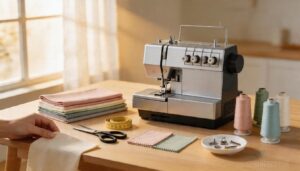
Knowing what to look for before you buy saves you from spending money you didn’t need to spend. A few smart habits can help you land the right serger without second-guessing yourself later.
Here’s what to keep in mind as you shop.
Set a Realistic Budget Before Comparing Models
Before you even glance at a single model, lock in your total spend. Budget surges generally run $200–$500, but your real number includes accessories, thread, and blades. A solid Total Cost Calculation keeps budget constraints from blindsiding you mid-purchase.
- Factor in Accessory Expense Planning: add $30–$120 for presser feet
- Build in Contingency Allocation: reserve 10% for blades and cones
- Include Tax Shipping Estimates: expect 5–15% on top
- Review Financing Options to dodge interest traps
- Use price comparison across retailers before committing
Compare Features Instead of Brand Alone
Once your budget is set, resist the pull of a familiar logo.
Feature Weighting matters more than brand loyalty — a solid comparison of budget serger models reveals real Performance Benchmarks quickly.
| Feature | Why It Matters |
|---|---|
| Differential feed | Prevents knit stretching |
| Stitch thread count | Affects seam strength |
User Scenario Mapping, Cost Ratio, and Reliability Metric checks keep your choice grounded in actual sewing needs.
Decide Whether You Need 3-thread or 4-thread
This choice comes down to what you actually sew. For simple Edge Finishing Needs, 3thread is plenty. But if Garment Longevity matters — think activewear or knits — the seam strength differences between 3 and 4thread sergers are real.
- 3thread: lighter fabrics, rolled hems, less Thread Consumption Cost
- 4thread: construction seams, stretch knits, stronger hold
- Stitch Density Preference affects how finished seams look
- Strength vs Speed trade-offs vary across budget sergers
- price range (~$300–$350) often unlocks both options
Avoid Paying Extra for Unused Advanced Features
Before you upgrade, ask yourself: when did you last use that feature? Simple Feature Audits over 60 days reveal which controls stay dormant.
Usage Tracking helps you skip Bundle Dissection headaches — many budget sergers include extras you’ll never touch.
Firmware Simplification and Downgrade Negotiation with sellers can trim your price range. Stick to features to evaluate in a serger that match your actual projects.
Watch for Seasonal Sales and Bundle Deals
Timing your purchase right can shave serious money off already budget‑friendly price ranges. Here’s where the impact of sales events on serger pricing really shows up:
- Black Friday holiday discount windows can cut listed prices by up to 36%.
- Limited-time bundle offers (24–72 hours) often add free presser feet or thread cones — use a bundle savings calculator to confirm real value.
- Flash sale timing around Cyber Monday targets online‑only deals, so set price protection alerts on retailer sites beforehand.
- Certified refurbished units regularly sell 30–50% below new retail, with inspected machines and warranty coverage included.
Choose Durability and Support Over Flashy Extras
A flashy LCD panel won’t help you when a looper snaps mid-project. Instead, prioritize metal frame construction, reinforced chassis, and sturdy rotary components — they’re what keep budget sergers running long-term.
When a looper snaps mid-project, metal frames and sturdy components matter far more than flashy extras
Look for brands with a solid spare parts catalog, easy maintenance design, and an extended service warranty. Strong brand reputation and support for sergers matters far more than buttons you’ll never use.
Frequently Asked Questions (FAQs)
Is there a difference between a serger and an overlock machine?
Honestly, the terms are often used interchangeably — but there’s a subtle difference.
A serger manages more threads and stitch variety, while an overlock machine focuses mainly on edge trimming and basic seam strength.
Can sergers replace a regular sewing machine?
A serger does one thing brilliantly — yet can’t do everything. No, it can’t replace a regular sewing machine.
You’ll still need Buttonhole Capability, Zipper Installation, and Complex Seam Construction that only a regular machine can perform.
How long do budget serger blades last?
Budget serger blades generally last 2–6 months with daily hobby use. Fabric load effect and material hardness impact wear rates — heavy knits dull blades faster than lightweight wovens.
Is coverstitch possible on affordable sergers?
coverstitch is possible on some affordable entry‑level serger models, but it often needs a manual Coverstitch Needle Setup and rethreading.
Thread Tension Stability and Fabric Stretch Handling vary, so test swatches first.
What thread types work best in sergers?
Polyester is your go-to for everyday serging — strong, flexible, and low-lint. Nylon adds stretch for knits, cotton softness suits natural fabrics, and core-spun durability manages heavier seams beautifully.
Do budget sergers handle curved seams well?
Curved seams are no mountain to climb.
With differential feed and foot pressure control, even a budget-friendly serger handles fabric stretch management and seam allowance consistency cleanly across knits and wovens.
Conclusion
Gone are the days when serger machines were a luxury only professionals could afford. Today, you can get a solid serger for under $200.
When shopping for serger machines for crafters on a budget, focus on features that matter most to your projects. Consider your fabric types, desired stitch options, and ease of use.
By matching your needs to the right machine, you’ll access a world of creative possibilities without breaking the bank or sacrificing quality.
- https://manuals.plus/asin/B06Y4NWHN8
- https://www.poconosewandvac.com/products/brother/machines/brother-1034dx
- https://www.oreateai.com/blog/brother-1034dx-34-thread-serger-a-friendly-look-at-a-popular-choice/7685994312c5a7ee8b230750701e1130
- https://en.matri.eu/serger-brother-1034dx
- https://www.sewingmachinefun.com/brother-1034d-vs-1034dx/