This site is supported by our readers. We may earn a commission, at no cost to you, if you purchase through links.
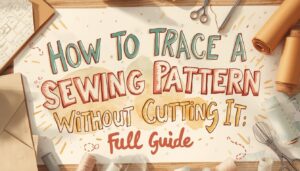
That vintage Vogue pattern you scored at the estate sale? It’s one cut away from being gone forever.
Original sewing patterns—especially out-of-print ones—can’t be replaced once they’re altered, and even modern commercial patterns fall apart after a few uses if you keep working directly from them.
Tracing gives you a working copy you can slash, pin, and toss without guilt, while the original stays intact in its envelope.
Learning how to trace a sewing pattern without cutting it is one of those skills that quietly transforms how you sew—cleaner fitting sessions, size adjustments you can undo, and a pattern library that actually holds up over time.
Table Of Contents
Key Takeaways
- Tracing your sewing pattern preserves the original so you can cut, pin, and adjust your working copy without ever risking an irreplaceable piece.
- The right materials — Swedish tissue, sharp scissors, a flexible curve ruler, and pattern weights — make the difference between a clean, reusable copy and one that falls apart after two uses.
- Every interior marking (notches, darts, grainlines, fold lines) must transfer to your traced copy, not just the outer edges, or the whole pattern is useless when you get to the machine.
- Storing traced pieces in labeled, acid-free envelopes in a low-humidity space — backed up with digital photos — turns your pattern collection into a library that actually holds up over time.
Why Trace Sewing Patterns?

Tracing your sewing pattern is one of the smartest habits you can build as a sewist. It takes few extra minutes up front, but it saves you from a lot of frustration down the road.
Once you get the hang of it, you’ll find that the best methods for tracing sewing patterns make the whole process quicker and keep your originals in perfect shape for years.
Here’s why it’s worth making part of your process every time.
Protect The Original Pattern
Your original pattern is irreplaceable — treat it that way.
Store it flat in acid-free envelopes or plastic sleeves, and always handle it with a cotton glove protocol to keep oils and dirt away. Maintain a documentation log tracking dates and storage locations.
Humidity monitoring and UV light protection will prevent yellowing and warping, so your pattern storage solutions stay reliable for years.
Make Reusable Pattern Copies
Once your original is safely stored, pattern duplication becomes your best tool for long-term control. For durable copies, consider using standard pattern paper options as a reliable base.
DIY reusable sewing templates let you cut freely without second-guessing yourself. Use adhesive-free layering with Swedish tissue to keep things clean:
- Apply weight distribution strategies to hold layers flat
- Use color-coded organization for multi-size template making
- Store copies using temperature-controlled archiving to prevent warping
Adjust Sizes Without Damage
Tracing also gives you a safe space for DIY pattern grading without cutting into anything precious.
Work from your traced copy and apply grading increments of 1/8 inch at the side seams. Use proportional scaling across all pieces, then validate with a muslin fit test before committing to real fabric.
| Step | Action | Tool |
|---|---|---|
| Grading Increments | Add 1/8" at side seams | French curve |
| Seam Allowance Boost | Increase by 1/8–1/4" | Ruler |
| Size Documentation | Label adjusted traced copy | Fine-point pen |
Keep Markings for Future Use
Once you’ve graded your copy, those markings become your long-term record. Use a standardized notation system — color coded symbols for darts, notches, and grainlines — so you can read them instantly months later.
Choose durable marker types that resist fading.
Slip each piece into a plastic sleeve or pattern envelope, add your pattern notes, and snap a photo for digital annotation integration. That’s solid pattern preservation.
What Materials Do You Need?

Before you start tracing, it helps to have the right tools within arm’s reach. Nothing slows you down like hunting for a ruler mid‑trace or realizing your paper keeps slipping.
Here’s what you’ll need to get the job done cleanly.
Tracing Paper or Swedish Tissue
Your tracing material is the foundation of every great copy. Swedish Tissue, made from abaca fibers, delivers impressive fiber strength despite its whisper‑thin profile — thickness variations usually range from 0.05 to 0.15 mm. Its paper translucency works beautifully over a lightbox or sunny window. Standard transparent paper works too, but wears faster.
Swedish Tissue’s whisper-thin profile belies its strength, making it the gold standard for tracing patterns that last
Choose your material wisely:
- Swedish Tissue — best reuse longevity for repeated pattern copies
- Regular tracing paper — affordable, widely available, less durable
- Baking parchment — a solid backup with good translucency
- Eco-friendly materials like recycled tissue — sustainable and lightweight
- Thin plastic sheets — waterproof and highly reusable
Secure whichever you choose with pattern weights or pins before you begin.
Pencil, Pen, or Fabric Marker
Your marking tool shapes every line you draw. A sharp pencil gives you thin, erasable lines on most tracing papers — easy to correct without a trace.
Fine pens and felt tip pens offer stronger Visibility Contrast, especially on lighter tissue.
Watch your Ink Types: Heat‑Set Markers and water-soluble fabric marker options suit different needs, so always check Fabric Compatibility before committing.
Ruler, Curved Ruler, and Tape
Measuring tools make or break your accuracy.
transparent ruler lets you align over printed lines without blocking your view — and its Scale Conversion Table saves you from flipping between metric and imperial.
flexible curve for necklines and armholes, trusting its Flexible Curve Memory to hold your shape.
measuring tape for Tape Stretch Compensation, since worn tapes drift.
Pattern Weights or Pins
Pins work, but pattern weights are a significant advantage for slippery fabrics like satin.
- Weight Material Choices range from glass beads to metal washers — heavier options handle thick wool or corduroy better.
- Pin Visibility Solutions, like glass-head pins, help you spot them instantly on light fabric.
- Weight Placement Strategies and Reusable Weight Storage keep your setup fast and consistent across projects.
Scissors for The Final Cut
Sharp scissors make or break your traced copy. Don’t settle for dull blades that drag and distort your outlines.
| Feature | Why It Matters |
|---|---|
| Blade Geometry | Curved tips navigate tight notches cleanly |
| Edge Retention | 2000+ cuts without dulling |
| Ergonomic Handle | Reduces fatigue during long sessions |
Choose paper scissors with a solid maintenance routine — clean, dry, and lightly oil after each use for lasting cutting accuracy.
How Do You Set Up?
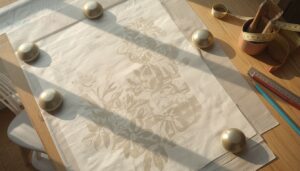
Before you trace a single line, your setup does most of the heavy lifting. A good workspace keeps everything stable, visible, and within reach so you can focus on accuracy.
Here’s what to get in place before you start.
Use a Large Flat Surface
Your workspace is the foundation of everything — get it wrong, and even the best tools won’t save you. Start with a flat surface large enough to hold your full pattern with edge clearance on all sides. A stable workspace prevents shifting mid‑trace.
- Kitchen counter or dining table with a cutting mat
- Dedicated cutting table for a non‑slip surface
- Craft mat for protective cover over furniture
- Drafting desk for reliable surface levelness
Improve Visibility With Bright Light
Once your stable workspace is set, lighting makes or breaks visibility. Aim for 400–800 lux with a daylight bulb around 5000–6500K — that’s your ideal light temperature for reading fine markings.
Use adjustable lamp angles (15–45 degrees) to catch notches clearly. lightbox underneath tracing paper is a significant improvement.
Add a diffuser for glare reduction techniques that protect your eyes during long sessions.
Smooth Wrinkles From The Pattern
Good lighting reveals every crease you need to fix.
Lay the pattern on a silicone sheet underlay to prevent tearing, then smooth out wrinkles from the center outward using a bone folder press.
A light moisture relaxation mist softens stubborn folds. Secure loose edges with low-tack tape, then let it rest under even weight overnight for a truly flat surface.
Keep Tools Within Easy Reach
Once your pattern is flat, don’t let a scattered workspace slow you down.
Set up a Pegboard Layout above your table to hang pattern weights or pins, a Magnetic Tool Strip for scissors, and a Rolling Cart Placement beside you for extras.
A Shadow Board System and Tray Organization keep sewing tools and pattern drafting tools visible and instantly grabbable — workspace ergonomics done right.
Prevent Paper From Shifting
Even with tools at arm’s reach, shifting paper can ruin your tracing. Place pattern weights or pins at even intervals across the sheet for consistent weight distribution.
Set your paper on a low friction surface like a cutting mat.
Lock outer edges with painter’s tape — that’s your edge locking and temporary adhesive combo.
Add clamps at corners for clamp placement stability without warping.
How Do You Prepare Pattern?

Before you trace a single line, the pattern itself needs some attention. A few quick prep steps make all the difference between clean results and a frustrating redo.
Here’s how to get everything ready.
Flatten The Original Pattern
A wrinkled pattern is a blueprint for mistakes. Before anything else, lay your original flat on a clean, smooth surface.
Use low-heat ironing with a Teflon backing sheet or baking parchment paper to press out deep creases without damaging the paper. A rolling pin works too.
- Iron with light, steady passes
- Place parchment paper between iron and pattern
- Use uniform weight placement to hold edges down
- Try vacuum sealed flattening for stubborn tissue patterns
- Smooth out any air gaps before securing
Align Grainline and Edge Marks
Once the pattern is flat, align the grainline arrow parallel to the fabric selvage — this is your Fabric Grain Detection moment. Use Ruler Verification to measure equal distance from the selvage at both ends.
Then sync your Edge Mark Synchronization by matching notches to corresponding fabric edges. Apply Pinning Strategies with pattern pins or pattern weights to lock everything in place before tracing.
Secure The Pattern Layers
Securing your layers is where precision meets control. Think of it as building a Hardware Rooted Trust into your workflow — once everything locks down, nothing shifts unexpectedly. Use pattern weights or pins to secure your pattern firmly before a single line gets drawn.
- Place weight or pins to secure corner and curved edge
- Apply a Secure Overlay Shield by smoothing the tracing paper flat before pinning
- Use Access Control Protocols — only touch the layers when adjusting, never mid-trace
- Maintain an Audit Trail Logging habit by checking alignment stays true at each anchor point
Tamper-Evident Envelopes come later, but solid pattern alignment now prevents errors that are costly to fix.
Test The Tracing Setup First
Before you commit to the real thing, run a quick test. Lay your tracing paper over scrap material and do a Scratch Paper Trial — check that markers don’t bleed through. Do a Pressure Consistency Check with your tracing wheel: light, even pressure only. Try a Weight Stability Trial to confirm weights and pins hold firm, then finish with an Edge Alignment Verification to double-check markings stay true.
| Test | What to Check |
|---|---|
| Lightbox Visibility Test | All lines visible through tracing paper |
| Pressure Consistency Check | Wheel leaves clean, unbroken impressions |
| Weight Stability Trial | Weights and pins don’t shift mid-trace |
How Do You Trace Outline?
This is where the real work begins. Tracing the outline takes focus, but once you know the right moves, it gets easier with every piece.
Here’s how to do it well.
Trace Around Outer Edges First

Start at the outer edge — it’s your anchor for everything that follows. Tracing the boundary first locks in Contour Stability before you touch a single interior mark.
- pattern weights for even Weight Distribution
- Run a sharp pencil or tracing wheel along the edge
- Keep a transparent ruler handy for straight sections
- Work on a flat surface under good light
- Maintain Edge Consistency with steady, light pressure
Follow Curves With a Flexible Ruler

Curves are where patterns get tricky — one shaky line and the whole piece is off. A flexible curve ruler bends to match any arc without forcing a straight edge across it.
For Alignment Tips, match the ruler’s longest arc to your pattern line. Use a transparent overlay ruler for Pressure Control, and practice Scale Transfer on scrap paper first.
| Ruler Type | Segmented Ruler Benefits | Best Use |
|---|---|---|
| Flexible curve | Locks complex shapes | Armhole and neckline curves |
| French curve | Smooth point connection | Dart and waist shaping |
| Hip curve | Long sweeping arcs | Bodice and sleeve edges |
Use a Tracing Wheel for Details

Once your curves are locked in, a tracing wheel manages the fine details a pencil can’t capture cleanly.
- Choose serrated wheel selection based on fabric compatibility — fine teeth for lightweight, larger for thick
- Roll along darts, notches, and grainlines with consistent pressure control
- Pair with carbon paper for clean transfer
- Practice tooth size choice on scraps first
- Wheel maintenance matters — clean teeth after every use
Keep Pressure Light and Steady

Light contact technique makes all the difference here. Rest your wrist on the table for wrist support, then guide your pencil or tracing wheel with gentle finger pressure — not a death grip.
Consistent hand grip and steady stroke pace keep lines smooth, especially on curves.
| Pressure Type | Result |
|---|---|
| Too heavy | Tears or embosses paper |
| Too light | Faint, broken lines |
| Just right | Clean, accurate outline |
Mark Seam Lines Clearly

Once your outline is clean, mark seam lines so they’re impossible to miss.
- Draw a dashed line style 2–3 mm inside the edge for seam allowance distance.
- Use contrast colors — different shades for plain seams versus topstitch lines.
- Label each line with a small note like SA 1/4 for seam allowance clarity.
- For dark fabric visibility, swap your fabric marker for a light chalk pencil.
How Do You Copy Markings?

Tracing the outline is just the beginning. The real detail work happens when you copy every marking inside the pattern — notches, darts, grainlines, and more.
Here’s what you need to transfer.
Transfer Notches and Darts
Notches and darts are the quiet architects of a well-fitted garment.
Notch Placement Rules by marking each notch at shoulder seams, waistlines, and side seams using a fabric marker or sharp pencil. Dart Notch Coordination to transfer dart base points accurately onto your traced copy.
Notch Preservation Tips keep your pattern tracing reliable — secure pins, transfer every mark, and never skip a single dart.
Copy Fold Lines and Grainlines
Fold lines and grainlines are your pattern’s hidden compass — skip them, and everything shifts.
- Fold Line Identification: Mark the fold line clearly; it shows where fabric doubles for Symmetric Fold Cutting.
- Grainline Arrow Interpretation: Follow the arrows exactly for proper pattern alignment.
- Trace grainlines parallel to the selvage.
- Note any Bias Grain Consideration markings.
- Confirm Pattern Piece Mirroring before lifting weights.
Mark Buttons, Pleats, and Symbols
Small symbols carry big responsibility. Every button, pleat, and icon on your pattern needs an exact transfer.
Use this quick reference:
| Symbol | What It Marks | How to Copy |
|---|---|---|
| Circle/X | Button spacing standards | Dot with fine pen |
| Parallel lines | Pleat width ratios | Trace with ruler |
| Long tick line | Buttonhole length marks | Match length precisely |
Follow the pleat direction arrows carefully and note every symbol legend key on your traced copy.
Label Each Pattern Piece
Every traced piece needs a clear identity before it leaves your work table. Write directly on each copy using a fine-point pen, capturing everything that matters at a glance:
- Pattern name and piece number in uppercase lettering
- Garment size with size indicators placed away from seam lines
- Grainline arrows aligned to match the original orientation
- Dart notation showing position and stitch direction
- Cutting directions and feature symbols for buttons or pleats
Preserve Size and Piece Names
Copy the pattern name and piece number exactly as printed on the original — don’t paraphrase or abbreviate.
Match the font weight, label placement, and size tags, so every traced copy mirrors its source.
Build a Piece Identifier Legend with a Digital Naming Index for quick lookups.
Add Version Control Labels when making size adjustments, keeping your originals clean and your traced copies consistently organized.
How Can You Check Accuracy?

Before you lift a single weight, take a moment to check your work. A quick accuracy review can save you from cutting a flawed copy and starting all over again.
Here’s what to look at before you call the tracing done.
Compare Traced Lines to The Original
Lay your traced copy directly over the original and hold both up to the light. Check edge fidelity along every segment — traced lines should stay within 2mm of the original.
Confirm radius accuracy on curves, angle consistency at corners, and length ratio across key seams. A quick gap inspection catches pressure inconsistencies before they cost you fabric.
Measurement verification seals accurate pattern tracing.
Recheck Corners, Curves, and Notches
Corners don’t lie — if something’s off, they’ll show it first. Before removing your weights, run a targeted recheck using these steps:
- Use a curved ruler to verify Curve Rolling accuracy along all arcs.
- Apply a Clipping Strategy by checking notches point toward the seam.
- Confirm Corner Symmetry by comparing opposite corners for parallel alignment.
- Review Notch Preservation — transfer marks must stay sharp and clear.
- Use Reinforcement Techniques at corner tips to double-check markings hold.
Confirm All Markings Are Complete
Once your curves and corners check out, run a full Notch Verification sweep across every piece. Confirm each dart with a Dart Alignment Check — tail ends should meet the grainlines cleanly.
Do a Button Placement Audit and Symbol Legend Review while you’re at it.
Double‑check markings for Seamline Consistency, measurement precision, and that notches, grainlines, and labels are all present before lifting a single weight.
Fix Gaps Before Removing Weights
With all markings confirmed, scan every seam line for breaks before lifting a single weight. Seam Gap Repair is simple: lightly redraw missing sections using a flexible ruler, focusing on Notch Alignment and Dart Continuity.
low-tack Tape Reinforcement along corrected edges, then do a quick Mock Pin Test to confirm pieces align cleanly.
Don’t remove weights until every line connects.
How Do You Cut Traced Copy?

Once your tracing is complete, cutting it out is the final step before you can actually use the piece. It sounds simple, but a few small habits here make a real difference in how clean and accurate your finished copy ends up.
Here’s how to do it right.
Cut Only After Tracing is Finished
Don’t reach for your scissors until every line is traced and verified. Premature cut risks are real — one snip too soon, and you lose the notch preservation, seam line accuracy, or grainline that holds everything together. Cutting only after tracing is finished protects against irreversible change prevention failures.
Before cutting, confirm:
- All traced lines and marking visibility checks are complete
- Notches, darts, and fold lines are fully transferred
- Seam line accuracy is verified against the original
- gaps remain along curves or corners
Use Sharp Paper Scissors
Now that every line is confirmed, the right scissors make all the difference. Sharp scissors with ergonomic grips give you the precision cutting control you need when trimming tracing paper.
Blade sharpness prevents tearing along your paper template.
Check the safety lock before storing, and practice simple blade maintenance — wipe blades clean after use.
That keeps your cut and your pattern edges crisp every time.
Cut Carefully Around Notches
Notches are easy to rush — don’t. Use V-shape notch cutting with sharp scissors, keeping notch depth control tight so you don’t cut past a quarter inch into the seam allowance.
On thick fabrics, space thick fabric notches every one to two inches.
Use a notch guard for tricky curves, then do a quick notch alignment check before lifting your pattern weights.
Keep Edges Clean and Accurate
Cutting clean edges is what separates a sharp traced copy from one you’ll fight at the machine. Keep your scissors moving in one smooth pass — no jagged restarts.
Use Precise Edge Weighting with pattern weights until the very last cut.
Uniform Seam Allowance stays consistent when you trace from the outside edge.
Smudge-Free Marking and Edge Protection Handling keep your copy crisp from first cut to final seam.
How Do You Store Traced Patterns?

Once your traced pieces are cut and labeled, storing them the right way keeps them ready for next time. little organization now saves a lot of frustration later.
Here are the best ways to store your traced patterns safely.
Label Each Traced Piece Clearly
Label each piece the moment you finish tracing it — don’t wait. Write the piece name and size using Label Format Standards: pattern name, size range, and a short descriptor like "front bodice."
Add Date and Initials, version control notes, your Notch Coding System references, and a Material Type Tag.
Clear labeling and storing traced patterns this way makes organizing and storing traced patterns easy later.
Use Envelopes or Folders
Once your pieces are labeled, slide each one into a dedicated envelope or folder. Clear envelopes offer transparent visibility at a glance — no digging required.
Choose acid-free storage for archival stability, and reinforced spine durability keeps frequently used folders intact.
Color-coding organization by project makes your pattern library management easy.
Add digital backup integration by photographing each piece, and your stored original pattern system stays bulletproof.
Store in a Dry Place
Moisture is a traced pattern’s worst enemy. A climate-controlled closet kept below 60% humidity is your best defense. Tuck silica gel desiccants into your archival envelopes to pull out lingering dampness, and check them every few months.
For solid pattern storage solutions and material conservation, prioritize:
- Humidity control with a small hygrometer
- Elevated shelving to avoid floor moisture
- Moisture monitoring every 30 days
Keep Digital Photos for Reference
Even a perfectly labeled envelope won’t save you if the paper gets lost.
Photograph every traced piece and back it up using Cloud Backup across two locations — that’s Redundancy Planning in action.
Apply Consistent Naming like "bodice-front-size10" and use Metadata Tagging so files stay searchable.
Checksum Verification catches silent corruption.
For PDF pattern work, this same system manages how you print and assemble a PDF pattern, organizing and storing traced patterns digitally alongside every stored original pattern and labeling storage envelopes for the decisions you make.
Frequently Asked Questions (FAQs)
What to use instead of a tracing wheel?
You don’t need a tracing wheel at all. A fine tip marker, carbonless tracing sheet, or lightbox transfer method works just as well — sometimes better for delicate tracing paper.
Can I trace patterns onto freezer paper instead?
Yes, freezer paper works great for pattern tracing.
Its shiny side grips fabric through Paper Adhesion when pressed with an iron, offering Template Durability and Cost Efficiency over standard tracing paper.
How do I trace multi-sized overlapping pattern lines?
Like a map with layered roads, a multi-sized pattern demands a clear system.
Use Color-Coded Sizes and a Line Weight Hierarchy so each size stays distinct, and your Reference Point Anchors hold everything in place.
What if my tracing paper keeps tearing mid-trace?
Your tracing paper tears mid-trace? Switch to 60–90 gsm paper with reinforced fiber blends. Use light pressure technique, weight edges down, and keep moisture away.
Can I reuse a traced pattern on different fabrics?
Perfectly preserved pattern paper pays off — yes, you can reuse a traced pattern on different fabrics, as long as you account for Fabric Stretch Compatibility, Drape Considerations, and run a Toile Test when switching fabric types.
How do I trace patterns with a lightbox?
A lightbox makes intricate pattern lines glow through tracing paper via uniform light diffusion.
Set adjustable brightness settings to reduce glare, position it ergonomically, and trace cleanly using essential materials like Swedish tissue and a 2B pencil.
Conclusion
A good carpenter never cuts from the only blueprint—they trace it, work from the copy, and keep the original safe. That’s exactly the mindset behind learning how to trace a sewing pattern without cutting it.
Your original stays intact. Your traced copy takes the pins, the slashes, the fitting experiments. Every adjustment becomes reversible.
Every vintage find stays protected. Master this habit once, and your entire pattern library transforms from fragile paper into something built to last.