This site is supported by our readers. We may earn a commission, at no cost to you, if you purchase through links.
Most sewists own a cutting mat for years before realizing it might be slowing them down. Not because it’s worn out—but because it’s the wrong type for what they’re making.
A fixed mat and a rotating mat look almost identical in the store, yet they handle completely differently at the cutting table. The rotating version spins 360°, letting you pivot fabric without lifting it, which changes how fast and accurately you can work.
Knowing the cutting mat vs rotating cutting mat differences comes down to what you’re making, how often you cut, and how much control you want over every piece.
Table Of Contents
Key Takeaways
- A rotating mat spins 360° so you move the mat instead of the fabric, which cuts faster and reduces hand fatigue—especially for quilting and small pieces like appliqué or lingerie.
- Fixed mats handle large garment panels better because rotating mats top out around 16 inches, making edge control a real struggle on anything bigger.
- Your skill level and budget should guide your first buy: beginners do fine with a $10–$30 fixed mat, while intermediate sewists get real value from a $25–$70 rotating version once they’re cutting regularly.
- Whichever mat you choose, a self-healing surface of at least 3mm thickness protects your blade and your table—and waiting too long to replace a worn mat costs you more in dulled blades than the mat itself.
Cutting Mat Vs Rotary Cutting Mat
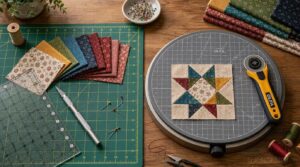
Both mats cut fabric, but the way they do it is pretty different.
Understanding those differences upfront can save you a ruined project, which is why choosing the right cutting mat for sewing or scrapbooking really comes down to knowing what each one is designed for.
Knowing those differences helps you pick the one that actually fits how you sew. Here’s what sets them apart.
Core Design Differences
Both a cutting mat and a rotating cutting mat share layered composition and embedded alignment grids — but their builds differ where it counts. The rotating variant adds a heavier base and rotating work surface, trading flatness control for mobility.
| Feature | Cutting Mat | Rotating Cutting Mat |
|---|---|---|
| Base | Lightweight | Heavier base |
| Alignment | Embedded alignment grid | Grid plus spin axis |
| Stability | Flatness control | Central stability |
Rebound resistance stays strong on both — typically featuring 3mm, 5-ply construction.
Fixed Versus Rotating Surface
Once you understand the build, the surface is where things really split apart.
| Feature | Plain Cutting Mat | Rotating Cutting Mat |
|---|---|---|
| Stability perception | Rock-solid, no movement | Stable base, spinning top |
| Rotation friction | None | Low, smooth glide |
| Weight distribution | Even across flat surface | Centered on spin axis |
| Maintenance frequency | Low | Slightly higher |
A plain cutting mat stays put, while a rotating work surface spins to meet your blade. This shift in cutting efficiency changes everything about how you work.
Best Sewing Use Cases
So which mat fits which job? A rotating cutting mat shines for Applique Detail Cutting, Patchwork Swatch Cutting, and Embellishment Trim Prep — anywhere small, repetitive pieces need fast pattern alignment without repositioning fabric constantly.
The efficiency of a rotating mat echoes the speed gains seen with industrial sewing machines.
| Task | Cutting Mat | Rotating Cutting Mat |
|---|---|---|
| Tailoring Fit Samples | ✓ Stable | ✓ Faster turns |
| Pattern Piece Nesting | ✓ Full layout | Limited by size |
| Applique Detail Cutting | Slower | ✓ Ideal |
Workspace and Table Needs
Your workspace setup matters just as much as the mat you choose. A rotating cutting mat requires a sturdy table with good load capacity (at least 60 pounds per square foot). Incorporate a non‑slip base underneath, adequate lighting angled at 45–60°, and position your ergonomic chair so elbows align level with the cutting mat grid.
| Need | Cutting Mat | Rotating Cutting Mat |
|---|---|---|
| Minimum table space | 24 × 18 in | 12 in clearance zone |
| Non‑slip base | Recommended | Required |
| Blade storage safety | Nearby tray | Within arm’s reach |
| Ergonomic chair height | 90° elbow angle | 90° elbow angle |
Beginner-friendly Comparison
Not sure where to start? A basic cutting mat wins on simplicity — minimal tool setup, no moving parts, and a gentler learning curve for straight cuts. A rotating cutting mat adds tool versatility once your confidence builds.
Either way, exploring cool sewing gadgets for beginners can help you figure out which tools actually match where you are in your sewing journey.
| Factor | Cutting Mat | Rotating Cutting Mat |
|---|---|---|
| Budget Start | Lower cost | ~$53 investment |
| Skill Progression | Beginner-friendly | Intermediate |
| Fabric Handling | More repositioning | Minimal movement |
Always cap your rotary cutter between cuts — a key safety tip regardless of mat choice.
How Each Mat Works
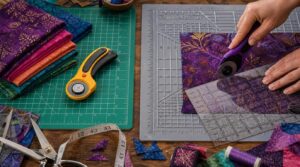
The two mats work differently from the moment you pick up your rotary cutter. How you hold your hand, position your fabric, and move through a cut all depend on which one you’re using.
Here’s a closer look at what each mat actually does.
Standard Mat Cutting Setup
A cutting mat setup begins with laying your mat on a flat surface, secured by a non-slip underlay for stability. Ensure your ruler is aligned parallel to the grid lines—ruler alignment is critical for precision.
Maintain sharpness in your rotary cutter blade, keep fabric flat during use, and clean the mat regularly to preserve surface compression.
This approach guarantees straight cuts, every time.
Rotary Mat Spin Mechanism
The spin mechanism is what sets a rotating cutting mat apart from every other mat on your table. A low-friction bearing sits at the center, connected by a metal shaft with corrosion protection built-in.
Air-gap spacers keep the surface level, while kinematic coupling maintains alignment after every spin. Bearing preload minimizes wobble, and friction adjustment lets you lock it steady mid-cut.
- The central shaft passes through a bearing sleeve in the base for smooth 360° rotation
- Kinematic coupling keeps the 16-inch mat surface precisely aligned after repeated spins
- Air-gap spacers prevent binding, so your rotating cutting mat turns without catching
- Bearing preload reduces wobble, giving your rotary cutter clean, consistent contact
- Friction adjustment lets you fine-tune resistance — the compact 10-inch version especially benefits from this control
Fabric Positioning Differences
Positioning fabric on a standard cutting mat requires constant movement—adjusting your body or rotating the piece by hand to check grainline alignment. With a rotating cutting mat, the mat handles this work, eliminating the need for physical repositioning.
Maintain consistent nap direction, align pattern repeats using the 90-degree grid, and employ overlay layering to confirm placement. Waste minimization naturally improves when bias lines remain visible throughout the process.
Hand Movement and Comfort
Your hands do a lot of talking during a long cutting session — and a rotating cutting mat listens. With wrist neutral alignment and grip texture underfoot, your body stays comfortable far longer. Good sewing ergonomics matter for both seamstress tools and DIY sewing projects alike.
- Forearm support stays steady when the mat spins instead of your arm reaching.
- Vibration damping beneath craft supplies reduces hand fatigue between cuts.
- Tool access stays within arm’s reach, so you’re not stretching awkwardly.
- Grip texture on rotating cutting mats reduces excessive squeezing force.
- One fixed hand position means less wrist strain across repetitive passes.
Accuracy While Cutting
Accurate cuts come down to one thing: keeping your fabric exactly where you put it. A good cutting mat provides edge alignment and ruler stability through its high-contrast grid, ensuring rulers lock at 90 degrees without drifting. Proper light positioning helps you see cut lines consistently and clearly.
Control fabric tension before every pass—this single habit outperforms even the sharpest dressmaking shears.
Size, Thickness, and Grid Differences
Not all cutting mats are built the same, and those differences matter more than you would think. Size, thickness, and grid markings all affect how well a mat works for your specific projects.
Here’s what to look at before you choose: size, thickness, and grid markings.
Common Mat Size Options
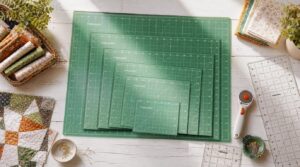
Standard cutting mats run from 9×12 inches up to 36×48 inches — think yoga dimensions scaled down for your worktable.
The popular 16-inch mat accommodates most quilting templates and rulers comfortably, while the compact 10-inch version suits tight spaces.
Need extra-long lengths or narrow widths for custom lengths projects? Options exist.
Travel size mats also pack flat for classes or retreats.
Small-piece Cutting Limits
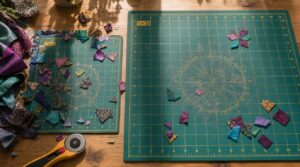
Size matters more than you’d think when cutting small pieces. A 10-inch version manages tiny appliqué blocks well, but the 16-inch mat gives you better edge visibility without your fabric crowding the border.
When cutting small pieces, watch for these common issues:
- Piece slippage increases on worn surface areas
- Grid resolution fades near heavy-use zones
- Blade dulling accelerates with tight, repeated cuts
- Wear rate rises along center rotation paths
- Paper and fabric edges curl past small mat borders
Self-healing Material Layers
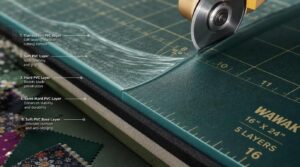
What saves your mat long-term is the self-healing layer underneath your fabric. Professional-grade mats use five compressed PVC layers — at least 3 mm thick — where polymer bond dynamics let the surface reseal after each cut. Microcapsule release and nanofiller reinforcement strengthen that recovery.
Your 16-inch mat withstands this better than a 10-inch version, which wears faster under repeated crafts and paper cutting.
Grid and Angle Markings
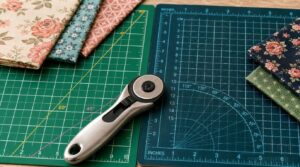
Once you’ve got a feel for your mat’s thickness, the grid becomes your best cutting partner. Most mats feature 1-inch increments printed with fade-resistant inks, while higher-quality options offer dual-sided grids — metric on one face, imperial on the other.
Color-coded angles at 45° and 60°, alongside protractor arc guides, assist with quilt-making accessories and challenging bias cuts. These features enhance precision for specialized crafting tasks.
Your 16-inch mat provides significantly more grid space than its 10-inch counterpart, offering greater flexibility for larger projects.
Blade and Table Protection
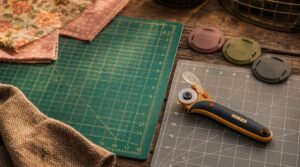
Your blade deserves protection just as much as your table does. Self-Healing Mats absorb each pass of your rotary cutter, preventing deep gouges that would otherwise ruin your work surface. Pair that with Silicone Blade Sleeves for storage and Blade Guard Systems during use, and your blades stay sharper longer.
The 16-inch mat accommodates fabric and upholstery panels comfortably, while the 10-inch version suits quilt-making accessories and smaller pieces perfectly.
Pros and Cons for Sewing
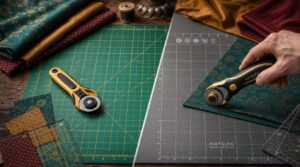
Both mat types have real strengths — and real trade-offs — depending on what you’re making. Knowing where each one shines (and where it falls short) helps you cut smarter, not harder.
Here’s how they stack up across the sewing tasks that matter most.
Quilting Block Accuracy
Accuracy in quilt making accessories starts with a stable, visible grid. A 16-inch mat provides ample space to align quilt pieces, preventing ruler slack from compromising corners.
Maintain even fabric tension during rotation, as shifts cause bias alignment problems that worsen with each subsequent block.
Prioritize good grid visibility to ensure your corner square remains true for every cut.
Swimwear and Lingerie Pieces
Delicate fabrics like swimwear and lingerie reward the right cutting setup. Small pattern pieces — think bikini panels with four-way stretch or lace overlay detailing — are where a rotating mat shines.
- Use the 10-inch version for tiny lingerie cups and adjustable strap pieces
- The 16-inch mat accommodates fuller swimwear panels with UV-protective finishes
- Smooth bonded edge pieces stay stable during rotation
- Slippery fabric behaves better when you spin the mat, not the material
Large Garment Panel Limits
A rotating mat has real limits when your project scales up. The 16-inch mat manages most small-to-medium cuts well, but large garment panels quickly outgrow it — edge drift prevention becomes a genuine struggle.
Use pattern weights and a standard flat mat instead to keep uniform surface pressure across the full width.
| Panel Challenge | Practical Fix |
|---|---|
| Panel width constraints | Switch to a large flat mat |
| Blade tip deflection | Use pattern weights at corners |
| Edge drift prevention | Align with a straight-edge guide |
| Weight distribution strategy | Anchor fabric every 10–12 inches |
Cutting Speed and Repetition
Speed matters more than most sewists realize. Cutting too fast on a fixed mat compromises edge quality, while cutting too slowly on a rotating mat wastes its primary advantage.
Here’s what controls your results:
- Ideal feed rate keeps fabric drag management smooth across the 16-inch mat
- Heat buildup control protects your blade wear cycles during heavy repetition
- Repetition tolerance limits vary — the 10-inch version manages small quilt pieces better than long garment runs
- Fabric type dictates speed; slippery swimwear needs moderate passes even near your sewing machine
- Sharp sewing notions extend how many clean cuts you get before performance drops
Storage and Sewing Room Space
A rotating mat takes up more counter space than a flat one, so your zoned workflow layout matters. The 16 inch mat needs a dedicated spot; the 10 inch version fits neatly on mobile rolling carts between your sewing machine and cutting area.
Use vertical cabinet solutions for sewing notions and a labeled bin system nearby. Task lighting levels above 300 lux keep everything visible without eyestrain.
Which Cutting Mat Should You Buy?
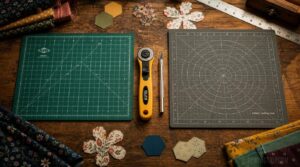
The right mat really does come down to what you’re making and how you like to work.
A few key factors — your skill level, project type, and budget — make the decision a lot easier.
Here’s a simple breakdown to point you in the right direction.
Best for Beginners
If you’re just starting out, a standard 24×18-inch fixed mat is your best first buy. It’s affordable, has a low learning curve, and teaches you to control your cuts with confidence.
Grip comfort matters early on — a non-slip backing keeps things steady.
Follow basic safety guidelines, regularly replace blades to ensure blade maintenance, and you’ll build real skills without overspending on sewing notions.
Best for Quilters
Once you move past the basics, quilting has its own demands. Long strip efficiency is where a rotating mat really earns its place — you spin the mat, not the fabric, which means serious hand fatigue reduction during marathon cutting sessions.
For quilters, spinning the mat instead of the fabric turns marathon cutting sessions into effortless work
- Bias cutting precision improves with 360° alignment
- Rapid block layout stays consistent across repeated pieces
- Portability considerations matter less when it lives at your machine permanently
Best for Small Pieces
For swimwear, lingerie, and tiny appliqué pieces, a 10–12 inch rotating mat with a lightweight base is your best friend. Fine grid lines, color contrast markings, and magnetic piece holders keep small shapes exactly where you put them.
The self-healing capability is crucial — frequent small cuts add up fast. Look for edge beveling to prevent scraps from snagging during cuts.
Cost Versus Convenience
Basic fixed mats start around $10–$30, while rotating versions run $25–$70.
That gap stings up front, but think about what you’re getting. For swimwear and lingerie work, the convenience of spinning your fabric without shifting your hands pays off quickly.
Factor in blade replacement and ongoing maintenance — cheaper mats dull blades faster, costing more long-term.
Space efficiency and transport portability also favor lighter fixed mats.
Sue Daley Rotating Mat Use
If you do a lot of English Paper Piecing or patchwork on the go, the Sue Daley rotating mat is worth a close look. Its 10-inch size offers real Travel Portability, making it ideal for crafting anywhere.
The Color Contrast Visibility of the grid markings ensures straightforward Template Alignment, enhancing precision in your work.
Smooth rotation controls naturally distribute Rotational Wear, extending the mat’s durability. Staying in one position during use also delivers genuine Fatigue Reduction over longer sessions.
Frequently Asked Questions (FAQs)
Are rotating cutting mats worth it?
Yes, rotating cutting mats deliver real Productivity Gains for quilters and small-piece work.
The Financial Payoff shows over time through Blade Preservation Impact and reduced fatigue — though expect a brief User Learning Curve before it clicks.
Does the rotary blade need a special mat?
Think of your rotary blade like a knife — it needs the right cutting board.
A self-healing mat with minimum mat thickness of 3mm ensures blade friction reduction, healing surface requirement, and real blade lifespan improvement.
How often should a self-healing mat be replaced?
Replace your self-healing mat every one to three years depending on your usage intensity. Deep grooves, warping, or lost grid visibility are your clearest replacement signals.
Don’t wait until the blade starts to catch.
Do cutting mats work with craft paper and vinyl?
Cutting mats handle both craft paper and vinyl well.
The self-healing surface closes shallow cuts, keeping things smooth for your next pass — great for clean paper trimming and precise vinyl decal work.
Can you use both mat types on a lap desk?
You can use both mat types on a lap desk — as long as the surface is flat, large enough, and fitted with anti-slip layers underneath each mat for stability.
Are rotating mats safe for kids to use?
Rotating mats can be safe for kids with the right setup. A non-slip base, stable setup, and age-appropriate supervision keep pinch-point prevention front of mind.
Always check material toxicity labels before handing one over.
Conclusion
It’s almost funny—the mat sitting on your cutting table right now might be working against you.
Understanding the cutting mat vs rotary cutting mat differences doesn’t require a sewing degree; it just requires knowing what you’re making. Quilters gain speed with rotation, while garment sewists need the full surface.
Match the tool to the work, and every cut becomes less of a struggle and more of a decision you already made.
- https://snugglesquilts.com/cutting-mat-rotary-cutter-and-sewing-machine-tips-maintenance-to-keep-you-sewing/
- https://www.threadsmagazine.com/project-guides/learn-to-sew/rotary-cutters-and-mats
- https://mypacklove.com/blogs/heat-transfer-labels/what-is-a-cutting-mat-your-guide-to-types-uses-perfect-cuts?srsltid=AfmBOoqFxzTFLFXSRT38aGxxaFZrMCNF9yLfca-yG0DOn9YUDnC2U9N3
- https://clothhabit.com/adventures-cutting-mats/
- https://sherriquiltsalot.com/2021/07/07/how-to-choose-the-right-cutting-mat-for-you/