This site is supported by our readers. We may earn a commission, at no cost to you, if you purchase through links.
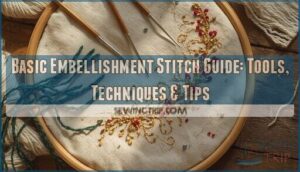
You’ve traced your embroidery needle through countless running stitches, but the moment you want to add texture, dimension, or a touch of sparkle to your work, the familiar techniques fall short. Embellishment stitches bridge that gap, transforming flat fabric into tactile art through strategic layering, surface detail, and decorative elements.
These foundational techniques aren’t just about making things prettier—they’re about controlling how light catches thread, how beads create movement, and how your finished piece communicates its story through touch and sight.
Once you understand which needle pairs with which thread, how tension affects texture, and when to reach for a stem stitch versus a French knot, you’ll approach every project with the confidence of someone who knows their craft inside out.
Table Of Contents
Key Takeaways
- Your needle and thread pairing determines whether embellishment flows smoothly or fights you at every stitch, with tapestry needles for cross-stitch and sharp embroidery needles for linen being essential distinctions.
- Foundational stitches like running stitch, back stitch, satin stitch, and French knot create the lines, fills, and textures you’ll use in almost every project, forming the backbone of all embellishment work.
- Successful embellishment requires controlling three critical elements—clean design transfer onto fabric, consistent thread tension throughout your work, and proper finishing techniques that protect your completed pieces.
- Decorative techniques like stem stitch, couching, and lattice filling transform flat fabric into dimensional art by strategically layering threads, controlling how light catches surfaces, and building tactile texture.
Essential Tools for Embellishment Stitching
Before you make your first stitch, you’ll need to gather a few essential tools that will set you up for success. The right needles, threads, fabrics, and supporting equipment make the difference between frustration and flow in your embellishment work.
Exploring proven sewing techniques online can help you understand exactly which needles and threads work best for different fabric weights and textures.
Let’s walk through what belongs in your toolkit and why each piece matters.
Choosing The Right Needles and Threads
Your needle and thread pairing determines whether your embroidery flows smoothly or fights you at every stitch. Tapestry needles work beautifully for cross-stitch, while sharp-pointed embroidery needles penetrate linen cleanly. Specialty threads like rayon or metallics need larger-eyed needles to prevent frustrating snags and fraying.
For medium-weight woven fabrics, reach for needle sizes 10, 12, or 14 with embroidery floss that matches your fabric’s weight. To further improve your technique, consider reviewing for compatibility tips and troubleshooting advice.
Selecting Suitable Fabrics for Embellishment
Once you’ve chosen your needle and thread, the fabric itself becomes your canvas. Fabric weight directly impacts how embellishments sit—lightweight fabrics like chiffon handle delicate beadwork without bulk, while heavyweight denim demands sturdy embroidery floss to prevent puckering.
Fiber content matters too: natural fibers such as cotton and silk accept hand stitching beautifully, whereas polyester blends grip adhesive trims securely.
Surface texture, color fastness, and dye transfer all influence your final results, so prewash fabrics to test stability before you commit your first stitch. For more insight on how your choices can enhance a project, see this guide on.
Using Hoops and Marking Tools
After your fabric is ready, you’ll need an embroidery hoop to hold it taut while stitching. Hoop selection depends on your project size—a 6-inch hoop works well for detail work, while larger designs need wider frames. Fabric tension prevents puckering and maintains stitch alignment, so tighten the screw gradually.
Use a fabric marking tool like a Frixion pen to transfer embroidery designs, creating clear guides for your embellishment layout before you begin.
Foundational Embellishment Stitches
Now that you’ve got your tools ready, it’s time to build your foundation with the stitches that form the backbone of embellishment work.
These essential techniques create the lines, fills, and textures you’ll use in almost every project, from simple outlines to dimensional details.
Once you’re comfortable with these core methods, exploring creative quilting stitch variations lets you combine techniques for one-of-a-kind designs.
Master these core stitches first, and you’ll have the skills to tackle more complex embellishment techniques with confidence.
Running Stitch and Back Stitch
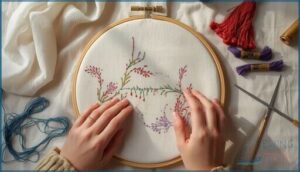
You’ll find that mastering two foundational embroidery stitches—running stitch and back stitch—gives you exceptional control over line work in hand embroidery. These stitches differ in strength and appearance, but both require attention to stitch tension, thread colors, and fabric choice for professional results.
- Running Stitch: Creates evenly spaced dashes; adjust stitch length from 1-6 millimeters depending on your project
- Back Stitch: Forms solid, continuous lines by stitching backward; ideal for crisp outlines
- Stitch Tension: Keep it relaxed to prevent puckering your fabric
- Embroidery Tips: Combine both stitches for varied texture and depth in stitching
Satin Stitch and Straight Stitch
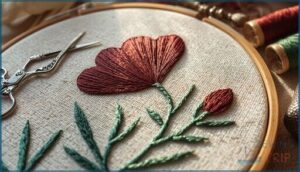
When you master satin stitch and straight stitch, you gain precise control over fills and accents in your embroidery techniques. Satin stitch uses parallel stitches 2-4 millimeters long for smooth, glossy fills—keep your stitch tension light to moderate and maintain consistent direction for even shine.
Straight stitch works beautifully for outlining narrow shapes with crisp edge finishing.
Your fabric choice affects both basic embroidery stitches considerably.
French Knot and Seed Stitch
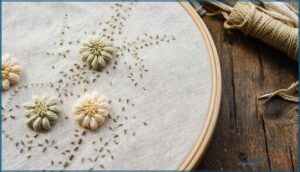
French Knot creates raised dots by wrapping thread around your needle two to three times before inserting it close to the entry point, while Seed Stitch scatters tiny individual stitches to build textured backgrounds.
You’ll control knot size through wrap count and thread thickness, and you’ll achieve seed stitch texture by alternating stitch directions between rows.
These foundational embroidery stitches combine beautifully for dimensional embellishment.
Decorative Embellishment Stitch Techniques
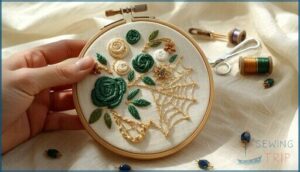
Once you’ve mastered the foundational stitches, you’re ready to explore decorative techniques that add dimension, texture, and visual interest to your embellishment work.
These stitches go beyond basic outlines and fills, allowing you to create rope-like lines, raised surfaces, and intricate lattice patterns that truly make your pieces stand out.
The following techniques will expand your creative toolkit and give you more control over the character and depth of your embroidered designs.
Stem Stitch and Outline Stitch
When you want a line that feels alive with movement, these two embroidery stitches deliver dimension and precision. Stem stitch builds a rope-like texture by overlapping each entry point halfway along the previous stitch, while outline stitch sits flat and crisp for sharp edge work. Your fabric choices and thread selection shape the final effect, so match embroidery floss weight to your desired stitch tension.
- Stitch Variations for Different Effects: Use stem stitch for curved botanical stems where you need subtle lift, and outline stitch for clean borders that hug the fabric surface.
- Thread Selection Matters: Two to three strands of cotton embroidery floss give you control over line weight without overwhelming lightweight fabrics.
- Maintaining Consistent Stitch Tension: Keep your fabric taut in the hoop and pull each stitch snug but not tight to prevent puckering along curves.
- Combining for Dimensional Outlines: Layer stem stitch on the inner edge and outline stitch on the outer edge to create professional-looking borders with visual depth.
Couching and Padded Satin Stitch
When you layer threads onto fabric and anchor them with tiny stitches, couching threads create dimensional lines that stand proud of your surface.
Padded satin stitch builds on this principle by stacking padding layers inside a shape before covering with tight satin stitches, transforming flat embroidery techniques into raised embellishments that catch light and add sculptural depth to textile decoration projects.
Lattice and Cloud Filling Stitches
Grid patterns transform empty fabric spaces into textured embroidery design elements through methodical stitching. Lattice stitches build a mesh foundation with parallel vertical threads woven across by horizontal passes, while cloud filling creates soft, dimensional texture through an initial anchor grid followed by zigzag weaving that never pierces fabric:
- Mark your grid lightly with erasable pen to maintain alignment
- Space anchor stitches one to two fabric threads apart for controlled stitch density
- Select even-weave fabric choice for uniform decorative stitches
- Add beads at intersections for layered embellishment ideas and enhanced texture effects
Applying Embellishments to Fabric
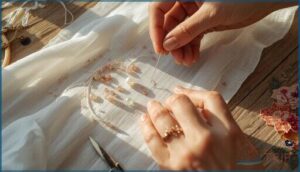
Once you’ve mastered the foundational stitches, you’re ready to add dimension and sparkle to your embroidery through embellishments.
This next step transforms your work from simple stitching into richly textured art, where beads catch the light, appliqué fabrics create bold contrasts, and layered stitches build depth you can feel with your fingertips.
The techniques ahead will show you how to securely attach these elements while maintaining the professional finish your projects deserve.
Integrating Beads and Sequins
You can transform fabric with beads and sequins through careful bead selection and sequin security techniques.
For bead placement, anchor each individually using a beading needle size 10 to 12, which slips through tiny holes without tearing your fabric.
Sequin texture emerges when you stitch through the center or crown each with a seed bead, creating an embellishment design that catches light beautifully while staying secure.
Appliqué Basics and Methods
Beyond beads and sequins, appliqué placement lets you layer fabric shapes onto your ground textile using hand embroidery techniques that elevate fabric embellishment.
Start with fabric cutting, leaving a quarter-inch allowance around your motif, then secure with fusing techniques or temporary adhesive.
Edge finishing with blanket or satin stitch provides stitch reinforcement while preventing frays, making these embellishment materials and embellishment techniques durable through wear.
Combining Stitches for Unique Designs
Once you’ve mastered appliqué, you can access even richer embroidery design through stitch layering and texture blending. Combine two or three stitches within a single motif to add dimension and visual interest that elevates your work beyond basic embellishment.
- Pair satin stitch fills with stem stitch outlines for defined edges
- Mix French knots with straight stitches to create textured clusters
- Use color blocking with contrasting threads for bold pattern mixing
- Alternate stitch patterns in repeating motifs for design fusion rhythm
Tips for Successful Embellishment Projects
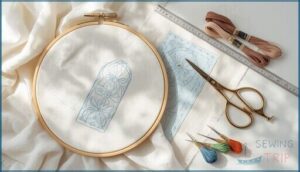
You’ve learned the stitches and practiced the techniques, but transforming those skills into polished, professional-looking pieces requires attention to a few vital details. Getting your design onto fabric cleanly, maintaining consistent tension throughout your work, and finishing your projects properly will make the difference between something that looks homemade and something that looks handcrafted.
Transforming skills into polished pieces requires clean design transfer, consistent tension, and proper finishing to elevate handmade work into handcrafted art
Here’s what you need to know to take your embellishment work from good to outstanding.
Preparing and Transferring Designs
A clean surface sets the stage for perfect design transfer. You’ll want to iron your fabric on low heat to eliminate wrinkles, then choose from marking tools like water-soluble pens or light pencil for tracing embroidery patterns and designs.
Place a stabilizer beneath delicate fabrics to prevent distortion, and always center your embroidery design using crosshair marks before you begin transferring with your preferred method.
Managing Thread Tension and Stitch Consistency
Once your design sits perfectly on fabric, thread balance becomes your next focus. Adjust your upper tension dial by quarter turns on scrap fabric until stitches sit centered between layers without loops or puckering.
Match needle calibration to fabric weight—switch to finer needles on delicate materials to prevent fabric stretch.
Test tension control with each new thread or basic embroidery stitches to maintain stitch regulation throughout your embroidery techniques and weaving projects.
Care and Finishing for Embellished Items
Your finished embroidery embellishment deserves protection that matches the effort you invested. Follow these hand washing guidelines to safeguard your fabric decoration work:
- Wash embellished items by hand in cold water using mild detergent to prevent color preservation issues and protect delicate hand embroidery
- Air dry flat on clean towels instead of wringing, which distorts stitches and loosens embellishments
- Store in breathable bags for proper fabric storage, avoiding direct sunlight that fades threads
Frequently Asked Questions (FAQs)
What are the six examples of decorative stitches?
Traditional embroidery stitches offer endless embellishment effects. Satin stitch fills shapes with smooth coverage, French knot creates raised texture, running stitch forms delicate lines, back stitch produces continuous outlines, stem stitch adds curved definition, and seed stitch scatters dotted accents across your fabric selection.
What are the 10 basic embroidery stitches for beginners?
Master these 10 Basic Embroidery Stitches: running stitch, back stitch, satin stitch, straight stitch, French knot, seed stitch, stem stitch, outline stitch, couching, and padded satin stitch for Beginner Projects.
How do you fix mistakes in embellishment stitching?
You can fix mistakes by carefully removing incorrect stitches with a seam ripper, then re-stitching using the same thread color and stitch type to blend seamlessly with surrounding embroidery work.
Whats the best way to store embroidery floss?
You’ll want floss organization that keeps threads tangle-free and color-coded.
Store embroidery floss in airtight containers away from sunlight, using bobbins or plastic cards labeled with color numbers for quick thread preservation and easy access.
Can you embroider on stretchy or knit fabrics?
About 65% of knit garments experience some distortion during needlework, but you can embroider stretchy fabric successfully.
Use stabilizers, ballpoint needles, and lighter stitching patterns to prevent puckering while maintaining the textile’s natural drape.
How do you prevent fabric puckering while stitching?
You can prevent fabric puckering while stitching by adjusting fabric tension in the hoop, selecting appropriate needle size and thread weight for your fabric, controlling stitch length, and using proper stabilizers during embroidery techniques.
What are the differences between embroidery and cross-stitch?
While embroidery techniques embrace stitch variations and design flexibility across fabrics, cross stitch follows counted patterns on even-weave cloth, creating structured images through uniform X-shaped stitches with limited thread differences and hoop usage.
Conclusion
Your embellishment journey doesn’t have to hang by a thread—you’ve now got the tools, techniques, and troubleshooting strategies to build texture, dimension, and visual impact into every project.
This basic embellishment stitch guide gives you the foundation to experiment confidently, whether you’re layering French knots for tactile interest or couching metallic threads along curved lines.
Start with one new technique per project, practice your tension control, and watch your stitches transform ordinary fabric into something remarkable.